
Wednesday, August 30, 2006
Oly Commercial
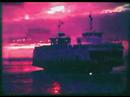
Here's another in what will constitute a short series of old beer ads. I've scoured the net, and so far have failed to come up with some of the classic Henry's and Rainier spots. Nor the "I seen 'em" ads from Oly. But here's a precursor, a headwaters, if you will, of the water that begat the artesians. (The embedding was disabled, so you just have to click on the picture.)


Oregon Classics - Terminal Gravity IPA
 Everyone is familiar with the story of IPA: during the glory days of the English Empire, casks of beer brewed in Burton--the brewing capital of England and the city that perfected pale ale--were sent across the globe in the holds of ships. The jewel in the English crown was India (which was also the source of many English jewels), and the viceroy needed fresh, tasty beer to cut through the dust of the Gangetic Plain. Thus was brewed a strong pale ale, liberally hopped. The strength kept the beer from wilting under Indra's heat, the hops innoculated it against the Subcontinent's abundant microbes. It became known as India Pale Ale.
You may not be as familiar with America's role in the style's durability. Bridging the gap from the time of the first British IPAs, a brewery founded in Albany, New York by Scottish immigrant Peter Ballantine began production of IPA in 1840. Ballantine's became one of the larger regional breweries by the late 19th Century, and survived prohibition by selling malt syrup to homebrewers. Shockingly, one of the beers it made throughout the 20th Century was an IPA which, in the early 1960s boasted an original gravity of 1.070 and 60 IBUs. Midcentury America was producing IPAs like Burton once did. Over time, the strength grew weaker, as did the company until, amid red ink in 1969, the brewery sold out. Ballantine's still exists, but went the way of Weinhard's. It is now owned by Miller.
 All of this preamble is to lay the ground for why Terminal Gravity is an Oregon classic. Many breweries hedge their bets and offer IPAs that won't overwhelm the drinker with alcohol and hops. Some of these, notably BridgePort, are amazing. But they wouldn't survive in an English ship on the journey to Injah. Terminal Gravity would, and I imagine it would arrive tasting mighty good.
Unlike Ballantine, Terminal Gravity has ridden IPA to success, somehow finding distribution throughout Portland (the brewery is located in Enterprise, in the Wallowas in the Northeast corner of the state). Since I took the picture above, the brewery has gone through an expansion and outgrown its brewery/pub bungalow, ensuring the capacity to keep sending its IPA on the somewhat less ardurous journey in a distribution truck down I-84 to the Rose City.
Tasting Notes
Pours a surprisingly dark, deep amber/orange with a nice head that, not suprisingly, doesn't survive the alcohol long. Malt and alcohol dominate the nose, hops singing harmony.
It's easy to brew a big beer adequately, but hard to do it well. Keeping the various elements in balance is the trick, and TG hits it right on the head. It's a burly beer, with a thick mouthfeel and warming alcohol. Hops seem to run along a continuum of flavor that starts with the alcohol and ends with a crisp citrusy note. The aftertaste includes a distinctive quality I searched for a long time to identify. Maybe chicory. It's a beer like a meal--so hearty and rich that it feels like you're drinking something as hearty as soup. It even warms the belly.
Stats
I could find no more information than was available on the bottle: 6.7% abv. You wouldn't question a beer that came halfway around the world, and I guess Terminal Gravity assumes you won't question them, either. Fair enough.
Rating
A Northwest classic.
Monday, August 28, 2006
Phantom Beer at Safeco Field
I caught my first baseball game at Safeco Field, lured up by a Red Sox visit. Sadly for me, the Red Sox are in one whale of a tailspin, so we were naturally waxed by a fairly woeful M's club. Big Papi had 46 dingers coming into the game, and left with 47, so the day had its perks. (Raul Ibanez hit a grand slam, too, which added drama.) But hey, the sun was out, we were in the shade, and the beer was good. Yeah, surprisingly, the beer was good.
At quite regular points near all seating were places to get bottled beer. Just up from section 213 was a vendor with over a dozen bottled beers, including Full Sail Amber and Deschutes. Redhook ESB was on tap just about everywhere. It nostalgically has that diacetyl character that was the result of inexperience when the brewery first got started in the early 80s. Not a lot of hopping, but a pretty tasty fair-weather beer.
Also on tap was a far better choice, a phantom beer that was not, I see now, Sierra Nevada Summerfest. When I ordered an $8 pint, I expected a summery straw-colored beer, a kolsh or light ale or perhaps a lager. And in fact, that's what Summerfest is--a classic pilsner. What I got instead was a thick, hearty ale of nearly brown hue that bulged with Chinook hops. It was a strong beer, too, for my head began to spin right about the time Raul was winding up to smack the grand slam.
As I ponder this mystery, something occurs to me. When I went to buy my afternoon coffee--that's pre-beer, to keep the caffiene demons at bay--I got fitty cents in change. (Biggest rip-off at Safeco? $3.50 coffee. Not latte, not mocha, drip coffee. Twelve ounces of. They know they have a whole lot of addicts at their mercy and they take advantage). One of the quarters was a state quarter for Massachusetts--which I brandished to nearby Sox fans as a lucky omen. Even after the Mariners went up 6-1, I still held faith in my little Mass quarter. With two outs at the top of the ninth, I whispered to my brother-in-law that my faith in the omen was wavering--but not completely gone.
Now I see what happened. The omen was accurate. It augured good beer for a Beervarian (Beervarian (n) a resident of Beervana) outside his home habitat. After all, what do I care about baseball?
At quite regular points near all seating were places to get bottled beer. Just up from section 213 was a vendor with over a dozen bottled beers, including Full Sail Amber and Deschutes. Redhook ESB was on tap just about everywhere. It nostalgically has that diacetyl character that was the result of inexperience when the brewery first got started in the early 80s. Not a lot of hopping, but a pretty tasty fair-weather beer.
Also on tap was a far better choice, a phantom beer that was not, I see now, Sierra Nevada Summerfest. When I ordered an $8 pint, I expected a summery straw-colored beer, a kolsh or light ale or perhaps a lager. And in fact, that's what Summerfest is--a classic pilsner. What I got instead was a thick, hearty ale of nearly brown hue that bulged with Chinook hops. It was a strong beer, too, for my head began to spin right about the time Raul was winding up to smack the grand slam.
As I ponder this mystery, something occurs to me. When I went to buy my afternoon coffee--that's pre-beer, to keep the caffiene demons at bay--I got fitty cents in change. (Biggest rip-off at Safeco? $3.50 coffee. Not latte, not mocha, drip coffee. Twelve ounces of. They know they have a whole lot of addicts at their mercy and they take advantage). One of the quarters was a state quarter for Massachusetts--which I brandished to nearby Sox fans as a lucky omen. Even after the Mariners went up 6-1, I still held faith in my little Mass quarter. With two outs at the top of the ninth, I whispered to my brother-in-law that my faith in the omen was wavering--but not completely gone.
Now I see what happened. The omen was accurate. It augured good beer for a Beervarian (Beervarian (n) a resident of Beervana) outside his home habitat. After all, what do I care about baseball?
Thursday, August 24, 2006
Whisky is beer ... condensed
Cool article in the Willamette Week about a partnership between Roots and House Spirits Distillery, which just moved in across the steet from the brewery:
It's hot as hell in Roots Organic Brewery, and Christian Krogstad is grinning and sweating like a whore in a confessional. The co-owner of House Spirits Distillery is standing atop a 600-gallon mash tun, stirring its contents with a canoe ore [sic].... Soon the concoction will be strained, placed in two 300-gallon cubes and shipped across the street to the new House Spirits distillery, where it will age in oak barrels for five years. The 600-gallon tank will make a mere 50 gallons of whiskey. The process will be repeated weekly....You know what they say about House Spirits Whisky: there's a little bit of Roots in every bottle. Cool.
The pair began distilling Medoyeff Vodka in Corvallis less than three years ago. Last December, they moved to a surprisingly cheaper space in hometown Portland, revving up a small liquor boom that includes locally distilled New Deal vodka and Indio Spirits, a development that has happy lushes clinking glasses all over the city.
Tuesday, August 22, 2006
Oregon Classics - Full Sail Amber
There is now a recognized beer style called "American amber ale." It's a style that didn't exist before about 1985, and one born, I'm sad to report, partly out of ignorance. In England, if you brewed an amber-toned, malty ale with notable but moderate hop character, you'd call it a best bitter or possibly extra special bitter (ESB). But in the US, brewpubs, brewing almost exclusively ales, knew of pale ales, browns, porters, and stouts. Apparently to round out the spectrum, they began filling in the gaps. In between pale and brown were added "amber" and "red."
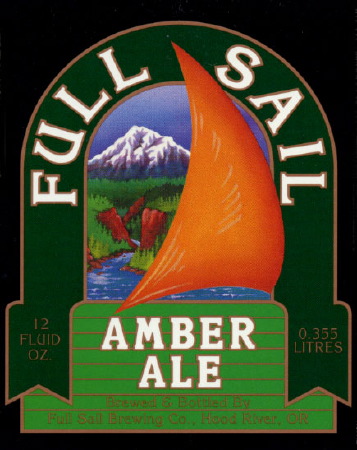
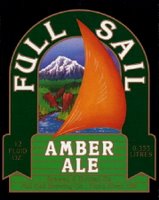 Of those early breweries, the first to get a product to the supermarket in Oregon was Full Sail, which began bottling beers shortly after its founding in 1987. It was a modest beginning. Their first year, they brewed but 2,000 barrels, and their operation looked more like large scale homebrewing than small-scale commercial brewing. After they brewed a batch, two employees bottled and capped the beer by hand while the receptionist prepared the labels with glue in the office.
The first beer was a golden (a beer whose color landed it on the other side of "pale" in the beer spectrum), and its brewer was Dave Logsdon, who left the brewery the next year to found Wyeast Labs ( a yeast manufacturer critical in the rise of American microbrewing). In came Jamie Emmerson, fresh from Seibel, and the future flagship Full Sail beer, Amber.
Among early beers to find a following, I recall Full Sail being an early alternative to the insanely-popular Widmer Hefeweizen. Although by today's standards it looks a little tame, at the time, it was stronger and hoppier than any beer Oregonians were used to drinking. It was the beer beer geeks drank.
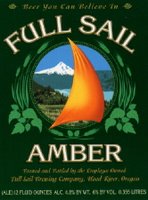 Full Sail is sometimes credited with having founded the style (though I'm sure some breweries dissent), and it's not hard to see why. The style description offered by the American Brewers Association is almost exactly a description of Full Sail, which may verify the claim:
Tasting Notes
The beer is a fairly dark copper with hints of red and a characteristic creamy head that doesn't dissipate completely even through the last sip. It has a faintly citrus aroma from Cascade hops and an inviting caramel note.
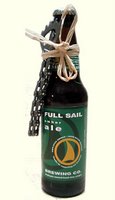 As the Brewers Association suggests, it is a beer in full balance, neither malt or hop character dominating. The quality of the malt is sometimes described as "nutty," but it's grainy to me, a flavor I attribute to the crystal malts. They impart a slightly astringent or tannic quality. The mouthfeel is rich and creamy, and the hops, with their citrus flavor, give the beer a sweetly comforting quality. However, the longer you drink the beer, the more the hops come to the fore, and toward the end you appreciate their stealth.
Not all beers have to be intense to be great. Full Sail Amber is a wonderfully drinkable beer, one that never rings flat, and one you enjoy drinking through an entire session. Few smaller beers have this much going for them, and almost no other American ambers.
Stats
Malts: Pale, crystal, chocolate
Hops: Cacade, Mt. Hood.
Alcohol by volume: 6%
Original Gravity: N/A
Bitterness Units: 42
Available: Throughout the Northwest
Rating
A Northwest classic.
 Of those early breweries, the first to get a product to the supermarket in Oregon was Full Sail, which began bottling beers shortly after its founding in 1987. It was a modest beginning. Their first year, they brewed but 2,000 barrels, and their operation looked more like large scale homebrewing than small-scale commercial brewing. After they brewed a batch, two employees bottled and capped the beer by hand while the receptionist prepared the labels with glue in the office.
The first beer was a golden (a beer whose color landed it on the other side of "pale" in the beer spectrum), and its brewer was Dave Logsdon, who left the brewery the next year to found Wyeast Labs ( a yeast manufacturer critical in the rise of American microbrewing). In came Jamie Emmerson, fresh from Seibel, and the future flagship Full Sail beer, Amber.
Among early beers to find a following, I recall Full Sail being an early alternative to the insanely-popular Widmer Hefeweizen. Although by today's standards it looks a little tame, at the time, it was stronger and hoppier than any beer Oregonians were used to drinking. It was the beer beer geeks drank.
 Full Sail is sometimes credited with having founded the style (though I'm sure some breweries dissent), and it's not hard to see why. The style description offered by the American Brewers Association is almost exactly a description of Full Sail, which may verify the claim:
"American amber is noteworthy for its relatively even balance between malt and hop expression.... American amber is also distinguished from its American pale ale parent by its fuller body and mouthfeel. Much of this comes from the liberal use of crystal malt, which not only contributes a pronounced caramelly sweetness, but also the style's signature red color. That same impartiality also applies to hops... [C]itrusy Northwest hops like Cascades are most common."As beer tastes have moved forward, Full Sail Amber has become the beer geek's session ale. It is an impressive example of rich flavor in a restrained beer, and has justifiably joined the pantheon Northwest classics. (By way of comparison, try one with a bottle with Flat Tire Amber and judge for yourself.)
Tasting Notes
The beer is a fairly dark copper with hints of red and a characteristic creamy head that doesn't dissipate completely even through the last sip. It has a faintly citrus aroma from Cascade hops and an inviting caramel note.
 As the Brewers Association suggests, it is a beer in full balance, neither malt or hop character dominating. The quality of the malt is sometimes described as "nutty," but it's grainy to me, a flavor I attribute to the crystal malts. They impart a slightly astringent or tannic quality. The mouthfeel is rich and creamy, and the hops, with their citrus flavor, give the beer a sweetly comforting quality. However, the longer you drink the beer, the more the hops come to the fore, and toward the end you appreciate their stealth.
Not all beers have to be intense to be great. Full Sail Amber is a wonderfully drinkable beer, one that never rings flat, and one you enjoy drinking through an entire session. Few smaller beers have this much going for them, and almost no other American ambers.
Stats
Malts: Pale, crystal, chocolate
Hops: Cacade, Mt. Hood.
Alcohol by volume: 6%
Original Gravity: N/A
Bitterness Units: 42
Available: Throughout the Northwest
Rating
A Northwest classic.
Our Program Will Resume Shortly...
I'm back and have a review almost ready to post. Thanks for your patience.
Tuesday, August 15, 2006
Meta
1.
As an FYI, I'll be out of town from midday today through Saturday, and may not even sit down in front of a computer until next Monday.
2.
I get a fair number of Google hits looking for things like "BridgePort IPA," and it occurred to me that I should go through the famous Oregon beers, even though I think for most of my regular readers (the two of you), this will be boring and redundant. I'll try to give some background and historical context, though, as appeasement. First up: Full Sail Amber. (Maybe before I leave.)
That is all.
As an FYI, I'll be out of town from midday today through Saturday, and may not even sit down in front of a computer until next Monday.
2.
I get a fair number of Google hits looking for things like "BridgePort IPA," and it occurred to me that I should go through the famous Oregon beers, even though I think for most of my regular readers (the two of you), this will be boring and redundant. I'll try to give some background and historical context, though, as appeasement. First up: Full Sail Amber. (Maybe before I leave.)
That is all.
Saturday, August 12, 2006
Changes at Belmont Station
 A Portland treasure, Belmont Station, is about to move. The temporal distance is not great--just a wee bit north to 4500 SE Stark--but in terms of beery opportunities, call it a vast surge forward. New improvements planned:
- On-site cafe to seat 45, so you can sample in the store. Food, too!
- Four or five taps with custom-made beer or beer unavailable in the bottle.
- 36 cooler doors so customers don't have to wait for a staff member to retrieve the beer. (The store is ensuring, via various filters, sleeves, tinted glass, and so on, that beer will remain free from harmful light exposure.)
- A new cross-indexing system so that the 1,000+ beers are referenced by brewery, style, and region.
I can't wait...
Update
I am in the (slow) process of putting up current listings of Oregon breweries and brewpubs. You can find the listings in the navigation section at right. Currently, I have the breweries section complete.
That is all.
That is all.
Friday, August 11, 2006
Fat Tire Amber Ale- New Belgium Brewing
I really yearn to like New Belgium's beers. The labels are pretty, the styles are interesting, the company is philanthropic and green, and they have a Belgian brewer. Alas, that makes them a lot like Starbucks*--cool company, poor brew. I've worked my way through most of their beers in the past few years, and I'm always disappointed. They are underwhelming echoes of the classic styles they were inspired by.
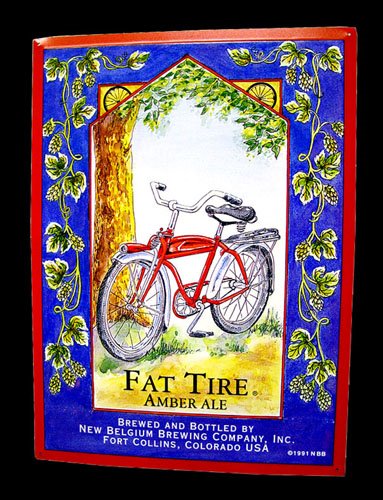
 But New Belgium didn't found its craft brewing empire on their interpretation of Frambozen or Abbey Ale. It is the company that Fat Tire built, and the company will be riding Fat Tire, good or ill, to the end. In 2005, New Belgium was the 13th largest brewery in the country, and the third-largest craft brewer, making about 33% more beer than Widmer, Oregon's largest. That's a lot of Fat Tire.
Sometime in the past three or four years, New Belgium decided it wanted a piece of Oregon's market, and it spent an enormous amount of money trying to get shelf and tap space. It appears the effort has been only partly successful--after displacing regional ambers for a time, New Belgium has given back a lot of shelf space and tap handles to Full Sail and Mactarnahan's. They may do decent business, but I don't think Oregon is the pot of gold NB hoped.
But before we get to the review, let me confess that I've always found this beer insipid and have, I think far from uniquely, taken to calling it "Flat Tire." I am, nevertheless, a trained beer-tasting professional and when I sat down to taste this beer, wiped my biases clean.**
Tasting Notes
Fat Tire pours out a brackish amber, with a quickly-dissipating head. The color is honey/amber, but strangely murky, as if by hop haze (foolsgold, of course). I pick up the briefest caramelly malt note in the nose, with possibly a hint of citrus.
Malt is Fat Tire's central flavor, backed by a creamy mouthfeel. Hops add a single flavor note, the same citrus you might detect in the nose, which draw out the sweetness of the malt. That's really all there is. If the brewery is like Starbucks, then Fat Tire is like that Charlie Sheen sitcom--a perfectly mainstream product without the character to inspire love or hate. It is a wholly inoffensive beer. What more to say?
The label promises that the beer's "appeal is in its feat of balance: toasty, biscuit-like malt flavors coasting in equalibrium with hoppy freshness." A friend of mine sitting at the table as I took notes offered a rebuttal: "it's weird and tinny and stale and gross. It would not be a beer I'd be proud of."
The truth lies somewhere between: Fat Tire will satisfy none of the beer drinkers who find delight in robust, characterful, hoppy Oregon beers. (The brewer, Peter Bouckaert, in describing how to brew a clone of this beer to Brew Your Own magazine, cautioned: "don't use Cascade or other overpowering hops." Cascades, gentle and aromatic, are the most common and beloved hops in Oregon ales.) But neither will they dump out their bottle.
It's a beer of a kind that get brewed across the globe: a mainstream product so lacking in character you forget you're drinking it.
Stats
Unavailable. Apparently Bouckaert regards his recipe as a state secret. He can keep it.
Rating
(very) average.
_______________
*Starbucks, for those who think their nine million stores are only a soul-destroying yuppie huts, is actually a cool company. They give their workers benefits and buy coffee from farmers. Sadly, their product is a thin gruel of over-roasted bitterness.
**No, I don't believe it, either.
 But New Belgium didn't found its craft brewing empire on their interpretation of Frambozen or Abbey Ale. It is the company that Fat Tire built, and the company will be riding Fat Tire, good or ill, to the end. In 2005, New Belgium was the 13th largest brewery in the country, and the third-largest craft brewer, making about 33% more beer than Widmer, Oregon's largest. That's a lot of Fat Tire.
Sometime in the past three or four years, New Belgium decided it wanted a piece of Oregon's market, and it spent an enormous amount of money trying to get shelf and tap space. It appears the effort has been only partly successful--after displacing regional ambers for a time, New Belgium has given back a lot of shelf space and tap handles to Full Sail and Mactarnahan's. They may do decent business, but I don't think Oregon is the pot of gold NB hoped.
But before we get to the review, let me confess that I've always found this beer insipid and have, I think far from uniquely, taken to calling it "Flat Tire." I am, nevertheless, a trained beer-tasting professional and when I sat down to taste this beer, wiped my biases clean.**
Tasting Notes
Fat Tire pours out a brackish amber, with a quickly-dissipating head. The color is honey/amber, but strangely murky, as if by hop haze (foolsgold, of course). I pick up the briefest caramelly malt note in the nose, with possibly a hint of citrus.
Malt is Fat Tire's central flavor, backed by a creamy mouthfeel. Hops add a single flavor note, the same citrus you might detect in the nose, which draw out the sweetness of the malt. That's really all there is. If the brewery is like Starbucks, then Fat Tire is like that Charlie Sheen sitcom--a perfectly mainstream product without the character to inspire love or hate. It is a wholly inoffensive beer. What more to say?
The label promises that the beer's "appeal is in its feat of balance: toasty, biscuit-like malt flavors coasting in equalibrium with hoppy freshness." A friend of mine sitting at the table as I took notes offered a rebuttal: "it's weird and tinny and stale and gross. It would not be a beer I'd be proud of."
The truth lies somewhere between: Fat Tire will satisfy none of the beer drinkers who find delight in robust, characterful, hoppy Oregon beers. (The brewer, Peter Bouckaert, in describing how to brew a clone of this beer to Brew Your Own magazine, cautioned: "don't use Cascade or other overpowering hops." Cascades, gentle and aromatic, are the most common and beloved hops in Oregon ales.) But neither will they dump out their bottle.
It's a beer of a kind that get brewed across the globe: a mainstream product so lacking in character you forget you're drinking it.
Stats
Unavailable. Apparently Bouckaert regards his recipe as a state secret. He can keep it.
Rating
(very) average.
_______________
*Starbucks, for those who think their nine million stores are only a soul-destroying yuppie huts, is actually a cool company. They give their workers benefits and buy coffee from farmers. Sadly, their product is a thin gruel of over-roasted bitterness.
**No, I don't believe it, either.
Tuesday, August 08, 2006
Theakston's Old Peculier
One of the more recognizeable imports--available in the US for decades--is Theakston's Old Peculier. Anyone who's taken the plunge knows that the beer is itself peculiar, but probably they don't know the half of it. Theakston's is a beer with a lot of stories.
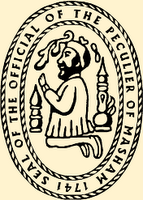 Let's start out with the peculiar spelling of Peculier. If you look very closely at the funny little seal on the bottle (reproduced for you at right), you'll see these words (in 2-point type): "the Seal of the Official of the Peculier of Masham." Curious. It turns out that a "peculier" is an ecclesiastical court established to arbitrate church law in the absence of a bishop on issues like wearing a hat during communion or carrying a dead man's skull out of the churchyard. You know, common offenses. In this case, the peculierate was established in Masham (a town in Yorkshire) by the archbishop of York. The offices were terminated by a series of laws 150 years ago, but it's just like a brewery to keep this odd bit of historical trivia alive (if obscurely so).
But wait!--we're only getting started. Now to the other word in the beer's name, "old," which designates its style of ale. Old ales are ... well, actually, there are two kinds of old ales. There are those like Thomas Hardy's Ale, which is a very strong beer designed to be aged in the bottle. And then there are those like Theakston's which harken back to beers brewed in the olden days. Of this latter variety, there can be great variation, but they should be sweet with unfermented barley, hearty, and dark. Strengths vary.
(There's another story Theakston highlights about its connection to the Crusades, but it is far enough afield that you'll have to go read it on your own.)
Tasting Notes
Theakston's has been around since 1827, and Old Peculier has been brewed since at least 1890--and probably long before that. So it is in fact, not just style, a fairly old ale. You have a sense of traveling back in time when you pour out a bottle. It is thick and viscous, and froths into a nice head in the manner you imagine medieval ales might have. I held it up to the sunlight, which refracted dimly and murkily only through the narrowest part of the glass. It's mostly an opaque brown, but under summer sunlight, it has a cloudy, dark amber-brown color, similar to iced tea. The aroma is bready and hearty, much as the beer looks. Fruity notes waft up with raisin and plum. There is one additional quality that I could only identify after I tasted it--we'll come to that in a moment.
I bet many people don't notice the odd spelling of the beer, or forget it once they take their first sip. It's a strange beer. First of all, it's rather thick in a way most commercial beers aren't. It is sweetish and estery, and again, I picked up a plum note. I suspected--and later confirmed--that sugar was employed, for it had that characteristic estery quality that seems to come mainly from fermented sugar. However, here again the main identifying quality about Old Peculier is a bit of funkiness. It's not like the funkiness you'd find in a Belgian or even an Irish stout, and it took me a long time before I could figure out how to describe it.
Rye is by itself not a sour grain, but when bakers make rye bread, they generally use the sourdough method of adding a little old dough that's gotten a bit of lactic-acid funkiness to it. Thus are most ryes varying degrees of sour.
Eventually, I came to discover that this is what Old Peculier reminds me of--liquid rye bread. It's dark and hearty and slightly sweet, but it's predominant characteristic is that "peculiar" note--a little bit of sourness like old dough.
So, perhaps we need to revise our definition of old ales, or at least tip our hat to the depth of meaning in this curious style, of which Old Peculier remains the world standard.
Stats
Malts: Pale, crystal, brewers' caramel, and torrefied wheat.
Hops: Northern Brewer, Fuggles, other unidentified hops. Dry-hopped with Fuggles.
Alcohol by volume: 5.6%
Original Gravity: 1.057.
Bitterness Units: 29
Other: Three sugars are also used.
Rating
A world classic.
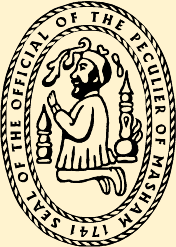 Let's start out with the peculiar spelling of Peculier. If you look very closely at the funny little seal on the bottle (reproduced for you at right), you'll see these words (in 2-point type): "the Seal of the Official of the Peculier of Masham." Curious. It turns out that a "peculier" is an ecclesiastical court established to arbitrate church law in the absence of a bishop on issues like wearing a hat during communion or carrying a dead man's skull out of the churchyard. You know, common offenses. In this case, the peculierate was established in Masham (a town in Yorkshire) by the archbishop of York. The offices were terminated by a series of laws 150 years ago, but it's just like a brewery to keep this odd bit of historical trivia alive (if obscurely so).
But wait!--we're only getting started. Now to the other word in the beer's name, "old," which designates its style of ale. Old ales are ... well, actually, there are two kinds of old ales. There are those like Thomas Hardy's Ale, which is a very strong beer designed to be aged in the bottle. And then there are those like Theakston's which harken back to beers brewed in the olden days. Of this latter variety, there can be great variation, but they should be sweet with unfermented barley, hearty, and dark. Strengths vary.
(There's another story Theakston highlights about its connection to the Crusades, but it is far enough afield that you'll have to go read it on your own.)
Tasting Notes
Theakston's has been around since 1827, and Old Peculier has been brewed since at least 1890--and probably long before that. So it is in fact, not just style, a fairly old ale. You have a sense of traveling back in time when you pour out a bottle. It is thick and viscous, and froths into a nice head in the manner you imagine medieval ales might have. I held it up to the sunlight, which refracted dimly and murkily only through the narrowest part of the glass. It's mostly an opaque brown, but under summer sunlight, it has a cloudy, dark amber-brown color, similar to iced tea. The aroma is bready and hearty, much as the beer looks. Fruity notes waft up with raisin and plum. There is one additional quality that I could only identify after I tasted it--we'll come to that in a moment.
I bet many people don't notice the odd spelling of the beer, or forget it once they take their first sip. It's a strange beer. First of all, it's rather thick in a way most commercial beers aren't. It is sweetish and estery, and again, I picked up a plum note. I suspected--and later confirmed--that sugar was employed, for it had that characteristic estery quality that seems to come mainly from fermented sugar. However, here again the main identifying quality about Old Peculier is a bit of funkiness. It's not like the funkiness you'd find in a Belgian or even an Irish stout, and it took me a long time before I could figure out how to describe it.
Rye is by itself not a sour grain, but when bakers make rye bread, they generally use the sourdough method of adding a little old dough that's gotten a bit of lactic-acid funkiness to it. Thus are most ryes varying degrees of sour.
Eventually, I came to discover that this is what Old Peculier reminds me of--liquid rye bread. It's dark and hearty and slightly sweet, but it's predominant characteristic is that "peculiar" note--a little bit of sourness like old dough.
So, perhaps we need to revise our definition of old ales, or at least tip our hat to the depth of meaning in this curious style, of which Old Peculier remains the world standard.
Stats
Malts: Pale, crystal, brewers' caramel, and torrefied wheat.
Hops: Northern Brewer, Fuggles, other unidentified hops. Dry-hopped with Fuggles.
Alcohol by volume: 5.6%
Original Gravity: 1.057.
Bitterness Units: 29
Other: Three sugars are also used.
Rating
A world classic.
Monday, August 07, 2006
Video - Oregon Brewers Festival
I had initially planned to take my video camera along to the fest when I when I went on Friday, but it's sort of heavy and bulky and would have interfered with the joy of my annual ritual. The downside is that I have no intersting human clips to offer. (And we did see Charlie Papazian and John Harris cruising around, so I might have had something kind of cool to show.) What I do have is a video scrapbook from footage I shot Saturday afternoon. The music playing is a momentary jam band called "The Jerry Garcia Birthday Band," whom I stopped to film. This is a low-res Youtube vid, and I'll have a high res version on Google video in a couple days. Enjoy.
Sunday, August 06, 2006
Micro Market Grows; Beervana Leads the Way
An article caught my eye this morning with the depressing title "Beer sales falling flat while wine, other beverages grow in popularity." The lede was equally depressing:
Conversely, the top ten craft breweries saw their sales increase rather substantially from 3.29 million barrels. in 2004 to 3.52 million barrels. That's nearly 7% growth. More impressively, all but one of the top ten showed growth in 2005. (Because Pyramid absorbed Portland Brewing in 2004, I threw it out for this calculation.) Here are the big 11 (including Pyramid), with total barrelage and growth in parentheses--and I'll toss in a couple of other Oregon bigs for comparison:
To put some context to this, when I first started writing professionally about beer back in 1997, we watched the first major contraction in microbrewing since it got started a couple decades earlier. That slump was a harsh reality for a lot of breweries that had over-extended themselves on unrealistic expectations of growth. Saxer and Nor'wester were early casualties, and Portland Brewing eventually got absorbed from the wound that slump caused. It was a long time before people came back to craft beer, and we're seeing a nice little renaissance now.
Predictably, Beervana leads the way...
____________
These are traditional regional breweries producing more mainstream beers. Some have been purchased by the big three, but are still regional in nature and distribution. They include: Yuengling, City Brewery, Latrobe (recently purchased by AB), High Falls (Genesee), Pittsburgh (Iron City), Leinenkugel, and Spoetzl (Shiner).
"U.S. beer shipments last year were flatter than a stale ale, falling 0.1 percent according to the Beer Institute. The industry group says shipments to the U.S. market -- which accounted for about 86 percent of overall business -- declined 2.2 percent to 178.8 million barrels."I did a little digging, though, and it actually looks like macro sales are falling flat--micros (many of which are no longer micro) are posting robust growth. And Oregon is leading the way. In 2004, according to Modern Brewery Age (.pdf), the big four (AB, Miller, Coors, and Pabst) brewed 171 million barrels of beer; in 2005, they brewed 169 million. Larger regional breweries* also saw their sales decrease from 5.47 million barrels in 2004 to 5.26 in 2005.
Conversely, the top ten craft breweries saw their sales increase rather substantially from 3.29 million barrels. in 2004 to 3.52 million barrels. That's nearly 7% growth. More impressively, all but one of the top ten showed growth in 2005. (Because Pyramid absorbed Portland Brewing in 2004, I threw it out for this calculation.) Here are the big 11 (including Pyramid), with total barrelage and growth in parentheses--and I'll toss in a couple of other Oregon bigs for comparison:
- Boston Beer Co. (1.4 million, +7.2%)
- Sierra Nevada (612,640, +3.9%)
- New Belgium (350,000, +5.7%)
- Matt Brewing [Saranac] (251,800, +8%)
- Redhook (234,200, +7.1%)
- Pyramid (230,500)
- Widmer (226,500, +13.8)
- Deschutes (144,422, +7.1%)
- Alaskan (105,300, +16.5%)
- Boulevard (103,584, +16.3%)
- Mass Bay [Harpoon] (90,333, -4.5%)
13. Full Sail (85,756, +3.8%)Finally, Oregon led all states in growth in 2005, up 100,000 barrels and 3.9%. Washington grew more marginally--36,000 barrels, just .9%, but good enough for 14th place.
23. BridgePort (43,432 , +2.2%)
24. Rogue (43,000, +12.%)
To put some context to this, when I first started writing professionally about beer back in 1997, we watched the first major contraction in microbrewing since it got started a couple decades earlier. That slump was a harsh reality for a lot of breweries that had over-extended themselves on unrealistic expectations of growth. Saxer and Nor'wester were early casualties, and Portland Brewing eventually got absorbed from the wound that slump caused. It was a long time before people came back to craft beer, and we're seeing a nice little renaissance now.
Predictably, Beervana leads the way...
____________
These are traditional regional breweries producing more mainstream beers. Some have been purchased by the big three, but are still regional in nature and distribution. They include: Yuengling, City Brewery, Latrobe (recently purchased by AB), High Falls (Genesee), Pittsburgh (Iron City), Leinenkugel, and Spoetzl (Shiner).
Thursday, August 03, 2006
OBF - Blind Tasting Results
I just received the results of the blind tasting they did at the OBF. It was the first time they'd tried it, and it got off to a slow start--only a couple hundred people showed. I suspect this is because there's no tradition for it, because anyone who's been to a blind tasting knows what a blast it is. Let's hope the OBF organizers give it a shot next year and hope to see growth. I could imagine this as a signature event a decade from now.
The way it worked was this: people were given 12 (1) beers in two categories, pale ales and IPAs, and asked to 1) judge their favorite, and 2) identify the beers they were drinking.
Identification
Those of us who conducted our own pale ale tasting this spring can take heart: none of the tasters in the pale ale flight got even half the beers right. The best was five of twelve, which a number of folks got. (They pulled names out of a hat to determine the "winner" and it was, I am not surprised to learn, Roots' Craig Nicholls. He seems lucky indeed.)
In the IPA category, brewer Jamie Floyd got 10 of 12 right, proving that there is far greater variation in IPAs than pale. I learned something else by this win--Jamie's no longer at Steelhead (Eugene), where he brewed a number of GABF-winning beers, but with the new Ninkasi Brewing, which was unfamiliar to me. Two data points from one winner--nice.
Judging
You may be surprised at the results of the judging. Despite some very big names in each category* (including some highly-decorated Oregon classics) it was the brewpubs in a near sweep. Here are the final tallies, with votes in parentheses followingthe brewery's name.
1. Rock Bottom Velvet Pale (22)
2. Alameda Klickitat Pale (16)
3. BJ's Piranha Pale (13)
A major brewery snuck into the IPA winners list, but it was still a win by a brewpub, and another brewpub rounding out the top three.
1. Pelican India Pelican Ale (28)
2. Deschutes Inversion (18)
3. Ninkasi Total Domination (16)
Shocking, no? Sure, Deschutes Mirror Pond has a bushelful of medals, but it gets aced out of the pales. BridgePort IPA may be the best beer in all of England, but it doesn't make the top three Oregon IPAs. Looks like the big boys have some cred to earn back. (In seriousness, it goes to show how many world-class beers Oregon has.) Congrats to the brewpubs for taking five of six slots on the medals podium.
____________________
Pale ales in competition: Klickitat Pale Ale (Alameda Brewhouse), Piranha Pale Ale (BJ's Restaurant & Brewery), Blue Heron Pale Ale (BridgePort), Mirror Pond Pale Ale (Deschutes), Full Sail Pale (Full Sail), Mac's Ale (MacTarnahan's), Pinochle Pale Ale (Old Market Pub & Brewery), Ringtail Pale Ale (Raccoon Lodge), Velvet Pale Ale (Rock Bottom), Juniper Pale Ale (Rogue Ales), Pond Turtle Pale Ale (Roots), Hop to Trot (Steelhead).
IPAs: BridgePort IPA (BridgePort), Inversien IPA (Deschutes), Full Sail IPA, Boss IPA (Laurelwood), Total Domination IPA (Ninkasi), India Pelican Ale (Pelican), Pyramid Thunderhead IPA, Paddle Me IPA (Siletz), Standing Stone IPA , Bombay Bomber IPA (Steelhead), Terminal Gravity IPA, Broken Halo IPA (Widmer).
The way it worked was this: people were given 12 (1) beers in two categories, pale ales and IPAs, and asked to 1) judge their favorite, and 2) identify the beers they were drinking.
Identification
Those of us who conducted our own pale ale tasting this spring can take heart: none of the tasters in the pale ale flight got even half the beers right. The best was five of twelve, which a number of folks got. (They pulled names out of a hat to determine the "winner" and it was, I am not surprised to learn, Roots' Craig Nicholls. He seems lucky indeed.)
In the IPA category, brewer Jamie Floyd got 10 of 12 right, proving that there is far greater variation in IPAs than pale. I learned something else by this win--Jamie's no longer at Steelhead (Eugene), where he brewed a number of GABF-winning beers, but with the new Ninkasi Brewing, which was unfamiliar to me. Two data points from one winner--nice.
Judging
You may be surprised at the results of the judging. Despite some very big names in each category* (including some highly-decorated Oregon classics) it was the brewpubs in a near sweep. Here are the final tallies, with votes in parentheses followingthe brewery's name.
1. Rock Bottom Velvet Pale (22)
2. Alameda Klickitat Pale (16)
3. BJ's Piranha Pale (13)
A major brewery snuck into the IPA winners list, but it was still a win by a brewpub, and another brewpub rounding out the top three.
1. Pelican India Pelican Ale (28)
2. Deschutes Inversion (18)
3. Ninkasi Total Domination (16)
Shocking, no? Sure, Deschutes Mirror Pond has a bushelful of medals, but it gets aced out of the pales. BridgePort IPA may be the best beer in all of England, but it doesn't make the top three Oregon IPAs. Looks like the big boys have some cred to earn back. (In seriousness, it goes to show how many world-class beers Oregon has.) Congrats to the brewpubs for taking five of six slots on the medals podium.
____________________
Pale ales in competition: Klickitat Pale Ale (Alameda Brewhouse), Piranha Pale Ale (BJ's Restaurant & Brewery), Blue Heron Pale Ale (BridgePort), Mirror Pond Pale Ale (Deschutes), Full Sail Pale (Full Sail), Mac's Ale (MacTarnahan's), Pinochle Pale Ale (Old Market Pub & Brewery), Ringtail Pale Ale (Raccoon Lodge), Velvet Pale Ale (Rock Bottom), Juniper Pale Ale (Rogue Ales), Pond Turtle Pale Ale (Roots), Hop to Trot (Steelhead).
IPAs: BridgePort IPA (BridgePort), Inversien IPA (Deschutes), Full Sail IPA, Boss IPA (Laurelwood), Total Domination IPA (Ninkasi), India Pelican Ale (Pelican), Pyramid Thunderhead IPA, Paddle Me IPA (Siletz), Standing Stone IPA , Bombay Bomber IPA (Steelhead), Terminal Gravity IPA, Broken Halo IPA (Widmer).
Wednesday, August 02, 2006
Fraoch and Ebulum, Ancient Beers of Scotland
In Gaelic the word heather is rendered "fraoch"--which has in turns become the name of a beer and shorthand for the brewery that produces it. That company began in 1986 in a Glaswegian homebrew shop, when a customer brought in an old family recipe for "Leann (ale) fraoich" (no word on what happened to the "i"). The owner, Bruce Williams, then went on a crusade to bring back the historic beers of Scotland. With his brother Scott, he first began to brew at the Maclay & Co. Brewery during heather season before the brothers ultimately got their own brewery in 2000. They relocated in 2005 to a larger brewery.
 And yet, although the company produces four additional historic brews, it is still known by its earliest incarnation: Fraoch. I've had a couple of bottles recently, and am finally getting the reviews posted. In addition to these two, the brewery also produces Grozet (a gooseberry ale), Alba (spruce and pine), and Kelpie (with, I kid you not, seaweed).
Fraoch Heather (5% abv)
The company claims that heather ale is the oldest style of ale still produced in the world, and who's to argue? We know of earlier Egyptian recipes, and the Williams Brothers don't actually have the 4,000-year-old Scottish version. But still--what's a little PR among beer geeks. What they have produced is a barley-based beer with botanicals--principally heather--in place of hops. Also added is sweet gale (related to bayberry), which is actually bitter and itself a historical additive, having been used in a Yorkshire brew (known, not surprisingly, as "Gale beer").
Tasting Notes
From aroma to aftertaste, this is a disorienting beer. Nosing around, you might think you're picking up notes of pine or mint (the gale?). In your mouth, your tongue keeps instinctively waiting for the hops to kick in, and when they don't you expect to be left with a cloying sweetness after swallowing.
It looks like a normal beer: a sort of nondescript amber with a nice head. It even, the further you get along in a pint, tastes like a beer. But the palate does disorient. Fraoch doesn't get treacly, and yet you never identify a source of bitterness that might offset it. Somehow the sweet gale and heather used to spice the beer balances the malt. It's ... herbal.
One note: it tastes weird the first four or five (dozen?) sips. Perservere. Much as with Craig Nicholl's Burghead Heather ale, Fraoch comes around. I find the palate both soft and substantial and strangely thirst-quenching. By the end of the bottle, ten to one says you'll be enjoying it--if not understanding why.
Rating: Good.
 Ebulum (Elderberry black ale) 6.5%
As much as I admire the heather ale, and could even drink a few bottles every summer, I don't know that I could ever grow to crave it. But the Ebulum is another matter. I try to avoid this where possible, but here's a bit of pretty cool text about the beer from the brewery:
As labeled, Ebulum is black and sports a toffee head. The aroma is herbal tending toward medicinal, but with a more traditional British yeast note. It is a deliciously rich and creamy ale, and fairly beery--although interesting new flavors abound, you're on more familiar footing here. The elderberries are rooty more than sweet, and they contribute a strange astringency that seems like it's anesthetizing your tongue. Of course, it doesn't. Elderberries apparently contain a host of compounds, and these contribute a flavor that seems like it includes more than one additive. (There is no fruit flavor.) It is a fascinating, lovely beer, and I envy the Scots who can go have a pint at the pub.
Rating: Excellent.
 And yet, although the company produces four additional historic brews, it is still known by its earliest incarnation: Fraoch. I've had a couple of bottles recently, and am finally getting the reviews posted. In addition to these two, the brewery also produces Grozet (a gooseberry ale), Alba (spruce and pine), and Kelpie (with, I kid you not, seaweed).
Fraoch Heather (5% abv)
The company claims that heather ale is the oldest style of ale still produced in the world, and who's to argue? We know of earlier Egyptian recipes, and the Williams Brothers don't actually have the 4,000-year-old Scottish version. But still--what's a little PR among beer geeks. What they have produced is a barley-based beer with botanicals--principally heather--in place of hops. Also added is sweet gale (related to bayberry), which is actually bitter and itself a historical additive, having been used in a Yorkshire brew (known, not surprisingly, as "Gale beer").
Tasting Notes
From aroma to aftertaste, this is a disorienting beer. Nosing around, you might think you're picking up notes of pine or mint (the gale?). In your mouth, your tongue keeps instinctively waiting for the hops to kick in, and when they don't you expect to be left with a cloying sweetness after swallowing.
It looks like a normal beer: a sort of nondescript amber with a nice head. It even, the further you get along in a pint, tastes like a beer. But the palate does disorient. Fraoch doesn't get treacly, and yet you never identify a source of bitterness that might offset it. Somehow the sweet gale and heather used to spice the beer balances the malt. It's ... herbal.
One note: it tastes weird the first four or five (dozen?) sips. Perservere. Much as with Craig Nicholl's Burghead Heather ale, Fraoch comes around. I find the palate both soft and substantial and strangely thirst-quenching. By the end of the bottle, ten to one says you'll be enjoying it--if not understanding why.
Rating: Good.
 Ebulum (Elderberry black ale) 6.5%
As much as I admire the heather ale, and could even drink a few bottles every summer, I don't know that I could ever grow to crave it. But the Ebulum is another matter. I try to avoid this where possible, but here's a bit of pretty cool text about the beer from the brewery:
Introduced to Scotland by Welsh druids in the 9th Century, elderberry black ale was part of the Celtic Autumn festivals when the "elders" would make this strong ale and pass the drink round the people of the village. The recipe was taken from a 16th Century record of domestic drinking in the Scottish Highlands.Tasting Notes
As labeled, Ebulum is black and sports a toffee head. The aroma is herbal tending toward medicinal, but with a more traditional British yeast note. It is a deliciously rich and creamy ale, and fairly beery--although interesting new flavors abound, you're on more familiar footing here. The elderberries are rooty more than sweet, and they contribute a strange astringency that seems like it's anesthetizing your tongue. Of course, it doesn't. Elderberries apparently contain a host of compounds, and these contribute a flavor that seems like it includes more than one additive. (There is no fruit flavor.) It is a fascinating, lovely beer, and I envy the Scots who can go have a pint at the pub.
Rating: Excellent.
Subscribe to:
Posts (Atom)