You love the blog, so subscribe to the Beervana Podcast on iTunes or Soundcloud today!

Showing posts with label MacTarnahan's. Show all posts

Wednesday, January 23, 2013

Heading in Opposite Directions, MacTarnahan's and Breakside

We begin today's post by turning it over to the economist Joseph Schumpeter:
The opening up of new markets, foreign or domestic, and the organizational development from the craft shop to such concerns as U.S. Steel illustrate the same process of industrial mutation—if I may use that biological term—that incessantly revolutionizes the economic structure from within, incessantly destroying the old one, incessantly creating a new one. This process of Creative Destruction is the essential fact about capitalism.
The truths of Schumpeter's observation (referred elsewhere, delightfully, as "Schumpeter's gale") are evident in the fortunes of two breweries, both with big news out this week.  The first comes from one of the shining new stars of the Oregon brewing scene: 
New Breakside brewery/taproom opens Jan 30.  From nanobrewery to microbrewery with a 30 barrel system in three years, Breakside Brewery’s new location is proof the craft beer producer has no intention of slowing down. The new 7,000 square foot facility opens Wed., Jan. 30 just behind Bob’s Red Mill in Milwaukie and features a tasting room with 24 taps. 
The second from one of the aging veterans of the first days of craft brewing (no link):
An exciting change for Portland’s beer scene is quickly taking shape. The company that brews the beloved MacTarnahan’s Amber Ale and other craft beers is going back to its original name and will once again operate as Portland Brewing Company, beginning in February 2013.
Schumpeter's thumbnail description nearly perfectly describes what's going on here.  American brewing has, in the aggregate, been very good for new breweries in the last 30 years.  But despite the overall health of the herd, there have been some pretty spectacular die-offs.  Indeed, when you look back at that first decade of microbrewing, you see how the game turned out to be  high-risk, high-reward.  When you look at the largest American breweries today, among those founded after 1980, most of the largest were founded in the late 70s or 1980s.  Early success gave those breweries a huge advantage.  You see that in Oregon, too, where the biggest breweries--Widmer, Deschutes, Full Sail, and Rogue--were all founded before 1990. 

But it was also high risk.  Breweries like Pete's Wicked skyrocketed and then collapsed.  Others, like Portland Brewing [MacTarnahan's] and Pyramid stumbled badly after the market re-set in the mid-1990s.  Redhook and Full Sail are two examples of breweries that nearly went the way of Pete's but finally flourished, but Portland and Pyramid fall into a separate, depressing cateogry, sort of like zombie breweries.  I have no idea how much beer the newly re-olded Portland Brewing makes, but if it weren't for that gorgeous facility they have, the brand would have died a long time ago.  Brands are fungible; brewing plants retain their value. Two months ago we learned that in yet another buy-out, Portland would be acquired by a Costa Rican company. That's not how Art Larrance and Fred Bowman drew it up when they founded the brewery 27 years ago.

Contrast that with the more modest risk/modest reward ventures of post-shakeout craft breweries.  They're among the safest businesses to start (at least in Oregon), and few fail.  On the other hand, most don't get huge, either.  Ninkasi is the rare example of a quickly-growing new brewery, and I'd put Breakside into that category.  Going from three barrels to thirty is a huge jump--rare in the 21st century.  Collectively, though, the dozens of small breweries create quite a force.  They are "revolutionizing the economic structure from within, incessantly destroying the old one." 

Is rebranding enough for a brewery dependent on a generation-old amber ale?  PBCo (as the employees used to call it) are reviving the elephant-themed IPA from the old Alan Kornhauser days, but is an IPA enough?  It sure doesn't seem like it.  What are you more excited about, Ben Edmunds' next concoction or a new "brand" from a tired old brewery?  The gale blows...

Wednesday, December 07, 2011

The Role of Star Power in Beer Appreciation

Connoisseurs are a funny bunch. And I mean here connoisseurs of anything--wine, dog breeds, indie rock. Embedded in their identity is a conflict of interest: on the one hand, they believe themselves to be the final arbiters of objectivity in their particular realm; on the other, there's a constant instinct to one-up everyone else by finding the new "best" or the obscurest rarity, but this can only be endorsed by the fellow traveler who is also in the know. Tribal objectivity; an oxymoron, but innate to connoisseurship. A few weeks back, the New Yorker had a wonderful piece on coffee, and writer Kelefa Sanneh captures its essence here:
Batlle resists snobbery, as any good evangelist must; she thinks that coffee salvation should be available to anyone who seeks it. But the coffee community she loves, where everyone knows everyone, wouldn't exist if the number of converts weren't so small. In order for connoisseurs to exist, they must be outnumbered by philistines, and if the connoisseurs are honest they will admit that they enjoy this state of affairs. The citric flavor of a Kenyan coffee might seem unpleasantly sour to a novice, and so loving Kenyan coffee is a way to show you are not a novice.
So it is with beer. Certain breweries have such bullet-proof cred among the geeks that their products enjoy a halo effect. Others are so scorned that everything they make is tarnished. This phenomenon was in play over the weekend at the Holiday Ale Fest--I think. You can weigh in if you think I'm off base.

Even before attending, I knew that the barrel-aged Velvet Merkin from Firestone Walker was going to be a buzz beer. Barrel-aged black ales are always loved, and few breweries enjoy such a solid reputation (an earned one, I'm happy to acknowledge) as Firestone Walker. Indeed, it was the fest's big buzz beer, and it was tasty.

It wasn't, in my mind, a perfect beer. The bourbon was overwhelming on the nose, and on the palate it was pure vanilla. I quite enjoyed it--the brewery describes it as "milk chocolate, smooth dark cherry, vanilla and coconut infused," which sounds absolutely delicious. I'd have preferred a bit more roast and beery balance, less Starbucks treat, personally, but hey, your mileage may vary. I enjoyed it, but.

Then I tried a beer from poor McTarnahan's, a brewery that suffered from years of wandering and neglect before finally finding its groove under some great brewers. Among beer geeks, few breweries have less juice than Mac's.The beer Mac's sent bore much resemblance to the Firestone Walker--a bourbon-barrel aged black beer, their Ink Blot Baltic Porter, steeped in Jack Daniels' barrels for a year. It was also not quite perfect--at 6.3%, it was a bit underpowered and thin. But overall, it was a quite lovely beer--the whiskey was milder and more integrated, the beer rounder and more complex. Of course, it got very little attention, and I, a classically conflicted connoisseur, ignored it most of the time I was at the fest.

Both were crowd-pleasing, tasty, slightly-less-than-perfect beers, and they had a lot in common. My guess is that if Preston Weesner had switched the kegs before the fest, the "Firestone Walker" would still have been the buzz beer. Loving Firestone Walker is a sure mark of the connoisseur, and the Mac's was a fantastic beer, so who wouldn't have been happy to laud it? We'll never know, but that's my guess.

As always, your dissents are welcome.

Sunday, November 07, 2010

On Brewing Experiments, a Dissenting View

Last week, I commented enthusiastically on Breakside's recent offering of five versions of a porter, each with one different adjunct. Vasilios Gletsos, MacTarnahan's brewer, added a comment I'd like to share.
I'm probably getting lost here at the end of the comments section, with all the excitement and all, but I wanted to suggest that this kind of thing happens at commercial breweries all the time, as part of the R&D process. It is just that the decision is typically made by the brewer before releasing the beer about which one is best.

Also, what is 'best' can also have different criteria. Like for yeast: how does it perform in the cellar?, flocculation, attenuation, longevity, and of course flavor profile, among many other questions.

We often trial different hops in our standard brews or quantites of spices, etc. What is unique here is that Ben is presenting the beers and letting the public decide for themselves. I would personally feel uncomfortable putting out a beer if I thought some other example worked better.
I have no doubt that Vasili speaks for lots and lots of commercial breweries here. A brewery is in the business of offering the very best product it can; beta versions may work for software, but not beer. Fair enough. I wouldn't expect to see a brewery's work as it's hammering out a new recipe (although Deschutes regularly releases in-development recipes to beer at their brewpubs).

What Breakside did is a little different. Ben used a recipe that was already excellent--it didn't occur to me to ask, but I assume he was pleased with it. With that recipe, he made four variants that used a single different ingredient. That's the kind of thing I'd like to see. Take MacTarnahan's for example. It's a beer made exclusively with Cascade hops. It would be absolutely fascinating to see the brewery do a few other versions that used different hops--everything else being identical (process, IBUs, etc.). It'll be a cold day in hell before they do it, but I'd love it. (Or, if you prefer, Mac's with different English and American ale strains.)

There's no right answer. One thing I've learned in talking with scores of brewers over the years is that they all have definite ideas about what they're doing--and these ideas are in no way identical. So I'll put Vasili in the "no" column. Any other takers?

Wednesday, August 11, 2010

Labatt Buys MacTarnahan's, Pyramid, and Magic Hat

Last week Widmer acquired Kona, and today, Labatt bought up the collective of breweries known as Independent Brewers United--that is, Magic Hat, Pyramid and MacTarnahan's. Labatt, which is owned under the title North American Breweries, also owns Genesee and Dundee. In a press release, the new owners claim that they will change nothing:
  • The beer will remain the same: it will be brewed by the same people in the same breweries, using the same recipes, ingredients and commitment to artisanship as it has always been.
  • All breweries, Alehouses and the Artifactory will remain open. They provide a unique opportunity to sample and showcase the company's best beers and brewing capabilities. Through the retail locations, we can talk to customers about the beers they want us to make.
I'm trying to track down someone for a comment on the Mac's side. I'll update you if I can find out more.

Update. Still haven't gotten anyone from Mac's, but there's a nice clarifier from Frank White in comments:
An NYC-based private equity firm called KPS Capital Partners bought bbought both Genesee and Labatt's USA rights (from Bud/InBev) last year, and formed a shell subsidiary called North American Breweries. NAB is now buying IBU, which is Magic Hat, Pyramid & Mac's.

This deal is happening because the private equity fund (Basso Capital Mgmt)that's financed Magic Hat's expansion and subsequent purchase of PyraMac (I just invented that) has been hemorrhaging cash and "has decided to exit the beer business". So they're selling the whole thing to KPS, which specializes in "turnarounds, restructurings, bankruptcies, employee buyouts and other special situations". Basically it's a distressed sale, not strategic in any way.

Thursday, May 06, 2010

The Cask Underground

So this is the scene. Last night, MacTarnahan's had a release part for Lip Stinger, their peppered saison, which is making a surprising return in 2010. (With exotic beers it's usually one and done, so kudos to Mac's for sticking with it.) But what really interested me was a far less ballyhooed feature of the party--a cask of MacTarnahan's. Very quietly, brewer Vasilios Gletsos has been experimenting with the notion of cask ales, tapping one on special occasions. Mainly, it happens, when I'm not around. Last night was typical; I already had plans and couldn't make the event. (Though I think the ubiquitous Angelo De Ieso, whom I've started to think of as the beer gypsy, did make it--so maybe you'll hear more.) Amazingly, Mac's Mark Carver poured out a growler and dropped it off at the house last night.

The whole thing had a kind of metaphoric quality. Over the past year, I have been spending a lot of time thinking about cask ales. My love of them blinded me to certain realities which have only recently become obvious: even in beer-crazy Portland, real ale commands the devotion of only a tiny group of fans. I have no idea why. To me, nothing draws the flavor of hops out like cask conditioning. I'm always frustrated by the near-freezing temperatures at which pubs have to serve regular draft; a 55-degree cask ale allows flavors and aromas to blossom. Even the "flat" quality is far silkier than the more-carbonated regular drafts. All of this makes me think more people should like cask. But no.

Those of us who do seem more like an underground society--dissidents who must secretly pass along critical data via oblique signal. I imagine developing a code--tap of the left temple with an index finger--and then whispering obscure messages: "The crow caws at Bailey's--Caldera pale." Last night had the feel of subterfuge. Mark and I were communicating via cell phone; he made the drop literally in the dark of night. Carver's last missive: "Delivered." I touch my temple in response, "Da, comrade."

Mac's is, of course, the perfect cask ale. Vasili was right to identify it as such and hatch this scheme. I expected it would be, but you never know--cask is a fickle mistress. Sometimes beers that should billow with flavor fall flat. Others that seem clearly unfit somehow become transmuted to rare elixirs. Mac's though, delivers. I've been drinking beers from the brewery for 20 years, and one consistent feature is that they are highly filtered, very clean beers. So seeing Mac's in its unfiltered, hazy glory was a little shocking (that picture above was taken last night at about ten). It has every bit of the silky texture a cask ale should have, but the hops are the big attraction. It's made solely with Cascades, and they express a lot more character than one is used to. I found a peppery pine note that is usually concealed, and overall they were greener, less citrusy. Mac's is dry-hopped, so the nose is wonderfully fragrant. If this beer were available on cask regularly, it would be one of my go-to tipples.

Sadly, the cask is probably already gone. Vasili is spooked by the idea that they'll start to turn, so he won't leave one on much more than an evening. This is the other problem with real ale--it doesn't last. Most pubs around town rotate their cask beers, so you can never find a one that's on all the time; this is both good and bad, but it does tend to accentuate the whole secret society thing. Last night I tweeted about Mac's--the 21st Century version of a dissident's whisper--and those who saw it had their chance. Now we wait for the next missive. The few, the secretive, lying in wait for a good pint of real ale.
______________
Share

Monday, March 15, 2010

Brief Reviews: Full Sail Imperial Stout, MacTarnahan's Spine Tingler

I am falling behind again in my reviews, and so here are a couple of quickies.

Full Sail Imperial Stout
I recently picked up a 22 of Full Sail's imperial, lured partly by the price ($4). Anything under five bucks these days seems like a bargain. Full Sail divided this batch into two; the first half is what's in bottles now and the second half is sitting in 19 and 19-year-old Heaven Hill bourbon casks for later release. So this is really just a preview of coming attractions. As imperials go, it's on the small end, just 8%, and what jumped out at me was how thin the body was. Generally imperial stouts are like pudding--you spoon them down rather than sip them. This isn't a criticism, though--it makes for a very smooth, creamy beer. It's a roasty, plummy beer, fairly sweet in the middle, though the hops assert themselves in the aftertaste. If such a thing as a session imperial is possible, this is it. Eight percent may not be a lot for an imperial stout, but it's a lot for 22 ounces. Careful when you crack this one. Rating: B+

MacTarnahan's Spine Tingler
Will Belgian strongs ever in Oregon? Several breweries have tried versions of robust golden ales--Duvel style, tripels, or hybrids--and none have repeated the experiment, which I take to mean that they're not selling well. Spine Tingler is a fairly straightforward tripel, brewed with a touch of wheat and sugar. This is a beer that depends on the yeast. I hope someone will correct me if I'm wrong on this, but I think I heard folks at the brewery say they went with a yeast like Unibroue. Here it produces a quite dry, sparkling beer with evident sugar alcohol and a crisp finish. Not a lot of funk, but clearly Belgian. Tripels are not actually my favorite style, so while this was a fine version, it didn't light me up. I'll be interested to see what true fans of the style think. Oh, and I don't know what it costs, because I had my pour at the brewery, gratis, when I visited. Rating: B+

Friday, March 12, 2010

Brand Dissection: MacTarnahan's

American craft brewing is still mostly a first-generation industry. The owners and brewers who founded these companies still run them. In this way, the brands of craft breweries very closely resemble the personalities of the founders. The first two brand dissections, of Hopworks and Rogue, were selected for this reason. But today we consider MacTarnahan's, a brewery in arguably its third incarnation, managed by people far removed from the founders.

Company History
MacTarnahan's was founded as Portland Brewing by Fred Bowman and Art Larrance, and occupied the building now owned by Rogue at NW 14th and Flanders. They didn't start putting beer out until 1986, but were busy setting up shop earlier than that--right at the dawn of craft brewing in Portland. At that time, trying to find money for breweries was like asking someone to bet on a sure bet in the third race at Portland Meadows. Art and Fred decided to approach this by getting a little money from a lot of people, so they sold shares Portland--a decision I think dictated how the company evolved. One of those people was Mac MacTarnahan, a businessman who offered $25,000 to get things started.

To begin with, like other early breweries, things hummed along. Their first flagship was called Portland Ale, a pale that they started bottling around 1990/91. As the bottled products gained currency, they added Oregon Honey Beer and MacTarnahan's. For awhile it looked like the honey beer might become the flagship, but Mac's came into its own in the mid-90s.

Around that time, Portland joined a bunch of breweries in expansion, building the new brewery and Tap Room in the early-mid 1990s. And, like a lot of breweries, they made a bad bet and the market for good beer dipped, leaving a lot of breweries stranded. Mac stepped in in 1998 and effectively bought the brewery. From there, Portland went through a series of buy-outs and mergers, acquiring Saxer/Nor'Wester in 2000. With those brands it became the 12th-largest brewery in the US, but the moment wouldn't last. In 2004, Pyramid acquired Mac's and in 2008, Magic Hat bought Pyramid. In the 1990s, Art left Portland and went on to found the Raccoon Lodge, and Fred left active management a few years later.

Currently, MacTarnahan's, Pyramid, and Magic Hat are separate shops, with separate brewers and marketing departments. Mac's was spared complete integration, ironically enough, by the facility that weakened them a decade earlier--the brand continues to have a home in the brewery built to produce MacTarnahan's, and in fact is the brewery where all of Pyramid's Northwest-bound beer is brewed, too.

Brand History
Predictably, the changes at the brewery led to similar iterations of brand identity. In the first instance, Portland Brewing highlighted its Portland identity. As it began to grow into a regional company, it downplayed the city roots (Portland Ale was scuttled fairly early on--a loss only we old-timers had the chance to lament) and got into stylistic experimentation. The company made a fantastic German-style weizen that purportedly sold well in Chicago (but not here). They also did an Irish Ale, a lager, and an Oktoberfest--all useful in moving the brand beyond the city. When Mac came on-board, the company eventually abandoned these products and introduced a new line that focused directly on Mac's Scottish heritage--along with a new name for the brewery. These labels featured tartans and names like Blackwatch and Highlander, brands that survived until very recently.

The next iteration came when the master-brewer, Alan Kornheuser, left for a year to manage Pabst operations in China. In his absence, head Brewer Brett Porter produced a series of the most distinctive beers the brewery has ever offered. They were based on beers he learned to brew at Gale's, a traditional brewery in England. For some reason, the brewery decided to go for garish, outlandish packaging in this period, culiminating in the psychedelic Bobby Dazzler.

When Kornheuser returned, the beers did, too, and the line and brand identity continued to attenuate until the re-design in 2007.

Brand Identity--Back to Square One
By the time of the re-design in 2007, MacTarnahan's was a receding brand. Pyramid has limited Mac's to sale in the Northwest, and so it made sense to return to to an identity focused on the city of Portland. Ironies abound: the brewery that abandoned the city so it could have a bigger market has returned to the city as a key branding strategy even while Portland--which has itself become branded as a beer town--is now recognizable far outside the Northwest.
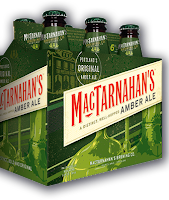
The re-brand was almost like starting fresh and getting back to basics. One of the brand's strengths is age, and this is echoed everywhere in the design: the classic font, suggestive of brands 50 years ago, the faux-rubber stamp on the label that reads "Portland's Original amber ale," and the stylized images of the copper kettles from the Tap Room, which themselves look antique. The design is intended to suggest solidity and age and associate the beer with Portland.

Two other elements jump out. First is the thistle that the brewery started using when it switched to the MacTarnahan's name. This is yet another nod to the brewery's lineage and an homage to Mac MacTarnahan's wish to see his Scottishness represented. But it's also a clever way of tying the brand together, even in its 22s, which have a totally different stylistic signature. Second, the tagline on Mac's, "A distinct, well-hopped ale" is a subtle cue to beer geeks that the brewery is trying to make something other than a bland, middle-market beer.

MacTarnahan's Amber anchors the brand (and in fact, it's the only regular beer left in the line-up; the rest are seasonals and special releases), but these elements are projected through the line. When I sat down with Mike Brown, president of Pyramid, last week, I asked about the bizarre characters on their seasonals, particularly the grifter and humbug'r. It started with Slingshot, he explained. They started with the kind of punky kid "mischievous," as per the label, and asked what became of him. Thus Grifter, the seedy character on their summer brand. Stylistically, these follow Mac's in the mode of nostalgia, with comic-book colors and images. "But Grifter, really? What were you thinking there?" I wanted to know.

Mike was blunt--"To catch people's attention. We wanted it to stand out on the shelf." Essentially, the branding scheme here was exhibitionism. When these beers were coming out, I was mighty skeptical of this idea. It seemed to mock the very quality the brewery was trying to project. But Brown says it was quite successful. Apparently, within the riot of new brands, standing out has its virtue. Of course, the test will be this year, when consumers are familiar with the labels; it will be the beer that will bring them back in year two.

Finally, Mac's has a line of specialty releases in 22-ounce bottles. The themes here d, but follow deviate from the Mac's themes, but do carry over with the thistle. And they follow the jump-off-the-shelves theory. These brands are released in small runs and won't drive sales much, except to the extent that they signal to beer geeks that MacTarnahan's is a brewery that takes beer seriously. (Personally, their brewing staff, not their labels, has been more convincing to me.)

Brand Health
I don't think you'd ever see a beer called "Grifter" from a brewery that saw the beer as an extention of themselves. It's hard to imagine Mac MacTarnahan signing off on that name. This is branding in a more traditional mode--the unemotional commodification of beer. As a good-beer fan, though, I ultimately care less about the theatrics involved in selling beer than I do in the beer itself. Breweries that try to put out a good product get a pass from me if they use crass means to sell them.

In the last few years, the bigger changes with MacTarnahan's involve the introduction of an imperial stout, saison, and now a tripel. These beers have not yet scraped the sky like Dissident or Abyss in terms of accomplishment or daring, but they indicate a brand that's trying to compete with beer, not just spin. The brewery is anchored by MacTarnahan's a lovely little session, and trying to get bold with more aggressive beers. The brand identity, a mixture of the very traditional and a pulpy sensationalism, pretty well mirrors what's happening in the brewhouse. All in all, a brand in coherence.

Tuesday, March 09, 2010

MacTarnahan's Reconsidered

Last week I went to the MacTarnahan's Taproom to chat with folks about new beers and brands. Mark Carver invited me out, and he may now be the longest-tenured guy left at Mac's. We were joined by Pyramid President Mike Brown and brewers Tom Bleigh and Vasilios Gletsos. The featured beer was Mac's Spine Tingler, a tripel that will be released within days. But the real revelation came just before I left, two hours later. Mark plopped a MacTarnahan's in front of me.

There are many cool things about writing about beer. Like sitting around drinking beer with brewers and brewery presidents. But there are some embarrassing moments, too, like the one I was about to experience. I sniffed deeply of the beer and was surprised at how vivid the hops were. Then I tasted it and was even more surprised. It was a totally different beer than the last time I tried it. "Have you changed the recipe?" I asked. "Not since we started dry-hopping it in 2001," Mark replied, mildly.

2001!?

It has apparently been that long since I've had a Mac's. (I never forget a beer--just the last time I had it.) MacTarnahan's was always a tasty beer, but understated and, as the decade of the 90s wore on, a bit underpowered as well. It went through a series of rebrands, becoming a "Scottish-style ale" for awhile (a nod to the namesake), and now calls itself a "distinct, well-hopped amber." I have always thought of the beer as perfectly characteristic for a brewery that prized consistency and drinkability above daring.

Despite the now-anachronistic name ("ambers" emerged during a phase of American craft brewing when consumers didn't know how to relate to ales. To help them along, breweries named their darker pale ales "ambers" to bridge the gap between pales and browns.) Naming tradition aside, MacTarnahan's is a pretty classic pale ale (in fact, it won gold at the GABF in that category last year).

Apparently, though, the brewers tuned it up a decade ago, and what a fine tuning it was. It's a very simple recipe, just pale and caramel malts and Cascade hops, and a modest beer at 5.1% and 32 IBUs. Dry-hopping is the key, because it takes those hops up a notch, saturating the mild recipe in lupulin goodness. As a region, we've grown to associate Cascade hops and pale ales so closely that a great many are, like MacTarnahan's, single-hop ales. With dry-hopping, Mac's wrings a bit more of the juice from them, and I found a perfumy note absent in most pales. (I had a bottle at home after I visited the brewery and I can confirm that if you really want the full monty, you need to try the beer on tap.)

One of the problems with writing about beer in the Northwest is that there are literally hundreds of new beers to try every year. I could easily try a new beer every time I went to the store or pub and never run out of options. As a result, I often fail to loop back around and try the old standards (a phenomenon I've Karl Ockert has called the "novelty curve"). It's been a long time since I've been out to the Tap Room, which is flanked by those beautiful copper vessels. If you have been similarly remiss, maybe it's time to take a trip out.
__________
Share

Thursday, December 24, 2009

Three Fine Beers

So for this Christmas eve, I offer you shorty reviews of three nice beers I've recently tried. All recommended as appropriate partners for your roast beast on Christmas day.

MacTarnahan's Goose Bump
"Wow. That's a little over the top for me."

Sally got to her half of our 22-ounce Goose Bump before I did, and when she offered her first reaction, I considered it a very good sign. When was the last time you heard someone describe a Mac's as "over the top?"

Goose Bump is an imperal stout saturated with a mighty infusion of coffee. When I saw brewer Vasilios Gletsos at the Holiday Ale Fest, he mentioned that it had been made with cold-brewed Stumptown coffee. The idea there is to extract the purer, tastier essences of the coffee been, leaving behind some of the harsher, more bitter compounds. Still, use enough coffee, and you get a mouthful of java, and that's apparently what Mac's did. This is absolutely not a beer for those who don't like coffee. Even for those who do, it's pretty aggressive. The most impressive element of this beer is its mousse-like structure, an amazing creaminess in the mouth. The beer employs oats to this end, but I wonder if the coffee didn't add something, too. A beer that won't be for everyone, which is a great credit to the brewery. For those who do like it, they'll really like it. I'll go a B+ on the ratings scale, partly just because the coffee flavor is so intense it will eliminate a fair number of drinkers from the picture. (Bonus: video of Vasilios talking about Goose Bump.)


Hopworks Kronan the Barbarian and Abominable Winter Ale
I finally made it down to Hopworks for a pour of Kronan the Barbarian, a Baltic Porter. This no-longer-so-obscure style is one of my faves, and I hadn't had a chance to try Kronan at the Holiday Ale Fest. It's a pretty nice version, too. A burly beer with lots roastiness and all the flavor you want out of a Baltic. If I were to ding the beer, it would be on the grounds that it's pretty ale-y. The Baltics I've tried distinguish themselves from porters and stouts by a smooth lager character. Some are so bitter they tend toward sourness, and there's little in the way of ale fruitiness to rescue the beer from this tendency. In a blind tasting, I'm not sure I would have identified this as a Baltic. A very tasty beer on its own merits, however, leaving aside style considerations. Also a B+.

The Abominable, though, was the real winner. Put it squarely in the Fa La La La La camp of exquisite extreme hopping. From the first whiff (evident at 12 inches) to the first sip, this thing is all hops. I scoured the intertubes, but found no mention of the varieties of hops used (Hopworks is in danger of joining Roots for most out-of-date website)--a pity, because I'd like to know how they achieved the almost lemon-intense citrus tang. For a beer of this heft, the hops are remarkably clean and articulated. Not for nothing, but it's also a damn pretty beer, too. Maybe the best beer I've ever had from Hopworks. I'll go an A- here, though that's a little Grinchly of me. If it's this good next year, Abominable will earn top marks.

Wednesday, November 04, 2009

MacTarnahan Humbug'r

The folks over at Pyramid/MacTarnahan's are trying--I'll give them that. They have not let the the Mac's line become just a single product and this year introduced a new line-up of seasonals. All of that is good. They even put out an exotic saison (and exotic not just by MacTarnahan's standards). So definitely an A for effort there.

We come now to the critical portion of our review: the names and packaging for the new family of beers: Slingshot Summer Pale (good), Summer Grifter IPA (not good), and now the latest arrival, Winter Humbug'r (oh dear lord). The art is actually very cool, suggestive of graphic novels and dangerous fun. But a grifter is a guy who hustles you out of money--likesay the $8.29 you spent on the six-pack. Would you call a beer Swindler or Cheater? As for Humbug'r, the sense of the lurid is such that--Bug'r, really? I remember the crazy Bobbydazzler of years past, a bizarre Englishism, but harmless enough. One might hope that Humbug'r is a name of similar provenance, but the label convinces you otherwise: a soused lunatic brandishing a sprig of mistletown and leering. And it's called Humbug'r.

What were they thinking?

The beer? It's pretty good. A light porter with a silky, oaty body. Porters and stouts are great winter beers, and I commend Mac's for eschewing another winter warmer. This beer is actually a bit of amalgam, equal parts dry stout, with a slightly burnt, roasted front note, part brown porter, with a pronounced sweet middle, and part sweet stout, with that silky full body. It is a bit on the mild side (a house character, so perhaps appropriate), and on those really bitter December days people might be reaching for the Obsidian instead. But overall, a fine beer. I'd give it a solid B.

But since we're giving advice to breweries these days, here's mine. It's nearly 2010. Beers that appear to succeed in the marketplace are those that distinguish themselves with bold flavors. I haven't really seen a line that has succeeded by dint of a clever ad campaign or brand identity, and locals tend to be turned off by anything that looks like it spent too long in a room with a wine-drinking design team. MacTarnahan's seasonal lineup now features a pale, an IPA, and a porter. These are fine beers, and they're perfectly well-made. I just think Mac's needs to come out of the gate with a little more under the hood and a little less focus on packaging. You've hired some great brewers--turn them loose and get out of the way.

Friday, August 28, 2009

MacTarnahan's Future

The release of Lip Stinger prompted much speculation about the future of MacTarnahan's. John Foyston throws a tidbit out for speculators to digest:
Mac's brand manager Mark Carver said that more special beers are on the way from Bleigh and crew (which now also includes the talented brewer Vasili Gletsos) including a new porter and an oatmeal stout as the year wanes...
Bleigh is Tom Bleigh, Pyramid head brewer. I read this to mean that he's getting credit for the Lip Stinger--whether or not he designed it. Porter and stout? Not revolutionary, but welcome.

Wednesday, August 26, 2009

The Riddle of Lip Stinger

[Note: A sharp-eyed reader noticed a repetitive use of the word "weed," which I've adjusted somewhat. Also, my latest copy editor has been beaten and fired.]

MacTarnahan's, the forgotten brewery.

Really, when was the last time you had a pint of an erstwhile Portland Brewing beer? With a reputation of safe, pedestrian beer and a flagship that now looks like a daisy in a field of craft brewing's exotic orchids, MacTarnahan teeters. Recent seasonals have done nothing to stem this impression (Grifter, Slingshot Pale) ... until now. Of all the major breweries most likely to release a saison, MacTarnahan's had to be the least. Yet here it is, Lip Stinger. The whole thing is mystifying. Including, it turns out, the beer itself.

It is a light saison, just 4.8%, but with a pretty pointed 32 BUs. Although the early buzz is positive, I found it an odd beer. Not timid, but strangely incoherent. The aroma is funky and phenolic. If the brewery didn't use a saison yeast, they did a good job of disguising the fact. Yet the beer is as clear and golden as a pilsner, which creates a kind of cognitive dissonance. Sniff: Belgiany, funky, saison. Look: gently effervescent, clear, bright, and filtered. Well, no matter: try a sip to resolve things. Except it doesn't. The palate is all tang and medicine. The Saaz hops are strong enough that it adds to the pilsnery aphasia, yet the yeast is estery, fruity (apricots?), and effervescent. Then there's the peppercorn addition, which comes across as a grating bitterness, almost like menthol. In the end, the needle was pointing in a positive direction, if provisionally. I would recommend this beer selectively, and only to the the experimental.

The riddle does not stop at the glass, however.

1. Why "Lip Stinger?"
Let's start with the name, which is terrible. The brewery used four kinds of peppercorn (a traditional saison spice), but there's nothing stinging about the beer. Which is good, because who wants stung lips? The pepper isn't peppery, though; I find it weedy and medicinal. It's not necessarily terrible, but "weedy and medicinal" will appeal to only a niche audience. It's subtitled a "farmhouse" ale, which is better. People relate to the word "farmhouse" positively. The word is vague, though, and only by tasting this dry, effervescent, spicy beer do you know that it's properly a saison. I get why the brewery would choose the more consumer-friendly "farmhouse" than saison; why then did they choose the consumersbane "Lip Stinger" as the topline name?

(There is a French wine grape known as picpoul--"Lip Stinger." It produces a very crisp, tart, food-friendly wine, and so the sense in French, apparently, is "lip-smacking." Whether this is an allusion to that grape, or a direct translation of the French, I can only imagine. Still, if this is the case, we're into the very deep grass in terms of naming arcana.)

2. Why is Lip Stinger Filtered?
This is a minor quibble alluded to in my description, but come on. Farmhouse ales are supposed to be "rustic." Rusticity is not a quality easily described, but we can infer from it a certain lack of polish. It comes from the Latin rusticus, for "open land"--it suggests "country" and "handmade." Filtering, an invention of industrialization, is definitely not rustic. The passion for clarity is a modern one. For once, couldn't MacTarnahan's have resisted filtering a beer?

3. Why Saison, of All Styles?
MacTarnahan's has, over the years, dabbled in a variety of styles. One of my faves was a traditional hefeweizen they made back in the mid-90s. They had a widely-lauded pilsner called Zig Zag. But except for a quasi-Belgian beer they made for the millennium, I don't recall any Belgian styles. Lately they have specialized in even more anodyne beers than usual, suggesting a slow fade into the kind of beers corporate brand-managers concoct. (Not to say that's what was actually driving things.) So to go for a Belgian beer, and even more a saison (quite a jump into the deep end of the Wallonian pool)--how did they get from there to here?

4. Why Only 3,000 Cases?
This is not actually a riddle: the answer is pretty self-evident. You don't bet the farm on a beer so radically different from the rest of your line. I ask it rhetorically: why not really try to make a splash. Putting these out in sixers for a month would have at least been a nice advertisement that MacTarnahan's is stepping up. Casual drinkers might have been persuaded to buy a bottle (or maybe not; see #1) and even if they found it shocking and gross, they would remember it. Sometimes that's a good thing. But putting it out in such a small batch and in 22s means that only the beer geeks will discover it. Ah well, baby steps.

You should go buy a bottle for the novelty and see what you think. MacTarnahan's effort is worth at least a bottle.

Thursday, May 21, 2009

MacTarnahan's Grifter

Has any brewery been in more of an identity crisis than MacTarnahan's? When I was first writing about beer for Willamette Week, I got invited to a tasting panel by members of the brewery and a few key stakeholders. It was intimidating; they were all gathered around a big conference table, and as I took my seat, I was peppered with questions. One of the first was what I thought of when I considered the brewery. It was then called Portland Brewing, and it had the same opaque identity it has now. I said something about the beers being very clean. There were sighs--this was a usual response.

Having clean beers is good, but it's not an identity. As the brewery tried to avoid bankruptcy, it tried a series of different strategies, finally settling on letting the flagship become the identity. And then it slid out of view, as its flagship, an above-average (clean!) amber was swamped by other mid-range ambers. I keep waiting for the brand to be fully supplanted by Pyramid or to try something bold to establish an identity.

Enter Grifter Summer IPA. This is the second in the brewery's new line-up of seasonal offerings, following a beer I completely missed, Sling Shot. In their press release, Mac's writes describes the series as "a growing portfolio of distinct, bold, and original offerings." I have grown to distrust press releases that use vague superlatives like this--usually it means the beer is likely to be bland, indistinct, and unoriginal. But with good packaging!

I hate to say it, but Grifter is, well, clean. It has that characteristic MacTarnahan's clarity, the light fruitiness, and the gentle, unassuming hopping. I could see no evidence that the brewery had spent a lot of time looking for something original to offer. (And it's not like we needed another IPA.) It's fine, but have a bottle and then try to recall the experience 24 hours later.

And then there's this Grifter business. Why Grifter? It sounds sort of cool, and there's always something magnetizing about an anti-hero. It allowed the MacTarnahan's marketers to go crazy with puns and allusions, perhaps not to their benefit:
MacTarnahan's Summer Grifter™ is a limited edition IPA for the summer whose cunning malt taste and hefty hop aroma will steal your attention and disappear in a wink! It's unique and thought provoking packaging depicts a mysterious character known by our brewers simply as "Clem", and who's haunting stare is just intriguing enough to make you want to know a little more. Summer Grifter IPA, is a deliciously wayward ale, lurking wherever thirsts gather!
A grifter is a confidence man--someone who lures you in with the promise of riches. First, you have to pony up some cash, and then of course he's gone. It's a terrible name for a beer, leading one to think that he's a sucker for putting his $8 on the line for a sixer. Of course, it's not a sucker's bet. It's fine. Just clean, forgettable beer.

MacTarnahan's is a brewery still in search of an identity.