I spent a lovely evening last night with Stuart Ramsay, John Harris, and McCormick and Schmick's Harborside chef Joshua Boyd. In advance of the event, the three huddled together and came up with a troika of troikas--Irish whiskey, beer, and food in three flights. For beer fans, flights one and three looked to be the big winners. Keelhauler Scottish Ale led off the night; rather extraordinarily, it was the first Scottish the brewery has ever produced. ("It's the only beer I've worried about in years," said the Reverend John O'Harris, as Ramsay re-dubbed him for St. Paddy's.) The last flight featured my central reason for attending--an 11-year-old Imperial stout. I'll write more on the event later, but let me devote a full post to the beer you've probably forgotten about, the middle flight's Full Sail Amber.
This is a beer dating back to 1989, the early days of the craft brewing renaissance. At its release, people marveled: the heft and sweetness of the body, the amazing sprightliness of the hopping. For people trained to think Henry's Private Reserve was "good beer," FS Amber was off the charts. Yet over the years, as people's experience with good beery expanded, they began to think of the beer as a starter beer, almost a throwaway. Jamie Emmerson once told me that people accused the brewery of changing the recipe. In their memory, Amber was this intense, rich beer--surely Full Sail had slowly watered it down. Of course they hadn't. Whatever adjustments the brewery has made were to accommodate the annual variability in hops and barley so that the beer was always the same.
I have a FS Amber irregularly, but I check in at least once a year. I don't think I've ever had the beer on cask, though, and it was a revelation. It was served with Tyrconnell Single Malt, a whiskey akin to a gentle Speyside, but sweeter in the Irish fashion, and Oyster Isobella and a beet slaw. Amber is a thoroughly America beer, but its lineage is much in keeping with the gentler session ales of the UK. On cask, the malt was smooth and creamy, a perfect base for the slightly sweet, fresh, fruity American hops. Some malts manage to communicate the quality of the fresh, lively springs that feed their distilleries. Cask Amber does, too. I originally frowned when I saw Amber on the menu, but it was an inspired choice--Harris recognized what a perfect complement it was to the whiskey and salad.
As beer fans, we tend to want to push the envelope on flavor sensations. We like to be surprised. But there's great virtue in the elegance of simplicity. To get a beer to harmonize so graciously, to be able to lure the drinker back to the glass quickly for another sample, to be such a perfect companion for food--this is a rare thing. The next time you're down at the Pilsner Room, check to see if they have Amber on cask. Vanquish all expectations and come to the beer again, as if you didn't know anything about it. Order a bit of food. It may knock your socks off, too.

Showing posts with label amber ale. Show all posts
Showing posts with label amber ale. Show all posts
Wednesday, March 18, 2009


Tuesday, September 09, 2008
Two From Silver Moon Brewing
I will confess at the outset that until bottles of Silver Moon's beer appeared at Belmont Station, I didn't know it existed.  This is a great oversight, particularly given that the brewery's eight years old. Oy. In my defense, they only brewed 1000 barrels last year--all draft--so apparently distribution has been limited. The brewery started bottling earlier this year, and you can now track down 22s in Portland.
Silver Moon Brewing
24 NW Greenwood Avenue
Bend, Oregon 97701
541-388-8331
Hours: 10-6 Mon -Fri, 10-5 Sat.
Silver Moon recently relocated to downtown Bend, where they have a pub featuring live music on Wednesdays and Saturdays as well as pool and a game room. They brew five regular beers: Hound's Tooth Amber, Snake Bite Porter, Bridge Creek Pilsner, Badlands Bitter and the Hob Knob IPA. The porter, amber, and hefeweizen are available at Belmont Station.
Hound's Tooth Amber
I wrote a little about this in an earlier post, where I described my trepidation with the style:
Snake Bite Porter
Again, one of the only criticisms I have of this beer is its name. It pours out with great viscosity, suggesting something, er, stouter than a porter. The head is like a cumulo-nimbus over the Wisconsin prairie--thick and foreboding. Again, not suggestive of a porter. The flavor was very roasty, so much so that it went to the point of sour. Okay, if it pours like a stout, foams like a stout, and is roasty like a stout, it ain't a porter. I found the roastiness just a hair too much, but it was a very effective Irish stout--one I would enjoy on a cold winter's eve. Those with images of that other Bend porter in their mind will be momentarily confused when this pours out of the bottle. Still, a fine effort and a distinctive, bold ale. Rating: B
 This is a great oversight, particularly given that the brewery's eight years old. Oy. In my defense, they only brewed 1000 barrels last year--all draft--so apparently distribution has been limited. The brewery started bottling earlier this year, and you can now track down 22s in Portland.
Silver Moon Brewing
24 NW Greenwood Avenue
Bend, Oregon 97701
541-388-8331
Hours: 10-6 Mon -Fri, 10-5 Sat.
Silver Moon recently relocated to downtown Bend, where they have a pub featuring live music on Wednesdays and Saturdays as well as pool and a game room. They brew five regular beers: Hound's Tooth Amber, Snake Bite Porter, Bridge Creek Pilsner, Badlands Bitter and the Hob Knob IPA. The porter, amber, and hefeweizen are available at Belmont Station.
Hound's Tooth Amber
I wrote a little about this in an earlier post, where I described my trepidation with the style:
I picked up a couple bottles of Silver Moon's beers this week (reviews to come), one of which is brewed in the dreaded "amber" style. I will confess to a certain weariness as I poured it out, because I'm almost never pleased with ambers.... Ambers seem to have been aimed at people for whom color is about as much information as they need. They are approachable, and their sweetness is enhanced by Cascade hopping, which make them a bit like lemonade. Add some body and you've got a crowd-pleaser, if not a great beer.What poured out of the bottle, however, was anything but tepid. It's an almond color in the glass, and the aroma is lush--fresh greenery and pepper. The aroma, redolent of English hops, suggested "best bitter" far more than amber (of perhaps because I like best bitters, and I was liking what I inhaled). The flavor balances a mild sweetness and the white peppercorn spicing of the hops. As you continue to drink, the hops gather strength, though never to they do more than nicely balance the malt. I'm probably wrong, but the hops were quite suggestive of Fuggles (therefore probably Willamette), enhancing the English pub quality of the beer. A very nice session and far better than I expected. Rating: A-
Snake Bite Porter
Again, one of the only criticisms I have of this beer is its name. It pours out with great viscosity, suggesting something, er, stouter than a porter. The head is like a cumulo-nimbus over the Wisconsin prairie--thick and foreboding. Again, not suggestive of a porter. The flavor was very roasty, so much so that it went to the point of sour. Okay, if it pours like a stout, foams like a stout, and is roasty like a stout, it ain't a porter. I found the roastiness just a hair too much, but it was a very effective Irish stout--one I would enjoy on a cold winter's eve. Those with images of that other Bend porter in their mind will be momentarily confused when this pours out of the bottle. Still, a fine effort and a distinctive, bold ale. Rating: B
Tuesday, April 10, 2007
Henry Weinhard's Organic Amber
There appears to be an imposter on grocery shelves. In Oregon anyway, a hard line divides micro and macro, and "gourmet" beers like Michelob are kept in their place (with the Hamm's, where the belong). Starting about two weeks ago a sleek sixer bearing the name "Henry Weinhard's" started appearing on the micro section of the beer case. It migrated just a foot, but there it is, like a Sooner on land grab day, on the other side of the line. So, what gives? Did Henry's finally game the system? No: in this case, appearances are misleading. Henry's had made a real micro-quality beer, and it has earned its place among the good beer, a rather remarkable development in industrial brewing.
Before the review, some speculation on what Henry's is up to. Ambers have evolved to become the classic "crossover" beer--an inoffensive style that non-beer (or tin-can-beer) people can tolerate. MacTarnahan's has managed to eke out a marginal place here, but other challengers to the throne continue to pop up--F[l]at Tire, Mac and Jack's, Alaskan. (Full Sail's Amber, which was the first, is too strong, hoppy, and ale-y to fit in this category.) If Henry's was going to mount a charge on this market, they chose a beer that might possibly appeal to their current customers.
But clearly, Miller (current owner of the Weinhard brand) has a more ambitious goal. By crafting an organic ale--and advertising on OPB--Henry's is aiming for a share of the Whole Foods segment. It's a canny move. Ever since Weinhard found a home at the Full Sail plant, it's fallen back into the good graces of Oregonians. For over 30 years, it has had the reputation of being a higher-quality beer than national brands, so trying to move it up the quality ladder is smarter than scrambling for the Pabst market.
And the price point is fully micro--I paid $5.99 for my six-pack, and it was on sale. It's possible they'll keep it marginally cheaper than other micros, but 50 cents isn't going to cause someone to abandon Mirror Pond. Henry's is going to have to compete on taste. Which takes me to . . .
Tasting Notes
It pours out a warm copper-amber, which was the first surprise (I had Blue Boar "Ale"--which looked like every other macro-lager--in my memory). It had a viscosity that you'd expect in a micro ale; unfortunately, the head dissipated rather quickly. Aroma is mild--nutty malting and a fleeting floral essence. In flavor, it's akin to Fat Tire, with an emphasis on malt. It's a little flaccid in the middle, with a cereal-malt-like quality. This is standard for the style, though not thrilling. The hops are detectable, but just. They balance the malt, but don't offer much in the way of actual character. I suspect that in a blind taste test, it would beat Fat Tire and Mac and Jack's, but lose out to MacTarnahans, which has about 50% more bitterness and a lot more hop character.
In terms of commercial prospects, I think the horizon is clear. No bets, but this is a very interesting experiment. Amber- and Hefeweizen-dependent breweries don't have to panic just yet, but they're probably breaking a sweat. We'll see.
Stats
Malts: Pale, Crystal
Hops: Mt. Hood, Simcoe
Alcohol by volume: 5.3%
Original Gravity: NA
Bitterness Units: 21
Available: Year round, on your micro shelf at the grocery store
Rating
Good (for style).
Before the review, some speculation on what Henry's is up to. Ambers have evolved to become the classic "crossover" beer--an inoffensive style that non-beer (or tin-can-beer) people can tolerate. MacTarnahan's has managed to eke out a marginal place here, but other challengers to the throne continue to pop up--F[l]at Tire, Mac and Jack's, Alaskan. (Full Sail's Amber, which was the first, is too strong, hoppy, and ale-y to fit in this category.) If Henry's was going to mount a charge on this market, they chose a beer that might possibly appeal to their current customers.
But clearly, Miller (current owner of the Weinhard brand) has a more ambitious goal. By crafting an organic ale--and advertising on OPB--Henry's is aiming for a share of the Whole Foods segment. It's a canny move. Ever since Weinhard found a home at the Full Sail plant, it's fallen back into the good graces of Oregonians. For over 30 years, it has had the reputation of being a higher-quality beer than national brands, so trying to move it up the quality ladder is smarter than scrambling for the Pabst market.
And the price point is fully micro--I paid $5.99 for my six-pack, and it was on sale. It's possible they'll keep it marginally cheaper than other micros, but 50 cents isn't going to cause someone to abandon Mirror Pond. Henry's is going to have to compete on taste. Which takes me to . . .
Tasting Notes
It pours out a warm copper-amber, which was the first surprise (I had Blue Boar "Ale"--which looked like every other macro-lager--in my memory). It had a viscosity that you'd expect in a micro ale; unfortunately, the head dissipated rather quickly. Aroma is mild--nutty malting and a fleeting floral essence. In flavor, it's akin to Fat Tire, with an emphasis on malt. It's a little flaccid in the middle, with a cereal-malt-like quality. This is standard for the style, though not thrilling. The hops are detectable, but just. They balance the malt, but don't offer much in the way of actual character. I suspect that in a blind taste test, it would beat Fat Tire and Mac and Jack's, but lose out to MacTarnahans, which has about 50% more bitterness and a lot more hop character.
In terms of commercial prospects, I think the horizon is clear. No bets, but this is a very interesting experiment. Amber- and Hefeweizen-dependent breweries don't have to panic just yet, but they're probably breaking a sweat. We'll see.
Stats
Malts: Pale, Crystal
Hops: Mt. Hood, Simcoe
Alcohol by volume: 5.3%
Original Gravity: NA
Bitterness Units: 21
Available: Year round, on your micro shelf at the grocery store
Rating
Good (for style).
Tuesday, August 22, 2006
Oregon Classics - Full Sail Amber
There is now a recognized beer style called "American amber ale." It's a style that didn't exist before about 1985, and one born, I'm sad to report, partly out of ignorance. In England, if you brewed an amber-toned, malty ale with notable but moderate hop character, you'd call it a best bitter or possibly extra special bitter (ESB). But in the US, brewpubs, brewing almost exclusively ales, knew of pale ales, browns, porters, and stouts. Apparently to round out the spectrum, they began filling in the gaps. In between pale and brown were added "amber" and "red."
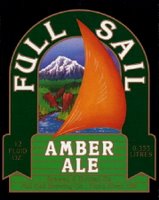 Of those early breweries, the first to get a product to the supermarket in Oregon was Full Sail, which began bottling beers shortly after its founding in 1987. It was a modest beginning. Their first year, they brewed but 2,000 barrels, and their operation looked more like large scale homebrewing than small-scale commercial brewing. After they brewed a batch, two employees bottled and capped the beer by hand while the receptionist prepared the labels with glue in the office.
The first beer was a golden (a beer whose color landed it on the other side of "pale" in the beer spectrum), and its brewer was Dave Logsdon, who left the brewery the next year to found Wyeast Labs ( a yeast manufacturer critical in the rise of American microbrewing). In came Jamie Emmerson, fresh from Seibel, and the future flagship Full Sail beer, Amber.
Among early beers to find a following, I recall Full Sail being an early alternative to the insanely-popular Widmer Hefeweizen. Although by today's standards it looks a little tame, at the time, it was stronger and hoppier than any beer Oregonians were used to drinking. It was the beer beer geeks drank.
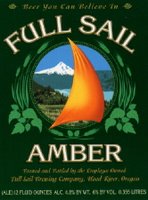 Full Sail is sometimes credited with having founded the style (though I'm sure some breweries dissent), and it's not hard to see why. The style description offered by the American Brewers Association is almost exactly a description of Full Sail, which may verify the claim:
Tasting Notes
The beer is a fairly dark copper with hints of red and a characteristic creamy head that doesn't dissipate completely even through the last sip. It has a faintly citrus aroma from Cascade hops and an inviting caramel note.
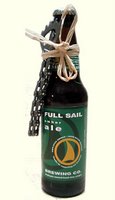 As the Brewers Association suggests, it is a beer in full balance, neither malt or hop character dominating. The quality of the malt is sometimes described as "nutty," but it's grainy to me, a flavor I attribute to the crystal malts. They impart a slightly astringent or tannic quality. The mouthfeel is rich and creamy, and the hops, with their citrus flavor, give the beer a sweetly comforting quality. However, the longer you drink the beer, the more the hops come to the fore, and toward the end you appreciate their stealth.
Not all beers have to be intense to be great. Full Sail Amber is a wonderfully drinkable beer, one that never rings flat, and one you enjoy drinking through an entire session. Few smaller beers have this much going for them, and almost no other American ambers.
Stats
Malts: Pale, crystal, chocolate
Hops: Cacade, Mt. Hood.
Alcohol by volume: 6%
Original Gravity: N/A
Bitterness Units: 42
Available: Throughout the Northwest
Rating
A Northwest classic.
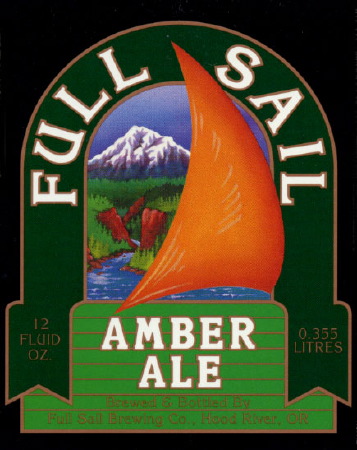 Of those early breweries, the first to get a product to the supermarket in Oregon was Full Sail, which began bottling beers shortly after its founding in 1987. It was a modest beginning. Their first year, they brewed but 2,000 barrels, and their operation looked more like large scale homebrewing than small-scale commercial brewing. After they brewed a batch, two employees bottled and capped the beer by hand while the receptionist prepared the labels with glue in the office.
The first beer was a golden (a beer whose color landed it on the other side of "pale" in the beer spectrum), and its brewer was Dave Logsdon, who left the brewery the next year to found Wyeast Labs ( a yeast manufacturer critical in the rise of American microbrewing). In came Jamie Emmerson, fresh from Seibel, and the future flagship Full Sail beer, Amber.
Among early beers to find a following, I recall Full Sail being an early alternative to the insanely-popular Widmer Hefeweizen. Although by today's standards it looks a little tame, at the time, it was stronger and hoppier than any beer Oregonians were used to drinking. It was the beer beer geeks drank.
 Full Sail is sometimes credited with having founded the style (though I'm sure some breweries dissent), and it's not hard to see why. The style description offered by the American Brewers Association is almost exactly a description of Full Sail, which may verify the claim:
"American amber is noteworthy for its relatively even balance between malt and hop expression.... American amber is also distinguished from its American pale ale parent by its fuller body and mouthfeel. Much of this comes from the liberal use of crystal malt, which not only contributes a pronounced caramelly sweetness, but also the style's signature red color. That same impartiality also applies to hops... [C]itrusy Northwest hops like Cascades are most common."As beer tastes have moved forward, Full Sail Amber has become the beer geek's session ale. It is an impressive example of rich flavor in a restrained beer, and has justifiably joined the pantheon Northwest classics. (By way of comparison, try one with a bottle with Flat Tire Amber and judge for yourself.)
Tasting Notes
The beer is a fairly dark copper with hints of red and a characteristic creamy head that doesn't dissipate completely even through the last sip. It has a faintly citrus aroma from Cascade hops and an inviting caramel note.
 As the Brewers Association suggests, it is a beer in full balance, neither malt or hop character dominating. The quality of the malt is sometimes described as "nutty," but it's grainy to me, a flavor I attribute to the crystal malts. They impart a slightly astringent or tannic quality. The mouthfeel is rich and creamy, and the hops, with their citrus flavor, give the beer a sweetly comforting quality. However, the longer you drink the beer, the more the hops come to the fore, and toward the end you appreciate their stealth.
Not all beers have to be intense to be great. Full Sail Amber is a wonderfully drinkable beer, one that never rings flat, and one you enjoy drinking through an entire session. Few smaller beers have this much going for them, and almost no other American ambers.
Stats
Malts: Pale, crystal, chocolate
Hops: Cacade, Mt. Hood.
Alcohol by volume: 6%
Original Gravity: N/A
Bitterness Units: 42
Available: Throughout the Northwest
Rating
A Northwest classic.
Subscribe to:
Posts (Atom)