You love the blog, so subscribe to the Beervana Podcast on iTunes or Soundcloud today!

Showing posts with label vignette. Show all posts

Monday, March 27, 2017

Vignette #14: Carlo Grootaert (De Struise Brouwers)

Brewer vignettes feature quotes from brewers I picked up in my travels around the world.

On the origins of Pannepot, the brewery's flagship.
“I heard that in my family, there were homebrewers at the time—100 years ago. The women were the brewers because the men were at sea to catch herrings. The women made beer in the wintertime on the stove.”

Here Grootaert interjected with a story about the name. It refers in part to the village of De Panne and the boats the fishermen there use, a flat-bottomed vessel able to land on sandy beaches. That is not, however, the boat you see on the label. That is the second half of the homage, which he went on to describe:
“The label is actually my great-granddad’s boat, the B-50. He died in 1918. He went to France in WWI. The war was finished November 11, 1918. And he came in his boat back to Belgium—but he came in a storm and on the 18th of November he fell overboard and drowned. So he didn’t make it. It’s a sad story.”
He continued on with the story behind Pannepot, Struise's thick, jammy beer.
“Anyway, the women made beer on the stove at the time. It was so strong and sweet and very alcoholic so they kept in a little cask in the cellar. If they wanted some beer, they went down with the jug and tapped off some beer—it was flat. But they didn’t like cold beer. So they had to heat it up: they put the metal poker in the fire and it was glowing red, and when they put it in the thick beer (it didn’t have a name, it was called “thick beer”) with lots of sugars in it and the sugars instantly caramelized. It gave it a roasted, caramelized flavor.”


Wednesday, March 08, 2017

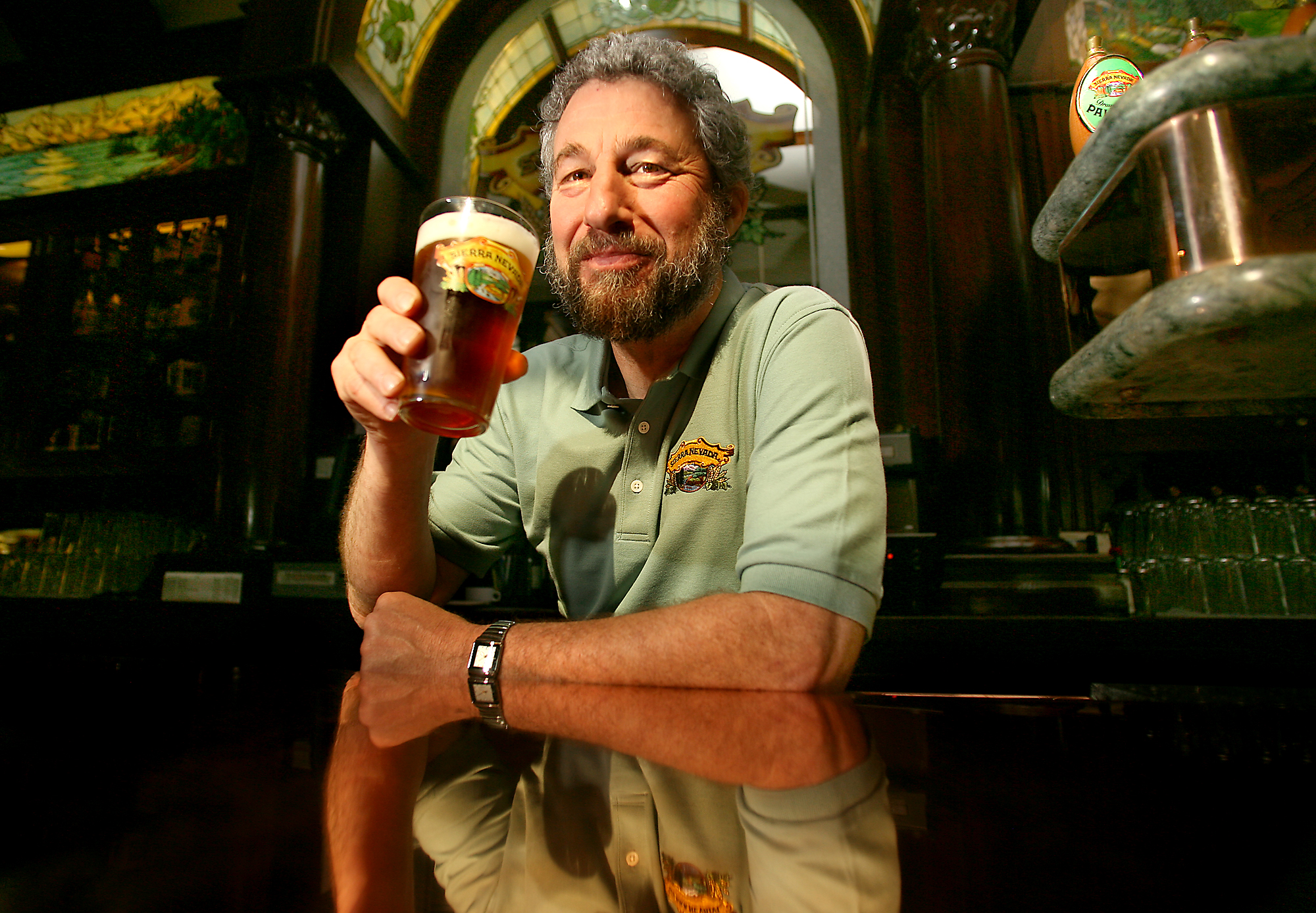
Vignette #13: Ken Grossman

Brewer vignettes feature quotes from brewers I picked up in my travels around the world.

“I was an avid homebrewer, starting back in 1969, and brewed through the seventies and ran a homebrewing supply store that I founded in 1976. I had brewed a range of pale ales and when we were thinking about starting the brewery I wanted to do something that was not British, that was American, and wanted to feature American ingredients wherever possible and so chose the Cascade hop as about the only signature American aroma hop at the time. I blended a little bit of brewing technology and history from England with my homebrewing and some US ingredients and came up with pale ale. It was my familiarity with that hop and the distinctive nature of the aroma—the piney citrus—that I appreciated and enjoyed and wanted to incorporate into our pale ale.”

The following answer was in response to a question I had about the durability of Sierra Nevada's Pale Ale.

“Well, I’ll take some credit as—I wouldn’t say we invented it, but we certainly focused in on and honed a style of pale ale that had a forward hop profile, which the English styles don’t so much have, and a more robust character, higher bitterness units, and higher alcohol than most of the British pale ales. So I think it’s certainly a variation on a theme—as all beers are, in reality. I mean, you’re brewing with a handful of basic brewing ingredients. We bottle conditioned. We did some fairly unique things for American breweries—not that they weren’t being done a few places in the world and by homebrewers—we also put that out there as one of our signatures. ”


I particularly love that second quote for its modesty. This is a man to whom I credit largely with inventing the American tradition. With Pale and later Celebration, Grossman fixed the DNA of the American palate. I gave him a chance to take a victory lap and celebrate this singular accomplishment, but he downplayed it the whole way.


source

Friday, February 10, 2017

Vignette #12: Michael Schnitzler (Uerige)

Brewer vignettes feature quotes from brewers I picked up in my travels around the world.

Two unrelated quotes today from Michael Schnitzler, the Weihenstephan-trained owner of Hausbrauerei Uerige. To go with them, I'll show you two photos, one of Michael, and one of the brewery. It contains, as you will see, one of the more unusual anachronisms still in use in Germany.

On Altbier's Health
“In general, the altbier is in bad condition. The smaller breweries are successful, that is not a problem, but if you remove the big breweries that were far more original Düsseldorfer breweries—now Frankenheim for example is with Warsteiner, Diebels is with Anheuser-Busch, Schlösser is somewhere, nobody knows really, then altbier is [not doing well].”

“The former biggest Düsseldorf breweries, they started twenty or thirty years ago to quit brewing in the town. [Real estate] prices are so high that everyone says, come on, it’s not [worth it] to sell beer. Let’s put it out to rent. The same with Munich—it’s even worse than Düsseldorf.  So the breweries were sold to Warsteiner—Frankenheim—to Anheuser Busch; so where is the echte Düsseldorfer brauerei, the real Düsseldorf brewery? That’s the problem everywhere.“


Wooden Casks
(It is typical to find altbier served from wooden casks perched on the bar; I asked about this.)

“It is just the traditional style of presenting the beers in a nice way. We tap it manually and then we put the barrel on the bar; this is the special way we do it, but there is no fermentation; there is nothing for the taste.”  (They're lined.) He went on to tell the story of why all the casks only have red-painted metal bands when once they came in all different colors. “Now every barrel has a red ring [metal band]. A couple of years ago we had a green one, a yellow one, something like that.  Nobody knows why. The regular customers they saw the barrels with the green ring on it and said, “oh no, we cannot drink this one; the red [ones] have the best beer.”

The coolship at Uerige. They also use a baudelot chiller.

Thursday, January 26, 2017

Vignette #11: Dan Carey (New Glarus)

Brewer vignettes feature quotes from brewers I picked up in my travels around the world.

A bit of background on the quotes that follow. I interviewed Dan in 2013 and was curious about why the early lagers they brewed when I lived there--the early focus of the brewery--fell into the background. In The Beer Bible, I highlight Staghorn as one of the best examples made in the US, and I wondered why it and other lagers weren't featured more. (I have hope that the "craft lager" trend will help New Glarus find a new generation of drinkers for these beers.)

“When we came [to Wisconsin] and we made lager beers, the general idea for craft beer was lager beer because that’s what Capital and Sprecher made. What we found was, when you go to Milwaukee and you try to sell your pilsner and you say, ‘hey, try our beer; we make a pilsner.’ And basically the fifty-year-old guy would say, ‘Uh-huh, sure. I’ll have a Spaten.’  He wants to drink a German beer, and I’m not going to change these guys’ minds.”

“And then the other thing that happened: Miller came out with an advertizing campaign. They said: ‘Miller Lite, it’s a fine pilsner.’ So then, if you went into a tavern or a store and said you had a really nice pilsner, they’d say ‘Uh-huh, we already got one. We got Miller Lite.’ And the world started to change as the effect of the west coast and east coast craft breweries moved in. People started to expect craft ales.”

“People might criticize us for one thing or another as if we are in control--and we’re not.  We brewed over 100 different beers and they would all go out into the marketplace. Some would meet with more success than others. It’s survival of the fittest. The ones that meet with success we brew again. As long as people keep buying them, we keep making them, and if people stop buying them, we stop making them. Our customers prefer ales. They expect a craft brewery to make ales with Cascade hops, pale ales, etc etc.  Lagers are a harder sell because the old farts if they want to drink a lager, they drink Spaten.”


Source: Brewpublic

Thursday, January 12, 2017

Vignette #10: Steve Barrett (Samuel Smith's)

Brewer vignettes feature quotes from brewers I picked up in my travels around the world.


“It’s a very flocculent yeast and it has a natural tendency to float to the surface of the beer. That can be a mixed blessing during the fermentation, because the yeast is so flocculent it does want to do that at a fairly early stage in fermentation. So the approach taken to encourage it to ferment right to the end is to carry out rousing. The rousing effectively means that we pump from the bottom of the tank up and around this circular [inaudible]--a fishtail/fan arrangement that screws onto the pipe and that throws out a fan of recirculated beer into the top--and that pushes the yeast back down and it keeps the whole thing in a dynamic state.”

“It’s quite unusual to do that during fermentation. You wouldn’t expect to be throwing your yeast through the air. Now this whole thing produces CO2 during fermentation, so for the most part there is protection by natural CO2.  It’s absolutely relevant to the beers we’re producing that whatever’s happening to the yeast in the process is having an impact on the flavors we’re getting. Typically, a very robust, complex, full-flavored beers.”

“It’s tradition. The brewery’s been here since 1758 at least and it’s still owned by the Smith family and they’re really, really heavily keen on maintaining traditions in everything. Traditional hand-crafted beer, and deliveries, the cooper making wooden barrels.  It’s very much about history and tradition, really.”


Steve Barrett retired shortly after I visited and was replaced by Colin Carbert in 2012.

Friday, December 23, 2016

Vignette #9: Stéphane Bogaert (St. Germain)

Brewer vignettes feature quotes from brewers I picked up in my travels around the world.

“Everybody thinks Belgium when you say beer.  In this region, we are not so famous compared to Belgian breweries--but the history is the same.... That’s why I say to my colleagues that they should write ‘bière de garde’ on the label because it’s profitable for everybody. We want to be different from Belgium and we want the people, especially in America, talk about French beer. Bière de garde is something you can say, okay, it’s a French style.”

“In the past, many local brewers decided to change and adapt the beer to new tastes and there was no more bitterness in beer. We were more interested in beers like Westmalle, Orval. We decided to make our own beer, but in a bitter style. More bitterness than we used to find in local beers. Three years ago we decided to work 100% with local hops. There is a movement to work with organic beer, but most of the people are obliged to buy hops from Germany or New Zealand, places like that. So we decided, we don’t want to make organic beer, but let’s work with local hops.”

“We have a tradition here. We try to stay traditional. Our philosophy is to respect the bière de garde tradition. The major activity of the brewery must stay this kind of beers. Because, if we want to export to the US, you have so many good IPAs--the American consumer will be more interested in bière de gardes [from France].”

Castelain's Loïc Falce (L) with Stéphane Bogaert (R)

St. Germain produces the Page 24 line of beers. They are located in Aix-Noulette, near Lille and the Belgian border, and all the ingredients to make beer are grown within a few miles of the brewery. St. Germain is one of the breweries committed to reviving a sense of "Frenchness" in their beers.

Monday, December 05, 2016

Vignette #8, Agostino Arioli (Birrificio Italiano)

Brewer vignettes feature quotes from brewers I picked up in my travels around the world.

“This is okay for, we call it ‘meditation beers’—special brews, specialty beers. These beers are beers you drink with your senses more than with your brain; birra da meditazione. When you drink a meditation beer, you really think about it. This taste reminds me of flowers; this taste reminds me of the food my aunt used to prepare me.  So you’re really thinking about the beer.”

“In Italy we grow up where you can spend hours and hours on Saturday and Sunday discussing sauce—the spaghetti sauce or anything we are eating for lunch. The whole family and the relatives and parents and so on and we can discuss food for a long time. This is better; last time was worse. It’s overcooked, or it’s too rare. Really, we talk about food a lot; we really care about food. So this probably automatically require us to brew beers that can fit with our sense of what is pleasant, what is balanced.”

Arioli (center) when he visited Portland in 2015.
Photo by Giulio Marini.

Wednesday, November 16, 2016

Vignette #7, Jim Bicklein (Anheuser-Busch)

Brewer vignettes feature quotes from brewers I picked up in my travels around the world.

 “There are six of these mash vessels per brewhouse, so I have 18 mash vessels. Those mash vessels, because we long-brew Bud Light, right?—we’re in the cooker for three hours—so to maintain that mashing cycle we had to have more mashing vessels. We long-brew the Bud Light. This is designed to make light beers with long brewing mashing cycle for the enzymatic activity to break down the starches. In order for the process to break down the sugars in light beers, it just takes time. In light beer, more of the sugars are being broken down. So for Budweiser a conversion cycle might be about 45 minutes; it’s about 210 minutes for a Bud Light.”

“There’s three brewhouses, six of these apiece, and each brewhouse has two lauter tubs, so we have six lauter tubs and six brew kettles. And that will support about 50-60 brews a day depending on production demands. It’s nice that the brewhouses are broken up, because technically I can do three different products at a time. I’ll mash in a Budweiser, and then I’ll mash in a Bud Light, and then I’ll mash in a Natural Light on the other brewhouse; so that’s commonly how we run.”

(Bicklein here is describing the process at the St. Louis brewery; he was the brewmaster at the time I recorded him in 2013.)


Tuesday, November 01, 2016

Vignette #6, John Keeling (Fuller's)

Brewer vignettes feature quotes from brewers I picked up in my travels around the world.

“On one side of the equation you have to have quality and consistency and that is balanced on the other side of the equation by flavor and character. There are breweries that specialize in producing high quality, very consistent beer—companies like Budweiser and Carlsberg and Heineken. They produce high quality, very consistent beer, but maybe they forgot about the other side of the equation, which is to have some flavor and some character.”

”What I want from London Pride—or any Fuller’s beer—is that when you order a pint of it, I want you to recognize it as London Pride. Yes, I want it to occasionally surprise you—today it’s a little bit more malty or caramelly or hoppy or fragrant or whatever—so that you are having a dialogue with that beer. You’re noticing things about that beer and it interests you and involves you because of that. And that’s really what we call character. So when you go into a pub and order a pint of London Pride, you drink it and you recognize it and you make a note of all these things. You can never make batches of beer that are exactly the same no matter how good you are, and in fact, to try to make them exactly the same, that means taking flavors out because they’re so hard to manage on that consistent basis. That’s why companies that want consistency above all do not produce very flavorsome beers.”

Derek Prentice (l) and John Keeling (r)

Wednesday, October 12, 2016

Vignette #5, Jean Van Roy (Cantillon)

Brewer vignettes feature quotes from brewers I picked up in my travels around the world.

“I taste first my old lambic.  If I have a mellow lambic with some soft beer, I can work with two- and one-year-old with mild character. If I have an old beer with character, I have to find other types of beer.  Each blend is different. The beer is very good, but you have this small flavor in the beer, so it’s never the same. Never. You never know what you will discover.  That’s why lambic is so fun.”

“No one, no brewers on the earth, can have the same rapport, the same feeling with his beer. In French we have a sentence. We say, 'tout est dans tout.'  If I translate it: 'Everything is in everything.'  In this brewery, everything is playing a role in the final product.  Everything.” 


Wednesday, September 28, 2016

Vignette #4, Adam Brož (Budějovický Budvar)

Brewer vignettes feature quotes from brewers I picked up in my travels around the world.

“It depends on the beer category you are producing.  If you try the lager type, the decoction is very important.  We compared decoction versus infusion on our  small-scale brewery; always the beer brewed by the infusion process was emptier in its taste—the body was not correct for the lagers.  Also the color changed.  If you boil during the decoction, you prepare the compounds which cause golden color.  So the infusion lagers were yellowish, not so full in its taste.”

“Always there is a discussion of the definition of pilsner lager.  We are a bit different [than Pilsner Urquell].  It is not so bitter, and a bit deeper fermented.  It’s really difficult to compete with Pilsner Urquell because I think that it’s really the style.  It became the style of the pilsner type.  We are a bit different in this category because bitterness is really fine, the alcohol is a bit higher than the pilsner has.  The Budweiser beer is really different.”


(Incidentally, there's a cool story about that mug Brož is holding. They're copper-clad but lined by tin, and are the vessels brewers have used to taste beer for ... ever, probably (Adam wasn't sure; "a very long time.") It's called something like a mazek, based on what I could hear him say, and that apparently derives from the name of the volume it holds which I think is related to the German Maß. When we were in the cellars, he used that little pigtail you can see in his left hand to zwickel beer (the pigtail is nearly always used for lagers in Germany), and he filled that that sucker nearly up to its full mazek. The day I visited, the brewery was having electrical work done, and there was no power on in the brewery. Except for the small flashlight he carried, we were in the dark, like thieves stealing the beer. After he filled it up, we passed it back and forth and crept around the echoing cellars--which I couldn't see.)

Wednesday, September 14, 2016

Vignette #3, Trevor Rogers (De Garde Brewing)

Brewer vignettes feature quotes from brewers I picked up in my travels around the world.

“We’re not masters of anything. We make wort, we don’t make beer. That’s very different; we’ve relinquished control for the most part. The one thing we do control is what goes into the barrel, and what gets blended from the barrel. But even after that, because it’s naturally reconditioned in the keg and bottle, you have zero control.” Pauses. “I didn’t have any gray hairs when I started.”

“Our biggest challenge as a natural, wild brewer is to restrain acidity. It’s going to be there, and you need some for the complexity, but it needs to be in balance. It’s like the hops arms race—we are in that phase. The demand for sour beer makes people think sour is good. Like hops are good; bitterness is good. But that shouldn’t be the defining feature of a beer. It should be an element that is essential to produce complexity—not the element defining the beer.”


Monday, August 29, 2016

Vignette #2, Hans-Peter Drexler (Schneider)

Brewer vignettes feature quotes from brewers I picked up in my travels around the world.

“There are three different styles of aroma in a Bavarian wheat beer: most of them are very fruity,  from the Weihenstephan strain; there’s one that is more neutral; and there are some that are more spicy like the Schneider yeast, spicy-tasting like clove and nutmeg.  We are very interested to have the raw materials that bring a lot of the ferulic acid to the wort to get a lot of vinyl guaiacol in the beer.  It comes from the barley and the wheat—most of it comes from the barley.” 

“The biggest challenge in the brewery is to keep the biological balance in the right way.  It’s a really big challenge. For me, wheat beer is terrible to produce.  There are so many screws you have to turn.  It’s crazy.  And these open fermenters are very hard to control.  But the result is amazing if everything works perfectly.”


Tuesday, August 16, 2016

Vignette #1: Nick Arzner (Block 15)

Brewer vignettes feature quotes from brewers I picked up in my travels around the world.

“I literally think about beer all the time. I have a list on my phone of ideas, and those ideas can come from wherever. They can come from even a name; if I think it’s a good name I’ll build a beer around it. It can come from an ingredient; I’ll build a beer around that. It can come from [events]. People ask me to do an anniversary beer; it can come from them. I look at some breweries, they say, ‘I’m a lager brewery,’ or ‘I’m a Belgian-style brewery, I won’t do hoppy beers’—I don’t know why you’d limit yourself to that. I dunno, I just really just like beer. I like all styles, I enjoy drinking all styles of beer.”