You love the blog, so subscribe to the Beervana Podcast on iTunes or Soundcloud today!

Showing posts with label cellar. Show all posts

Thursday, December 11, 2014

Lessons From a 25-Year-Old Beer

Last night a group of friends and I cracked open the first bottling of Old Knucklehead from BridgePort--a beer dating back to 1989.  Back in the day, Old Knucklehead (OK) was a wonderful tradition.  The brewery honored a local codger (some famous, some not) by putting his visage on a little nip bottle.  It combined localness, particularity, and tradition all in one lovely little package.  (The brewery would do well revive the tradition, methinks.  It's hyper local tradition and wouldn't account for many barrels in absolute terms, but it would get a ton of press and continue a beloved tradition.  It's also perfect for the social media age.)

I have no idea who's on that first bottle--I think it was a regular at the old brewery.  Labeling standards were different then (no government warning, for instance), and the ABV isn't listed.  If memory serves, OK was a relatively low-alcohol barley wine--nine percentish.  All of which made analyzing it more dependent on what our senses could tell us. 

One thing you could tell right away was the clarity--even in the bottle.  That was a good sign.  When we cracked it, the bottle let out a nice pssst, and bubbles sprang to the surface.  Old Knucklehead was bottle-conditioned, and there was a thick layer of now-black yeast at the bottom.  Bottle conditioning is great for aging beers in the shorter term--the yeast harvests oxygen while refermenting in the bottle.  But it also raises the risk of autolysis (yeast cell degradation). 
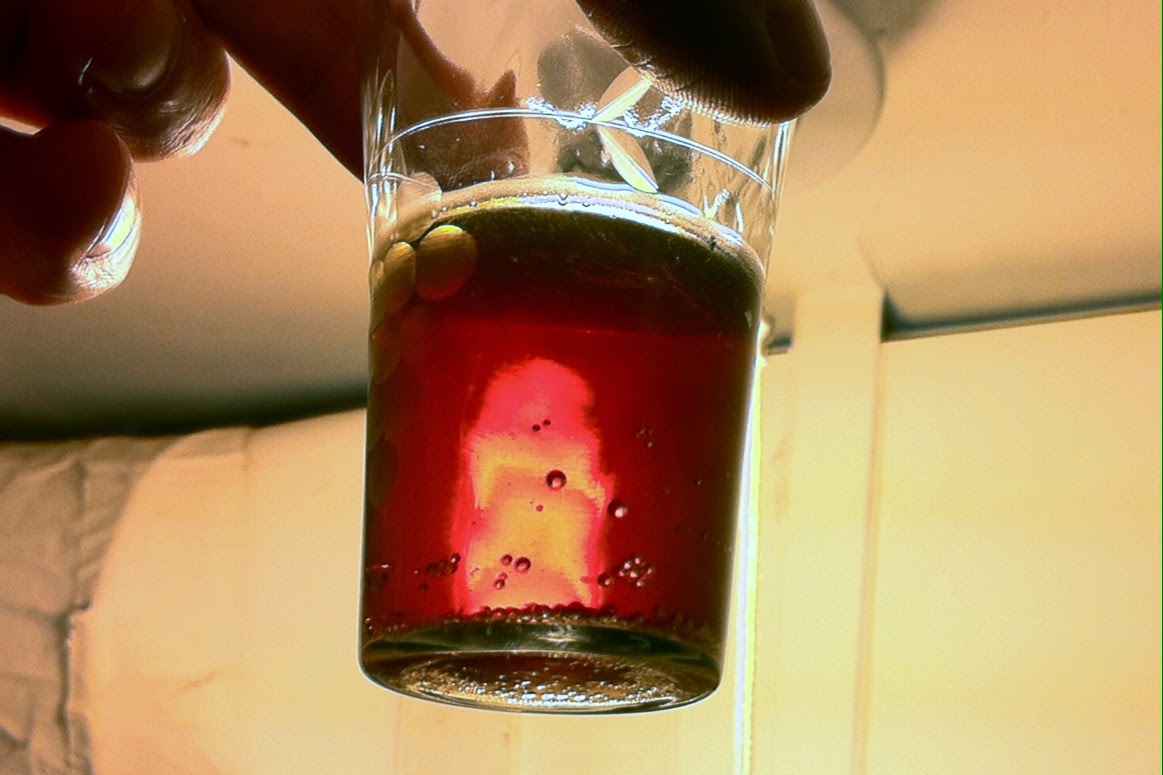

 Twenty-five years is a long time, but amazingly, the beer had little flavor of autolysis and also not a ton of oxidation.  For those who like the effect of oxidation on high alcohol beers, this was an argument for the prosecution.  A tinge of paper, but mostly a rich, sherry-like note.  There were no hops left, but the beer was not overly sweet.  Some bread pudding and raisin, but balanced by the sherry note. 

The beer probably would have been better a decade or two earlier, but it was still surprisingly fresh and tasty.  People often ask me how long you can store beer before it's a lost cause, and I've always been reluctant to answer.  My data set--like most people's--is not flush with examples.  But 25 years is quite a test.  And this bottle, which was well cared-for in that quarter-century, held up remarkably well.

Bright and effervescent after 25 years.


Monday, December 24, 2012

Ghost Beer

It began as traditions do, unintentionally, with an ill-defined start date.  The tasting of aged beers over a small (select one as fits your tastes: Christmas, solstice, winter, maybe-we-should-call-it Festivus) party.  Originally I used it as an excuse to raid my own larder, but this year, others brought rarities.  One friend has a batch of Jubel 2000s and gifted one.  I have another friend who, knowing he won't actually be able to leave his own beer alone, gives me some to cellar for him.  And the big treat was a ghost from the past: Roots Epic, vintage 2008 (the fourth in the five-year series--thanks, professor, for the generosity).  Roots died a couple years back and there was no 2010 vintage.  The brewery lives on, for a time, in these last bottles.  (Jason McAdam, one of the two men behind Roots, carries on at Burnside, which is some consolation.)

Epic, you'll recall...

is a truly hand-made beer. The long process begins when [owner] Craig [Nicholls] smokes a small proportion of Munich malt (small by percentage, but 55 pounds in total) over cherry wood that has been soaked in Glenlivet, cognac, and cherries. The final beer finishes out somewhere around 14%.
At first release, Epic is overly sweet.  I once asked Craig when he thought the beer achieved maturity and he guessed five years.  The '08 was just about in its prime then.  If you follow the link above, you'll find my notes on a flight of beers from the release of the last one, in 2009.  I called the '08 the "sweetest of all the vintages."  No more.  The bottle we sampled had become smoky and chocolatey.  There's no point in discussing it in too much depth--you won't be able to get a bottle, anyway.  It was an exceptional treat to end the year, but bittersweet.  Wherever you are, Craig, I hope all is well.

Craig (r) and I from 2009.  More pics here.
 

Sunday, December 11, 2011

Cellar Report

We've been hosting a holiday party for a number of years, and three or four ago, I started busting out some gems from the cellar. As my cellar gets fuller over the years, the annual roll-out gets more and more extravagant. Yesterday, boosted by some of the beers I brought back from Europe, we had quite the blowout. Below are some comments on a selection of the bounty.


Westvleteren Blonde, 2011. I was not much impressed by the famous 12 at the brewery, But the blond was a treat. It was even better out of the bottle. A light, spritzy beer with a notable saison yeast character. I have no idea why this beer isn't the legendary one.

Fuller's Vintage Ale, 2000. John Keeling, the master brewer at Fuller's, pulled this out of his own cellar when we visited--and it was definitely the highlight of the night. Eleven years is pretty long for an 8.5% beer, but Keeling designed this for the long haul. (Amazingly, it's still available for just eight pounds--the best deal in brewing.) There is, predictably, lots of dark fruit and smooth, caramel notes. The immediate impression is port, though. The taste of age, chemical changes and very slight oxidation, is on perfect display here. It is a crucible for cellaring beer: if you don't like this beer, cellaring is not for you. Our crowd greeted it with astonishment and delight.

Upright Billy the Mountain, 2010. I didn't get a lot of this one--just enough to take note. Alex has changed the process for this beer, but he might want to reconsider. After a year, the brettanomyces have added a lovely tart snap to an otherwise hearty, sweet, English-style ale. they've thinned the beer a bit, but it's still rich and still has a fair amount of sweet, candyish malt. If you have a bottle, consider drinking it now--it's really nice.

Block 15 Ferme De La' Ville Provision, 2011. I love this beer and wanted folks to try it while it was still fresh and bright. In my view, one of the best saison made, and the very vest made with wild yeast.

Deschutes Dissident, 2009. I bought a case of this, and I wish I'd drunk it quicker. It's just on the edge of passing too far. Already, the Brett has eaten a hole in the center of the palate--and it seems almost to pull moisture out of the cells of your mouth by osmosis, so dry has it become. Still quite a tipple, but I remember what it was like last year.

Fuller's Past Masters Stout, 2011. Another real joy, this stout was made from an 1893 recipe and ingredients as authentic as the brewery could procure. It is a roasty, meaty stout, but one broadly similar to current recipes. No brett, but otherwise a trip to Victorian England.

Widmer KGB Stout, 2010. Speaking of roasty, I was amazed to find this beer had changed very little in a year's time. I think it could easily go another five years.

Full Sail Doppelbock, 2008. Just a hair past its prime, with a stewing that goes a bit flaccid in the middle.

Hair of the Dog Doggie Claws, 2008. I had only a mouthful of this--enough to confirm it remains in perfect, tasty form.

There were several more, but those are some of the more interesting highlights.

Saturday, August 11, 2007

ROS Party - a Cure for Hoarders' Loss Syndrome?

Lew Bryson has a problem I can relate to: inveterate hoarding.
I realized earlier this year that I literally had too much beer. The Dedicated Beer Fridge was full to bursting, I had almost a case in our regular fridge, there were two cases sitting under the kitchen table, and 14 cases under the basement steps. Some of it was beer that was never meant to age -- I had most of that in the DBF -- some of it was probably over the hill, and I had no good storage space for more beer.
In the hoarder's mind, hoarding is its own end. Getting rid of these beers, even using them for the purpose you hoarded them in the first place--drinking them--is hard to face. Lew plans a one-clean-motion remedy:
I happened to talk to Scott "The Dude" Morrison about my problem. "Dude, R.O.S.!" he said, with a big Dude grin. R.O.S.? "You need to have a Really Old Shit party! Get it all out and drink it!"
I see the virtue here, and perhaps I'll muster the courage. A lot of the beer I have is irreplaceble though--Tony Gomes doppelbock, single-batch concoctions that go back to the millenium, etc. If I drink them, then ... they'll be gone. Oh, the dilemma!

I should read some wine blogs; surely they have to deal with "hoarders' loss syndrome."* How do they manage it?

________________
*Not an actual diagnosis.