You love the blog, so subscribe to the Beervana Podcast on iTunes or Soundcloud today!

Friday, May 30, 2014

Beer Sherpa Recommends: Köstritzer Schwarzbier

This is a slightly sneaky post.  While I do come to praise Köstritzer, I also want to celebrate the opening of the Stammtisch Bar on NE 28th and assure folks that it's as good as billed.  They have a spectacular line-up of 18 (!) German biers on draft.  For this post, I was forced to choose from among some of my faves--a Schlenkerla (Helles), Ayinger Maibock, Andechs Hell, Schneider Edelweiss, to name just a few.   You can find these beers in the bottle, but it's a rare treat to have a nice pour--into a liter mug if you want it--just like you would in a pub in Munich.  There's a heavy emphasis on Franconian and Bavarian breweries, which suits this helles-lover just fine.  The selection seems to rotate pretty quickly, a practice that will reward regulars.

But I choose to highlight Köstritzer, one of the rare beers that fits a person's mood no matter if it's 20 degrees outside or 90 (Fahrenheit).  It is frothy and light yet assertive and roasty--the best of all worlds.  It's an enduring standard in the Alworth household.

Like so many of the old German beers, Köstritzer's originally makers were monks.  They founded a monastery at Bad Köstritz in 1543 (which highlights another distinctive feature of German beers--they are very often named after the town of their origin).  Lagers were a Bavarian thing, so the dark beer they brewed in the town, not far from Leipzig, was an ale.  Lagers came late to Köstritz--typical for ale country--and the brewery didn’t shift from ales until 1878, nearly 100 years after the monastery had been secularized.  In an interesting twist on the usual story, though, the second world war, usually the destroyer of beers, may actually have helped preserve the style; Bad Köstritz, located in East Germany, continued to make the obscure roasty beer until reunification.  In 1991, not long after the wall came down, Bitberger snapped up the brand and has been making it since.  (Bitburg has its own fascinating history, but that's a different post.)

Köstritzer manages to be at once assertively roasty while maintaining a delicate caramel sweetness.  The color of cola, it has a top layer of coffee-like roasting quite similar to an Irish stout; the palate is complex, however, and licorice, chocolate, and port all add distinctive notes.  Perhaps most impressively, the beer finishes dryly, leaving no lingering flavors; the finish is so complete you almost immediately raise the glass for another taste.

If you live in Portland, go have a pint of it at Stammtisch, but never fear--Bitburger has made sure it is readily available in the bottle for those of you who live farther afield.

_______________________
"Beer Sherpa Recommends" is an irregular feature.  In this fallen world, when the number of beers outnumber your woeful stomach capacity by several orders of magnitude, you risk exposing yourself to substandard beer.  Worse, you risk selecting substandard beer when there are tasty alternatives at hand.  In this terrible jungle of overabundance, wouldn't it be nice to have a neon sign pointing to the few beers among the crowd that really stand out?  A beer sherpa, if you will, to guide you to the beery mountaintop.  I don't profess to drink all the beers out there, but from time to time I stumble across a winner and when I do, I'll pass it along to you.

Wednesday, May 28, 2014

Brewing Pioneer Jack Joyce Dead at 71

Source: NY Times
I was staggered to get the news that Jack Joyce, Rogue founder and one of the central pioneers of craft brewing in Oregon, died yesterday.   Jack brought a world of experience to Rogue that few of the founding craft brewers could match.  In addition to a background in law, he was also an executive at Nike.  He was in charge of production during the introduction of Air Jordans and had a box seat view of what truly spectacular branding could do for a company.

When he founded Rogue, Jack brought a savvy to the brand side of the business that probably only Jim Koch could match.  Until Jack came along, breweries cast their eyes backward in time for branding inspiration.  The western-themed look of Sierra Nevada, the Germanic touches like Widmer adopted, these were more common.  Others went for a naturalistic theme, like BridgePort's iconic fish and birds.  But Jack looked forward and saw what craft brewing represented to the beer industry--a challenge.  Now almost every brewery adopts the pose of iconoclastic outsider, but they are actually just following Jack's lead.  He was the first to brand a craft brewery as a rebel, and he helped define the industry.

On a personal note, Jack was always kind to me, no matter what I was writing on the blog.  Sometimes he'd read something I'd written and I'd get a gnomic phone message with his gravely, terse voice.  I would have to try to crack the code by figuring out what the 19 words he spoke related to.  He sent me notes from time to time as well, and last year I got a Christmas card from him.  It was smart business not to alienate writers, but I never sensed that was his motivation.  He loved the brewery, and he was a strong advocate for it.  His enthusiasm was infectious, and your affection for him couldn't help but translate to the brewery.

I have no doubt that he left the world feeling that he'd built America's best brewery, and I will raise a pint high to his memory tonight.  He was an original and Oregon is a little less Roguish without him.

____________
Update: Kendall Jones has a nice remembrance.  

Tuesday, May 27, 2014

Full Disclosure

Source
The media landscape is getting incredibly hazy.  The line between sales and content is not only blurred--in many cases, it's completely merged.  You may have noticed that respectable news orgs now regularly have links at the bottom of articles to other "articles you may have missed" from weird websites you've never heard of.  This is one of the more recent techniques.  Another is the concept of "native advertising"--text-based ads that look like actual articles but are written by advertisers--is now so established that even the Gray Lady does it.  The ethics of journalism are being completely overhauled.  Bloggers fall in a different category, but that doesn't mean that you as the reader shouldn't expect a ethics-free landscape of secret promotion and graft.

Just this morning I got an email from Craft Marketing, a company created to promote beer in the digital realm, and they invited me to sign up for a program wherein they'll ship me beer, presumably on the assumption that I'll write about the beer--and implicitly, write favorably about it.  I'm actually going to sign up for the program, and you may like to know why.  What ethics do I hold myself to?

Beer samples.  There are currently nine jillion breweries in the world--thereabouts.  I am a natural bottleneck in the flow of potential stories because I can't drink nine jillion beers.  I have never asked to be put on a brewery's mailing list, but a few have asked to put me on theirs (I get everything from Widmer and Deschutes and occasional disbursements from Portland, BridgePort, Goose Island, Ninkasi, Crux, Double Mountain, Fort George and others).  If I'm at a brewery, someone occasionally puts a pint in front of me gratis or presses a bottle in my hand.  My rule is this: I will drink any beer (or cider) a company sends me, but no promises that I'll discuss or review it, and definitely no promises that I'll discuss it favorably.  It's a relationship I'm comfortable with.  The brewery makes sure to get their beer at the front of the line so that it will pass through my bottleneck--but that's it.  I try to make sure always to reveal whether a beer has been supplied by a brewery so readers can judge.

Oh, I accept books for review, too, with all the same rules.  For what it's worth, getting samples is completely typical in the world of media.  I suppose because samples could be construed as "payment" to unfunded bloggers, the onus to admit you received samples is greater for the blogger than the newspaper.   But you should recognize that newspapers get tons of books and beers, too.

Junkets.  This is the hardest one to know how to handle.  I get incredible access to breweries and cideries, and that definitely influences me.  If a brewer walks me around her joint and indulges my questions for two hours and then we retire to the pub to taste and discuss the beers, that influences me; it just does.  There's really no way around this, and the trade-off might not look so good if you don't understand the alternative.  By being able to see facilities and chat with the people who make the beer and cider, I get a much deeper understanding of their products, and I pass that along to the reader.  On the other hand, if I don't do a tour, you get a completely unbiased opinion--and one with 90% less information.

I try to be as transparent as possible about my experiences.  Sometimes, the junkets come with considerable bennies.  The last two I enjoyed were in Seattle to see Pyramid (free train, lodging, food, and beer) and two weeks ago when BridgePort gave the media a big tour of their ops along with free beer, breakfast, and lunch.  As with the beer samples, though, these arrangements buy my attention, not my love.  Or anyway, I do my very best to keep it that way.  I'm guessing my pieces on Pyramid and BridgePort weren't exactly what those breweries wanted when they drew up the plans.  Again, transparency is critical.

There are junkets I won't take.  When I was in negotiations for my cider book, I had to pay for a European trip.  The publisher suggested that I get a sponsor; recently, another writer had Diageo arrange for a European trip for a different book.  I absolutely refused a set up like that.  Instead, I did a bunch of research and selected the cideries I wanted to go to.  I wanted to write a book about the world's best cideries, not the best cideries that would underwrite my trip.  One of them offered to put me up during my stay, and I agreed--by that time, I'd already decided on the trip.  A different cidery had an onsite guest house and they didn't offer to pick up the tab, and I happily paid full freight and stayed there anyway. 

Ads.  Almost everyone takes ads, and should, too.  There's not a ton of money in it if you do the ethically pure thing--Google ads or other products which are placed on your site by a third party--the angels ride your shoulders.  On the other hand, if you solicit ads, it could potentially create the appearance of influence.  I have an idiosyncratic blog and the content is totally unbalanced.  I mention certain breweries WAY more than others.  I have been accused of being "in the tank" for certain breweries.  All well and good--I am in the tank for certain breweries, but it's because I love their beers.  When I write an effusive comment about a beer I've had at Brewery X, I want you to get excited about it.  I don't want you to look at an ad from that same brewery on my website and wonder if the effusiveness was enhanced by ad dollars. I may someday revisit this decision, but for now it seems to work.

Products.  I don't solicit these and will reject them if people offer to send them along.  I just don't do product reviews.

Events. This is going to start sounding repetitive, but giving me free access to an event only means I'll cover it, not that I'll cover it favorably.  I get free mugs and tokens for the Holiday Ale Fest and OBF, but I pay to get into most of the others, like Cheers to Belgian Beers and the Fruit Beer Fest.  If you want to ensure a writer attends an event, comp him.

I think that covers most of the circumstances.  Distilled, the general rule is this: accept invitations and samples, but disclose them.  I like to think I maintain my objectivity reasonably well, but by disclosing these relationships, you the reader get to be the final arbiter.

UPDATE: This post, like so many, had they occasional garbles typical of an unedited post.  I have fixed the ones I noticed.

Wednesday, May 21, 2014

How BridgePort Got Its IPA

BridgePort IPA was released in 1996, which doesn't exactly place it at the front of the hoppy American ale line.  In 1996, I was already a hophead, and I got my fix through assorted offerings, the majority of which were not called "IPA."  But as I sat in the Gypsy across from Cinema 21 killing time before a show 18 years ago, I first encountered the flavor of the future.  Bitterness would soon become the rage, and an "arms race" followed, each beer more violent than the last.

BridgePort, though, foresaw the post-war period, when bitterness would give way to a different kind of intensity made of saturated flavors and aromas.  Hopping has now moved down the line, from the front of the boil to the end and after, in the conditioning tank.  (Sometimes breweries now skip the front of the boil altogether.)  I don't know that we can draw a direct line of causality directly backward from beers like Boneyard RPM all the way to NW Marshall, but BridgePort IPA was indeed the earliest example of these contemporary hoppy ales in the Pacific Northwest.

Last week, the man who first brewed that beer talked about it.  Appropriately, he's not from around here.  Sometimes it takes an immigrant to point out to locals what they have right in front of them.  Here's Australian brewer Phil Sexton describing his inspiration for BridgePort IPA.


Tuesday, May 20, 2014

Considering BridgePort at 30

Last week, the folks from Gambrinus organized a day-long retrospective of BridgePort Brewing.  It seemed partly to be for the benefit of the eight or ten media folks, and partly for members of the management who may not know the story of the last three decades.  The agenda called for speeches from some of the historical figures and a trip down to Goschie Farms to see where BridgePort sources most of its hops.  The idea was to focus on the brewery's hugely influential IPA and use that as a launchpad for visualizing the future.  We were meant to walk away thinking about BridgePort as the brewery of hops, past and future.  Instead, I was left with a much different impression. 

The Past
BridgePort is now Oregon's oldest brewery.  Perhaps more importantly, it was the first brewery to successfully fuse its identity and Portland's, owning the unofficial city beer, Blue Heron.  Its line of beers, including Pintail and Coho Pacific, were the most Oregonian of the early beers, and BridgePort banked a ton of local cred.  In 1989, they introduced Old Knucklehead Barleywine, with a different local beer legend on each year's label.  They also had the ur-brewpub, a an old rope warehouse lined with worn wood that helped define modern pub style.  When people took their relatives out for a quintessential Portland experience, they went to BridgePort.  (For a great history of this period, I direct you to Pete Dunlop's fantastic Portland Beer--a book that should be on the shelf of every Oregonian.)

In 1996, the brewery released IPA, a beer that predicted where the market would be headed a decade and a half later--toward mid-bitterness hoppy beers saturated with flavor and aroma.  It was not the first American IPA, but it was the most influential here in Portland.  Hops had been gaining among the geeky fringe but hadn't yet burst into the mainstream.  BridgePort's hazy, sunny IPA became a sensation and fixed expectations for what the Portland style should be.  (It's one reason why pedants distinguish Pacific NW IPAs from San Diego IPAs.)

(l-r) Carlos Alvarez, Dick and Nancy Ponzi, Phil Sexton,
and Jeff Edgerton
But this was also the moment the Ponzis decided to get out of the beer business and focus on their first love, wine.  They sold the brewery to Carlos Alvarez and his Gambrinus Company. Gambrinus was a nine-year old Corona importer that had purchased the Spoetzl Brewery (Shiner) in 1989.  It began the period when BridgePort began shedding its Portland-ness.  They dumped all the old beers (a backlash convinced them to bring back a retooled version of Blue Heron), replacing them with generic style-named beers: ESB, Porter, and so on.  A decade after he bought the brewery, Alvarez decided to do a complete renovation, and out went the old warehouse and in came a sterile, generic restaurant that got poor reviews from old-timers.

The Present
All of this has mystified me for the better part of two decades.  Why take a a brewery with so much local brand capital and slowly leach it off for little appreciable gain?  After having met Carlos Alvarez, I think I have an answer.  The guys in Texas have no interest in keeping the Portland weird in BridgePort.

Before the official program started last week, I chatted a bit with Alvarez, who emphasized the difference between a regional brewery and small, idiosyncratic brewpubs.  He likened it to the difference between a Chili's and the corner Ma and Pa restaurant.  This isn't an uncommon view--larger breweries often highlight with pride how they focus on quality control and consistency.  It was only later, as Alvarez addressed us in his speech, that I began to consider the restaurant example he used in that metaphor.  As he spoke, he talked a lot about his own journey, from his experience as the son of Corona distributor in Mexico to his arrival in Texas.  BridgePort became a part of the narrative of his life.  In fact, he talked more about and old fish warehouse nearby and how he wanted to make fish tacos instead of pizza at the pub.  It was a running joke, but it was instructive.  Alvarez wasn't interested in finding out what made Portland tick so he could keep BridgePort at the front of the local zeitgeist; he wanted to rid it of all that.

Craft brewers have spent three decades talking about the virtues of local beer.  It's baked into the cake of the American craft identity, so much so that any brewery that's tainted by the wrong owners is drummed out of the club.  That's a dubious benefit of localness, but this isn't: local breweries are attuned to the mores and preferences of their customers.  When they exist at the community level, their hyper-local focus can appear almost inexplicable to outsiders.  You see this in Cologne, Brussels, and Bamberg--and you see it in Portland and Oregon.  The breweries that attend to locals sell more beer to locals, and the ones who sand off the cultural edges to sell to a wider market (Rogue, BridgePort), sell less beer to locals. 

Alvarez clearly doesn't realize he's sanded off those edges.  He trademarked the word Beervana and has tried to associate the brewery with the Portlandia vibe in the recent "Keep Portland Beered" campaign.  No brewery is less weird than BridgePort, though, and the notion that a brewery would try to trademark "Beervana" is a miscalculation only a non-native would make.  Gambrinus removed the actual markers of localness that we would recognize and replaced them with slogans.

In 2006, BridgePort sold the 3rd most beer in Oregon, with just under 24,000 barrels.  Last year they sold 176 fewer barrels in Oregon than they did in that year.  They have since been supplanted by Ninkasi, Portland Brewing, and Full Sail, and 10 Barrel will likely overtake them in coming years.  Alvarez told me that BridgePort is available in 20 states, and maybe the de-Portlandizing of BridgePort helps sell beer in Texas. It seems pretty clearly like a miscalculation here, though. 

The Future
Despite all that, BridgePort has identified its remaining key asset: IPA.  In our tour last week, the brewery brought in Phil Sexton, the Australian brewer who created the original recipe.  They are laser-focused on this heritage (so much so that the mention of Karl Ockert, the founding brewer who helmed BridgePort for twenty years, was verboten), and this year will release something like seven or eight different hoppy ales--the large majority of their line.

Phil Sexton
Gambrinus is fortunate to have Jeff Edgerton making the beer, even if he appears to be on a very short leash, recipe-wise.*  Jeff is a talented brewer who manages to bring character and individuality into his beers.  The Citra Hop Czar and especially Trilogy 1 were both exceptional beers.  There's every reason to believe the brewery will continue to put out great beers.  Alvarez may not get Portland, but he gets good beer, and lets his brewers make a quality product.

I've rattled on so long now that I doubt many of you are still with me.  I'll wrap it up by saying that I think the odd place BridgePort occupies in the beer world will eventually look a lot less odd.  It's a brewery of the future, more corporate and generic, less tied to place.  It's not a bad brewery by any stretch--indeed, it's a very good brewery--but it's not very distinctive.  Alvarez spoke glowingly of Chili's, and whether you think of that as fortunate or not, that appears to be the model for BridgePort's future.

________________
*  When he was describing the development of Trilogy 3, which is a collaboration with the students at OSU, he mentioned that he has veto over the final beer.  And from the back of the crowd, Alvarez shouted that he had a second veto.  The interjection had enough pepper on it that there weren't many chuckles--he didn't appear to be joking.

Friday, May 16, 2014

A Tumwater Dream

I'm running out the door for a weekend off line (to be followed by another one next weekend), but I leave you with this heart-warming story from the Evergreen State:
Ever since the Olympia Brewery Co. closed for good on June 27, 2003, eliminating 400 family-wage jobs, Tumwater officials have struggled over how to revitalize dozens of prime acres in the heart of the city. For the past decade, the once-iconic brewery, so visible from Interstate 5, languished in real estate entanglements and bankruptcy....

A Craft Brewing and Distilling Center taps into two young and growing Washington state industries – think the Wine Science Center at Washington State University in the Tri-Cities, but with a larger scope.
Full story at the link; see you next week--

Read more here: http://www.theolympian.com/2014/05/16/3135065/finally-positive-momentum-at-historic.html?sp=/99/109/#storylink=cpy


Read more here: http://www.theolympian.com/2014/05/16/3135065/finally-positive-momentum-at-historic.html?sp=/99/109/#storylink=cpy

Thursday, May 15, 2014

On the Other Hand, Maybe IPAs ARE the Most Popular

I am about to embark on a fascinating day hosted by BridgePort Brewing in celebration of their 30th anniversary.  They're going to have a lot of the pivotal figures from the brewery's history in attendance--folks like founder Dick Ponzi (whom I've never met), Gambrinus founder Carlos Alvarez, and the often-forgotten Australian brewer Phil Sexton--the man who built BridgePort IPA.  But before I go, a comment on yesterday's thread and the difficulty of fingering the "most popular."

In comments, Tim pointed out that mass market lagers are still king, outselling craft 6 or 7 to one.  And of course he's right.  However, that doesn't actually tell the whole picture--and indeed, it may confound it.  If we think of popularity as defined by barrels sold, mass market lagers undeniably "most popular."  But that's not usually how we count popularity.  We count heads.  How much of the beer-drinking population favors mass market lagers?  On that score, it may be a lot lower than we think.

There's that old 20/80 rule (the "Pareto principle") that describes markets: 20% of the people do 80% of the drinking.  What portion of those heavy drinkers are consumers of mass market lagers versus craft beer?  Probably a lot--that's why Natty Light is sold in multiples of 12 and craft beer comes in 22s.  If we look at all the people who drink beer, the population will include a ton of people who just have an occasional pint, many of them choosing craft.  (The data are woefully incomplete, but surveys have vividly illustrated the point.)

When we measure hits on websites to determine popularity, we don't focus on the people who spend three hours each visit--we just count heads.  By that metric, craft beer--and IPAs--are a lot more popular than the sales figures suggest.

Wednesday, May 14, 2014

Is IPA the Most Popular Style?

Via the Beeronomist, an article from The Economist detailing the rising popularity of IPA.  And then comes this claim:
The beer that craft brewers like making the most is IPA. Artisan beermakers in America adopted old recipes from Britain for their IPAs but gradually began to adapt the brews to their own tastes. The heavy use of hops allows them to show off their skills in blending different flavours. Some parts of America, like Britain, have an excellent climate for growing top-quality hops. The bold flavours and high alcohol content create a beer that has a distinct style and bold taste, yet can come in many shades. The passion for hops in American craft beers has taken on the characteristics of an arms race, as brewers try to outdo each other in hoppiness. - See more at: http://www.economist.com/blogs/economist-explains/2014/05/economist-explains-6?fsrc=scn/tw/te/bl/ee/howindiapalealeconqueredworld#sthash.8dzgWZVS.dpuf
The beer that craft brewers like making the most is IPA. Artisan beermakers in America adopted old recipes from Britain for their IPAs but gradually began to adapt the brews to their own tastes. The heavy use of hops allows them to show off their skills in blending different flavours. Some parts of America, like Britain, have an excellent climate for growing top-quality hops. The bold flavours and high alcohol content create a beer that has a distinct style and bold taste, yet can come in many shades. The passion for hops in American craft beers has taken on the characteristics of an arms race, as brewers try to outdo each other in hoppiness.
It's a careful and accurate article (no mention of Hodgson!), and even the claim about IPA's popularity is situated with the brewer, not the consumer.  So no big quibbles.  But the real if unspoken point is that IPAs are the most popular style in American craft brewing, one I think most even casual Oregonians would endorse.  And I do, too!  I'd go further and say that the modern IPA is the ur-American beer, with all the hallmarks of the American tradition (hops, caramel malt, octane). 

But is it the most popular?  Even in our massively data-driven world, we lack the numbers to tell.  On the west coast, IPAs surely outnumber other styles, and many are best-sellers.  But people drink a lot of light wheaty ales, too.  More pointedly, the West Coast is not America and the drinkers who haunt Saraveza are not representative of all craft beer drinkers.  It seems improbable that IPA won't become America's favorite craft beer (and quite possibly its favorite beer), but I do wonder if we're there yet. 

Something to consider as I sit in the shade today, possibly with a hoppy American ale.
The beer that craft brewers like making the most is IPA. Artisan beermakers in America adopted old recipes from Britain for their IPAs but gradually began to adapt the brews to their own tastes. The heavy use of hops allows them to show off their skills in blending different flavours. Some parts of America, like Britain, have an excellent climate for growing top-quality hops. The bold flavours and high alcohol content create a beer that has a distinct style and bold taste, yet can come in many shades. The passion for hops in American craft beers has taken on the characteristics of an arms race, as brewers try to outdo each other in hoppiness. - See more at: http://www.economist.com/blogs/economist-explains/2014/05/economist-explains-6?fsrc=scn/tw/te/bl/ee/howindiapalealeconqueredworld#sthash.8dzgWZVS.dpuf

Monday, May 12, 2014

First Look: Astoria's Buoy Beer

[Source]
The town of Astoria, where the Columbia River drains into the Pacific Ocean, has become one of the best places in Oregon to drink beer.  In the space of a half-mile stroll, one can proceed from Fort George Brewing to Astoria Brewing (.3 miles) and then on down the Riverwalk to newly-opened Buoy Beer, smack dab on pilings in the river.  It's on the site of the former New England Fish Company of Oregon cannery (a 90-year old structure; it's not clear how much of the current building dates back that far). 

The principals in the brewery are a group of guys who had various things to bring to the table (story here), including Dan Hamilton, a homebrewer with a penchant for lagers.  They brought in Kevin Shaw, a brewer whose professional experience dates back to Star Brewing in the mid-90s.  He also brewed for Bert Grant, got a degree at Siebel, and then went on to work for 14 years at BridgePort.  The focus on lagers is the hallmark of Buoy's line (at least now), and they have a helles, pils, and cream ale on tap now, and a dunkel is apparently part of the regular rotation (but not on now).  There's a pale but--shocker!--no IPA.  (Given that Astoria and Fort George are so close and so closely identified with hops, this may be an astute move.)

The building is pretty spectacular.  It's got a wonderfully worn wooden floor and wood-paneled walls that make for a cozy pub session.  They've installed a sliding door that opens out on the boardwalk portion of the Riverwalk, which they can swing open on those rare, sunny and warm days.  All the wood makes it relatively quiet inside.  The real treat is still coming, though.  When you enter the building, you pass by the main bar and restaurant on one side and the brewery on the other.  If you keep following the hallway, it dumps out you into an as-yet-unfinished room that is bounded by large windows looking out over the river.  If you incline your head, you can see the bridge to the left.  They are installing a bar in that room and it looks like it isn't super far from being complete.  It's going to be one of the prize places to sit in Astoria once they get it open.

The Beer
Buoy clearly emphasizes lagers.  They prefer classic, unadorned old-school lagers in their traditional presentation.  No 38-BU dunkels here.  I really hope they sell, because these are rare beers in Oregon (which is exactly the reason I'm worried they won't).  In addition to the lagers, they have a pale, a porter, and a red.  My notes:
  • Helles.  The malt is nice and bready, but quite light--one has to bring attention to notice it at all.  The hops are delicate and lightly spicy, just as you would expect, and there's a mineral component that reminds me of Bavaria.  The surprise is that it's a fruity beer, too--berry, perhaps, and definitely banana.  I think isoamyl acetate (the banana) probably gets you drummed out of the Munich brewers guild, but it's subtle enough that the overall presentation here isn't hurt by it.  And I tried more than a few Franconian helleses that had odd esters floating about. 
  • Czech Pils.  It looks and smells just right--although the hops are not especially pronounced in the nose.  At first sip, the malts really pop nicely, too, but then the hops come in fast and sharp.  Czechs talk a lot about "soft" bittering, and a lot of them use first-wort hopping to try to get a softness.  Perhaps this version is too dry, but the 35 IBUs throw things a bit out of balance.
  • Pale.  An impressive beer keyed by vividly piney hops.  It has excellent balance, with rich, saturated flavor.  As I was drinking it, I started thinking about what kind of conifer was I tasting.  Was it really pine?  Maybe juniper.  Cedar?  Sweet spruce?  There's definitely a touch of dank as well. Both the pale lagers were clear and bright, and I was happy to see the pale was cloudy in the Oregon manner.
  • Cream Ale.  This doesn't seem to be part of their regular line-up, but it is their most impressive beer.  You want a cream ale to have a sweet, approachable palate, but in order for it to be a satisfying session ale, it's got to end with a crisp snap.  This one does that, and has a lovely touch of corn sweetness in the middle  (I'll probably learn there's no corn and lose all credibility--wait, I have no credibility.  Never mind.)  I had a pint and the last sip was as refreshing as the first.
  • NW Red Ale.  A chewy, spicy, caramelly beer with a somewhat jagged, ragged finish.  Okay but not especially memorable. 
  • ESB.  Seems like it has a great recipe, with lots of bready malts topped by soft hopping--but it was overwhelmed by diacetyl.  The brewers may have been trying to leave a dollop of diacetyl in, but this was way too much.
  • Porter.  Chalky black malts greet your tongue, but they're not supported by anything.  The mid-palate is hollow, and it stays chalky and charred throughout.  There is a bit of berry ester that works well, but I could use a few more crystal malts to add body and sweetness.

The Food
Oysters above and fish and chips below.
Astoria has quietly become a pretty decent food town, too.  Twenty years ago, it was a food desert, and if you went out to a "nice" restaurant, you paid 20 bucks for rubbery, bland fish.  Buoy's trying to offer a serious menu, and based on the two dishes Sally and I had, they're pulling it off.  You'd think Astoria would have a lot of seafood, but it doesn't (except for fish and chips, a local specialty).  Buoy's menu is seafood-heavy, and is helmed by chef Eric Jenkins, an old hand with fish. Not only is the focus on seafood, but where possible, Jenkins sources local catches.   Buoy also offers burgers, and good call--despite the seafood, most people seem to be going for them.  (It may have had to do with portion size--see  below.)

I'm a fish and chips fan, and I love both Bowpicker's and Fort George, both of which serve tuna F&C.  At Buoy you get a choice of salmon or rockfish, and I went the latter.  The breading was delicate and not greasy (critical), but it was the fish that stood out.  Flaky, flavorful, and moist.  I could have eaten a pound of it.  The fries were crisp and salty.

Sally had pan-fried Willapa Bay oysters with jalepeno jam.  By the description, I expected it to be an overly-fussy misfire, but no.  The jam had only a trace of fire, and that balanced the sweetness.  Both drew out the succulence from the oysters. Impressive.  If there's a drawback to the menu, it's portion size.  The fish and chips are hearty, but the oysters weren't a complete meal.  If she didn't have my fries to snack on, Sally would have had to get a side.  That makes it a fairly spendy outing--but worth the price.

Overall, a strong debut, and I expect it will only improve as rooms and recipes come on line and get refined.  Since I make it to Astoria pretty often, I will be happy to check in and report back.  I'll throw a few extra pictures below the fold for those who admire my beautiful iPhone handiwork.

Saturday, May 10, 2014

Cider Saturday: Winter Harvest and Cidre de Glace

The November leaves are falling, but the fruit stays put.
When I was working on the cider book, all the pieces fit together like a puzzle.  The English, French, Spanish, and new American traditions all related to each other and to historical antecedents.  And then there's this weird thing in Quebec called cidre de glace, or ice cider. It is as thick as maple syrup and nearly as sweet, but balanced by intense acidity.  It comes in tall, narrow bottles, and it's best for  sipping after a meal or as a warming tipple by the fire. 

If you're looking to see where it fits in the world, you need to cast your eyes to the vines.  The inspiration for ice cider is eiswein, an old beverage that lived a sort of spectral existence dependent on the whims of mother nature.  The first eiswein was probably made in 1794 in Franconia, when an unseasonably early frost struck.  It must have been a hell of a chill, because it lasted long enough that the vintners decided to press their grapes as they found them, frozen solid.  Well, not exactly solid; the juice inside separated out into water and concentrated juice.  The water was frozen, and the juice a viscous treacle.  Once pressed, the concentrated juice became the source of a heavy, sweet wine that could only be reproduced when the weather cooperated.  That was, until Québécois vintners realized they had the perfect climate for eiswein--and they now make the bulk of the world's output.

The first cider-maker to realize it could be done with apples was Christian Barthomeuf, who noticed that there were certain apple varieties that hung on the tree long after the leaves had quit it.  He made early ice ciders (which he called, confusingly, cidre doux, "sweet cider"--a name used for a very different product in France) on a non-commercial scale and then collaborated with François Pouliot at La Face Cachée de la Pomme to make the first commercial version.  Pouliot wisely rechristened their product "cidre de glace."  Barthomeuf went on to found his own cidery called Clos Saragnat.

Cryo-Extraction
François Pouliot. (Pete Brown fans should look
closely at the book near his right elbow.)
There are two ways to make ice cider, and both have fussy names.  "Cryo-extraction" follows the procedure of eiswein.  As apples hang in the frozen air, ice collects near the core and freezes, forcing the thick, sweet juice out toward the skin.  But here's an interesting wrinkle to the process: in the natural environment, the apple is frozen, thaws, is re-frozen, and so on.  At La Face Cachee they explained, "The taste of it when you bite into it is like a cooked apple coming out of the oven because it’s cooked by the cold.  The apple is a little bit brown, and soft, and crinkled."

The cideries wait until the dead of winter--January, usually--to press the fruit.  They press during a long cold snap so that the fruit is thoroughly frozen.  What trickles out is a juice concentrated several times over.  The cideries let it ferment very slowly (amazingly, that dense liquid doesn't overwhelm the wine yeasts they pitch), but stop it when it reaches about ten or 12%, leaving lots of sugar.  

What's fascinating about the cryo-extraction method is the flavor it produces, which is incredibly distinctive.  I found it musky and funky, with deep, sensual--and slightly over-ripe--tones.  As I chatted with François, he knew immediately what I meant and said, "wild mushroom."  He called it "exotic," which is definitely true. 

It takes roughly 80 apples to make one small bottle (375 ml) of ice cider, so you can imagine how little ice cider is made through this method.  One maker I visited, Cidrerie du Minot, blended in cryo-extracted cider with cider made by cryo-concentration.  The musky flavor is strong enough that even at 20% it ably carried through.


Cryo-Concentration
Eden Ice Cider.  Farmhouse in the front, cidery
around back.  Those are containers of juice
awaiting the freeze on the right-hand side.
An easier--but not easy--way to make ice cider is by freezing the juice rather than the apple.  This is the method Eden Ice Cider uses just south of the border in Vermont.  With the frozen-fruit method, makers are limited to those varieties that will actually still cling to the tree through the winter.  At Eden, Eleanor and Albert Leger select their fruit based mainly on the way it tastes.  They use lots of heirloom American varieties, leaning heavily on acid fruit.  

There is something similar in the process, though.  The Legers stack plastic totes out on the ground beside the cidery and let Vermont's winter do the rest.  As with cryo-extraction, the changing temperature freezes and thaws the juice until the liquid migrates down to the bottom of the vessel.  She explained it this way.  "You get a much more intense concentrate than if you were to put it in a commercial freezer; the juice is stuck in the matrix of the water."  The natural freezing is so important that when the cideries of Quebec submitted their definition of cidre de glace for legal protection, they stipulated it must be frozen by nature, not a refrigerator.  

It's pretty hard to find this stuff.  You can get a bottle of Eden in Portland, but the Quebec ice ciders are a lot harder to find.  (Possibly it's easier on the East Coast.)  If you happen to stumble across a bottle--made via either process--I recommend you buy it.  The flavor and intensity is unique, and cider fans will definitely appreciate it.

Tuesday, May 06, 2014

Brain Freeze

There are so many interesting things to write about right now.  I have remedial blogging to do on the question of bad beer.  There's Pete Coors' recent cri de coeur about big beer's struggles.  I've been sitting on a post about Old Town Brewing.  And there's the question of women, machismo, and beer styles--another post I'll get to one day.  But it seems I still can barely figure out the order of subjects and objects, adjectives and adverbs, and so the blogging drought continues.  Sorry--

Friday, May 02, 2014

The Specter of Stateless Beer

In the past few months, I've missed the opportunity to comment on a few interesting developments.  Perhaps the most interesting is the newly-founded Global Association of Craft Beer Brewers.  As the name implies, it's an international collection of breweries lashed together in a spirit of collaboration.  It appears to differ from the Brewers Association in the sense that it is a way for breweries to pool their collective resources and knowledge to their mutual benefit; it's not a trade organization designed to give the member breweries greater exposure and political heft.  (Which makes sense: it's hard to accomplish those goals when you have a diffuse, international membership.)

So you get sunshiny but vague organizing principles like (emphasis theirs):
The GACBB stands on this spirit of collaboration and exchange. We believe that not only does this new generation of brewers share our attitude and our passion for brewing, but they share an interest in working together instead of always in competition. We invite independent craft brewers from across the globe to join us in empowering independent craft brewers around the globe.
and
We want to help independent brewers come together and learn from each other. We've set up a few projects which we think will be helpful to our members, and are pulling together information to keep our community better informed. Various events and publications will keep members informed and give them the opportunity to exchange with each other. Databases of scientific articles, international cicerones and experts, international media outlets, and interested distributors (micropubs/bars in other countries) will be available to registered members and we will also distribute a newsletter and a yearbook of our members' best brews.
The criteria for inclusion is similar to (and slightly more straightforward than) the Brewers Association's.  Seventy percent of your beer must be sold "in and around your brewery's community"; the founders must own 51% of the brewery; and it must be "creative."  One might reasonably ask how big a "brewery's community" is and who gets to arbitrate questions of "creativity," but you see where they're headed. All well and good.  It makes sense that small breweries would see other small breweries as kindred spirits and find greater prospects for collaboration than, say, national breweries from their home countries. 

What is unnerving to me, though, is how American craft brewing has become a kind of national tradition all to itself.  I first started noticing this trend a few years back, and at the time called in "international extreme."
The internet has been a huge boon to tiny breweries who can now reach out to drinkers a continent away for almost no cost. Exotica, strength, and hops are their calling card, and as Fromson notes, sites like BeerAdvocate and RateBeer generate massive excitement (blogs and Twitter help, too)... 

What we're seeing is the emergence of an international style of brewing abetted by instant communications and relatively cheap exports. These breweries aren't of a place, they're of every place. Brewers can learn instantly whether a style, ingredient, or technique is popular and instantly replicate it. All of this is fine in one way, but it is a very different model from the slow, evolutionary model of style development that has resulted in offbeat curiosities like saison or mild ale or Bavarian weizens. Those styles evolved because of local conditions and circumstances, almost because they didn't have the information of other places or the resources to replicate beer styles from them.
The GACBB has a list of 19 regional board member breweries from around the world.  I started clicking though to their company websites to see what kind of beer they were making.  Their board members are located in Nairobi, UK, US, Tel Aviv, Buenos Aires, Lima (Peru), Cape Town, Žatec (Czech), Beijing, Copenhagen, Holsbeke (Belgium), Ensenada (Mexico), Valencia, Ribeirão Preto (Brazil), Berlin, Seoul, and Port Stephens (Australia). 

Some of these breweries are in places with no extant beer culture, so seeing IPAs, pilsners, and porters made sense.  But those were the same kind of beers I found at the Czech and German breweries, too.  (The English and Belgian breweries--Stringers and De Vlier--are brewing local styles.)  The styles of beers, the names and branding--everything looks perfectly American.  These craft breweries might be from Capetown or Valencia, California. 

It sort of makes sense that Americans would guilelessly put a pilsner, dubbel, cask bitter, IPA, and Baltic porter on their menu.  We have Germans and Belgians and English immigrants and we happily regard the world as our cultural buffet.  In the process of appropriation, we tend to mangle things so that they become something American.  That's our culture. 

The problem here is not that breweries from Tel Aviv to Lima make a lineup that could be from any American brewpub, it's that the more an more these breweries share and collaborate, the more those styles become a fixed set of international styles, stateless, floating loosely above a country's culture and history.  Breweries become like airports.  It doesn't matter if you are in Tokyo or France--they all have the same faceless look and feel. 

Do we want a world where the beer in Žatec (birthplace of the hop that made pilsner famous) and the beer in Berlin are just like the ones we drink here in Portland?*

___________________
*No.  The answer is no.


Thursday, May 01, 2014

I Am Only Gathering Strength

I make this solemn vow: next week, the content you've enjoyed* on this blog for the past eight years will return to form.  I will again start delivering all the random material that has made this blog famous**.  In the meantime, the longueurs of late Spring continue, and I direct you to Pete Dunlop's nice piece on current IRI data showing Portland is now a craft-plurality town. (And it's almost certainly a craft-majority town, because IRI's data comes from grocery scans, not draft, and they don't track some of the funkier little retailers who are much more craft-centric.)

_________________
* Be nice.
** Read by at least three dozen people daily.

Sunday, April 27, 2014

Cider Sunday: Txotx!

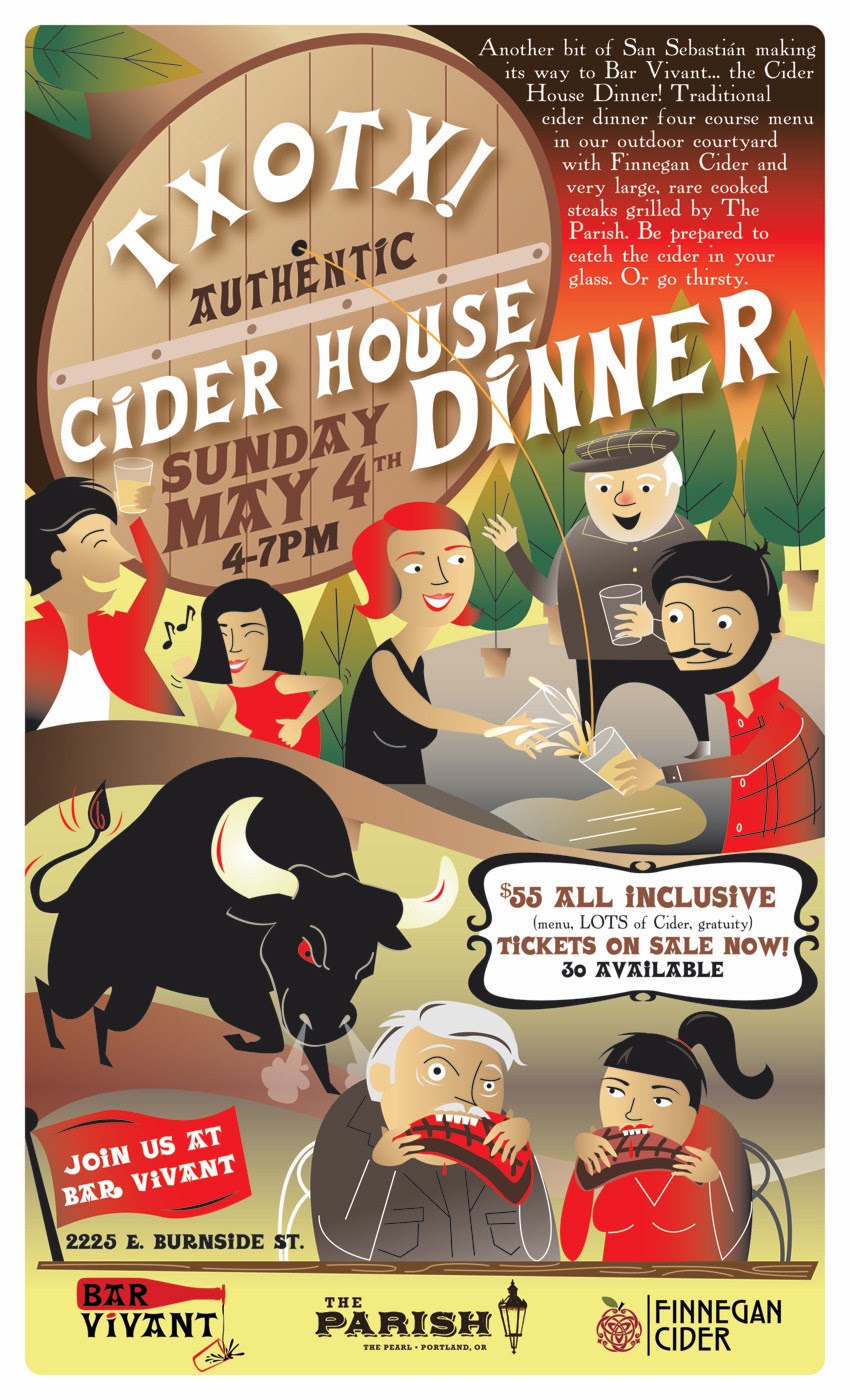
Since we're calling out cool cider events, let me offer a hearty Txotx!  A week from today, on May 4, Bar Vivant on East Burnside is hosting an authentic, honest-to-goodness txotx feast.  In the Spanish Basque country, Txotx (pronounced "choach" and rhymes with coach) is the celebratory feast that accompanies the ripening of local cider.  I had the great pleasure to visit Gipuzkoa in January and wrote about Txotx here.  For one day only, you'll get to sample the feast here in PDX:

Here's the menu, which is spot-on what you'd find in a cider house in Astigarraga. 
  • Finnegan Cider al Txotx  
  • Chorizo cooked in Finnegan Cider  
  • Salt Cod Omeletes  
  • Ribeye Bone In Steaks - served rare unless otherwise specified (grilled by The Parish)  
  • Idiazabal Cheese with Quince and Walnuts  
  • Ken’s Bread
There aren't going to be many chances to do this outside of Spain, so if you're interested, give it a look.  

Saturday, April 26, 2014

Cider Saturday: Rustic Mexican Tepache

It is one of my (now not so) secret desires to write a book about traditional beers and fruit wines.  They are cultural sturgeon--artifacts from a far, far earlier age.  Whether it's ancient African or Peruvian beer or Indian palm wine, sitting down with a glass is a ritual you can imagine ancestors doing 100 years ago.  Add tepache to the list.  Until Nat West told me about a batch he made last year, I'd never even heard of it, and am still 99% ignorant.  Fortunately, in these modern times, we have the Google.
This hard-to-find drink called tepache — pronounced "tay-PAH-chay" — is a lightly fermented cider typically made from pineapple and seasoned with spices such as allspice, cinnamon and clove. An unrefined brown sugar called piloncillo is added for sweetness and depth. It is not uncommon for oranges, apples, tamarind or other fruits to find their way into the mix.

Traditional versions found in Mexico usually demand that it be made in a seasoned wooden barrel called a tepachera, but because of the lower cost and ease, most tepache made in Chicago is fermented in glass or plastic jars. After one to five days of fermentation, tepache takes on a slightly acidic effervescence and a surprisingly pleasant funk, characteristics also found in other styles of fruit ciders. If tepache is left to ferment for much longer, a sharp vinegar flavor starts to creep in. Home-brewers often reinforce their own renditions with beer.
It is invariably described as lightly alcoholic, which given the brix of pineapple, seems odd.  (The spiky fruit contains about as much sugar as an apple and therefore, fermented, should be 6% or so.)  But there's also this fascinating fragment from the dictionary: "an intoxicating beverage made from pulque and coarse sugar with timbe used to retard fermentation."  That's inaccurate, apparently (pulque is a different ancient fermented beverage), but this thing called timbe is an interesting clue: "the bark or root of any of several Mexican trees and shrubs (esp. Acacia angustissima and Calliandra anomala) used in the manufacture of tepache."

Well, Portlanders will have a chance to look more deeply into the phenomenon on Cinco de Mayo as Nat releases this year's batch.  
Tepache is a traditional Mexican drink, frequently consumed out of a plastic baggie with a straw, sold by street vendors in Jalisco and made at home. We make our ¡Tepache! with fresh Costa Rican pineapples, pure Michoacan piloncillo (raw unrefined sugar) and a blend of three spices – No Apples! The fermentation happens on the scales and rind of the pineapples, imparting a deep and unique flavor. 
Details about the event and tickets are here, and if you see Nat, you can ask him how it's made. 

Wednesday, April 23, 2014

Evolving GABF Style Guidelines

The Brewers Association has new style guidelines out, and in a couple weeks, I will return to them for some more meaty analysis.  For the moment, have a look for yourself (.pdf).  There are some significant changes to the methodology to go along with the usual adjustments and additions. 
  • There are now more "American-style" beers listed than beers from any other national origin.
  • There are 35 subtypes listed under the catch-all "hybrid" category, more than lager subtypes (30)
  • Bamberg gets a lot of love: four subtypes reference the city.  (No other city, including Munich, is listed more than twice)
  • Countries now referenced as origin points for styles: England, Scotland, Ireland, US, Germany, France, Belgium, Poland, Netherlands, Australia, Czech Republic, Austria (sort of--Vienna lager), and Japan--plus "Baltic-style," "Australasian," "Latin American," and "indigenous."


Australasian for bee-ahr.
The last thing I'll leave you with is this statement in the preamble to the rules.  It is, more than anything else, a distillation of the American view of brewing.  I have no problem with that as far as it goes--each country has very different brewing philosophies--but because the GABF and World Beer Cup are so influential, I do despair that this view should infect the thinking beyond our shores.
Each style description is purposefully written independently of any reference to another beer style. Furthermore, as much as it is possible, beer character is not described in terms of ingredients or process. These guidelines attempt to emphasize final evaluation of the product and try not to judge or regulate the formulation or manner in which it was brewed, except in special circumstances that clearly define a style.

Go have a look and share your thoughts.

Monday, April 21, 2014

We'll Soon Be Getting Back to the Spotty Content You Prize

I see that I last posted on Wednesday, and a lame filler post at that.  Well, guess what?  More filler!  An article making the rounds today comes from the Chicago Tribune, recounting the grim beer scene in Germany.  I've been reading these articles for years, and to be fair, they reflect the mood of breweries in the grand old bierland. 
Yet for many German brewers, the good times are over.  A slump in consumption of more than a third in the last 25 years has hit Germany, Europe's biggest beer producer, triggering intense competition and price discounting.  With young Germans turning to spirits and non-alcoholic fruit drinks, beer sales fell 2 percent last year alone.  Traditional family breweries, also under pressure from double-digit rises in energy, glass and malt costs, are struggling, some dying.

"We're in an extremely tough market," Weihenstephan boss Josef Schraedler told Reuters. "You can't grow here unless you lower prices or .. develop a cult brand and charge a premium."
I'd like to add a Very Big Caveat here for all to consider: compared to what?  In the United States, where beer geeks have declared undiluted cultural victory over the vanquished mass market lagers, something like 90% of the beer is still mass market lagers.  In the US, beer consumption continues to dwindle, too, and wine and liquor consumption are on the rise.  Belgium, where local breweries are even more morose than Germans, has one of the most robust ale markets in the world--far stronger than anything in the UK or US.  (If I weren't doing a filler post here, I'd check on Ireland.)  At my last check, ales had about 11% of the market in Britain, but 30% in Belgium. 

So yes, things used to be better in these countries, and if you were watching production slip every year, you'd be anxious and morose, too.  But German and Belgium (and the Czech Republic) are the world's greatest beer success stories, where local styles have managed to weather the onslaught of mass market light lagers.  And things change.  The trend is down now, but that doesn't mean it always will be.  The craft renaissance may well come to those countries, and it may have unpredictable and yet still wonderful effects.

Just sayin.

Wednesday, April 16, 2014

More Randomness!

Two dudes wander around Newcastle drinking in various pubs.  If you miss ambling around the streets of chill cities where the rain rattles down spitefully and then ducking into warm pubs with cask ale, this will please you. 

Tuesday, April 15, 2014

Is There a High Culture of Beer?

Someone from Eugene's Bier Stein pointed me (via Twitter) to this article by Saul Austerlitz in the Times magazine.  It discusses the rise of "poptimism," the backlash among music critics against those who have long lauded mainly old, white dudes.
The reigning style of music criticism today is called “poptimism,” or “popism,” and it comes complete with a series of trap doors through which the unsuspecting skeptic may tumble. Prefer Queens of the Stone Age to Rihanna? Perhaps you are a “rockist,” still salivating over your old Led Zeppelin records and insisting that no musical performer not equipped with a serious case of self-seriousness and, probably, a guitar, bass and drums is worthy of consideration. Find Lady Gaga’s bargain basement David Bowie routine a snooze? You, my friend, are fatally out of touch with the mainstream, with the pop idols of the present.

Poptimism wants to be in touch with the taste of average music fans, to speak to the rush that comes from hearing a great single on the radio, or YouTube, and to value it no differently from a song with more “serious” artistic intent.
Okay, so far so obvious.  But then he asks--and this is where the tweet came from: "I like to entertain myself by imagining what might happen if the equivalent of poptimism were to transform those other disciplines."  He imagines the worlds of literature and film under such a backlash (which makes me wonder where he's been--this backlash is very much active in these other disciplines).  Indeed, it's a flavor of meditation that we have been happening since at least the 1960s when pop art challenged the mores of art.  (I mean, it's right there in the title.  How is "poptimism" anything remotely new?)

But now we come at last to the point of this post: in beer, what is haute?  You can't have a backlash without a lash, and I'm not sure we can make the case for one.  Certain beer styles are very popular with a niche group (barrel-aged beers, strong hoppy beers, sour beers), but there's no ruling beer orthodoxy.  The sourheads, to take one example, aren't zymurgical royalty; they are, to use the music analogy, like metalheads.  Many people want to declare a high and low among beer styles, but no one has come close to enforcing it.  Even a group like CAMRA, set up to expressly to do this, now finds itself defending beer that many craft beer fans consider old and lame.

(Parenthetical semi-digression.  The whole notion of orthodoxy probably died around the turn of the century, or perhaps a few years later when Facebook and Twitter arrived.  We're no longer really aware of worlds we choose not to inhabit.  Without a collective dataset that includes both high and low, the critical framework collapses in on itself.  I listen to certain types of music, watch certain kinds of movies, read certain kinds of books, and drink certain kinds of beers.  But only in rare cases do I actually find myself discussing these critically with anyone else; they all have their own, different groups of movies, books, and music.  Everyone sees the Avengers and we all judge it like it's sui generis, or possibly in comparison with a set of very similar movies.  No one thinks to mention Fellini.)

So unless someone can make a very effective argument that there's a high culture in beer, I don't think we're really ready for our pop art correction. 

Monday, April 14, 2014

Spring in the Gorge

On Saturday, I pried myself away from the computer to head down the gorge for the first annual Hard Pressed Cider Fest just outside Hood River.  The location was a fruit warehouse in the middle of acres and acres of rolling orchards in bloom.  I'm still in super slo-mo on blogging as I enter the final two weeks of book-writing (about cider, so I justified the trip as "research"), so you just get pictures. 

Hood-san rises above the flowery scene.


A nice western swing/country band serenaded fest-goers. (Cider is more
country than beer.)


The view from the fest.


When you get to within ten miles of Parkdale, Solera is a must.

Friday, April 11, 2014

A Quick Cheers to Old Town

A Portland landmark is celebrating 40 years.  In 1974, Richard Nixon told the country "I've never been a quitter" on national TV as he fled the White House.  As if re-balancing the scales of wholesomeness, Old Town Pizza opened that same year in Portland.  It has been through a lot in those four decades--haven't we all?--but is now a vibrant new pizzeria and brewpub.  Last week, owner Adam Milne invited me to check out their modern NE Portland outpost.  That's where they do the brewing under the oversight of one of my favorite brewers, Bolt Minister, and also where I got to meet Madi the Piemaster. 

This is a placeholder post until I can give you the full story.  Old Town is celebrating their major milestone now, so go celebrate with them.  The old site remains one of the more interesting places in the city (even without considering Nina, the resident ghost), and if you haven't been to the pub out on MLK, it's really worth a visit.  More in a few weeks' time, but for now--cheers to Old Town.

Wednesday, April 09, 2014

Beer Sherpa Recommends: Coalition Wheat the People

Photo: Samurai Artist/The New School
If I weren't being willfully perverse, I'd tell you to go to Coalition for the barrel-aged barley wine they're currently pouring.  It is a decadent treat, one that even I--a drinker suspicious of bourbon-aged beers in general and barley wines in particular--loved.  It is rich and intense but balanced (if chocolate mousse is your idea of balance), exactly the kind of beer most beer geeks seek out.  But I am willfully perverse, and this sherpa therefore eschews the obvious soaring peaks and guides you to the verdant valleys instead.  To where the wheat grows.

Coalition's Wheat the People is that lush valley.  There is absolutely nothing flashy about this beer.  It's a simple American wheat, with gentle aromatics, a soft body, and some stone-fruit esters that inflect the very light, grassy hopping.  It's the kind of beer that presents itself, wholly and fully, on the first sip and does not evolve or change with a pint, or two, or three.  If your attention wanders to conversation, when you return it to your beer, you will find all the pleasures you left there a half hour earlier.  It rewards attention but does not demand it. 

It's a timely beer because it illustrates the point about appreciating simplicity.  And, on a warm day like the ones we're enjoying now, a body pines for something less dense.  Wheat the People is perfect sunshine beer.  If you drop by the brewery, you probably ought to try the barley wine, too, but don't overlook this simple pleasure. 


_______________________
"Beer Sherpa Recommends" is an irregular feature.  In this fallen world, when the number of beers outnumber your woeful stomach capacity by several orders of magnitude, you risk exposing yourself to substandard beer.  Worse, you risk selecting substandard beer when there are tasty alternatives at hand.  In this terrible jungle of overabundance, wouldn't it be nice to have a neon sign pointing to the few beers among the crowd that really stand out?  A beer sherpa, if you will, to guide you to the beery mountaintop.  I don't profess to drink all the beers out there, but from time to time I stumble across a winner and when I do, I'll pass it along to you.

Tuesday, April 08, 2014

Outage Notice

My other project seems to be taking more of my time, energy, and attention than I anticipated.  Slow blogging ahead...


Saturday, April 05, 2014

Cider Saturday: The Climate of Cider

File this under "hmmm."  When I traveled to England, France, and Spain in January to do cider research, I was amazed at how consistent the weather was.  I'd pull up my weather app, which was set to Portland, OR, and it would say 42 degrees Fahrenheit and rainy.  Then I'd swipe over to Bristol (which is a decent midpoint between Hereford and Somerset), and it would say 42 and rainy.  Then to Lisieux and it would say ... 42 and rainy.  As I write this, it's 53 in Portland, 56 in Bristol, and 57 in Lisieux.  (All cloudy, natch.)  It got me thinking about climate and whether there was something to wet, temperate places that make for good apples. 

In the book I'm working on, I have used a narrative model to describe cider, focusing in on traditional cider makers from various places in Europe and the US.  In the charts below, you can see how they stack up in terms of temperature and rainfall.  I selected the places based on the cideries I covered in my book, throwing in Fennville, Michigan as a final entrant, even though I didn't visit Virtue Cider.  It's on the coast of Lake Michigan.  (I did speak with Greg Hall and the cidery is mentioned in the book.)  You could add a lot more lines to the chart--Oviedo, Asturias, Yakima, Virginia--but this seems to illustrate things well enough. 

Let's look first at average high temperatures, which are relevant during the growing season.  At the height of the growing season, there's a ten-degree difference between England (72) and all the US locations, which interestingly have average highs of 82.  That's the widest gap. Spring temps are warmer in Spain, but similar in the other locations. 


I was especially interested in the lows, because in traditional cider-making, the juice is fermented naturally.  Temperatures that are too low would halt that process without intervention, while high temperatures would put the ferment at risk.  (All the Europeans do natural fermentation, as do EZ Orchards in Salem, Virtue in Fennville, and although Farnum Hill pitches yeast, they don't have much temperature control.)  Michigan and New Hampshire are real outliers here, but Oregon and the European countries stay largely within a few degrees of one another. 


Finally, rainfalls are pretty similar, too, except for insanely wet San Sebastian in the Basque Country, which is a wetter city than New Orleans.  The rainfall patterns are different: Oregon's dry in the summer, Bristol in the Spring, and Lisieux in the winter.  San Sebastian is never dry, and New Hampshire and Michigan get fairly even precipitation throughout the year.


It's not easy to draw big conclusions, but I pass it along for your edification nevertheless.

Wednesday, April 02, 2014

Happy Anniversary, Guys

Thirty years ago today, brothers Kurt and Rob Widmer officially launched their eponymous brewery.  (They didn't have an actual brewery or beer yet, but they mark the anniversary to the moment they started building all that.)  Five years ago, I did a retrospective that covers the arc of their history and includes a few photos of that haute 80s fashion.  For this anniversary, they've gone back to the brewing logs and plan to release thirty beers from the archives.  The first three are their first three beers--Altbier, Weizen, and Hefeweizen.  You can see the brewery they thought they'd be when you glance at the early beers, which in addition to the first three include Festbier, Maerzen, Bockbier, Oktoberfest, and Ray's Amber Lager, Doppelbock, and Ur-Alt.  I doubt very seriously that they looked into the 21st century and saw a rotating IPA series in their future.

Raise a pint to the venerable old brewery.  (Well, venerable by American standards).  Prost!

Tuesday, April 01, 2014

Brewers Association Unveils New Definition of Craft Beer

Since its founding, the Brewers Association has maintained an occasionally-revised definition of what a craft brewery is, and they've also run a campaign targeting "crafty" beers--but this is the first time they've dared to actually define "craft beer."  Have a look.
American craft beer is disruptive, impactful, and made by the right people.
  •  Disruptive: Like all revolutionary technologies, craft beer disrupts the dominant paradigm.  Craft beer disrupts the old definitions of beer and brewing.  It disrupts a drinker's expectations.  It disrupts the marketplace with innovation and originality.  After three imperial IPAs, it even disrupts a person's ability to find his car.
  •  Impactful:  Craft beer is bold, it's unexpected, it's radical.  Drinking craft beer is like getting punched by a stevedore. 
  •  Brewed by the "right" people:  Craft beer is brewed by the guy down the block.  Or possibly contract brewed by the guy down the block.  Or possibly by 243 guys on the other side of the country.  It might be brewed in a series of large industrial breweries as well, just not breweries that are too large.  It is never brewed by large Belgian-owned brewing conglomerates, but middle-sized Belgian brewing conglomerates are a-okay.  (Middle-sized Costa Rican conglomerates are not a-okay.)  Actually, we'll tell you who the right people are.  We keep a list.

I will say this: it's honest.  I'm not sure it will be a PR coup, but you never know.  I thought that "crafty" campaign was going to backfire, too.