You love the blog, so subscribe to the Beervana Podcast on iTunes or Soundcloud today!

Showing posts with label brewing history. Show all posts

Thursday, December 01, 2016

Does Belgium Have an "Intangible Cultural Heritage" of Beer? Does Anyone?

Yesterday, news came out that UNESCO had given Belgium a singular honor:
Citing Belgian beer's integral role in social and culinary life, UNESCO is putting the country's rich brewing scene (with nearly 1,500 styles) on its list representing the Intangible Cultural Heritage of Humanity. Belgium's beer culture is one of 16 new additions that were announced Thursday.
The honor came with an accompanying video (see below), which helped flesh out the case--one that might have come straight from the Belgian tourist board. Perhaps you picked up on one tell of a certain kind of exaggeration in the quoted paragraph: "with nearly 1,500 styles of beer." That would indeed be a hell of an accomplishment!

I actually think UNESCO intuited something profound in Belgium's beer culture, but they didn't do a very good job of documenting it. Had they done so, they would have seen that a few other countries have a similar cultural status. Beer, almost uniquely among human activities, is a mirror of the culture that brews it. This was the great discovery I made researching The Beer Bible, and one I speak about whenever anyone invites me to do so. When you pick up a glass of beer from one of these countries in question (Belgium, Czech Republic, Germany, the UK), you can only understand it fully if you know the agriculture, history (including things like wars, famines, and rulers), drinking culture, laws, and ineffable qualities that seem to have no source. Of course, these manifest not just in the ingredients and final color, strength, and flavors of the beer, but the way it was made.

In the video, Senne's Yvan De Baets describes the four different types of fermentation found in Belgium, but he skips over the most interesting element--warm rooms. This is absolutely central to the production of Belgian ales of all types, and is a process used nowhere else (except the new world, where breweries make Belgian-style beers). The English practice of cask-conditioning, the Czech insistence on decoction, the German approach that is filtered through the restrictions of Reinheitsgebot--all these countries do something that looks totally bizarre when you compare it to other countries. And those practices are a kind of distilled version of the whole national tradition.

Perhaps the Belgians, living in a smaller country where cultural heritage is more evident nationwide, decided to pitch this idea first. (I have no idea what gave UNESCO the idea.) But they have no greater claim to the heritage than these other countries--though indeed they have enormous claim to it on its face. Even Julius Caesar noted that the Belgians brewed beer. (They were probably doing something offbeat even back then.) Walk into any cafe in Belgium, and it's hard not to observe something unique and pervasive happening there. So yes, Belgium deserves this. But so do at least three other countries.

Now, enjoy the film (it is pretty good).


Friday, November 11, 2016

The History of Beer is Political


When I give talks on beer, I usually pin them to national tradition. Wine, a similar fermented beverage, is a product of the grape, of agriculture. Beer is a constructed beverage, like cuisine, and is a product of culture. What is culture? I give examples: local ingredients, history, tax laws, famine, war, and those ineffable preferences that make Germans prefer schweinshaxe and the French Coq au vin.

The first Belgian brewery I ever toured was Palm (long story), and I heard a story there that was repeated in visits to breweries elsewhere in the country. The brewing equipment dated to around 1920, even in breweries that were decades or centuries older than that. The reason? During WWI, Germans harvested the metal for munitions.

Post-WWI


The Czech Republic is another fascinating case study. The breweries there are retro; they are all designed around a four-vessel decoction system, which is by law the way one must make any beer called "Czech beer." They often have antiquated equipment like grants. In neighboring Bavaria, where decoction was invented, many modern breweries have abandoned the practice and it will someday be considered a rustic, old-fashioned exception, not the rule that defines lager-brewing. The reason? The former Czechoslovakia was for much of the 20th century an occupied land, and the innovations that visited breweries elsewhere skipped Plzeň and České Budějovice.

Exactly 500 years ago, a Bavarian Duke passed a law mainly concerned with price regulation, but which included a rider designed to protect the wheat supply of local bakers. Today, in a unified Germany, that law has radically shaped the way Germans brew--affecting beer styles, ingredients, and brewery design. The British government had a similar restrictive law in the 19th century, one that changed in 1880 and allowed brewers to use sugars and unmalted grain in their beer. That eventually led breweries in Ireland to include roasted (and unmalted) barley in their grists--an ingredient now considered the most distinctive element in Irish stout.

As a onetime political blogger, I often contrast the experience to writing about beer with the axiom "politics divide; beer unites." And interpersonally, this is undoubtedly true. In front of the taps, we are all on the same team. (Yay, beer!) But politics have had an enormous effect on the way beer, this cultural fixture, develops and evolves. Rarely in the US have national politics had much to do with the world of beer. After the rise of small breweries in the 1980s, a few laws were tweaked, but most of the serious change took place (or didn't) at the state level. But that doesn't mean they can't.

The election of Donald Trump may not change things much--all we can do now is guess at what his policies will be. But the GOP is almost certain to gut environmental regulations to address climate change. This could have very serious consequences, and not least for brewers who depend on both water-intensive crops and water itself for their livelihood (and it's why so many brewers, from Hopworks to Carlsberg, are focused on the issue). His economic policies may affect people up and down the economic ladder--and the economy as a whole. Foreign policy rarely affects breweries--until, as in the case of those Belgian breweries, it does.

I won't be getting into public policy on this blog unless it directly affects the beer industry--and I hope therefore never to get into public policy on this blog. But it's worth mentioning, on a week in which it at least feels like we've had a political earthquake, that elections do matter. And they can affect things as remote and unconcerned with politics as beer. We know this because the beers we drink were in so many ways shaped by politics, near and distant. The history of beer is a political one.

Be well, you all--

Tuesday, October 11, 2016

Nothing New Under the Sun

If you've read The Beer Bible and were in a generous mood, you might have thought, "Gee, it looks like Jeff did quite a lot of research." Indeed! But one thing you won't see are the hours of research I put into postulates I could never verify. Like this, from page 333:
Breweries learned millennia ago to brew in cool weather, and the most prized ales were made just after harvest. No reference has explicitly distinguished fresh and dried hops, but it seems safe to guess that the practice dates back to the beginning of the hop era. If brewers did make their October beers with fresh hops in the distant past, the practice ended by the industrial age and wasn’t rediscovered until around 1992.
I probably spent a week on those three sentences, trying to find a source that would confirm my assumptions, but I never did. And so the week can only be inferred as I move briskly to the modern era. And now finally, thanks to Ed, we have the goods!
In the book Hops AH Burges quotes from Reynold (Reginald) Scot's A Perfite Platforme of a Hoppe Garden, (complete with olde English spelling):

"Some gather them, and brue with them being green and undryed, supposing that in drying, the vertue and state of the Hoppe decayeth and fadeth awaye..."
The book dates from 1574, and is in fact the earliest book in English written about hops, written 50 years after hops started being cultivated here.

Reg wasn't keen on the idea himself continuing:
"...wherein they are deceyved, for the verdure is woorse, the strength less, and the quantitie must be more of the greene Hoppes that are to be brued in this sort"
One thing I learned writing The Beer Bible is that humans are humans, and if we thought of doing something in the 21st century, there's an almost dead certainty someone thought of doing it in the past hundred decades or so of the hop era. Now we know, and I can breathe a sigh of relief for writing that it was "safe to guess" the practice had antecedents dating back more than 24 years.

Read the book here.

Tuesday, October 04, 2016

Recreating a Stock Pale Ale in Chicago

We have another Very Special Episode for you on the latest edition of the Beervana Podcast. And actually, I'm not just horsing around. This week we hear the story of how brewing historian Ron Pattinson worked with Mike Siegel at Goose Island to recreate a 19th century stock pale ale. (To get fully meta, here's a blog post from Ron referring to the podcast you see beneath these lines.)

Stock pales are one of the more fascinating discoveries in the Pattinson trove--one I've been interested in for years now. It was a pleasure to speak to Mike and Ron about the process, and pick up a few fascinating tidbits about brewing on the side. I know there's a fair number of you who read both Ron's and my blog, so this should be right up your alley. 


You can find the episode on all the usual channels, and a plea here from Patrick and I: send us your comments/questions/criticisms. We have yet to fully launch the mailbag feature and get that conversation going we'd so love to have. So please holler: the_beerax(at)yahoo.com. Also, please consider rating us on iTunes, which will help boost our standing in the charts and get the pod out to more beer-lovin' folks.

Wednesday, August 17, 2016

Amazing Predictions

Maine writer Josh Christie was perusing some old archives today and tweeted out two fascinating articles that illustrate why we should regard current doomy proclamations with some skepticism. They date to the 90s, and were written in a now-defunct weekly. Article one (1994) poses the compelling question: with four Portland (ME) breweries, can the city absorb yet a new one opening up?
"That's a lot of new brewing capacity, considering local beers still account for only 1.5 percent of beer sales in Maine. And if the growth curve starts to level off, LaCharite and his competitors could end up fighting each other to survive."


 Five breweries??? Mon dieu!--it's a bubble!

In article two (1998), the thesis is that craft beer microbrewing has become too boring. This isn't exactly the same as the complaints we hear today--though IPA weariness is similar--but it illustrates that complaining about what looks like a stable situation in beer is pretty foolish. Don't like things now? Give it five minutes.
"Most of the supermarket survivors fall into the traditional categories of the tried and true: pale ales, wheat beers, lagers. There's nothing intrinsically wrong with that. Many of these brews taste just fine. Some of them are personal favorites. But after more than a decade of innovative brewing, the spirit of imagination seems to have seeped out of the bottles. There are too many beers with taste profiles that are all too familiar. Even worse, there are too many beers with too little taste. Just as it's tough to tell Bud from Miller from Coors, it's slowly becoming more difficult to distinguish among the micros."


I can only imagine what a boring landscape awaits this city two decades hence, after the imminent demise of microbrewing.

Thursday, August 11, 2016

The Awkwardness of Middle-Aged Breweries

As a gentleman now past any reasonable definition of "young," I am sensitive to ageist derision. Nevertheless, it must be admitted that once you've been around awhile, you do get stuck in your ways. You can start to look a bit fusty. And so it is with breweries. The ultimate reward for building a successful brand that stretches out across some or all of our broad country isn't public admiration for your portfolio of stable, popular brands. No, it's yawns. In the craft beer biz, the question is always, "what have you done lately?"

This became a topic of discussion on Facebook and Twitter earlier in the week following my post about Sam Adams. To the thesis "the flagship brand needs to be refreshed," I don't think I heard a single voice say, "no way--it's a perfectly current classic!"  And this is just the problem. The successful old-school breweries (let's say pre-1990) all became successful because they built up a popular brand. Sam Adams had Boston Lager, Sierra Nevada had Pale, Widmer had Hefeweizen, and so on. It's very hard to keep a beer exciting for 30+ years. The best breweries can do is try to transition these older brands into a "classic" slot and hope to keep the brand of the brewery alive and vital.

One of the reasons I declared Boston Beer doomed was because as a brewery it does not seem vital. The brewery does have a barrel program, but it's pretty anemic. They still roll out the Utopias from time to time, but it's been a long time since beer geeks swooned over anything but its price. The recent nitro line was curious at best--a fifty-year-old package dispense system is not exactly the cutting edge. Meanwhile, one of the main trends in craft beer right now is lagers, a concept Boston Beer should absolutely own, but they seem to be missing the boat.

Contrast that with Sierra Nevada, which is one of the most active and interesting breweries in the country right now. Their core lineup is as always anchored by Pale Ale, but they've added a great pilsner (not missing the current trends), a gose, and two IPAs, Hop Hunter and Torpedo, which use innovative new techniques to produce vivid hop flavor. (Sam Adams' Rebel series of IPAs seem, by contrast, pro forma at best). They have managed to serve both their tradition--they exalt in it, in fact--as well as trying to remain current with the styles and techniques that are driving new sales.

And that's without mentioning the incredibly successful Beer Camp project, which makes this venerable grandfather of craft beer look anything but stodgy. It not only integrates them into this vital world of brewing they've honestly sort of outgrown, but allows them to both be a leader and a participant in building the notion of "craft" (which, admittedly, is a lot more spin than reality these days).

It's a difficult trick to pull off. Most of the middle-aged breweries have had their share of failures and miscues. You don't want to end up looking like the dad who's dropping middle-school slang into conversation, but you also don't want to just slowly go to seed. And so far, we really only knows what this looks like for breweries in the middle-thirties. Imagine what they'll look like when they're truly middle aged (like me).

As a final, related thought, it seems like that in one of these decades pretty soon we're going to see the failure of some large craft breweries. Maybe they won't outright vanish, but like regional breweries following Prohibition through the 1970s, they might get absorbed into a giant corporate entity, become mere SKUs in a company's bottom line, and eventually mostly fade out. When I came of drinking age in Oregon, we had brands like Lucky Lager and Heidelberg that soon vanished. Could Bell's or Rogue go the way they did? Eventually, some will.

Anyway, this rumination has been brought to you by Metamucil and old farts everywhere....

Friday, May 13, 2016

Widmer Brothers Hefe at 30: A Reconsideration

This is the first part of a pair of posts on the legacy of Widmer Brothers Hefe. For the sibling post, an oral history of the beer, go here

_____________


The City of Portland officially declared May 15 "Hefe Day."


On Sunday, the Widmer Brothers are throwing a party at Pioneer Courthouse Square to celebrate the 30th Anniversary of their flagship, the venerable Hefeweizen. It is almost impossible to overstate the significance of this beer in the history of its hometown. In the early days of craft brewing, breweries had a hard time convincing beer drinkers to switch over to the heavier, more full-flavored ales they were selling ... until Hefeweizen came along.

It became the city's first breakthrough beer, and in the late 1980s, everyone in the city wanted to hold a tall, curved weizen glass of the cloudy orange liquid, garnished ostentatiously with a lemon slice. In most cities, it took years--often decades--to reach that tipping point where craft beer was an accepted, popular drink. Thanks to Hefeweizen, Portland made the transition by the time Nirvana was first playing Satyricon downtown.

That MTV-era success launched both Widmer Brothers and their strangely-named beer, and both became giants in craft brewing. But it also dated them as surely as shoulder-padded power suits and synthy new wave music. As with any multi-generational phenomenon, Hefeweizen now carries with it the weight of all those impressions that have accumulated over the decades. It's interesting to speak to people who encountered this beer at different times; those who know it from the 80s have entirely different impressions than those who came across it later (see here for more). Those impressions seem to contain as much of the mood of the industry at the time as they do of the beer itself, for good and sometimes ill.

I began my own reconsideration of this beer within the last decade, and particularly when I had to write about it in the Beer Bible. When Kurt and Rob decided to call it a "hefeweizen," they plunged us into a netherworld of stylistic confusion, a legacy with which we're still contending. But, leaving aside the name, the beer turns out to be more interesting, unusual, and influential than we give it credit for--especially us old timers--and it's actually better positioned now than it has been in decades. If you strip away all that history, it looks surprisingly contemporary. And for the first time, it may also be poised to exchange its status of "old" to that rare category of "classic."

"American" Bones
For the past few months, we've been enduring a weird little boomlet in very cloudy IPAs that supposedly come from New England. Oh really? Cloudy beers have been pretty popular here in Oregon since 1986, when Widmer Brothers first launched Hefeweizen. In fact, if you look at the bones of Hefeweizen, it has all the hallmarks of what we have come to think of as the classic American style.
  • Cloudiness and rusticity. In 1986, that cloudiness was the most potent rebuke to industrial lagers Portlanders had ever seen. It said, without words or PR gloss, 'this is not your father's Lucky Lager.' That visual cue has been a part of Oregon brewing ever since, though the valence has changed as hops have come into the picture. Haziness is now associated with the addition of bales of hops, and when an IPA is absent at least a shimmer of haze, many drinkers regard it with skepticism. As craft beer gets ever larger and more industrial, that haze becomes a more potent proxy for artisanal. This is all something Rob and Kurt learned in 1986.
  • Late hop flavors. American wheat beers have become their own thing. Made with neutral yeast, they accentuate the soft breadiness of the grain and are brewed to be drunk in twos and threes. This style really flourished in the Midwest, where beers like Bell's Oberon and Three Floyds Gumballhead have become perennial favorites. Hefeweizen is not actually a member of this group. It's really a pale ale, featuring a lovely layer of citrusy American hop flavor. The Widmers were certainly not the first to feature the bright notes of Cascade hops, but they understood how well it worked with a beer highlighting a citrus smack. 
  •  Sessionability. The life-cycle of craft beer has come back to where it started. Beer was a sessionable drink, and people rarely sat down to drink just one. As craft beer evolved, beers got ever more intense, pulling the focus away from sessionability. Ultimately, drinkers started coming back around to sessionable beers that were full-flavored but not so intense they resisted having a pint or three. Hefeweizen, which combines light hoppiness with a layer of soft malts, is a perfect session beer, and has the complexity even beer geeks admire.
If you look at where American beer is right now, Hefeweizen looks remarkably contemporary. It even predicted the move to fruit. That slice of lemon, once derided by purists as a gimmick, doesn't look at all out of place in a world where grapefruit IPAs are the hottest trend. Go pour out a Hefeweizen and then grab another old-time craft standard--a Dogfish Head 60 Minute IPA, for example--and pour that out for comparison. Which one seems more in keeping with the mood of 2016? Not that strange, heavy, bitter old IPA, that's for sure.

Sustained Success
It's also worth noting how few beers introduced in the 80s are still on the market. Beer is a commercial product, and breweries can't afford to keep any brand alive for nostalgic reasons. In the thirty years since Widmer Brothers released Hefe, they've introduced scores of beers to the market. They would happily be brewing, say, Drifter Pale Ale now if it were still selling well. But breweries can only afford to sell what people are buying When I spoke to Rob Widmer earlier this week, he mentioned how this phenomenon affected Hefe's predecessor, Weizenbier. It was actually just a filtered version of Hefeweizen, but it couldn't compete with its unexpectedly alluringly cloudy incarnation:
“Backing up even further, there were very few people who appreciated Altbier. We were kind of circling the drain—there wasn’t really any velocity there at all. We introduced the Weizenbier because we realized people wanted something that was a little more approachable. So Weizen really saved us. Originally we hoped to have Altbier, Weizenbier, and Hefe on tap. What we found was that Weizen drinkers, once they discovered Hefe, they just stopped. Over the course of the rest of ’86, we just slowly wound down Weizen. It was bittersweet; we hated to see that Weizenbier go.”

Over the course of thirty years, the craft beer segment has changed radically--and gone through several stages along the way. Each one of those shifts in preferences killed off a certain number of formerly-popular beers. But ever since its introduction, Hefeweizen has been far and away the most popular Widmer Brothers beer, even as other brands in the portfolio came and went. Over the thirty years since its introduction, they've brewed millions of barrels of the stuff. There's never been a time when it didn't account for the lion's share of the brewery's production and sales.

Sometimes craft beer fans are wary of the old. When he was master brewer at BridgePort, Karl Ockert called this the "novelty curve"--that period when a new beer sells well simply because its new. Other industry watchers call it "drinker promiscuity." Popularity is a double-edged sword, though. Everyone's trying to capture that lightning, but holding on to it--that's the trick. One of the reasons Hefeweizen has had this sustained success, year after year, era after era, is because it has a classic timelessness that people respond to.

I will confess that in the 1980s and '90s, I was not much a Hefeweizen fan. It had a status in that era of an entry-level beer. In the '80s, it also had an association with yuppies that warded me off. (For youngsters, yuppies, though very different in class and status, were sort of the hipsters of their day: a lot more people were called yuppies than claimed to be one.) It wasn't until sometime in the 2000s that I rediscovered Hefeweizen, and I was startled by what I found. My own palate had gone through that shift toward balance and subtle complexity, and I discovered what a triumph Hefeweizen was. In the years since, I will occasionally find myself in a place with a mediocre tap list that includes Hefe. I smile as I order it, knowing I've discovered this wonderful gem hiding there among the Stellas and Blue Moons.

After years of seeming like they were vaguely embarrassed by Hefeweizen, the Widmer Brothers have started to give full-throated support to their flagship again. Sales are up. They've even begun extending the brand a bit with beers like Hefe Shandy. (I'd love to see a cloudy, wheaty, late-hop IPA next; it would bear all the fingerprints of its ancestor and be on the cutting edge of the new trend.) My sense is that even beer geeks have come back around to it.

If you survive long enough, you're no longer old. You're classic. Maybe Widmer Hefeweizen has, after thirty years, finally gotten there.

Tuesday, February 02, 2016

Why the Beer Matters

Yesterday, I discussed the beer Cartwright Brewing made when it launched an early microbrewery in Portland in 1980. It was definitely the most interesting part of the papers posted by The Oregon Hops and Brewing Archive. But there is an element that's almost as interesting. Chuck Coury, Cartwright's founder, came to the project from wine-making. He'd already seen the change that had taken place in wine, and he gave an incredibly prescient overview of where beer was heading. (Although a small handful of American microbreweries had opened within the year or two before Coury started thinking about opening his own, they were far too new and tiny to suggest that any of his predictions were imminent.)

In the review he made of his own project at the time, here's what he observed about the coming beer market:
  • "There is a market for quality domestic beer. Note the rise in import sales. Compare to the explosion in fine wines. Prohibition theory: America's beer palate is only now recovering."
  • "Not everyone will enjoy your beer. That is good."
  • Things to stress about your brewery: "Local, small-scale production. Traditional/European quality. Re: chill haze and sediment; stress positively as 'real beer.'"
Kurt Widmer at the recent
release of Hopside down.
This is exactly what happened. It's remarkable that he had this insight into the market, because it took the rest of the country more than a decade to catch up with him. For basically all of the 1980s, it was touch and go in terms of whether what he wrote above would actually come to pass. Karl Ockert once told me that when the Ponzis were looking for bank funding to open BridgePort a few years later, the banker said (paraphrasing), "Nobody opens breweries; they just shut them down." But here we are, a generation later, and it turns out there is a market for domestic beer. Not everyone like every brand, and that is good--it means we have a very rich and diverse market. He even correctly identified that elements of craft beer that would be anathema to a large industrial brewery like haze could become a marker for hand-made authenticity.

Which raises the question: why did Cartwright fail?

Part of it was that the market Coury envisioned wouldn't emerge for years. Sometimes visionaries suffer a first-mover disadvantage (you could say Cartwright was the MySpace of beer). But a far bigger reason was the beer. It just wasn't good. There are still lots of people around who remember it, and that's the overwhelming memory; even on Facebook people were recalling the beer with amusement as a crapshoot. Apparently there were a few good batches, but they seem to have been the minority.

When you look at the breweries that survived the 1980s, nearly all of them did so by making very good beer. But it's also true now. A glance at the largest breweries in the roughly "craft" camp (Boston Beer, Sierra Nevada, New Belgium, Craft Brewers Alliance, Lagunitas, Deschutes, Bell's) confirms that quality really helps a brewery. It's not the only thing that matters. Good branding, smart distribution, fortunate brand performance, good location--all these things can really help. Good beer alone is not sufficient to become a big brewery, either; there are thousands of small breweries worldwide, from Block 15 and Breakside to Dupont and Schlenkerla, that make world-class beer. Some breweries making great beer even fail for reasons unrelated to the beer.

But an iron rule is that without quality beer, it's very, very hard to build a successful brewery if you're competing in the "quality" category. (I'd say impossible, but wise hive mind is going to point out a case where it's happened.) Coury understood where the market was headed. Unfortunately, he charged into it with bad beer and that insight didn't do him any good.

Monday, February 01, 2016

Cartwright Brewing's Weird Steam(?) Beer

In June 1979, Fred Eckhardt reported two items in Amateur Brewer:
"PORTLAND, OR -- The Pabst Brewing Company of Milwaukee announced that it was acquiring the Blitz-Weinhard Company..."
and
"PORTLAND, OR -- The country's [missing word] (very) small brewery will produce its first brew in June, according to brewmaster Charles Coury, of Oregon's new Cartwright Brewing Company...."
Both of these things probably made very little impression on people at the time, but they augured big things to come. Henry's would be shuttered 20 years later, after it was clear Oregon had become a "craft beer" state. And although Cartwright brewing vanished after a couple years, Coury's quixotic venture would inspire others to consider the possibility of brewing their own beer. I recall Rob Widmer telling me once that he and Kurt saw the brewery and later agreed, "we could do that."

Charles Coury.
Source: Fred Eckhardt


But peering through the looking-glass from this side of history distorts things. While the scale of Cartwright must have seemed comprehensible, the actual act of brewing turned out to be a bigger trick. I have long heard about Cartwright's troubles, but the Oregon Hops and Brewing Archive posted a remarkable document that explains the nature of Coury's challenges. It was an assessment of the brewery by Coury himself. The whole thing is worth a read, but I want to focus on the beer itself. The business stuff is interesting, but a look at the beer Coury designed in late 1979 or 1980 tells us a lot about the state of beer then. Here's the recipe:
"The basic formula: 93% pale malt, 7% caramel malt, about 1 pound of hops per barrel (2/3 boiling--Cluster, 1/3 finishing--Cascade), typically a bottom yeast is used."
That's an odd recipe (more in a moment), but it's nothing compared to the process.
  •  He started out with a 3.5 hour mash in apparently three steps ("rests for protein reduction, saccharification, dextrine production")
  • "Lautering takes 3-4 hours" (!)
  • "The wort is boiled for 2 hours 15 minutes."
  • "It is cooled overnight by recirculating cold water in the kettle's steam jacket."
  • "The cool wort is racked and pitched the following morning."
  • The final beer was bottle-conditioned and spent a month carbonating.

It's a funny, almost frontier beer. I wonder if Coury consulted Fritz Maytag, because the recipe looks quite a bit like Anchor Steam. There's no evidence he had any lagering equipment, so it seems like he was fermenting lager yeast warm, like Steam. The hops are different (Anchor uses Northern Brewer), but with the Cluster they would definitely have an old-time American authenticity. It took the poor man over nine hours to brew one batch of beer--and that doesn't include the time spent milling grain, which he called "a tedious and difficult task." And then there's the business of leaving it to cool overnight. One of the most common descriptions of people who tried this beer was "infected," and I have an idea that nice 8-hour cooling period before pitching didn't help. This formulation and process reads a lot more like a 19th century brewery than one from the 21st century.

Cartwright Brewing. Source: Fred Eckhardt


(Other amusing tidbit. He listed "problems with the process," and included this one: "Clean-up after brewing. Shoveling the spent grains and scrubbing the equipment takes a good part of the day." You don't say? Oddly enough, the first two modern Oregon breweries were founded by winemakers. Reading between the lines, it seems like Coury hadn't bargained for how much different, and more laborious, brewing would be than wine-making.)

There's a sheet of paper among the documents from Fred Eckhardt, who was apparently taking notes on the beers Cartwright made. He describes two beers, "Original" and "New." The stats on Cartwright's original beer are these. It was brewed to just 11.2 P (1.045) and finished out at 3 P (1.012)--which would have made it a 4.4% beer--and had just 18 IBUs. The "new" beer was 12.3 P (1.049) and finished drier, 2.4 P (1.009)--a 5.4% beer. It had 40 IBUs (of rugged Clusters, no less), which even today would seem plenty bitey. I have no idea if the second beer was ever made.

Coury thought his product was quite distinctive. He compared it to "traditional/European quality" beer and thought the bottle conditioning could be spun as a positive--though he seems to have fretted it would seem strange to consumers. What's interesting is that the beer is so similar to commercial beer at the time--it's just a half step in a different direction. It's a 4.4% copper-colored steam beer with 18 IBUs. The color and fuller flavor would have been unusual, but hardly unrecognizable, to consumers in 1980.

Source: Fred Eckhardt


The Archive includes a contemporaneous article from the Eugene Register-Guard that offers a bit more insight into the beer. "[Coury] says he found century-old beer beer-making recipes in 'beautiful, old brewing textbooks' in the stacks of the Multnomah County Library in Portland." Coury also gives a specific nod to Anchor Steam. It seems history, tradition, and a desire not to get too far outside the mainstream guided the development of the beer.

Two other random facts going out. Cartwright was selling the beer for $.90-$.95 a bottle, which is $2.59 to $2.73 in today's dollars--a fairly steep price. And according to the newspaper article, he was also planning on brewing a stout. Wonder if he ever made it that far?

Wednesday, January 27, 2016

From Cartwright to Session IPA in 272 Words

I'm a bit short for blogging time this week, though there is a remarkable post over at Oregon Hops and Brewing Archive that will feature prominently in (hopefully very near) future posts. A trove of documents reveals what the state of brewing was like in the late Carter administration as Chuck Coury struggled to make one of America's first microbreweries a viable enterprise.

Original Cartwright site.
source
I don't want to step on that blogging too much, but suffice it to say that what brewers and drinkers understood then--a long time by one measure, but well within living memory--was shockingly primitive. That article contrasts nicely with a piece that provoked a lot of debate on the nature of Session IPAs. In that post, Londoner Mark Dredge argues that there's nothing sessionable about this style. Unsurprisingly, his British commenters all offer their hear-hears (as did Alan, in a thread that sadly took place on Facebook). I'll leave aside for a moment my strong dissent of Mark's point--"sessionable" may be a British word, but which flavors Americans choose for their sessions is not under British oversight*--but what's striking is the distance between Cartwright and Session IPA.

We've gone from a time when Americans neither knew how to brew beer nor what most beer tasted like to a time where we argue about "sessionability" and "session IPAs"--two concepts that would have been abstruse to the point of gibberish just 36 years ago. I have a decent shot at being alive in another 36 years, and it's hard to even imagine what world we might inhabit then.

____________________
*Okay, I didn't entirely leave it aside.

Tuesday, October 20, 2015

Scenes of Mergers Past

I'm about to be booted from my Chicago hotel room, so I don't have time to explore this theme in detail, but I wanted to put a bookmark on something. Yesterday I spent a couple hours walking around (and photographing--more on that later, too) the derelict Pabst Brewery in Milwaukee. I keep hearing about how it's been redeveloped or under redevelopment, but basically the giant buildings--blocks and blocks of them--are gutted and idle, like a quickly-abandoned Soviet city. And it was quickly abandoned, 20 years ago, when the owners shifted production to a different facility, turning Pabst into a contract brew.

Each time I speak on my book tour, someone asks the same question: what's going to happen with the future of beer, with consolidation and so on? Wandering around that complex is a nice meditation on at least one potential future--and a likely one, at least for many of these quickly-growing young breweries. Capitalism is a violent and sometimes jarring force, and as quickly as it graces a business with the generative force to rise from the pavement, it can strike it right back down. The excitement and energy we are witnessing in brewing now is no different than the one that visited the US 150 years ago, and thinking it is a permanent, stable state is belied by the lessons of history. Anyway more on that soon. Meanwhile a couple of pictures to tide you over.


Thursday, March 05, 2015

What Can We Learn From 170-Year-Old Beer?

I got an email yesterday alerting me to this technical paper of analyses done on 19th century beer recovered from a shipwreck. Interestingly, they have no idea what the provenance of the ship was--nor, therefore, any idea where the beers came from.  But when they cracked two of the bottles open, this is what they found.
Bubbles of gas, presumably CO2, formed during sampling, producing a light foam. Both beers were bright golden yellow, with little haze. Both beers smelt of autolyzed yeast, dimethyl sulfide, Bakelite, burnt rubber, over-ripe cheese, and goat, with phenolic and sulfury notes. As the samples warmed to room temperature, the smell of hydrogen sulfide disappeared and that of butyric acid (particularly strong in C49) strengthened.
Hmm, those don't sound like particularly inviting qualities.  Some of this was the result of time (autolyzed yeast, goat and cheese), but I've never heard of DMS or butyric acid developing in aged beer.  Sounds to me like bad beer to begin with. 

I was instantly drawn to the study, but then wondered: is it really of much use? There is a trove of chemical analysis here for the nerd--esters, phenols, carbonyl compounds, hop levels and compounds, and so on.   But what does this really tell us?  The authors give incredibly detailed analysis, but the sum seems far less than the parts:
In summary, these two about 170-year-old bottles contained two different beers, one (C49) more strongly hopped than the other (A56) with the low α-acid yielding hop varieties common in the 19th century. Both beers exhibited typical profiles of yeast-derived flavor compounds and of phenolics. Present knowledge of the long-term chemical and microbiological stability of these compounds is not adequate to assess how closely the observed profiles indicate the original flavor of the beers. The flavors of these compounds were hidden by very high levels of organic acids, probably produced by bacterial spoilage. The composition of the microbial mixture used to produce these beers is unclear, but it probably did not include many strains producing the Pad1 enzyme responsible for the volatile phenols characteristic of wheat beers. Pad1 activity is common in wild yeast, and its absence suggests that the yeasts employed were domesticated rather than wild.
These kinds of analyses will probably add some knowledge in the margins.  As far as I can tell, there hasn't been a ton of study on the aging process in beers past a certain point.  (Those who pay for these studies--beer companies--have wanted to know what changes happen in the normal lifetime of a beer, not what changes happen years or decades later.)  So what we know by taking a snapshot like this comes with a pretty serious cloud of mystery.  Personally, I think there's quite a bit of evidence from the primary sources historians have lately been studying--evidence that is more relevant to the layman's understanding of beer evolution. 

Monday, October 27, 2014

What Did "Sweet" and "Sour" Mean in the Old Texts?

Lars Garshol has an interesting post on a question that has bothered me for the last four years: how sour were pre-20th century beers?  His post is well worth a read because he tackles it from a few angles.  The portion I'm interested in, though, is the survey of historical materials, which often indicate that 16th-19th century beers were not soured.  For example, Lars cites a typical 16th century Swedish account by Olaus Magnus, an archbishop:
He describes both sweet and sour wines, but of beer he says that people brew it sweet or bitter according to preference. He says winter water is the best, as it never makes the beer go sour. Today we can see what was really going on, but he was right that beer was less likely to go sour in winter, due to lower temperatures. He says winter water is used in the brewing of Danzig beer, "the noblest and healthiest beer". It's clear from the text that to Olaus Magnus, beer is a sweet or bitter drink, and mainly sour by accident.
So here's the thing: I don't trust Magnus.  The problem is that language is not precise, especially in describing flavor, which is by necessity always relative.  We don't have precise language for flavors, except to compare them to other things.  Flavor descriptions build on shared understandings of the way known things taste, and we use those understandings when we describe related flavors.  When we say hops taste "like citrus," we mean to say that relative to other hoppy flavors, they have a few molecules that remind us of orange.  Originally, though, hops like Cascade were so exotic and bizarre when compared to European hops that they weren't always described as citrusy.  People were using a different baseline for hop flavor in the 1970s.

Similarly, if the accepted baseline for beer was always a bit tart (by modern standards), then all the terms writers used would be relative to that reality. We have zero-level thresholds for "sour" because we can control microbiological activity. Did 19th century writers share that threshold? My strong suspicion is no; therefore, beer that was "sour" was relatively sour--that is, sourer than the baseline.  Let me draw your attention to the 19th century writer Georges Lacambre and his famous Traité Complet de la Fabrication des Bières.  He illustrates the point.

In the section on the old style of beer called uytzet,  He quotes the work of another writer who had written about chemical analyses done on uytzet.  That writer, Wauters, described double uytzet as "the most delicate and sweetest of all known beers."  What did he mean by "sweet?"  Fortunately, we have the actual analysis as well, which measured things like "resinous grain," "dry mucilage," and "vinegar" (acetic acid).  In 48 ounces of beer measured, 3 ounces of which were acetic acid.  (The 48-ounce figure come from a conversion Randy Mosher did, which is sadly no longer online.)  Lacambre comments: "However, we agree that Mr. Wauters must be accustomed to such a beer to find it so good, as it contains so much vinegar and so little alcohol."  Even then, language was imprecise enough that writers didn't agree on meaning.  You see this throughout Lacambre's book, where he dutifully explains what locals think of their beers, then savages them with his own less-admiring descriptions. 

When I read sources like Lacambre, I read "sweet" as "not yet very sour," or "young."   It's not the modern definition of sweet, which means "not hoppy."  When writers of this era--and earlier writers, like Magnus--mention "sour," I think they mean what we would call spoiled. It's why they talk about winter and summer brewing--when we know very well thanks to lambic-brewing that winter beers can get very sour indeed without spoiling. 

As a final data point, it's useful to turn to Louis Pasteur himself.  In his seminal work on yeast, Etudes sur la Bière (translated into the English as Studies on Fermentation), he recommended the lager-brewing practice, because ale-brewing so often resulted in soured beer.  “How is it that the use of ice and yeast operating at a low temperature [in lager brewing] so greatly facilitates the preservation of our beer and enables us to secure such striking advantages?  The explanation is simple: the diseased ferments, which we have pointed out, rarely appear at a lower temperature than 10° C. (50° F.), and at that temperature their germs cease to be active.”  This further suggests to me that the ales must have been either sour or had such a short window before they got sour that he discouraged their manufacture.  And indeed, his research was one of the reasons lager-brewing (along with technological advancements) took off at such a rapid clip.

Without being able to taste these old beers ourselves, we can't know the microbiology of pre-20th century beers based on the descriptions of contemporary writers from earlier periods.  But I would encourage readers to exercise a healthy skepticism.  Our assumptions about the way beer tastes is very unlikely to reflect their assumptions--and subsequent descriptions are going to confuse modern minds. 

Monday, August 25, 2014

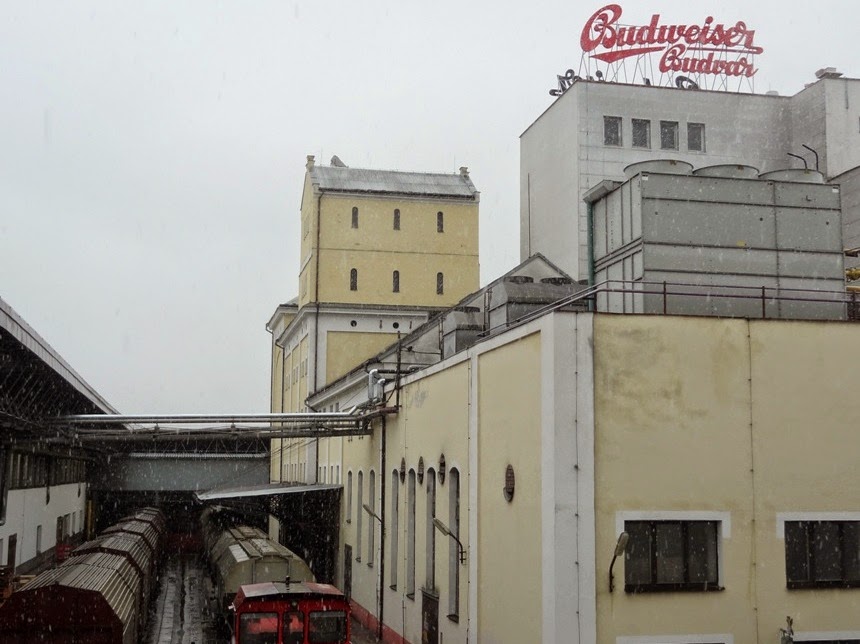
The Budweiser Ironies

A couple weeks ago, Pete Brown posted a wonderfully nuanced piece about Budweiser--both of them--in London Loves Business.  He argued that the two Buds were about as well-made as any on the planet and that, while you may not enjoy the American Bud, you could not doubt its quality.  He's correct. As sensory experiences go, American Budweiser is not a particularly thrilling ride.  (When I visited the St. Louis plant, brewmaster Jim Bicklein took me to the cellars, where we had a zwickel from the huge conditioning tanks.  On every previous occasion when I've been offered a tank-fresh pour, I have found depths and delights in a beer I missed in the store-bought incarnation.  I held my breath and sipped the cool, sparkling lager through a skiff of snowy head and ... it was just Bud.  Very, very fresh Bud.)  But the brewing process is exacting and there are no shortcuts.  It is intentionally unthrilling.  (And millions of drinkers like it that way.)

But what really caught my eye was this paragraph:
One of the most famous battles in Beerworld is the epic David and Goliath tussle between the world’s biggest brewer – Anheuser-Busch Inbev – and the small, state-owned Czech brewer Budweiser Budvar. In 1876 Adolphus Busch stole the name Budweiser from the town of Ceske Budejovice – or ‘Budweis’ in German – and over the ensuing decades agreements were reached about who had the rights to the name in various parts of the world. When the Czech Republic disappeared behind the Iron Curtain after the Second World War the American brewer tore up the arrangements it had agreed to and made American Budweiser the world’s biggest beer brand. 
There are a few stories about the Budweisers, and this is the one only a fraction of beer drinkers know.  It is not the one they tell in St. Louis.  However, even this version isn't exactly right.  The real story is much more interesting and filled with irony.

Jim Bicklein at the brewery in St. Louis
The town of České Budějovice [pronounced, roughly, ches kay bud ye-oh vit sa] is located in the south of Bohemia.  Bohemia being located in the Czech Republic, you will not be surprised to learn that the people there speak Czech.  But this also the crossroads of some very important empires, and in centuries gone past, the region was controlled by a German-speaking population, who called it Budweis. Beer brewed there, as it has been since the 13th century, was therefore either Budějovický or Budweiser—literally, beer of the town of Budějovice or Budweis.  Fast forward to the period following the success of Josef Groll’s 1842 pale lager in Pilsen.  Other Czech breweries began making pale lagers, too.  The Civic Brewery in the town then called Budweis was one of them.  A supplier to the court of King Wilhelm II, the lager earned the nickname “the beer of kings.”  Ring a bell?      

By the 1860s an enterprising American brewery, enchanted by the idea of Bohemian beer, decided Budweis’s were the best.  It was no easy task to make those kinds of beers in the United States, but Adolphus Busch of the Anheuser Brewery had managed to do it and in 1876 debuted his own Budweiser beer.  Busch was selling beer for twenty years under the Budweiser name before a new brewery opened back in Budweis as a rival to the older, German-owned company.  This new brewery, the Joint Stock Brewery, was one of a wave of new Czech-owned businesses to spring up as a part of the Czech National Movement of the late 19th century.  Eventually that brewery became known as Budějovický Budvar.    

The fascinating part of the history is that the claims and counter-claims the two companies hurl at each other are generally founded in fact.  As it happens, Adolphus Busch did find inspiration for his beers from Budweis and did spirit away both the type of beer and the name.  But it’s also true that he brewed his beer before Budweiser Budvar even existed.  He did also apparently appropriate “the beer of kings” and turn it into “the king of beers”—one of the most valuable corporate slogans in the world.  (Budvar disputes the history of “beer of kings.”)  But the brewery that inspired Busch is no longer in existence.  And in the most wry of ironies, neither company has a clear historical claim to the name Budweiser: Busch obviously borrowed and rebranded it with absolutely no connection to the town or people; on the other hand, except as a valuable trademark, why would the people of České Budějovice want the name?  Budvar remains state-owned and is an artifact of the Czech National Movement.  “Budweis” was the name the city has abandoned.      

Pete points out that the dispute hasn't exactly been terrible for Budvar.  Picking a fight with the world's most famous and popular brands has its upside.  But the real story is actually more interesting, and the clean lines of the narrative a bit more smudged. 

Friday, November 08, 2013

Hair of the Dog's Place in History

Alan Sprints (L) with Bill Night and John Foyston at FredFest
Nearly every year now there's an important anniversary.  Deschutes is concluding their 25th and BridgePort is gearing up for their 30th, with Widmer Brothers to follow.  These are all great opportunities to think about a brewery's past, and I enjoy seeing old photos of young and rakish mustachioed brewers standing around old warehouses full of salvaged dairy equipment.  This Saturday Alan Sprints will host a bash at his newish digs in the Fruit District to celebrate the 20th anniversary of Hair of the Dog.  But in this case, we may think less about the brewery's own history than its place in history.  In many ways, Hair of the Dog was the first modern brewery, a 2013 brewery back in 1993 and an emanation of the future to come.

You have to shake yourself out of your 2013 mindset and go back to a different time.  Kurt Cobain had less than six months left to live; Bill Clinton was in the first year of his presidency and none of us knew the name Monica Lewinsky.  Frazier was just debuting on TV and Sleepless in Seattle was a big hit on the big screen (Seattle was having its Portlandia moment).  In the beer world, things were very different.  Although craft brewing already had 15 years under its belt, the beer landscape was still in its beta stage, one it would soon leave permanently behind.  In the mid-1990s, there were almost no IPAs on the market (even as late as 1997, only about 4% of the beers were IPAs).  If you pull out old guidebooks to the craft breweries of the day, the overwhelming majority had the same slate of English-derived styles--pale, amber/red, porter, stout--plus a few wheats and goldens for good measure.  (On the East Coast, a few breweries specialized in lagers, but these were the anomalies.) There wasn't a lot of diversity yet, and an extreme beer was a 7% winter warmer.

Alan Sprints and his then-partner Doug Henderson opened the doors to what was then an unprecedented business model based on obscure, strong styles of beer.  They began with Adam, inspired by a long-extinct style from Dortmund, Germany.  Whether or not it is much like the old adambiers (it's probably not--those were brett-soured--but it's closer than Alan is generally given credit for), it was, for 1994, almost inconceivable to most beer drinkers.  Barley wines existed then, so 10% beers were not unheard of, but this was unlike anything we'd encountered--smoky and dark, more tawny port than beer.  It was followed by Golden Rose, a Belgian strong ale in a time when no one knew anything about Belgium.  And these two were followed by Fred, of course, another titan and a direct precursor to the super hop imperial IPAs that people would only begin to make a decade later.

Source: Hair of the Dog
This unorthodox approach is now common now, even typical.  You can build a brewery on niche products.  In 1993-94, it was a whole lot harder.  There was a loyal (if small) cadre of homebrewers who loved what Alan was doing, but the market was focused on beers like Widmer Hefeweizen.  A weird, smoky strong ale was well outside people's expectations.  Distributors didn't understand it and didn't work hard to sell it to the retailers who also didn't understand it--and besides, you couldn't keep wheat and fruit beers on the shelves.  It didn't help that these were bottle-conditioned products offered to a town that at that time was all about draft beer.

It is often the fate of the pioneer to struggle to lay the trail for others to follow to greater success.  Other breweries have built empires, but they are in many ways following the mold Sprints and Henderson created two decades ago.  Almost immediately, Hair of the Dog started barrel-aging, acquiring a couple bourbon barrels in 1994.  Although I think it was always off the books, freeze-distilled Dave was a secret legend among friends of the brewery who would sometimes be offered a nip of the 20-something percent beer.  The most important landmark was Fred, which was a watershed beer in American brewing.  Released in 1997, it sounds like a typical 2013 beer: another 10% giant made with rye malts and ten varieties of hops.  Even though Hair of the Dog wasn't selling a lot of beer, it was getting quite a bit of press, and Fred was one of the most discussed beer at its release--not just in Oregon but nationwide. 

There is tons of debate on the point, but I think Hair of the Dog was the brewery that convinced America to go big.  Alan's beers were so unorthodox, so different from anything else happening in the US that they recalibrated expectations--particularly among other brewers.  In 1995, Malt Advocate (now Whisky Advocate) named Adam its beer of the year, precipitating all kinds of interest in the activities happening in that old warehouse by the train tracks in Southeast Portland.  National newspapers and magazines began writing about it, Michael Jackson became an advocate, and it achieved a status something akin to a Dupont or Cantillon (tiny, hard to find, but superlative) among beer geeks.  Alan has never sold a lot of beer, but his influence has been unmistakable.  He's like the Velvet Underground of the brewing world--only 30,000 people tasted his beer in those early years, but they all went on to found their own breweries.  (With apologies to Brian Eno.)

Beyond its place in history, Hair of the Dog rightly gets credit for making some of the world's best beers.  I know a lot of Fred devotees, but my favorite is Adam.  It's a pretty astounding fact that this is Alan's first release.  If I were forced to draw up a list of the world's 20 best beers, I'd quickly add Adam.  The last two autumns, when I traveled to Europe to do research for the book, I packed away bottles to pass out when I arrived.  I chose them for some combination of excellence and American particularity, and again, Adams were among the first to get the nod.  Doggie Claws and Blue Dot are not far out of that top 20.

If you live in Portland and haven't been to the brewery recently, go have a glass of beer.  If you live outside of Portland, make sure to put Hair of the Dog on your itinerary if you manage to come see us.  It's now two decades old, but it's one of the most contemporary breweries in the country.  

Friday, October 25, 2013

A Better History of American IPA

Source: Ron Pattinson
It was never preordained for the United States to develop an industry of 2500 independent breweries by 2013.  It took the extraordinary work of a vanguard of pioneers to till the soil and make ready the flowering to come. Among that handful of important figures, few stand taller than Charlie Papazian, and we rightly hold him in high esteem.  But he isn't a great historian of brewing, and his current blog post about IPAs gets a ton of stuff wrong.  It's a problem precisely because he's held in such high regard by so many people.  I don't want to do a point-by-point dissection of the post (though use the opportunity to read Martyn Cornell's multi-post exegeses on IPAs if you're feeling hazy on the history). 

Instead, I'd rather tackle the heart of Charlie's argument and make an important global point about brewing history and America's role in it.  
The second reason why hoppy beers have become popular in the USA is that successful American craft brewers have learned how to use new, modern and innovative techniques to extract the complex characters of American hops...  Not until the last decade of the 20th century did American craft brewers really perfect their methods to infuse maximum and varied hop character into their beer.
This is just wrong.  Beer has brewed on this planet since before civilization (making dating its origins tricky), but probably in the neighborhood of eight thousand years.  In that long time, brewers have made exactly three watershed discoveries.  Just three!
  1. They learned to malt grain.  Again, we're pre-history here, so it's all murky, but archaeologists have found evidence of a proto-beer made from unmalted barley and wheat.  (They call it "gruel beer.")  It was very weak because humans hadn't yet figured out how to unlock the sugary potential of the grain kernel.  By the time the Sumerians and Egyptians were writing about beer, they had.
  2. They figured out how to use hops.  For seven thousand years, brewers tried to balance the sweetness of fermented grain with myriad spices.  Eventually someone--probably a monk--figured out that if you boil wort with hops in it, the resultant beer will last a great deal longer.   Because hops are very strongly flavored, it took centuries for the innovation to become a standard practice.
  3. They figured out the microbiology of yeast.  Brewers knew about yeast, but they didn't know what it was or exactly how it worked.  Pasteur taught them that it was a biological process and within a few decades, they had learned how to control souring microorganisms in a way that had eluded brewers for 7,850 years.  Some ignored the information; most did not.
That's it.  One of the things you realize if you pore through the records of old beer is that nothing is new.  If you've been brewing for a few years and an idea occurred to you while you were showering one morning, go ahead and assume that it had passed the brain of another brewer in the centuries before you picked up the mashing fork.  Not only are we not brewing unusual beers now, we're brewing stuff that looks incredibly tame by the standards of the old brewer.  Those guys brewed weird.  They made titanic beers; they made tiny beers.  They made beers with tons of hops--and beers with very few.  They made light beers, dark beers, wheat beers, sour beers, beers with beans and eggs, beers with chimney soot.  They boiled some of their beers for 18 hours and others they didn't boil at all. 

The United States, if we keep our eye on the ball for the next century, may well become an important brewing country.  If we manage the trick, it won't be because we've done something new, it will be because we've done something well enough that it has developed its own contours and lines.  It will have become distinct and identifiable.  People will taste a beer and, as when they sample a cask bitter, helles lager, or abbey ale, know the country from which it came. 

IPAs look to be a good candidate for part of that development.  They have particular characteristics (though ones that are in a state of flux) that make them a cohesive group.  They have begun to capture the attention of the population.  But let's not kid ourselves: strong, hoppy ales are hardly new.  It wasn't our cleverness or modern techniques that made them take off.  We have great hops here, vivid and varied, but great hops have been in use, in different countries, for nearly a thousand years.  It takes an equal measure of hubris and historical ignorance to think we've invented something new.  (Sort of like how Europeans "discovered" America.)  We have found a style that harnesses local ingredients and expresses our flavor preferences, and we've stuck with the style for about a decade.  All good.  But we have more work to do.

Be leery of claims about America's import in the brewing world.  Few endeavors have a longer history or have been practiced by more people over the millennia.  It is an exciting time to live, and thanks to technological advances and a shrinking world, more styles of beer are available to Americans than have ever been available to one nation before.  But we didn't invent those styles or the methods of brewing them and, even when we can maybe fool ourselves into thinking an idea is new, it's best to start with the assumption it's not. 

Tuesday, October 01, 2013

Politics and Brewing

A little more than twelve hours ago, the US government embarked on a semi-shutdown.  It was purely the result of politics, but that doesn't make the real effects any less real.  Now, despite the fact that I am a known [choose epithet of preference: pinko commie, defeatocrat, liberal], I have attempted to eschew all political discussion at this site.  Politics divide and beer unites, and I don't want the one to sully the other.  Nevertheless, politics does sometimes intrude on the happy world of beer, unavoidably.  Indeed, a fair amount of the beery terrain we now inhabit is a result of politics. 

Source: White Beer Travels
Unlike wine or cider, beer is a constructed potable.  We formulate a recipe and make a product.  There are a lot of ways, both from within the brewhouse and without, to affect the beer that gets made.  I spent two and a half years in Utah, where politics had a decided effect on brewing.  This was the 1980s, as old stalwarts like Wasatch and Squatters were getting their start, and they were prohibited by law from making beer in excess of 4% (or 3.2% by weight).  It forced brewers to learn how to brew things like four percent IPAs and bocks--which they did, admirably.  Now, that law didn't create a national tradition of weirdly low-alcohol beers, but it might have.  Throughout time politics have created weird circumstances that changed the course of beer and beer styles.  I don't expect the current shutdown or even the debt ceiling fight to affect American brewing.  It does give me the opportunity, however, to illustrate how politics have constantly shaped beer.  We may wish to leave politics out of beer, but sometimes politics barges in anyway.

Belgian beer tax.    One of the keys to understanding Belgium’s ales is a bizarre 19th century tax law.  Rather than levy a fee based on the amount of beer produced or the strength of the beer, the government tax was assessed on the size a brewery’s mash tun.  Breweries responded, of course, by using tiny mash tuns--no matter how much beer they were brewing.  To get some kind of efficiency out of their wee tuns, brewers used extremely thick mashes, and after brewers had packed as much grain as they could into the tun, it left little room for water.  As a consequence, breweries had to draw their mash water off and add new water to the grain bed several times for every batch.  When you read 19th century descriptions of the brewing process, it's astonishingly baroque.  The mash regimes took hours.  The legacy of this law is still evident in the turbid mashes lambic makers use.
Flourishing Hoegaarden.  While we're talking Belgium, let's have an example about what happens in the absence of politics.  You may wonder why a town the size of Madras, Oregon is such a famous burg in the annals of brewing.  The reason is this: in the early 16th century, tiny Hoegaarden fell between regions ruled by Liege and Brabant, a tax-free seam that gave it an exporting advantage that lasted through the end of the 18th century.  During that period, beer exports buoyed an energetic collection of hometown breweries—as many as 38 in the mid 1700s. 

Reinheitsgebot.  This most controversial of beer laws has a hugely political backstory.  In the official telling, the Bavarian government enacted it to ensure that beer was free of funky and unhealthful adjuncts.  Less charitably, it can be read as a sop to bread-producers, ensuring bakers had enough tasty wheat to work with.  Because wheat breweries could still get an exemption from the government, there was an element of graft in the whole thing, too, because granting weissebrauerei brewing rights became a form of patronage and a lucrative source of revenue.  "Purity" is probably not the best word to associate with the law.

American Prohibition.  This is a gimme, right?  What was more politicized than a nation banning booze?  It put half the country's breweries out of business and opened the way for the massive consolidation that began in the 1940s.  (There were 684 breweries in 1940 and 229 twenty years later.)

Great British Gravity Drop.  Before the World Wars, Britain was known for strong beer.  (I refer you to the ten million pre-war log books Ron Pattinson has assembled documenting the fact.)  The wars forced the government to ration grain, and beer got weaker.  This was actually much more pronounced in WWI, when average gravities plummeted to just 1.030 (7.5 P).  In WWII, they never dropped below 1.034.  And in between the wars, they rose.  But an interesting thing happened as a result of all those years of low-alcohol beer: drinkers started to like it that way.  It's a legacy that now defines British beer.

The effects of these policies are everywhere evident.  Hoegaarden remains a famous brewing city (though it was touch and go there for a decade).  Germans remain wildly suspicious of adjuncts.  The US developed a monochromatic beer culture based on a single type--which may have actually created the conditions for this crazy brewery revival we now enjoy.  And Brits still think 5% is a strong ale.

We could go on--and perhaps you will, in comments (though I'll watch them closely--go to one of the kajillion politics sites if you have a comment on Obamacare).  The upshot is that beer does not exist in a vacuum from politics.  Today, when we're thinking deeply about what happens when the political system intrudes in our lives, and so it's a nice moment to recognize that legacy in the beer world, too.

Thursday, August 15, 2013

When IPAs Didn't Exist

It's difficult to remember that there was an era BIPA (before IPAs,) but man, was there ever.  I've been doing a little research and I dug out Jack Erickson's Brewery Adventures in the Wild West from 1991.   It's a fascinating little time capsule that goes a long way to shaking my revisionist memory.  I was attempting to find out when exactly the IPA thing really got going, so I looked at his listings for the breweries and beers they made along the West Coast.  Together, the three states had 99 breweries in business by then.  Erickson listed the beers brewed by each brewery, coming up with a total of 235 of them (some breweries didn't yet have beer out, or didn't have regular lines).  Of these 235 beers, would you care to guess how many IPAs there were?

Three.

Sierra Nevada had been making Celebration for some time, and by '91, Bert Grant had had his IPA on the market for a few years, too.  The final entrant was from Rubicon in Sacramento, a brewery that has lived 26 under-the-radar years.  (Rubicon was known for IPA, winning gold at the GABF the first two years the category existed, in 1990 and '91.) That's it.  There were a ton of amber ales, porters, pales, and stouts (in roughly that order), but hops were definitely not the thing.

For what it's worth, in Jennifer Trainer Thompson's The Great American Microbrewery Beer Book from 1997, things hadn't changed that much.  Thompson cataloged only bottled beer, and listed a total of 182 from 37 breweries.  Number of IPAs?  Eight.  Grant's and SN Celebration plus Buffalo Bill's Alimony Ale, San Francisco Brewing Shanghai IPA, Full Sail India Ale, Oregon Ale (a short-lived contract brewery) Oregon Original IPA, Big Time's Bhagwan's Best IPA, and Pike IPA.

It's difficult to imagine a time when hops weren't the center of American brewing, but even the not-very-old don't to have to imagine.  We just have to remember.  Still, it doesn't seem like things were that barren just 15 years ago.


Friday, August 09, 2013

Why Americans Don't Make "Lambics"

Note: Post has been updated.

I sparked a mild fracas on Twitter* yesterday when I responded to a tweet with this:


Americans are the great appropriators, though, and people started making the point that many styles have origins in other places and we still use those style names when we make the beers in America:


It's true.  An even better case would be kolsch, which has a European PGI and which the Germans take very seriously.  Americans blithely brew kolsches without the slightest thought about how the style relates to place.  And because I'm an American, I'm generally sympathetic to this view.  There are two good reasons we shouldn't call anything outside Payottenland a lambic, though.

Working to keep lam
The first is pedantic.  Lambics aren't just a legally protected style (though they are that)--they're a product of place.  It's the oldest extant style on earth (or anyway the oldest that is essentially the same as it was in the 16th century), and one that is bound to the area around Brussels by the particular fauna yeasts [see comments below] that seed the cooling wort.  Moreover, it is a extremely specific product of craft.  In order to preserve that lineage of what a "lambic" is, lambic-makers all agree to produce their beer in specific ways to specific specifications: at least 30% unmalted wheat; spontaneously fermented; hops aged at least a year; in the case of gueuze, the beer must be refermented in the bottle; contain specific compounds like the presence of brettanomyces and absence of isoamyl acetate that affirm it was made properly; must be aged at least a year on wood (or in the case of gueuze, must include one-, two-, and three-year-old blends).

All these things define what a lambic is and should be.  Other breweries make spontaneously-fermented beer in Belgium, but unless they're in Payottenland and make it to these standards, they don't call their beer lambic.  They are making, both in the letter and spirit of the law, different beers.

The second reason is actually the one that convinces me, though.  It's not pedantic or supercilious, as the first one is usually thought to be.  Lambic is certainly one of the hardest beers to make in the world (and for my money the very hardest).  It has nearly disappeared at least once, and despite the wild ale revolution in the US and Italy, isn't an especially robust segment of the Belgian market.  When I visited Cantillon, I encountered owner fourth-generation brewer Jean Van Roy up to his elbows in a whirlpool, trying to extract hops from wort as it went to the kettle.  He had already been working for six hours and his day was nowhere near done.  The Van Roys, along with a handful of other families in Belgium, have continued to make this beer the old way, no matter how much of a bitch it is, and seemingly, no matter how small the market got.

Amazingly, when they finally started to find an export market in the US, folks like the Van Roys were happy to receive US brewers and tell them their secrets.  Brewing days are open at Cantillon.  You can ask Jean any question you like; you can film every minute of his brew and write extensive notes.  You can take this information home and brew your own beer to his exact specifications.  And you can do this all with his explicit blessing.

All he asks is that you shouldn't call it lambic.  In the long, lean decades of the 1950s, 60s, 70s, and 80s, his family toiled to keep the tradition of lambic-making alive.  Their brewery contains a small museum that tells the story of this lineage and illustrates how the brewery fits into it.  It is the tradition of lambic-making, and now that the style is enjoying a bit of a renaissance, he'd like you to remember this long tradition and what it means and has meant to his family (and the families of the other lambic-makers).  When you think of lambic, think of the beers these brewers have kept alive in this little corner of the world for so long.  It's not a huge request.

In America we make wild ales or spontaneous ales.  We don't make lambic.


Update.  Since this post has been discussed broadly on Twitter, Facebook, Reddit, and at least one other blog, I'd like to add two more points.   I made the first one, but extremely obliquely.  It's that wild ales are different depending on where they're brewed.  They're spontaneously fermented: that is, wild yeasts floating in the air seed the wort.  You can do spontaneous fermentation anywhere, but you'll get different yeasts.  In lambic land you get brettanomyces bruxellensis--named for the city of origin.  When Rob Tod started making spontaneously fermented beer at Allagash, he had his brett culture looked at and found it was unlike anything anyone had seen before.  (Brettanomyces portlandensis?)  The wild ales Ron Jeffries makes in Michigan are different.  Lambics are beers principally defined by the yeasts, and it is therefore literally impossible to make spontaneously-fermented beer taste the same if you make it in a different place.  This is (in addition to the stuff I mentioned above) why it's different from a lot of the protected European names, which actually can be pretty easily replicated elsewhere.  Lambics are wild ales from Payottenland.

The second point has to do with why I care about this.  Apparently I've been a little vehement on the issue.  (I have!)  It's because the style very nearly died out in the 1960s and 70s. When I visited Frank Boon, he explained the sad fate of many of the beers during that time:  "Forty years ago, this was a time when breweries were closing and all the local styles were disappearing. Everywhere in Belgium. Louvain white disappeared, Peeterman disappeared, [ascot beers] disappeared. In the 1950s and 1960s. If gueuze had disappeared in the 1960s, nobody would ever have imagined to make such a beer."  Other Belgian breweries have very often stolen names.  They used "Trappist" to describe beer that had nothing to do with monks.  They took kriek and gueuze and faro and used it on beers that had nothing to do with lambic.  In a last-ditch effort to save the style, lambic makers and blenders banded together to get a PGI to protect some of their products.  If they hadn't, I have no doubt but that there would be no lambic today.  Kriek is a cautionary tale.  It was appropriated by other breweries for beers that aren't made traditionally, and now you can find a debased cough syrup product called "kriek" everywhere.  That would have been the way of lambic had they not taken action to protect it.

Obviously, these are all businesses and they all want to protect and promote their products.  But in this case, the word has real power.  If we allow "lambic" to mean "any sour beer," then what happens to the beers that take 12 hours to brew and three years to age?  If I'm vehement, it's because I'm scared to death that my favorite styles of beer will vanish.


__________________
*The discussion proceeded, as Twitter discussions do, in increasingly smaller, tarter fragments.  As more people join the conversation, you end up with tags for other people taking up 100 characters, leaving you with enough space to offer a brief, cutting reply.  Twitter doesn't facilitate discussions, it destroys them.