Just an acknowledgement of something you may already have noticed: I'm not doing a lot of high-quality blogging these days. That's likely to continue, as I am currently pretty buried, and the ten-day forecast is calling for more buried. I'll keep up with the weekly post on All About Beer, but you may see only scattered randomness here.
Sorry--

Monday, May 11, 2015


Thursday, May 07, 2015
Good Reads
All About Beer lives up to its name today, with three articles you'll want to check out. The first comes from Oxford-based writer Tim Hampson and concerns the latest developments in English hops.
“The British climate is maritime with even fairly even rainfall throughout the year. The majority of other hop-growing regions in the world are much hotter in the summer and much colder in the winter, and all require irrigation. It is the terroir created by our unique climate that produces hops with lower levels of myrcene than in the same hops grown elsewhere in the world. Lower levels of myrcene deliver a more delicate aroma and leave room for more of the other hop oils, which provides the complexity of flavor."Next we have a Cinco de Mayo post from Jeff Cioletti on mezcal. It's tequila's more rustic cousin, and it is by far more interesting and tasty (in this drinker's humble opinion). It's the smoky Islay malt to tequila's Highland.
Before the agave is fermented and ultimately distilled, artisans bake the heart of the plant in underground charcoal-heated ovens, imparting the not-so-subtle smokiness. Tequila distillers, on the other hand, steam their agave, which has no such effect on its taste.Finally, the last bit is a piece I wrote about the wild, wonderful cocktails of centuries past, now documented and reproduced by local Portland mixologist Jacob Grier. You ain't drunk cocktails 'til you drunk a mulled, curdled-milk cocktail made with eggs.
I think it’s human nature to believe that the olden times were boring and monochromatic. The people were more innocent, their interests less racy, their choices few and limited by what would grow on the back forty. That may be true of most things, but not beer. Beam back 300 years, and you’d find an orgy of exotica inhabiting the average pint glass. One of my favorite descriptions, from a 17th-century source, suggests starting with wheat and oats and “one bushel of beans.” It continues: “once fermentation begins thirteen flavorings are added, including three pounds of the inner rind of a fir tree…” Another source, from the 1500s, mentioned laurel, ivy, henbane (a poison) and chimney soot. Tasty!Perhaps some reading you can do over your lunch hour.
Wednesday, May 06, 2015
Lessons From Oregon's Mature Market
Josh Lehner of the Oregon Office of Economic Analysis, has an interesting teaser for a larger report that will be coming out next week in June. Because Oregon is such a mature market, the trends he sees might soon visit states elsewhere. To wit:

I wondered aloud on Twitter whether this trend was an artifact mainly of Ninkasi's rapid growth. The answer--a little, but not much. "Overall, from '05-'14 if pull @NinkasiBrewing out, Oregon growth of 102% instead of 118% actual." Most of the growth comes from production breweries, but as distributor Jim Fick noted on Facebook, that trend will be affected by saturation at certain outlets in the future: "Grocery stores and on-premise are close to being saturated - but convenience stores are the next growth opportunity as craft sales are under-weighted there. It's already started somewhat but look for a large expansion of craft beers in convenience stores in the next 1-3 years."
So, even in Oregon, the most mature market in the US, growth has been robust and has the potential to keep growing for awhile. If you live in a state where craft beer has less than 10% of the market, you shouldn't be worrying about a bubble anytime soon.
[T]he vast majority of the growth in local sales is driven by new breweries and their products. While the state’s legacy breweries have seen increased sales, much of their growth in recent years is outside of Oregon (either in other states or internationally.)It comes with these handy graphs:
I wondered aloud on Twitter whether this trend was an artifact mainly of Ninkasi's rapid growth. The answer--a little, but not much. "Overall, from '05-'14 if pull @NinkasiBrewing out, Oregon growth of 102% instead of 118% actual." Most of the growth comes from production breweries, but as distributor Jim Fick noted on Facebook, that trend will be affected by saturation at certain outlets in the future: "Grocery stores and on-premise are close to being saturated - but convenience stores are the next growth opportunity as craft sales are under-weighted there. It's already started somewhat but look for a large expansion of craft beers in convenience stores in the next 1-3 years."
So, even in Oregon, the most mature market in the US, growth has been robust and has the potential to keep growing for awhile. If you live in a state where craft beer has less than 10% of the market, you shouldn't be worrying about a bubble anytime soon.
Friday, May 01, 2015
New Book Project: The Secrets of Master Brewers
I've been a little slow to mention my latest book project, but now that it's well under way, it's time to come clean. The idea was an outgrowth of my research for The Beer Bible; in traveling around to Britain, Belgium, Germany, the Czech Republic, and elsewhere, I became far more attuned to the national brewing traditions in those countries. I would periodically post blogs or discuss my travels, and the people who were most interested were invariably homebrewers. People were fascinated about, say, the way in which nearly every Belgian ale spends time in secondary fermentation in a warm room, or how open fermenters are pivotal in developing flavors distinctive in weissbier, and were keen to learn more. So a flicker of an idea sparked in the back of my brain: what if those same brewers I spoke to offered basic advice on their techniques for the homebrewer.
Which brings us to (working title) Brewing the World's Classic Styles; Advice From the Professionals (Storey). [Update. new title, The Secrets of Master Brewers] I've been partnering with some of my favorite breweries from around the world to discuss the way they brew classic beers. Brewers like:
Each chapter will contain an overview of the style and brewing tradition. It will include basic instructions for ingredients and formulation of a typical recipe (not necessarily the brewery's own), with "next steps" for how to riff on the theme, and "deep cuts" for the truly avid homebrewer (parti-gyle brewing, making your own invert sugar, home casking, open fermentation, kettle souring, and so on). In many chapters I've got advice from other brewers that make these kinds of beers as well, so the overall effect--I hope--will be like having a resource library of the techniques of the world's great brewers.
I've already kicked off "Science Lab Fridays," wherein I test out some of these techniques so I can write sensibly about them. (You'll be very delighted to learn I'm not pretending to be a master homebrewer--I'm more like a beer ethnographer.) It's already been quite a blast, and I've learned a ton. I hope that when it's done, you will, too.
No doubt I'll reference this over the coming months. It's due December 1, and I've got a book tour starting sometime in August, so I'll be cranking away especially through the next quarter-year.
Which brings us to (working title) Brewing the World's Classic Styles; Advice From the Professionals (Storey). [Update. new title, The Secrets of Master Brewers] I've been partnering with some of my favorite breweries from around the world to discuss the way they brew classic beers. Brewers like:
- John Boyle at Mighty Oak (mild)
- Hans-Peter Drexler at Schneider (weissbier)
- John Keeling at Fuller's (strong bitter)
- Phil Leinhart at Ommegang (witbier)
- Peter Mosley at Porterhouse (Irish stout)
- Matthias Richter at Bayerischer Bahnhof (gose)
- Daniel Thiriez at Thiriez (rustic French ales)
- Ben Edmunds at Breakside (hoppy American ales)
Each chapter will contain an overview of the style and brewing tradition. It will include basic instructions for ingredients and formulation of a typical recipe (not necessarily the brewery's own), with "next steps" for how to riff on the theme, and "deep cuts" for the truly avid homebrewer (parti-gyle brewing, making your own invert sugar, home casking, open fermentation, kettle souring, and so on). In many chapters I've got advice from other brewers that make these kinds of beers as well, so the overall effect--I hope--will be like having a resource library of the techniques of the world's great brewers.
 |
| Beer ethnography in action at Samuel Smith's in Tadcaster. |
I've already kicked off "Science Lab Fridays," wherein I test out some of these techniques so I can write sensibly about them. (You'll be very delighted to learn I'm not pretending to be a master homebrewer--I'm more like a beer ethnographer.) It's already been quite a blast, and I've learned a ton. I hope that when it's done, you will, too.
No doubt I'll reference this over the coming months. It's due December 1, and I've got a book tour starting sometime in August, so I'll be cranking away especially through the next quarter-year.
Thursday, April 30, 2015
One More Post on Sexism
I recognize I've been on a bit of a tear about this lately, but this is the last one. You can find it over at All About Beer:
Tuesday was one of those days of convergence when the universe seemed to be telling us something. In Baltimore, anger bubbled over from protest to riot following the death of yet another black man at the hands of police. Meanwhile, the Supreme Court listened to a case that could potentially legalize gay marriage across the U.S. For those of us who take solace in frivolities like beer, there was no relief: Anheuser-Busch (AB) dominated the news with an incredibly boneheaded new slogan slapped on Bud Light bottles (AB released bottles with this tagline, not realizing the inadvertent pro-rape sentiment it endorsed, “The perfect beer for removing ‘no’ from your vocabulary for the night”).(It's also interesting to see the differing reactions on social media. For whatever reason, on Twitter it seems uncontroversial, while on Facebook, there are some fairly dark comments.)
All of these incidents have something in common—they represent the friction that inevitably happens during social change.
Tuesday, April 28, 2015
Bud Bombs Again
Wow. Just wow.
 The feminist site Jezebel gets my vote for best response:
On Tuesday, Bud Light was pushed to apologize for a tone-deaf (and avoidable!) tagline that appeared on a number of bottles as part of it’s “#UpForWhatever” campaign, which advertised the beer as “perfect” for “removing ‘no’ from your vocabulary for the night.” The label was criticized for promoting rape culture after an image appeared on Reddit, prompting social media backlash.
Ideally, what I’d like out of this is several free 30-racks and a promise that they will hire at least one woman or even one non-idiot to help out at the Budweiser copy desk: how many people do you think this label had to go through without anyone side-eyeing it to the grave?The company has offered an anemic apology, which the internet fires received as gasoline:
“The Bud Light Up for Whatever campaign, now in its second year, has inspired millions of consumers to engage with our brand in a positive and light-hearted way. In this spirit, we created more than 140 different scroll messages intended to encourage brand engagement. It’s clear that this particular message missed the mark, and we regret it. We would never condone disrespectful or irresponsible behavior. As a result, we have immediately ceased production of this message on all bottles.”What a disaster. But by cultivating a bro campaign in a social media culture, I suppose this was inevitable.
Monday, April 27, 2015
Dive Bar Challenge: The Nite Hawk

Established in 1931, the Nite Hawk is divided neatly between two halves--the cafe, which has a Village Inn vibe about it, and the neighboring lounge, which is the classic pool-tables-and-video-poker dive bar. It's not a great sports venue, as the TVs are small and few, but that makes it better in most other ways. Interstate Avenue used to be one of the skeeziest thoroughfares in the city, but now that the Max light rail runs down the center, you're seeing some very slow gentrification--a New Seasons grocery store is just across the street. (But so is an adult video store.) Yet despite the fact that it's only five miles from downtown, the vibe is very much North Portland working class and on the day we visited, hipster-free.
The Stats*
Breweries in ZIP code: 0
Distance from the heart of downtown: 4.9 miles
Neighborhood hipness factor (1-5): 1.5, not hip
Seediness factor (1-5): 3 neither seedy nor not seedy
Beers on tap:12
Mass market beers: 2 (Bud, Coors Light, Pacifico)
Craft beers: 9
Imports: 0
Ciders: 0
Verdict: Pretty crafty

It has a retro taplist which was nevertheless heavily tilted toward craft. Of twelve taps, just three were devoted to macro (and one of those was Pacifico, the thinking-man's macro). The craft taps were studded with nostalgic classics--Rogue Dead Guy Deschutes Mirror Pond and Black Butte, Widmer Hef, and Full Sail Amber. That's a line-up straight out of 1997. But there was also some Ninkasi IPA, Fort George 1811, and Breakside Pils. Unfortunately, the taps weren't spectacularly clean, so the pints came with a fair dollop of diacetyl. The food was also mediocre (soggy, limp, flavorless are a few of the adjectives that jumped to mind)--even by the standards of dive bars.
It is, however, a great place to shoot pool, so there's that.
Incidentally, while I may do one or two more of these, I think I've more or less already proven the point that no matter where you go in Portland (Lents will be my final test), you're going to find good beer. So far, I note with some interest that no one has conducted the Dive Bar Challenge in other cities. I'd love it if you would--it could easily be the case that good beer is more widely available than we imagine, and that might say a lot more about the state of beer in 2015 than the latest brewery-count figures.
________________________
*Breweries in ZIP code determined by the Oregon Brewers Guild listing. I selected Pioneer Courthouse Square, "Portland's living room" as the heart of downtown.

Thursday, April 23, 2015
Collagen Beer for the Ladies
Since we've been having this discussion about gender and beer, it seems appropriate to pass along this little tidbit:
 Now, aside from that 1960s-era sentiment, what's the story with collagen?
And as far as anti-aging elements go, the collagen expert believes topical therapy (like using advanced moisturizer with retinol, antioxidants, DNA repair enzymes etc.) is the most effective. But...
Ah well.
Recently, Suntory Holdings Limited launched the latest beer targeted at women in Japan and named it “Precious.” It has five percent alcohol and two grams of collagen per can. The tag line is: “Guys can tell if a girl is taking collagen or not.”
And as far as anti-aging elements go, the collagen expert believes topical therapy (like using advanced moisturizer with retinol, antioxidants, DNA repair enzymes etc.) is the most effective. But...
While more collagen in your skin could make you look younger, collagen in itself isn’t considered an anti-aging ingredient, according to Dr. Ostad. Our digestive system works to break up the collagen just like any other food or drink.And so...
It would, according to Dr. Ariel Ostad, collagen expert and Clinical Assistant Professor of Dermatology at New York University Medical Center. Alcohol is not healthy for the body or for your skin’s complexion. It actually inflames the skin resulting in puffiness, rosacea and irritation. With only two grams of collagen per can, “there isn’t enough collagen to make a remarkable difference for your skin’s complexion,” said Dr. Ostad.This is far from the first time a beer company has tried to appeal to women and it surely won't be the last. I can't speak to how this Japanese-only product is likely to sell because I'm ignorant of the market. But it has all the hallmarks of a classic #fail. 1) Beer company tries to lure women to beer with a specifically feminine flourish (additive, brand, label, name)? Check. 2) Fails to see how this ghettoizes a product, limiting its appeal, and subtly (or not so subtly) condescends to its target audience? Check. 3) Appears to have completely ignored flavor in favor of packaging and branding? Check.
Ah well.
Monday, April 20, 2015
Strip Clubs and Sexism in Craft Beer
There were a number of interesting subplots to the Craft Brewers Conference last week, but none more so than the attention lavished on Portland's famous strip clubs. And from old England to New England to Montreal, many women found it pretty offensive. Stan has a good round-up of some of the voices in that debate, but I wanted to add a local's perspective. As with so many things, the further away from a situation you are, the clearer the lines look. Up close, they're fuzzier.
1. Why so many strip clubs?
Oregon isn't a particularly libertine place (a majority of residents came from New England and the Midwest) and Portland, with its sapphire-blue politics, is pretty women-friendly, two facts that make strip clubs seem like a weird fit. And indeed, strip clubs have been controversial for decades. They exist because Oregon has one of the most liberal free-speech laws on the books. ("No law shall be passed restraining the free expression of opinion, or restricting the right to speak, write, or print freely on any subject whatever.") In two famous cases, limits on strip clubs came up before the Oregon Supreme Court (in 1982 and 2005) and both times the Court said strip clubs were protected by the Constitution. (It also means a rather liberal interpretation of "expression"--full nudity is Constitutionally kosher.)
2. Prudery, objectification, and agency
Portlanders have had all the strip club debates--often. When they are such a prominent fixture of your streets, you have to think through the thorny issues. Are strippers victims of patriarchy or third-wave feminists expressing their bodies naturally? If you see strippers as victims, you are obliquely asserting that they have no agency in the matter. This is one of those times when living far away may make things less clear. Once you know a stripper (as I have), it's not so easy to take the I-know-what's-best position. On the other hand, it's pretty clear why strip clubs exist. Not everyone who walks into a strip club is thinking about the wonderful celebration of women's rights they're about to experience.
 3. Titillation for fun and profit
Oregonians have made our peace with them, but some percentage of visitors always turn into 16-year-old boys when they hear there are strip clubs here. Three years ago, I was gobsmacked to hear that Redhook was going to host a strip club crawl. "Beer and strip clubs?--partay!" By merely hosting the CBC in Portland, strip clubs were guaranteed to become an issue. Since Portland's strip clubs always magnetize people coming to the city, I suppose it was inevitable that they would play a starring role in the CBC. It seems crazy to associate your brand with an activity that will offend some decent proportion of your customer base, but it happens regularly.
4. Women, beer, and Portland
The beer world is overwhelming dominated by white men. It has a history of racism, bigotry, and rampant sexism. If you go to any beer geek event--like the CBC, say--you'll see an ocean of white, mostly male folk. Anyone who would like to see this world evolve has to take special steps to avoid making the same mistakes that have made it an exclusive club for so long.
And here's where Portland and Oregon really have shined. We have a number of women brewers and this is where the Pink Boots Society was formed. If you walk into any pub in town, you'll see a pretty even distribution of men and women (all drinking, naturally, good Oregon beer). Women run some of the best pubs in town, write about beer, and even (until recently), talked about it on the radio. It's frustrating to think that people will walk away think Portland is this uniquely sexist city, when the picture's a lot brighter than that.
That said, if this whole strip club discussion got the brewing industry thinking more deeply about its own sexism and how to include women, I'm willing to have Portland take its lumps.
1. Why so many strip clubs?
Oregon isn't a particularly libertine place (a majority of residents came from New England and the Midwest) and Portland, with its sapphire-blue politics, is pretty women-friendly, two facts that make strip clubs seem like a weird fit. And indeed, strip clubs have been controversial for decades. They exist because Oregon has one of the most liberal free-speech laws on the books. ("No law shall be passed restraining the free expression of opinion, or restricting the right to speak, write, or print freely on any subject whatever.") In two famous cases, limits on strip clubs came up before the Oregon Supreme Court (in 1982 and 2005) and both times the Court said strip clubs were protected by the Constitution. (It also means a rather liberal interpretation of "expression"--full nudity is Constitutionally kosher.)
2. Prudery, objectification, and agency
Portlanders have had all the strip club debates--often. When they are such a prominent fixture of your streets, you have to think through the thorny issues. Are strippers victims of patriarchy or third-wave feminists expressing their bodies naturally? If you see strippers as victims, you are obliquely asserting that they have no agency in the matter. This is one of those times when living far away may make things less clear. Once you know a stripper (as I have), it's not so easy to take the I-know-what's-best position. On the other hand, it's pretty clear why strip clubs exist. Not everyone who walks into a strip club is thinking about the wonderful celebration of women's rights they're about to experience.
Oregonians have made our peace with them, but some percentage of visitors always turn into 16-year-old boys when they hear there are strip clubs here. Three years ago, I was gobsmacked to hear that Redhook was going to host a strip club crawl. "Beer and strip clubs?--partay!" By merely hosting the CBC in Portland, strip clubs were guaranteed to become an issue. Since Portland's strip clubs always magnetize people coming to the city, I suppose it was inevitable that they would play a starring role in the CBC. It seems crazy to associate your brand with an activity that will offend some decent proportion of your customer base, but it happens regularly.
4. Women, beer, and Portland
The beer world is overwhelming dominated by white men. It has a history of racism, bigotry, and rampant sexism. If you go to any beer geek event--like the CBC, say--you'll see an ocean of white, mostly male folk. Anyone who would like to see this world evolve has to take special steps to avoid making the same mistakes that have made it an exclusive club for so long.
And here's where Portland and Oregon really have shined. We have a number of women brewers and this is where the Pink Boots Society was formed. If you walk into any pub in town, you'll see a pretty even distribution of men and women (all drinking, naturally, good Oregon beer). Women run some of the best pubs in town, write about beer, and even (until recently), talked about it on the radio. It's frustrating to think that people will walk away think Portland is this uniquely sexist city, when the picture's a lot brighter than that.
That said, if this whole strip club discussion got the brewing industry thinking more deeply about its own sexism and how to include women, I'm willing to have Portland take its lumps.
Sunday, April 19, 2015
Area Man Takes Pictures, Week of April 13
Craft Brewers Conference pics, in the Convention Center and around Portland.
 |
| The Hallertau Hop Queen. |
 |
| New German hop varieties. |
 |
| Rogue's John Maier (l) and Pelican's Darron Welch (r) at Saraveza They were toasting Yorkshire's Samuel Smith's. |
Tuesday, April 14, 2015
Correlation, Causation, and Culture (or, Don't Blame the Baptists)
Looking for the latest Hillary/Rubio politics news, I stumbled across this article in The Atlantic:
A big part of the riddle, I think, has to do with parochialism--or the degree to which parochialism is expressed through local breweries. When you look at German (or American) beer production figures, rather than just counting breweries, the picture changes. Bavaria drops to number two in production, and the other states don't trail by nearly the same margin. As Gohmann points out in the article (again undermining his thesis), Southerners drink a lot of beer. They just don't insist that it be brewed on a local 10-barrel system.
I'd love to know why some places have tons of breweries and some don't, but I doubt anyone will offer a plausible reason. We're talking culture here, and the variables are too numerous and, well, too varied to ever nail down.
But don't blame the Baptists.
While observations abound about "the rise of America's craft breweries," the story has been very different on the state level. Vermont, for example, had one brewery for every 25,000 residents in 2012. Mississippi, meanwhile, had one for every 994,500. These aren't anomalous islands of booziness and temperance—they're exemplars of their regions. The nine states with the fewest breweries are all in the South. What is it about the region that might make this true?I don't have access to the article (and I'm not paying six bucks to read it), but this is almost certainly wrong. It's one of those cases in which the correlations are incidental and depend on getting the right cluster of variables in play. Gohmann apparently undermines his own thesis by observing the dominance of locally-distilled spirits.
In short, it's because of the Baptists. Steve Gohmann, a professor of economics at the University of Louisville, recently published a paper in Entrepreneurship Theory and Practice cataloguing the potent blend of regulation, religion, and corporate interest that makes the South less hospitable to small breweries.
Even though the South doesn't have many breweries, it does have plenty of whiskey distilleries—Kentucky, Gohmann said, is the American capital of whiskey. What do Baptists, Methodists, and their votes have to say about that? "My results are less likely to apply right now because microdistilleries are not capturing that much of the market from the large producers," he says.Beer culture is bizarre and hard to explain. Had Gohmann looked at countries besides the US, he would have seen similar patterns--breweried regions next to non-breweried regions. Take Germany. In 2006 (the most recent numbers I could find and good enough for our purposes), Bavaria had 618 breweries, while neighboring Baden-Würtemburg had just 180. Seven of the twelve states had fewer than 60 breweries (ten percent Bavaria's total). The Baptists at play again? (No.)
A big part of the riddle, I think, has to do with parochialism--or the degree to which parochialism is expressed through local breweries. When you look at German (or American) beer production figures, rather than just counting breweries, the picture changes. Bavaria drops to number two in production, and the other states don't trail by nearly the same margin. As Gohmann points out in the article (again undermining his thesis), Southerners drink a lot of beer. They just don't insist that it be brewed on a local 10-barrel system.
I'd love to know why some places have tons of breweries and some don't, but I doubt anyone will offer a plausible reason. We're talking culture here, and the variables are too numerous and, well, too varied to ever nail down.
But don't blame the Baptists.
Monday, April 13, 2015
Welcome to CBCers
As one citizen of Beervana, let me offer a warm welcome to all those traveling from across the country and world for the Craft Brewers Conference. I hope you have a wonderful time and enjoy your stay in the City of Roses (acceptable alternatives include Stumptown, Bridgetown, or Puddletown).
To help you feel right at home, I'd like to direct you to two posts: 1) some facts about Portland and its beer culture, and 2) recommendations for five local beers and five local pubs.
One thing I didn't mention was Portland weather, which in April can be 50 and rainy or 75 and sunny (occasionally on the same day). Fortunately, you're going to see the whole gamut.

Maybe I'll see you around town. Enjoy--
To help you feel right at home, I'd like to direct you to two posts: 1) some facts about Portland and its beer culture, and 2) recommendations for five local beers and five local pubs.
One thing I didn't mention was Portland weather, which in April can be 50 and rainy or 75 and sunny (occasionally on the same day). Fortunately, you're going to see the whole gamut.
Maybe I'll see you around town. Enjoy--
Thursday, April 09, 2015
Public Events During the Craft Brewers Conference
Updated. One event was sold out, and I added another. Events may be somewhat fluid as the week unfolds, and I'll keep updating the post.
The Craft Brewers Conference (CBC) visits Portland next week. The official dates are April 14-17, Tues-Fri, but there are special events happening all week long. CBC has become a road show, stopping off in a new town each year, bringing more and more people as it grows. As a result, next week is going to be the biggest, baddest event ever (until next year). You are the lucky beneficiary of this traveling circus, and I want to highlight just a few of the events you might like to experience.
The Oregon Brewers Guild has the most comprehensive listing, so if you are a completist, have a look at that. What follows is a selective guide to the things I think look really special. (The CBC website also has a listing, but it blends private and public events, so beware.)
All Week
Saturday, April 11
Monday, April 13
Tuesday, April 14
Wednesday, April 15
Thursday, April 16
Friday April 17
Saturday, April 18
Sunday, April 19
The Craft Brewers Conference (CBC) visits Portland next week. The official dates are April 14-17, Tues-Fri, but there are special events happening all week long. CBC has become a road show, stopping off in a new town each year, bringing more and more people as it grows. As a result, next week is going to be the biggest, baddest event ever (until next year). You are the lucky beneficiary of this traveling circus, and I want to highlight just a few of the events you might like to experience.
The Oregon Brewers Guild has the most comprehensive listing, so if you are a completist, have a look at that. What follows is a selective guide to the things I think look really special. (The CBC website also has a listing, but it blends private and public events, so beware.)
All Week
- Sour and Wild Ale Invitational, Cascade Barrel House. Cascade hosts two dozen sour-beer specialists from around the country (including Allagash, Crooked Stave, Jester King, Russian River, the Bruery). A special food station is also being set up. April 14-18. 939 SE Belmont 3-11pm
- Le Pigeon beer flights. "Le Pigeon will offer beer pairings to accompany their five and seven course chef’s tasting menus during the week of the CBC, from Monday, April 13th- Sunday, April 19th." Reservations are available online or by calling the restaurant to book at (503) 546-8796. 738 E Burnside Street, Portland, Ore.
- The Drinking Lot by Bailey's (MLK and Burnside). A pop-up bar that will be pouring beer from "Block 15, Breakside Brewery, The Bruery, Crux, Ex Novo Brewing, Founders Brewing, Gigantic Brewing, Laurelwood Brewing, Mill City, Pints, Oakshire Brewing, pFriem, Stone Brewing, Sun King, and many more." April 13-18 at the parking lot on the corner of Burnside and MLK.
Saturday, April 11
- pFriem Bottle Release at Beermonger's. This is where you can get a bottle of that spectacular Flanders Red--along with seven other bottled pFriem beers. 1125 SE Division, #110, 6-9pm
Monday, April 13
- Artisan brewers workshop with Karl Ockert. "Karl Ockert will be exploring and discussing the fundamentals of brewing ingredients and the brewhouse processes in a full day workshop perfect for the practicing brewer who wants more training and for those who are new to the craft." Lucky Lab, 1945 NW Quimby Street
- Eastburn brewers dinner. "The East Burn is hosting a 7-course dinner featuring rare beers from Avery, Burnside, DC Brau, Firestone Walker, Flying Dog, Maui and Surly all paired with a creative menu driven by Chef Joseph Dougherty." 1800 East Burnside, 6-10pm
- Victory brewing and brewmaster at Belmont Station. " Bill Covaleski, the founder and brewmaster of Victory Brewing Co. Enjoy a taste of Philly with the Italian Market food truck (on-site) and savor several special Victory beers on draft in the biercafe, plus bottles of Deep Cocoa Baltic Porter will be available for sale." 4500 SE Stark, 5-7pm
- Le Pigeon beer flights. (Ongoing)
- The Drinking Lot by Bailey's (MLK and Burnside). (Ongoing)
Tuesday, April 14
- Commons, Breakside, and Stone collaboration beers at Green Dragon. " Stone has collaborated with local breweries Commons & Breakside to create two luscious beers that you won’t be seeing for long. On top of that, Stone’s newest Spotlight Series ale will be making it’s premier – the illusive Imperial Mutt Brown Ale. Come by and down a few pints alongside the Stone crew!" 928 SE 9th Ave, 4-8pm
- Deschutes Woody at Belmont Station. "When Deschutes’ ginormous beer-barrel shaped party-on-wheels rolls into town, you know it will be a good time. And Woody just got a makeover, with all kinds of shiny new features. This will be his Portland debut, so swing on by to see Woody in action! We will be pouring 8 different and very special Deschutes beers on draft and will even be handing out commemorative CBC/Deschutes/Belmont Station glassware (while supplies last)!" 4500 SE Stark, 5-7pm
- Bell's After Dark at Belmont Station. "Come join Larry and some of his crew and enjoy several Bell’s beers on tap — a rarity in these parts for quite some time. We also will have bottles of Two Hearted Ale for sale in the bottle shop! Come by, enjoy some Bell’s beers, pick up a bottle of Two Hearted, and say hello to one of craft beer’s pioneers." 4500 SE Stark, 8-11pm
- Sour and Wild Ale Invitational, Cascade Barrel House. (ongoing)
- Le Pigeon beer flights. (Ongoing)
- The Drinking Lot by Bailey's (MLK and Burnside). (Ongoing)
Wednesday, April 15
- SoCal Breweries at Roscoe's. "Join Roscoe's in welcoming the brewers of Southern California to the city of Portland! The taps will be taken over with beers that are unique and previously undistributed in Portland! It will also be a great opportunity to meet many of the breweries and brewery owners. Modern Times, Beachwood, Ballast Point Brewing & Spirits, Eagle Rock, Highland Park, Golden Road Brewing, Cismontane, Alpine Beer Company, Kinetic, The Bruery, Phantom Carriage, Green Flash, Monkish, Stone, and many more." 8105 SE Stark St, noon to close
- Central Oregon Brews and Beats at the Crystal Ballroom. A DJ, live music, and beer from "Goodlife Brewing, Worthy Brewing, Sunriver Brewing, Deschutes Brewery, Mcmenamins OSF, Silver Moon Brewing, Bend Brewing Company, Wild Ride Brewing, Crux Fermentation Project, Three Creeks, Solstice and more!" 1332 W Burnside, 6pm on
- Sam Smith's toast with American brewers at Saraveza. A tribute to venerable Yorkshire brewery Samuel Smith's, with lots of American brewers and their beers on hand, like Fal Allen (Anderson Valley), Garrett Oliver (Brooklyn), John Harris (Ecliptic), Jamie Floyd (Ninkasi), Darron Welch (Pelican), John Maier (Rogue). 1004 N Killingsworth St, 7pm on
- Breakside collaborative brewers dinner at Ned Ludd. "This 5 course 10 beer pairing dinner of epic proportions features Jester King Brewery (Austin, TX), Melvin Brewing (Jackson, WY), Crooked Stave Artisan Beer (Denver, CO), Moody Tongue Brewing (Chicago, IL) and Breakside Brewery (Portland & Milwaukie, OR)." Elder Hall at Ned Ludd, 3929 NE MLK Jr Blvd, 6-10pm
- Sour and Wild Ale Invitational, Cascade Barrel House. (ongoing)
- Le Pigeon beer flights. (Ongoing)
- The Drinking Lot by Bailey's (MLK and Burnside). (Ongoing)
Thursday, April 16
- Ecliptic and Dogfish Head Power Lunch. "Join Sam Calagione and John Harris for a Power Lunch at Ecliptic Brewing on Thursday the 16th at noon. The owners of both breweries with be pairing a 3 course lunch with a beer from both Dogfish Head and Ecliptic Brewing. Call 503.265.8002 or email eringrey@eclipticbrewing.com for tickets." Ecliptic Brewing, 825 N Cook St., noon
- Boneyard and friends Beergasm at Green Dragon. Participating breweries: 3 Floyds Brewing Co., Bagby Beer Company, Surly Brewing Co., Crooked Stave Artisan Beer Project, Hollister Brewing Company, Boneyard Beer, Almanac Beer Co., Rogue Ales, Fat Heads Brewery, Barley Browns Beer, Melvin Brewing, Ballast Point Brewing Company, Societe Brewing Company, Beavertown Brewing, Piece Brewing, Alpine Beer Company. 928 SE 9th, 5-10pm, tix: http://boneyardbeer.ticketleap.com/beergasm/
- Beers of Enchantment (NM) at Beermongers. "We, along with Alebriated Distributing and Brewpublic, are very happy to showcase the fine beers being brewed in New Mexico. We’ll be featuring beers from La Cumbre, Marble and Santa Fe Brewing Company." 1125 SE Division St
- OMSI + Ninkasi Space Dinner. "The evening will begin with a space science demonstration, followed by a 3-course dinner created by Bon Appetit’s Executive Chef and paired with delicious Ninkasi beers. The grand finale with be dessert served with the exclusive space beer, Ground Control, an Imperial Stout." 1945 SE Water Ave., 6-9pm
- Allagash, Crooked Stave, and Crux at Hop and Vine. "On Thursday, April 16th The Hop & Vine is hosting Allagash Brewing Company, Crooked Stave Artisan Beer Project, and Crux Fermentation Project. The evening will include special tappings from all three breweries as well as a collaboration bottle release between Crooked Stave and Crux" 1914 N Killingsworth St., 6pm on
- Sour and Wild Ale Invitational, Cascade Barrel House. (ongoing)
- Le Pigeon beer flights. (Ongoing)
- The Drinking Lot by Bailey's (MLK and Burnside). (Ongoing)
Friday April 17
- Pioneers of Craft Beer at the Horse Brass. "Breweries in attendance include: Ecliptic Brewing, Deschutes, Alaskan, Widmer, Anchor, Rogue, Sierra Nevada, Bridgeport, Hales, Pikes, Bells, Hair of the Dog, Full Sail, and Dogfish Head. We will also be welcoming some of the other pioneers of craft beer including like Tom Dalldorf from Celebrator magazine, Fred Eckhardt, and John Foyston." 4534 SE Belmont, 6-9pm
- Experimental Hops at Apex. "try beers brewed with some new and experimental hops from the American Dwarf Hop Association (including Azacca, Jarrylo, Pekko, ADHA527, ADHA529, and ADHA484). Breweries showcasing beers brewed with these hops include Ecliptic Brewing, Bagby Beer Company, Bear Republic, Cigar City, Coppertail, 3 Floyds, Founders, Alameda, The Post Brewing Co., Stone, The Hop Concept, Wicked Weed, Victory, Phillips, OXBOW, Lagunitas, Iron Goat, Tributary, and The Unknown." 1216 SE Division, 2pm on
- Sour and Wild Ale Invitational, Cascade Barrel House. (ongoing)
- Le Pigeon beer flights. (Ongoing)
- The Drinking Lot by Bailey's (MLK and Burnside). (Ongoing)
Saturday, April 18
- Beer and Donuts at Culmination Brewing. "join Oregon Breweries author Brian Yaeger and Culmination Brewing Company for a morning repast of a baker’s dozen doughnut samples and a baker’s dozen of the perkiest coffee beers. Admission includes a total of 13 3-oz beer samples, 13 gluttonous doughnut morsels, coffee, and also available for purchase will be breakfast sandwiches." 2117 NE Oregon, 10a-1pm
- BeerAdvocate at Belmont Station. "Kill Kegs! Help kill Belmont Stations’s rare and one-off kegs with the Alström Bros and the rest of the BeerAdvocate crew. Meet the BA crew, BA mag contributors, beer media, and fellow BeerAdvocates." 4500 SE Stark, 2-5pm
- Sour and Wild Ale Invitational, Cascade Barrel House. (ongoing)
- Le Pigeon beer flights. (Ongoing)
- The Drinking Lot by Bailey's (MLK and Burnside). (Ongoing)
Sunday, April 19
- Le Pigeon beer flights. (Ongoing)
Tuesday, April 07, 2015
Beer Sherpa Recommends: pFriem Flanders Red

I should say, I had never had a good American Flanders Red until last week, when I tried Josh pFriem's. His just-released variation is absolutely sublime. I say "variation" because it's not a recreation of an existing beer, but it does bear the hallmarks of the Belgian approach: rich complexity but broad appeal. Classic examples like Rodenbach or Verhaeghe contains tons of flavor elements, but they're also immediately approachable to novices. I think that will be true of pFriem's Flander's red as well. It has a light acidity, bright cherry esters, and a gentle cosseting of natural sweetness. It's a tremendous beer.

Flanders reds are a product of age and wood. They can be made in a number of different ways--in old Belgium, each town had a different way of doing things--but the key to making them so well was aging them for months or years on wood. The complexity evolves when the various yeasts and bacteria interact over time. Here's brewmaster Rudi Ghequire describing Rodenbach's process:
"In our [process] we work with a yeast culture with eight different yeast strains and also a little bit of lactic bacterias. During the first week, we have an alcoholic fermentation from the yeast cells, and after one week the lactic bacteria took it over during the lagering time. During the lagering time we reduce the yeast cells in the beer by precipitation, and then we go with a nearly bright, young beer to the wood. The big difference between spontaneous fermentation and mixed fermentation is with spontaneous you go with wort on wood and we go with young beer. The beer has an alcoholic protection, so it is less risky."Once it goes onto the wood--in the case of Rodenbach, in giant, ancient oak foeders--the Brettanomyces get to work. But the goal is not to produce that dry, leathery, sometimes funky quality we associate with lambic. Instead, the Brett makes those distinctive cherry esters that give Rodenbach its characteristic balsamic flavor. As Rudi says, Rodenbach has “a triangle of taste: sweetness, dryness, and acidity.”

pFriem's Flanders Red release is part of a huge bottle roll-out that also includes Pilsner, IPA, Blonde IPA, Belgian Strong Dark, Belgian Strong Blonde, Saison, and Flanders Blonde. (A drier, sharper beer than the red. There is no traditional "Flanders blonde," but inventing one is exactly what a Belgian would do.) Here's the full list of release dates by city (Eugene to Seattle).
 |
| pFriem's pub |
_______________________
"Beer Sherpa Recommends" is an irregular feature. In this fallen world, when the number of beers outnumber your woeful stomach capacity by several orders of magnitude, you risk exposing yourself to substandard beer. Worse, you risk selecting substandard beer when there are tasty alternatives at hand. In this terrible jungle of overabundance, wouldn't it be nice to have a neon sign pointing to the few beers among the crowd that really stand out? A beer sherpa, if you will, to guide you to the beery mountaintop. I don't profess to drink all the beers out there, but from time to time I stumble across a winner and when I do, I'll pass it along to you.
Sunday, April 05, 2015
A General Note to All Breweries
This is a bit random, but it's also long overdue. I get a fair number of packages from breweries (mostly containing beer, but not exclusively). Nothing like Brian Yaeger or Ezra Johnson-Greenough, but still, one every week or two. Of course, I love beer and love getting beery deliveries, but I hate the yards of plastic bubble wrap and drifts of styro peanuts that collect in the basement waiting recycling. Some breweries send me a single 12 oz beer in a box that could hold a case of wine--cossetted way too safely in a bed of earth-destroying packaging.
By an imperial mile, the best packaging in the industry comes from Deschutes, which has these dandy little boxes:
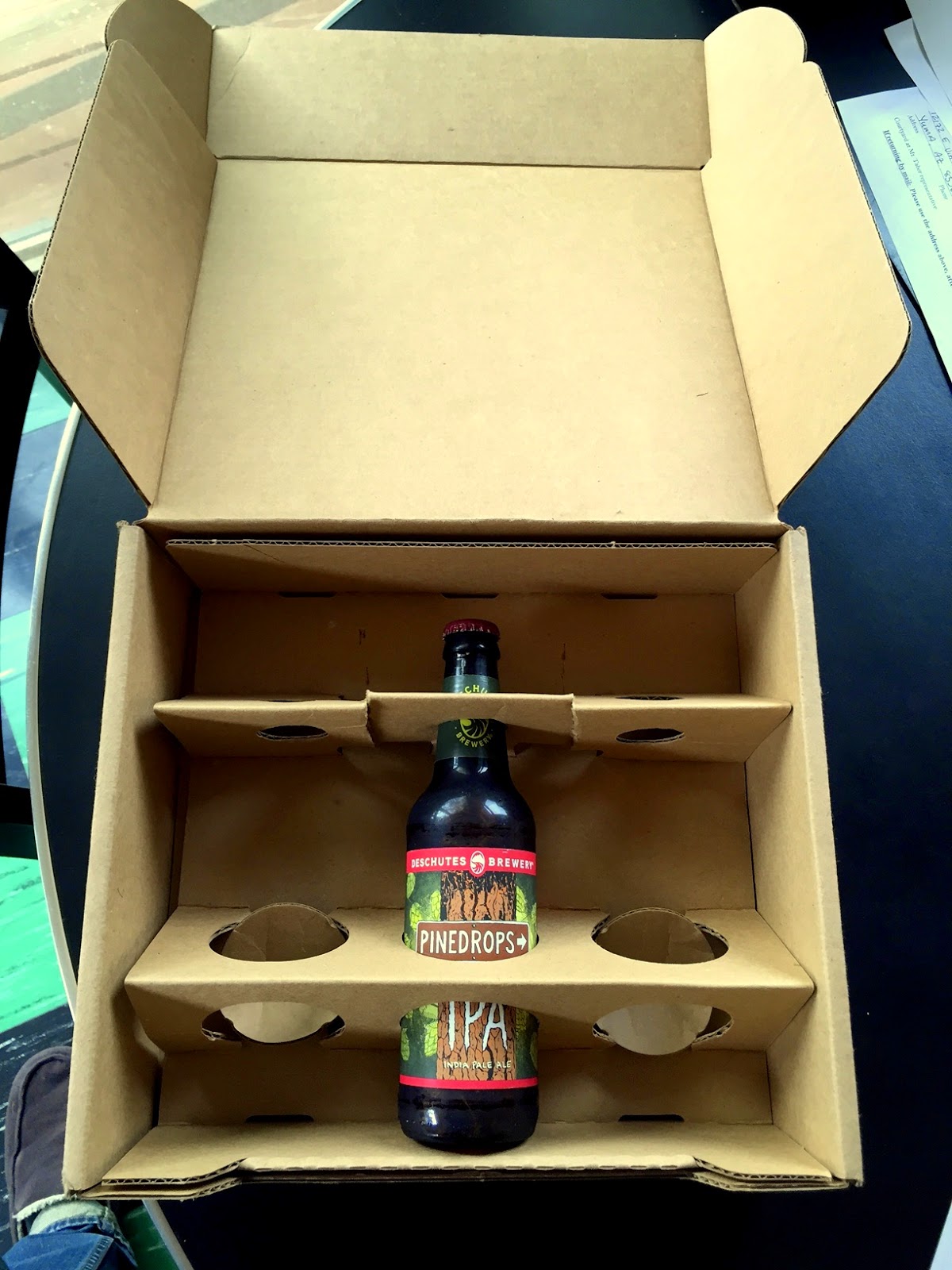
They hold three 12-ounce bottles firmly and without chance of breakage (barring natural disaster)--and without a single peanut. (They also have a version that holds a single 22-ounce bottle.) In fact, there's only once small piece of packing tape on the whole box, which holds the top flap down once it has been tucked inside the box.

Takes 12 seconds to open, and the whole shebang goes in the recycling. Other breweries take note!
(The Pinedrops IPA? Not for me. It's a bit of a throwback style, with aggressive bitterness that, because it's so piney, is a bit harsh. A touch of sweetness helps mitigate this, but it's still all a bit much. Give me a Fresh-Squeezed IPA instead.)
By an imperial mile, the best packaging in the industry comes from Deschutes, which has these dandy little boxes:
They hold three 12-ounce bottles firmly and without chance of breakage (barring natural disaster)--and without a single peanut. (They also have a version that holds a single 22-ounce bottle.) In fact, there's only once small piece of packing tape on the whole box, which holds the top flap down once it has been tucked inside the box.
Takes 12 seconds to open, and the whole shebang goes in the recycling. Other breweries take note!
(The Pinedrops IPA? Not for me. It's a bit of a throwback style, with aggressive bitterness that, because it's so piney, is a bit harsh. A touch of sweetness helps mitigate this, but it's still all a bit much. Give me a Fresh-Squeezed IPA instead.)
Thursday, April 02, 2015
Thanks to CBC, Portland Will Be Awash in Good Beer

Each April, an event known as the Craft Brewers Conference visits one lucky city. Thousands of beery types flow in, attending seminars that are mostly not interesting to the average beer fan ("How to Build a Brewery," "Best Practices in Brewery Date Coding," etc.). What is interesting, and the reason you should prepare your liver for a marathon of pub-going during the week of April 12-18, is that there are a ton of extremely cool events happening around town. For example:
- The week of CBC, the Cascade Barrel House will have two bars and a food station on the production side of the brewery where they'll host "Sour Week," featuring wild ales from breweries across the country.
- On April 15 from 2pm on, Gigantic hosts Gigantic and Friends at Apex Bar. They'll be pouring beers from Three Floyds, Solemn Oath, Lost Abbey, Beau’s All Natural, Sun King and Surly.
- April 13-18, Breakside's Milwaukie brewery will be open from 11am - 8pm with " many of special barrel-aged, mixed culture, and library beers." The brewery is also releasing six collaboration beers with breweries from around the country (which will be pouring, along with collaborations from other national breweries, at the White Owl Social Club on April 16).
Next week I'll try to post a complete(ish) list. (Email me at the_beerax(at)yahoo.com if you don't trust me to get your event on the list--and given my detail-herding skills, you shouldn't.) In the meantime, clear your calendar.
Wednesday, April 01, 2015
Willamette Valley Growers Working on Cannabis-Hop Hybrid
Okay, this isn't something you see every day. A group of Willamette Valley hop-growers are working on a hybrid plant containing both cannabis and humulus lupulus. Keep in mind that Washington state currently has recreational marijuana, and Oregon will have it as of next year. Keep further in mind that both hops and mary jane are members of the Cannabaceae family, so this may actually work:
Even though both alcohol and marijuana will be legal, it's not clear that the combo will be. (Remember the Four Loko debacle?) But hops take a long time to develop--up to ten years to get a new strain to market--but it sounds like this is experimental R & D. Hop growers are used to working with plants that never go to market. And this was funny:Growers have been tinkering with hybridization in order to produce hops with lightly psychoactive properties as well as pleasant flavors and aromas. Gayle Goschie, one of the growers of the experimental plants, says they've had luck with a variety she calls Harlequin Cascade. "We picked a cannabis strain known for moderate THC levels and high CBDs to go with the classic Cascade hop. The flavor isn't quite right, but it produces a really mellow sensation."
Goschie has been working with Oakshire brewer Matt Van Wyk to figure out how the strain works in beer. In order to convert the psychoactive properties of the cannabis, the hops must be heated, but Van Wyk has found that the effect is best when the hops are added late in the boil. "For one thing, they're really potent--stanky, dank hops. You put them in at the beginning of the boil and it's like eating hash. You also lose some of the effect. The sweet spot is about five minutes before knockout. That's when you get the best effect--though they are still pretty dank."
Goschie admitted that she didn't ever expect to see the hops go into commercial beer. But she added, "there are a ton of homebrewers out there."That there are. Stay tuned.
Tuesday, March 31, 2015
Two Odd Things
Odd Thing #1: Biggest Breweries List
Each year, the Brewers Association releases lists of the biggest US breweries--and today they put out the 2014 lists. The first one contains all breweries, the second one "craft breweries." But that second one is becoming increasingly bizarre and baroque. Let's just compare/contrast:
Odd Thing #2: Powdered Alcohol
A bill in the Oregon state legislature would ban powdered alcohol, which was recently approved by the FDA. Apparently this is a thing, powedered alcohol. The company that brought it to market, is vigorously (but in my view not entirely effectively) fighting back. Their arguments include: 1) if you ban it, people will want it more; 2) once the black market gets going, you'll lose control of it; 3) don't waste precious government money fighting the black market!; 4) Alcohol is... well, this argument is so nakedly self-serving it deserves a quote in full. "Alcohol misuse and abuse is a real problem. People can abuse any product and there's no controlling what a person does with a product. What's the solution? We know that you can't legislate behavior so banning Palcohol is not the solution. We have to educate people on the responsible use of alcohol."
I have no opinion on the matter except that the Palcohol company needs to hire a decent political strategist and communications director immediately.
Each year, the Brewers Association releases lists of the biggest US breweries--and today they put out the 2014 lists. The first one contains all breweries, the second one "craft breweries." But that second one is becoming increasingly bizarre and baroque. Let's just compare/contrast:
- Craft Brewers Alliance, an association of three independent craft breweries with a minority stake by Anheuser-Busch, is not on the list.
- The Belgian conglomerate Duvel Moortgat, owner of Boulevard and Ommegang, Gambrinus, an importer that owns a menagerie of beer companies, and North American Breweries, owned by--not making this up--Cerveceria Costa Rica, a subsidiary of Florida Ice and Farm Company, are all on the list.
- Yuengling and August Schell are on the list--after years of being excluded.
- Boston Beer, a giant company that makes Twisted Tea and Angry Orchard, is on the list.
Odd Thing #2: Powdered Alcohol
A bill in the Oregon state legislature would ban powdered alcohol, which was recently approved by the FDA. Apparently this is a thing, powedered alcohol. The company that brought it to market, is vigorously (but in my view not entirely effectively) fighting back. Their arguments include: 1) if you ban it, people will want it more; 2) once the black market gets going, you'll lose control of it; 3) don't waste precious government money fighting the black market!; 4) Alcohol is... well, this argument is so nakedly self-serving it deserves a quote in full. "Alcohol misuse and abuse is a real problem. People can abuse any product and there's no controlling what a person does with a product. What's the solution? We know that you can't legislate behavior so banning Palcohol is not the solution. We have to educate people on the responsible use of alcohol."
I have no opinion on the matter except that the Palcohol company needs to hire a decent political strategist and communications director immediately.
Monday, March 30, 2015
American Wild Ales Evolve

American wild ales, by contrast, aren't even well-known in the US. But if the beers at that fest are any indication--and I think they were a pretty good cross-section of what's available--wild ales may be more distinctively American than IPAs. (When you sit down to a Matuška IPA in Prague, you realize how well other breweries have learned to imitate them.) Two other countries have a solid tradition of wild ales, and they're instructive for the ways they contrast American wilds.
Belgium, of course, is the standard-bearer for the category.* Belgium kept the traditions of spontaneous fermentation, mixed fermentation, and wood-aging alive, and it's hard to imagine there being any wild ales had lambics, tart flanders ales, and assorted oddball beers died out before the current revival. Belgian wilds have two distinctive features--complexity and balance--that make them unique. This comes partly from spontaneous fermentation, but more from the varied ecosystems that inhabit the old wooden foeders in places like Brussels and Roselare. Take gueuze, which for my money is the world's most accomplished style. Not only does it come from lambic, which is the product of a zoo of wild creatures, but also different vintages of lambic. The old blends are dry, austere, and still, the medium blends richer with yeast compounds, the young blends still lively and sweet. A gueuze is tart but not overly so; the flavors are so nuanced and varied that you can fall into a meditation as you experience them. Beers like Rodenbach are more tart--aged, unblended Rodenbach is very sour--but they also have tons of layers. You'll find rich esters, rounded, balancing sweet notes, that characteristic balsamic note, and on and on.
Italy has, like the US, really taken to wild ales, too, but they have an entirely different orientation. Most of Italy's breweries are in the North, in wine country, and this influence is profound on the beers. Wild ales there are lightly acidic but never puckeringly sour. (I used to include a sour-o-meter when I did reviews, and rarely would an Italian ale go past two on that chart.) Balance is the hallmark of all Italian beers, though unlike German beers, in Italy they may be extremely complex and full of flavor--just never too much. My suspicion is that this has to do with cuisine; the beer is meant to go with food, and as such it's meant to remain in harmony with food. As a result, you find few face-melting palate-wreckers.
The US? The wild ales do very often approach face-melting intensity, but even more notable is how certain notes dominate. It may be an exceedingly dry quality from Brett or sharp sour, but they are mostly not brewed for subtlety. They often seem to lack complexity for this reason; it's difficult to maintain complexity when one quality dominates. (There are exceptions. Block 15 continues to make the best wild ales I've tasted in the US. They are balanced, complex, and extremely approachable. Like gueuze, I think most of Block 15's wilds would be as welcome by sourheads as by novices or those who don't normally like sours. That's a real trick.) This may all be inexperience. Wild ales are an art, and a very advanced one. Belgians have had centuries to gauge the effects of oxygen and age on beer and to learn how to blend--knowledge that comes slowly at best.
There is one development that is quite promising: hoppy wild ales. It also follows a classic pattern of the way styles mutate and develop. Americans know hops inside and out. We know how to coax all kinds of different flavors out of them, and when we brew beers, we always keep one eye on how hops will inflect the other flavors. (For decades, this was considered a naive fault of Americans, that we couldn't brew anything without over-hopping it.) Because Americans are so good with hops, they naturally started seeing how those citrusy, fruity flavors would harmonize with sour ales (which have native citrusy, fruity flavors themselves). Americans can use hops to add spice, zest, aroma, and flavor, and they can do it precisely. When they add hops to wild ales, they're adding that depth and complexity I miss with the extremely acidic or dry beers.
In Belgium and Italy, the complexity comes through fermentation. In the US, wild ales may one day get theirs from hops. It's a good trend, one that makes American wilds distinctive, and one that may actually expand the appeal of wild ales beyond a purely niche audience.
____________
*And let's not get too anal about our definitions. Wild ales are not a style, but a broad family that includes any beers made with Brettanomyces, pediococcus, lactobacillus, or other wild yeasts and bacteria--whether or not they were spontaneously-fermented or pitched.
Thursday, March 26, 2015
A Report on Latir (Neomexicanus) Hops
Last fall, Stan Hieronymus alerted us to a new commercially-available strain of native North American hops. It is one of the most interesting developments in the beer world in recent memory, and so when a few of these precious gems came on the market, I invested in a strain called "Latir." I finally got around to brewing with them, and I have a report on what they taste like, but let's back up and refer back to Stan for a little background:
(For those who care, I made a basic pale ale with two-row, wheat, and a dab of caramel, fermented with American Ale II. I essentially divided the pack in thirds and added them at 60 minutes, 30 minutes, and 5 minutes.)
Latir Hops
Different groups have used different methods to try to taxonomize the aromas and flavors in hops (there are various wheels and graphs out there). I'd like to contribute to this philosophical tradition by adding a system that divides hops into either "high" or "low" varieties. In my experience, different hops either have bright, light, "high" notes (think Hallertauer, East Kent Goldings, Cascade) or are heavy, resinous, sticky and "low" (CTZ, Centennial, Summit). I point out this dichotomy because typical flavor and aroma elements (citrus, pine, fruit) may be found in hops of either high or low type. What flavor alone fails to account for is this high/low distinction.
All of this is relevant because I have rarely encountered a hop as low as Latir. It is an amazing variety. The aroma is extremely dense and resinous--and strong. It will easily fill up the space between two drinkers as they sip a pint. It's a strongly herbal hop, and I mean that partly in the Jamaican sense. But Sally pointed out that what first struck me as marijuana was actually much closer to sage. It also has quite a bit of orange in it, though more marmalade than fresh fruit. I picked up some grassiness as well. The flavors seem very American.
In a single-hop beer, Latir overwhelms--though I suspect there are a number of people who would love its intensity. But it has so much character, it would be wonderful in a supporting role, along with some "high" varieties to lighten and brighten the beer up. It's an IPA hop--too big and brassy to play a bit part in more mildly-hopped styles--and in that way seems very contemporary.
I wasn't expecting much. Just because a hop comes from wild strains doesn't mean it will be any good, and the grass-roots background of these hops made me wonder if they would have been hybridized into anything approaching a commercial palate. But these are badass hops, and I would happily use them regularly if they were available. (Though probably not at $5 an ounce.) All in all, a most exciting find.
Update. By amazing coincidence, this arrived in the mailbox about two hours after my post went live.

The genus Humulus likely originated in Mongolia at least six million years ago. A European type diverged from that Asian group more than one million years ago; a North American group migrated from the Asian continent approximately 500,000 years later. Five botanical varieties of lupulus exist: cordifolius (found in Eastern Asia, Japan), lupuldoides (Eastern and north-central North America), lupulus (Europe, Asia, Africa; later introduced to North America), neomexicanus (Western North America), and pubescens (primarily Midwestern United States).(If that doesn't sate your appetite, there's more here.) The people selling these hops are monks, and owing to the iron law of supply and demand, I ended up paying a mint for my 3.5 ounces. No worries--I'm happy to pay the price to be an early adopter. What's significant about the pricing part of the story is that it dictated which variety I chose--Latir, the highest-alpha variety (7.2%) they had left. I figured it would be just enough to single-hop a batch and see what they smelled and tasted like.
Varieties European brewers identified early on as outstanding, such as Saaz and Spalt, were Humuplus lupulus. When the first settlers arrived in North American they brewed beer with hops (Humulus lupuldoides) they found growing wild, but also used hops (lupulus) they brought from Europe. Not surprisingly, native and imported hops cross-bred naturally. As recently as 1971, Cluster — one of the hops that resulted — accounted for nearly 80 percent of U.S. hop acreage.
(For those who care, I made a basic pale ale with two-row, wheat, and a dab of caramel, fermented with American Ale II. I essentially divided the pack in thirds and added them at 60 minutes, 30 minutes, and 5 minutes.)
 |
| Source |
Latir Hops
Different groups have used different methods to try to taxonomize the aromas and flavors in hops (there are various wheels and graphs out there). I'd like to contribute to this philosophical tradition by adding a system that divides hops into either "high" or "low" varieties. In my experience, different hops either have bright, light, "high" notes (think Hallertauer, East Kent Goldings, Cascade) or are heavy, resinous, sticky and "low" (CTZ, Centennial, Summit). I point out this dichotomy because typical flavor and aroma elements (citrus, pine, fruit) may be found in hops of either high or low type. What flavor alone fails to account for is this high/low distinction.
All of this is relevant because I have rarely encountered a hop as low as Latir. It is an amazing variety. The aroma is extremely dense and resinous--and strong. It will easily fill up the space between two drinkers as they sip a pint. It's a strongly herbal hop, and I mean that partly in the Jamaican sense. But Sally pointed out that what first struck me as marijuana was actually much closer to sage. It also has quite a bit of orange in it, though more marmalade than fresh fruit. I picked up some grassiness as well. The flavors seem very American.
In a single-hop beer, Latir overwhelms--though I suspect there are a number of people who would love its intensity. But it has so much character, it would be wonderful in a supporting role, along with some "high" varieties to lighten and brighten the beer up. It's an IPA hop--too big and brassy to play a bit part in more mildly-hopped styles--and in that way seems very contemporary.
I wasn't expecting much. Just because a hop comes from wild strains doesn't mean it will be any good, and the grass-roots background of these hops made me wonder if they would have been hybridized into anything approaching a commercial palate. But these are badass hops, and I would happily use them regularly if they were available. (Though probably not at $5 an ounce.) All in all, a most exciting find.
Update. By amazing coincidence, this arrived in the mailbox about two hours after my post went live.

Subscribe to:
Posts (Atom)