You love the blog, so subscribe to the Beervana Podcast on iTunes or Soundcloud today!

Showing posts with label Deschutes. Show all posts

Thursday, April 21, 2016

Toasting John Harris' Thirty Years

John Harris' 30-Year Anniversary FĂȘte
6 pm, Thursday April 28th
Ecliptic Brewing (825 N. Cook St)

We've reached the stage of maturity in American brewing when each year brings a raft of milestones for one of the founding brewers or breweries. I comment on very few because just surviving doesn't count as much of an accomplishment on its own. There are some exceptions, and John Harris, who will be celebrating his thirty years as a professional brewer next Thursday, is certainly one.

Source


Let's trot briefly through the highlights. In 1986, he started his brewing career at the McMenamins, got a couple of years experience, and then joined Gary Fish to help launch a little start-up brewpub in Bend called Deschutes. In those early years, John gave the world Cascade Ale, Bachelor Bitter, Black Butte Porter, Mirror Pond, Obsidian Stout, and Jubelale. He came back to Portland to work for Full Sail at their RiverPlace brewery, and stayed there twenty years before starting his new solo venture, Ecliptic, in 2013. More than any other brewer, his fingerprints are all over Oregon beer.

In the press release to mark the event, John included this invitation, which has a delightful little allusion in it:
I started Brewing in April of 1986 at the Hillsdale Brewpub in Portland. It has been a long strange ride!

I am very proud of all my years making beer for a living. I have created many beers over those years but there is one I am linked to more than any other. I brewed a special beer, Reflection Nebula Pale Ale, to celebrate this 30 year milestone. I invite you to join me for a beer to celebrate on April 28th at 6pm.

Cheers,
John
What would you likely see your reflection in? A mirror, you say? I think we can connect the dots well enough.

No brewer more deserves a victory lap than John, and this one is open to the public. I expect it will be a mob scene, because I know more than a few people who speak sotto voce in reverence when they catch sight of John--as if the pope had just walked by. And they're sort of right.  I wouldn't miss it for the world.

Monday, April 18, 2016

Of Culture and Business

Over the weekend, the Asheville Citizen-Times published a fascinating analysis of how the deal to lure Deschutes went sideways. If you're interested at the intersection of public policy and business, it's a great piece. But beyond general lessons, there are some particularities that jumped out at me. There were so many moving parts, it's hard to know what tipped the scales in Roanoke's favor, but it looks like culture played a dominant role. Consider:
  • "The beer culture fit well with what the outdoors tourism officials were trying to promote, said that city’s economic development director, Wayne Bowers. 'We’re on the Appalachian Trail. And the Blue Ridge Parkway comes right through town,' Bowers said." All you have to do is pick up a bottle of Deschutes to understand how central the outdoors is to the brewery. It's embedded very deeply into their DNA.
  • Asheville sold Deschutes' first-choice site, but Deschutes stayed engaged because Asheville is such a beery city. 
  • On the one hand, Deschutes was dealing with this from Ashville: "Republican Commissioner Joe Belcher later would say that his problem with the arrangement was bigger than the land purchase. Belcher said he was opposed to alcohol in general due to 'a deep personal and religious conviction.'" 
  • And if some in Asheville didn't love beer, Virginia was going all out for the deal. The state launched an online campaign that Virginians could participate in, and they got the governor involved in the courting process. And then there was this, which cracked me up. "Those intangibles also included ... the discovery that Haymore and Deschutes President Michael LaLonde were fellow 'Deadheads....' It was in the middle of one of the Dead’s most well-known tunes 'Franklin’s Tower' that McAuliffe got the handshake from LaLonde that he wanted, Haymore said."


If you're planning for the next few decades, brewery location isn't a casual consideration. You're stuck with that very expensive property. The natural environment, beer culture, and cultural mores of the city and state will play a huge role in whether the brewery succeeds. One might imagine that sweetening the pot with a few million dollars would make the decision easy, but against these long-term considerations (and an $85 million price tag), location and culture has a lot more to do with it.

East to West?
It's a little surreal to read about how much two states (and South Carolina was an early contender, as well) wanted Deschutes. I absolutely cannot imagine an Oregon city working with local businesses and the governor to try to score a new, say Dogfish Head, Boston Beer, or Yuengling plant. For one thing, Oregon has invested on the front end. The state already brews well over a million barrels of beer a year (not clear whether this stat includes CBA or not). By encouraging breweries with a good regulatory environment, self-distribution laws, and low taxes, Oregon has already developed five of the top 50 largest breweries in the US. Virginia, South Carolina, and North Carolina have developed none.

But of course the bigger thing is that Oregon has such a strong self-identity as a brewing state. We don't import breweries, we build them. We don't drink beer from elsewhere (for good and mostly bad), we drink Oregon beer. I suppose Dogfish Head could set up a brewery here for distribution purposes, but it's hard to envision a scenario outlined in the Citizen-Times playing out here.

All beer is local. That's starting to make things confusing, but only to a point.

Update (9:41am). I meant to add this point. A few people on social media have made the point that one reason for the west-to-east migration of breweries has to do with population densities. West Coast breweries are moving east because that's where the people are, and it's why we're not seeing the reverse. That's true to a point--but only a point. There are a lot of people in the NE, but they're not a giant market. Yet. One of the reasons West Coast breweries grew so fast (fourteen of the fifty largest US breweries) is because there are a lot of people here drinking those beers. Deschutes and Widmer Brothers sell 200,000 barrels of beer in Oregon alone--three times the amount all New Jersey breweries made last year.

Monday, March 28, 2016

The Dangers of Expansion

Just a quick follow-up to that Deschutes post. As so often happens, it precipitated a nice discussion on Facebook--which no blog readers would have seen. In the post, I alluded briefly to "tough sledding" for Deschutes as they move forward. I didn't unpack that at all, and I think there's some benefit in doing so.

No one outside the Pacific NW has any idea what this
is or how it relates to Deschutes Beer.


Every brewery faces business challenges. If you're a brewpub, you must get people in the door. If you're a small production brewery, you have to compete in the craft market with very efficient large breweries even while making comparatively more expensive beer. If you're a mid-sized regional, you have to develop a mass market approach, but you don't have the might to defend against better-funded national brands. Of course, each of these has certain advantages, too. They're all local, and have a home-court advantage on sales. Brewpubs appeal not just through their beer, but the ambiance and food at the pub. Regional breweries are more responsive to local trends.

Every time a brewery expands, though, it takes on a new level of risk. Most outright brewery failures happen during expansion. You predict where the market will be and how you'll fit into it, take on a bunch of debt, and then hope you weren't wrong. Nowhere is the risk greater than when a brewery wants to go national. The barriers, costs, and complexity are immense:
  • You have to establish relationships with distributors in every market;
  • You have to understand the vagaries of each market with respect to retail access (some states only sell beer in liquor stores; others have restricted hours, etc, etc) and build a national sales force;
  • Laws governing beer sales differ in every state;
  • You have to create national brands that will sell in places as diverse as NYC, Houston, San Francisco, and Des Moines;
  • You take on a ton of debt and can't afford to suffer through too many years of underperforming sales;
  • You're competing against breweries backed by multinational corporations with almost unlimited resources to secure distribution, advertise, play hardball at the retail level, run promotions, and staff giant sales forces;
  • You have to maintain your identity as a local brewery that's from a place while at the same time create a bridge to people with no natural affinity or interest in that place. Deschutes is a case in point: people in distant states don't even know how to pronounce the brewery's name, much less have any idea what Mirror Pond or Black Butte are;
  • You have to predict where the market will be nationally in five, ten, and twenty years and make sure your brand can continue to compete with national brands that might seem more current or sexy.
There's nothing to say that Deschutes can't pull this off. If you think of the 4,000 breweries in the US, there are only about twenty that have any kind of shot at this, and Deschutes is definitely one of them. They have one of the strongest and most diverse line-ups in beer, a great brand, and they've been incredibly astute about anticipating trends (think of the timely releases of Chainbreaker White IPA, Red Chair, and Fresh-Squeezed). But they will also be competing against companies that could afford to drop hundreds of millions of dollars just to acquire a brand--never mind the millions they're prepared to spend establishing them. So it is a pretty ballsy move and carries with it huge risk. If the bet fails, the brewery may end up a slowly-receding brand in the AB InBev portfolio in twenty years--the fate of so many other brands over the past century.

Sunday, March 27, 2016

Deschutes in Virginia

While I was in Dublin, Deschutes announced it would be opening a new production facility in Roanoke, Virginia. Three east coast states were wooing the brewery, but Virginia got the call.
[Virginia Governor Terry] McAuliffe met with Deschutes executives in Oregon last fall and company officials recently visited Richmond, where they enjoyed Deschutes beer in the Executive Mansion kegerator before telling the governor that Virginia won the bid, said Todd Haymore, Virginia Secretary of Agriculture and Forestry.
... Deschutes is getting a $3 million state grant for the project and will be eligible for additional state aid, officials said.
It's going to be a very slow process--Deschutes doesn't even plan to break ground until 2019. There doesn't seem to be any suggestion that this augurs a future change in ownership, so it looks like Deschutes is going to try to compete with AB InBev, MillerCoors, Constellation Brands, and Heineken on its own terms. That could be some tough sledding, but it certainly adds some intrigue to the market as it shapes up.

Interesting times. Anyone have any hot takes on this news?


Thursday, June 04, 2015

Karl Ockert Headed to Deschutes

This is pretty big news:
04 June 2015 – Bend, Oregon –Deschutes Brewery today announced the hiring of Karl Ockert as Director of Brewery Operations. In this position, Ockert will use his 30-plus years experience in the brewing industry to oversee and guide all functions and activities related to brewing, cellaring, packaging, safety, continuous improvement, maintenance and quality control. Ockert, who spent a total of two decades with Bridgeport Brewing Company, most recently served as an independent consulting brewmaster and the technical director for the Master Brewers Association of the Americas (MBAA).
In some ways, that slightly undersells Ockert's bona fides. He didn't just spend two decades at BridgePort; he was the founding brewer and the man who helped guide the winemaking Ponzis through the process of opening a brewery. He'd just graduated from the brewing program at Davis when he got the job.

After toiling for many years under the quixotic rule of Carlos Alvarez and Gambrinus, I suspect heading to Bend looks like an excellent opportunity for Karl. 

Sunday, April 05, 2015

A General Note to All Breweries

This is a bit random, but it's also long overdue. I get a fair number of packages from breweries (mostly containing beer, but not exclusively). Nothing like Brian Yaeger or Ezra Johnson-Greenough, but still, one every week or two. Of course, I love beer and love getting beery deliveries, but I hate the yards of plastic bubble wrap and drifts of styro peanuts that collect in the basement waiting recycling. Some breweries send me a single 12 oz beer in a box that could hold a case of wine--cossetted way too safely in a bed of earth-destroying packaging.

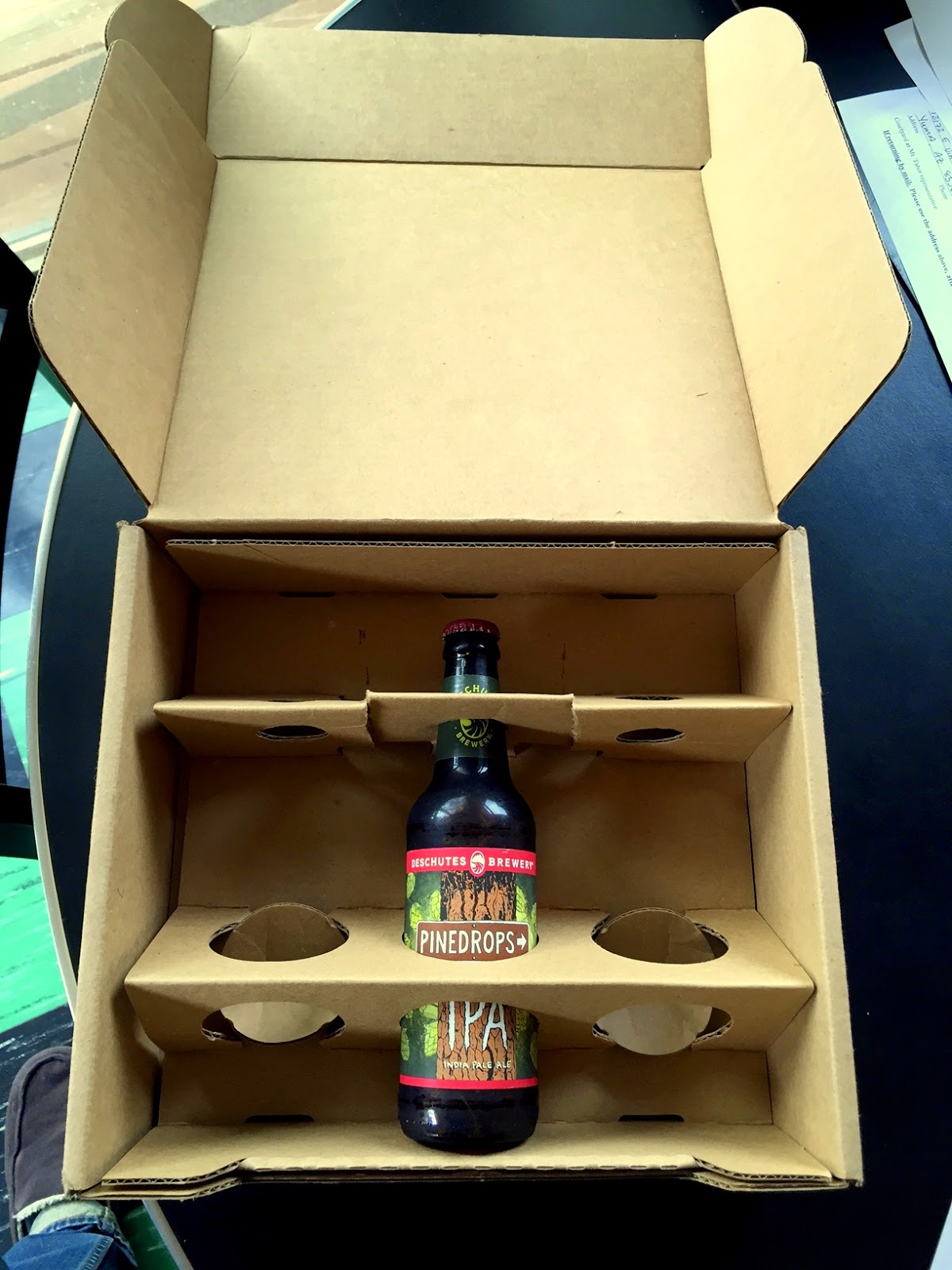
By an imperial mile, the best packaging in the industry comes from Deschutes, which has these dandy little boxes:


They hold three 12-ounce bottles firmly and without chance of breakage (barring natural disaster)--and without a single peanut. (They also have a version that holds a single 22-ounce bottle.) In fact, there's only once small piece of packing tape on the whole box, which holds the top flap down once it has been tucked inside the box.


Takes 12 seconds to open, and the whole shebang goes in the recycling. Other breweries take note!

(The Pinedrops IPA? Not for me. It's a bit of a throwback style, with aggressive bitterness that, because it's so piney, is a bit harsh. A touch of sweetness helps mitigate this, but it's still all a bit much. Give me a Fresh-Squeezed IPA instead.)

Thursday, October 30, 2014

Fresh Hops, Neomexicanus Hops, and No Hops

Hot on the heels of a bottled Lagunitas fresh hop beer, two from Deschutes arrived at Casa Beervana, Chasin' Freshies (still the worst name in beer!) and Hop Trip--and two more chances to disprove my skepticism that fresh hop flavor can be bottled. 

(As a side note, Chasin' Freshies plays a prominent role in my skepticism.  One recent year, I was down at Deschutes sampling fresh hop beers, and Chasin' Freshies was on tap.  It was the first year they made it, and I assumed it was just one of the many one-offs they do during fresh hop season.  It was one of the best examples I'd ever had, though, and so imprinted itself on my brain.  A couple hours later, I arrived home and found a bottle of the same beer waiting for me.  That Chasin' Freshies was nothing like the beer served on tap and yet was, presumably, as fresh as the brewery could make it.)  (As a side note to the side note, I'll add that I've only previously had one fresh hop beer worth a damn--BridgePort Hop Harvest.) 

So back to Deschutes' 2014 bottled fresh hop offerings.  Did they manage to bottle the flavor?  Must I revise the theory?  Our findings are inconclusive: Chasin' Freshies (22 oz bottle) was superlative.  Fully alive and green and fresh-hoppy.  Hop trip (12 oz bottle) was a dud--very little hop character at all, and therefore a sweetly malty soup with no zip.  My advice: if you want the experience of fresh hop, get on down to your favorite grocer, buy a 22 of Chasin' Freshies and drink it tonight.  You might even risk waiting until tomorrow, as you hand out chocolate to small fiends.  I wouldn't wait longer than that.  Skip the Hop Trip.


The Neomexicanus Hops Are In
Stan Hieronymus has an update on some monk-grown native hops that will soon be available to the home beermaker.  Step lively if you want to get in on the action.


In Lieu of Hops
Finally, let me direct your attention to my latest post over at All About Beer.  Today's offering involves Eric Steen's project Beers Made By Walking, wherein Eric and brewers go on a hike and forage ingredients to use in a beer, along with my consideration of which of those ingredients seem like candidates for regular use. It starts:
Artemisia douglasiana, also known as California mugwort, grows along stream banks up and down the West Coast. Dried and—particularly—burned, it has a distinctive aroma similar to another plant famous in the region, Cannabis sativa. Perhaps for this reason, it creates a pungent, hop-like quality when added to the conditioning tank of a light ale. The flavor is anything but subtle; it is sticky and musky and surprisingly bitter, reminiscent of some of the more exotic modern hops in vogue. I discovered it in a gluten-free beer by Portland’s Ground Breaker Brewing, the result of a project called Beers Made By Walking in which brewers go out and forage for local ingredients they later use in a beer.
Go read the whole thing.  (Please!)  

Friday, July 05, 2013

The New Breed of Sweet IPAs

Last night, reclining on the roof of an undisclosed warehouse in the inner Southeast beneath an exploding sky, I poured out a measure of the new Deschutes Fresh Squeezed IPA.  It's one of the many IPAs out now that harnesses the intense fruitiness of new American hops, in this case Citra and Mosaic.  The name and tagline tell you everything you need to know about the beer's nature: "no fruit was harmed in the making of this beer."

When you have been tasting beer for decades, your mind has a tendency to become enclosed by habit.  IPAs have evolved in increments, from screamingly bitter, mildly grapefruity versions of the 90s to the increasingly aromatic, dank, dry-hopped incarnations in the mid aughts to now, when bitterness is dialed pretty far back in favor of vividly fruity IPAs.  Since it has gone in increments, I have mainly just revised my old mental model to accommodate for new trends.  IPAs are bitter beers rich with aromatics and hop flavor.  The formula may change, but these facts remain the same. 

But last night, one of the roof-sitters--not a beer geek--sampled Fresh Squeezed IPA and remarked: "Wow, that's a sweet beer."

He's right.  Deschutes put 60 bitterness units in this beer, but it has a ton of caramelly body (it's closer in color to Newcastle than Pilsner Urquell) that adds a lot of sugars to the mix.  Layer those intensely fruity new-variety hops on top and you add a level of juiciness the mind tracks as purely sweet.  From a sensory perspective, these aren't bitter beers at all--they are actually sweet. 

Even when the beer is stronger, has less sugars and more bitterness, the purity of the fruit flavors gives these beers a distinctly sweet character.  Boneyard and Gigantic make juicy IPAs that were, in Oregon, the harbingers of the sweetening trend.  Hop-growers have been going crazy bringing new products to the market, and what people seem to love most are the tropical fruit flavors.  (Hops with resiny, dank qualities or piney character seem to be fading, trendwise.)  I saw this in Europe, too, where breweries have more ready access to New Zealand hops, which also have saturated fruit flavors--though they tend toward berry and lychee. 

I was feeling somewhat oppressed by the heavy, ganja-like hopping that was most popular a few years back--those beers were a sensory and alcoholic kick to the head.  These new IPAs, sweet with the sunshine of fruit and often more sessionable, are right up my alley. 

Monday, May 06, 2013

Old-School Barley Wines and Other Thoughts

Fred with the BridgePort Old Knucklehead that bore
his likeness.  Credit:
In the year of Deschutes' birth, 1988, I was twenty years old--which is to say well into my drinking career.  The Northwest was getting into hops by then, but the trend hadn't cohered into the categories we have now.  When breweries wanted to stagger you with hops, they tended to go big and brew barley wines*.  In retrospect, this was an interesting layer in the sediment of craft brewing.  By today's standards, those early barley wines weren't especially huge--seems like nine to eleven percent was the range--but they were crazy unbalanced.  The hops were screaming banshees of grating Chinooks placed atop a gelatinous goo the flavor and consistency of caramel sauce--everything was baled together with the razorwire of higher alcohols.  A lot of these came in wee nip bottles, which was a kindness to the customer who had to handle the damn things with tongs and gloves.  Let them age a few years and they softened into the texture of worn saddle, but that was as gentle as they ever got. (Old Crustacean is still made to what looks like a pretty classic recipe.)

So that was barley wine. 

A few weeks past, during the time my blogging was quick and cheap, I got a bottle of Deschutes collaboration Barley Wine Ale.   The conceit of was that:
Deschutes Brewery, North Coast Brewing Company and Rogue Ales have teamed up to create a traditional barley wine as the first in Deschutes Brewery’s Class of ’88 collaboration series. Each of the three breweries working on the project brewed their own interpretation of that original recipe. The Class of ’88 Barley Wine was based on the guide lines published in renowned beer connoisseur Fred Eckhardt’s The Essentials of Beer Style, which was originally published in 1988.
I must report with ambivalence that Deschutes' reboot isn't the least bit old school.  It's much more along the lines of what we now, in this much more taxonomically-precise era, would call a double IPA.  Barley Wine Ale has a snickerdoodle malt base and a rich fruitiness that is accentuated by melon-papaya hopping.  (In 1988, melons and papaya were available mainly in fruit and candy form, and certainly not humulus lupulus.  We also had to walk barefoot in the snow for 14 miles to get to a pub in order to procure a bottle of molten barley wine.)  The alcohol is very well hidden, coming in just at the end, when the hops turn spicy.  It has a mousse-like satiny body, quite rich, which is the one way in which it deviates from the modern imperial IPA, but it is not a caramel bomb, as beers of the 80s inevitably were.

If you actually want something that evokes the 80s--in a palatable 2013 kind of way--you might prefer Babylon, a beer Ninkasi calls a double IPA.  The malt bill, though, which relies heavily on bready Maris Otter, actually makes Babylon more reminiscent of those crazy old barley wines.  It's not an exact match: there's no caramel (the rest of the grist is a melange of malts from different brewing traditions) and the hops are a lot more marmalade-y than alley-catty.  There are El Dorados and Horizons--modern--but also old-timey EKGs, Fuggles, and Targets, which also remind me of the old days.  But it is quite a bitter blast, and the malting is thick and syrupy (if short of gelatinous).  For those of you who are younger than me--something like 60% of the population--and who live the terrible, benighted lives of plenty, Babylon isn't a bad place to start.  Throw in a splash of gasoline for the full effect.

As a last comment to the geezers, I invite you to mention your own recollections of the 80s and their hoppy beers.  Perhaps I'm just misremembering the beers of the day.  This is unlikely, but I'll entertain the question.

_________________
*Barley wine, not barleywine.  That latter term came about because the government wouldn't allow Fritz Maytag to properly label his first batch of Old Foghorn.  Apparently they believed it would confuse consumers, who might mistake it for Chardonnay. 

Thursday, March 07, 2013

All the New Beers

The release of new beers has an unpredictable quality.  Some years it seems like breweries collectively stand pat, while in others they issue a torrent of fresh suds.  This year is shaping up to be a torrent.  No single beer tells much the tale of the market, but if you look at them collectively, you can start to get a sense of where things are headed.  Saisons had their day, tarts, black IPAs, gluten-free, and organics.  So what's new in 2013.  Cue the ray of sunshine and the angelic choir, because it appears to be session ales. I have been flogging the joys of small beers for half a decade, and even, in one bright, shiny moment, helped to get a festival of sessions off the ground.  So obviously I'm psyched about this boomlet. So let's have a look at what's out there. 

Redhook Audible Ale and Deschutes River Ale
I received bottles of these beers on successive days in the chill of February.  I don't totally understand the superstructure around Audible's release--it has something to do with sports broadcaster Dan Patrick--but the beer is straightforward enough.  A lithe 4.7% beer, it is "brewed for crushability with lots of flavor," in the inexplicable language of the brewery.  ("Crush" apparently means "drink.")  Deschutes River Ale is just 4%, and the brewery even goes so far as to admit it's a session ale--no shilly-shallying around.

The contrast between them is the difference between old-school American craft and old-school English bitter.  While many breweries have shifted with the times, Redhook is a bit of a throw-back brewery, making very clean, bright ales that ignore the IBU arms race.  Audible is much in this vein.  Deschutes, by contrast, is a dead ringer for a nice bitter, with a rounded body, biscuity malt flavor, and bright citrusy-crisp hops (Cascades and Crystal).  I even thought I detected a touch of diacetyl, which brewer Brian Faivre confirmed: "We are targeting a low level of diacetyl, 30-40 ppb, as we feel that it lends a positive flavor attribute to this beer, similar to that nice character found in traditional English style ales."

It will come as no surprise to readers that my palate inclines toward the Deschutes.  Audible is a bit less complex than I would like, and there's a hint of roast in there that puts me off.  Deschutes River Ale, though, is a beer I would love to find on cask in a pub where I could spend a couple hours getting to know it.

Widmer Brothers Columbia Common
The name of this beer is instructive.  "Common" is, of course, the non-trademarked reference to San Francisco steam beer.  They get the hybrid character by using their regular yeast and a lager strain.  (Steam beer was made by fermenting lager yeasts warm in the age before refrigeration reached the wilds of California.)  The Columbia refers to a type of hop bred simultaneously with Willamette.  Budweiser was looking for a domestic replacement for imported hops and a couple of varieties were bred largely from Fuggle stock to grow well in the US.  You know how this ends: Bud chose Willamette, consigning Columbia to the scrap heap of forgotten strains. 

In fact, Columbia Common uses a variety of hops--the Widmers' standard Alchemy blend for bittering, and the sisters, Willamette and Columbia, together in later additions.  For the hop nerd, this is slightly frustrating--I'd love it to be a single-hop beer so I could get a sense of the flavor.  But there's no arguing with the results; it's really a wonderful beer.  I had it at the Rose Garden first, and it tasted really fruity, making me think the hops were quite a bit different from their Fugglish sister.  But in subsequent samplings from the bottle, I've found the "grassy, spicy" flavors the brewery promised.  In fact, the hops are a lot more German in character than English, and I was reminded of some of the helles lagers I had in Bavaria.  It's got a wonderful copper color (Widmer used chocolate malt for color but didn't get any roast, just color), and is a perfectly crushable 4.7%.  I really enjoy this beer and wish it would stick around through the summer.

Other Releases
Not all beers are sessions.  BridgePort has a new chocolate cherry stout called Bear Hug that is every bit as decadent and dessert-like as it sounds.  It comes in a 22 ounce bottle, so I'd be sure to invite a friend along before you pop the cork.  Full Sail has their latest vintage of Barrel-Aged Imperial Stout out.  Every year, the brewery alternates between a big porter and a big stout they age in bourbon casks, and every year the vintage is on one side or the other of excellent.  This year's is spectacular--akin to one they had out back in 2010 (maybe?).  An amazing balance of chocolaty roast blending into vanilla-y bourbon.  Double Mountain has its usual rotation of new one-offs, and I'd like to draw your attention to Project 48, a double IPA that really sings.  For me, double IPAs work best when the sweetness of the malt harmonizes with the flavors of the hops to accentuate bitterness and frame the lush aromas.  It's hard to pull off, which is why so few double IPAs stick around.  Project 48 does that in spades.  I think you probably will only find it in Hood River, but if you're up for the drive, you could do worse.

Thursday, November 03, 2011

What's Up With the New Jubelale?

If you've had a chance to try the Jubelale this year, it may not have matched your expectations. This happens with beer drinkers all the time, largely because their memories are faulty or they have experienced unnoticed palate shift between samplings. With Jubel, though? You're not imagining things.

I've done two blind tastings of winter warmers (the original iteration that gave us Wassail and Snow Cap) over the past few years, and in both cases, Jubel came out on top. It had a candyish sweetness balanced by a perfect blush of peppery hops. It was incredibly smooth and warming, like a hot chocolate on a chill day.

This year's, by contrast, has a much pricklier hide. It's got some roast roughness and what I perceived as a dry tannic note. In fact, it was so dry I suspected that some wood-aged, brettanomyces-soured portion had been blended in. It is a startling departure from the Jubel of my memory. I shot Deschutes owner Gary Fish an email to get the lowdown, and he described the changes:
The original motivation for Jubelale that John Harris formulated was an English Old or Strong Ale.... I had been noticing for several years as our brewing techniques have gotten better and the equipment we were using became more sophisticated, a “drift” of our Jubelale flavoring to becoming, essentially, cleaner and drier (less estery). My comment to the brewers a couple years ago resulted in a project to, essentially, engineer back in the flavors or characteristics our processes were removing, but to do it deliberately, not by accident the way we, and most small brewers, have done things. The result is what you perceive as a change, whereas, from my perspective, we have simply returned to the way Jubelale used to taste, before these “improvements.” It is interesting you perceive wood aging. There is no wood aging in Jubelale, no brett, no oak.
So there you have it.

Fish says the beer is selling well and the customers seem to like the change. For my part, I think it's a step backward. The Jubelale of 2009 and the few years before was in my view a nearly perfected beer. There's not a thing I would have changed, even by the smallest degree. I will damn the new (or return to old) recipe by that weasel word we use in beer reviews and call it more "interesting" than the old Jubel. There is more going on here. So much, in fact, that I was completely thrown off about what was in the beer. Simplicity has its virtues, though, and the seductive balance and approachability of the recipe from a couple years ago was a triumph of clarity and drinkability. The new beer is more challenging, less satisfying and way, way less moreish.

That Deschutes will tinker with sacred cows and risk losing customers like me by reformulating recipes is one of the many reasons I think it's a model for large craft breweries. Deschutes has launched a branding strategy based on the slogan "bravely done," but they've earned it. This is a ballsy move, and the consequence is that people like me will buy less Jubel this year. They've always bet on their own palates, though, and Fish clearly believes they'll earn more customers in the trade-off. (And it may work, if reviews like this are any indication.)

_______________

Relatedly, I had this year's Full Sail Wassail last night, and it is an excellent vintage. (There was one in the early aughts that remains the standard-bearer, but this one's not super far behind.) Wassail is sometimes a bit hoppy for my taste, but this year's is a wonderful blend of chocolate and caramel malts and assertive woody hopping. It is deeper and rounder than some years--my preference in a winter ale. Stock up--this is definitely a beer to have in the fridge for the long nights ahead.

Thursday, October 27, 2011

Deschutes' New Brewmasters

Clarification: Jon Abernathy, master of all things Bend, tweets:


Today:
Deschutes Brewery has promoted Cam O’Connor and Brian Faivre to two newly formed brewmaster positions. The two, who have been instrumental in the development of such game-changing brews as Hop in the Dark, Red Chair NWPA, Gluten Free Ale, the soon to be released Chainbreaker White IPA, and others, were chosen for their abilities to both innovate and lead.
Good choices. Actually, I don't know Brian, but Cam seemed like an obvious choice. He worked in the brewery and was putting out really exceptional beers in the Deschutes mode. I think we'll see lots of continuity here. As a long-time admirer of the brewery, I am quite pleased with this news.

Cam was the first brewer at the Portland pub when it opened in 2009, has been responsible for crafting many of the exclusive experimental beers served there. He has also worked on labors of love like Hop in the Dark, which wasn’t released formally until it had gone through 22 rounds of tinkering. He joined the company in 2004 after spending a couple of years with Sierra Nevada Brewing Company. Cam holds a bachelor of arts in biology with a minor in chemistry, and has completed the University of California Davis Master Brewer Program.

Brian has been with Deschutes Brewery for five years and worked in various roles in the brewing department, most recently as assistant brewmaster for production technology. With a background in computer science and software development, Brian brings this precision to the brewhouse - optimizing recipes and developing operating procedures. He holds a bachelor of science in computer science and has also completed the University of California Davis Master Brewer Program.

Monday, September 26, 2011

Best New(ish) GABF Category: 14b, Fresh Hop Beers

As you may know, I'm not a huge fan of the ever-widening range of new beers styles judged at the GABF. Blackberry brambles spread more slowly. And yet one category--sub-category, really--is very cool. Lodged in category 14 (experimental beer) is a subcategory for fresh hop ales.

There are a couple reasons this style is a real boon to the fest: for one, while it's not exactly an American invention, commercially speaking, it's really Amero-centric. Here in the Northwest, probably half the breweries make a fresh hop beer--orders of magnitude more examples than anywhere else. Since there aren't so many truly American expressions in brewing, we should really ride this horse.

Second, the GABF is perfectly scheduled to take advantage of these beers*. [And see yet another update here**] Fresh hop ales have zero shelf life. That green, leafy quality that defines the style comes only from just-plucked hops, and it has the life cycle of a gnat. Whatever it is in fresh hops that give these aromas and flavors doesn't last. If the GABF were in July, you couldn't really do this category. But early October is the perfect time--in fact, you could actually really play up the harvest hop beers. The only criticism I have of the style category is that it isn't a stand-alone. Give it a few years.

___________

Deschutes Fresh Hop Mirror Pond
Speaking of fresh hop beers, I got a bottle from Deschutes of a beer I like to think of as the current owner of the Bill Night endowed chair of fresh hop beers. For Bill, no beers are as sublime as fresh hopped ones, and of this group, Fresh Hop Mirror Pond is king. (Given that each year is different and by necessity pretty much a one-shot deal, I understand this designation may be revoked.) In the case of this year's batch, Deschutes, working with Goschie Farms, went to OSU to find the original root stocks Cascade came from (they call them "heirloom" hops). It raises a separate, but perhaps digressive point: how has the strain changed? We'll leave that until another time.

In any case, the beer rocks. It has a vivid nose, alive with the green fresh hopheads demand. It's a vibrant, spritzy interpretation, not the least bit composty or strange. The quality of fresh hops is not for everyone; they're so green you get an almost weedy intensity out of them (this, I believe, would be considered among fresh hopheads a desirable quality). This beer has it in spades. No mistaking it as a standard pale. It's loaded with flavor. Although I am generally not a big fan of fresh hop beers, this one is in my wheelhouse. It tastes like a freshly-picked flower, still warm with the rays of the summer sun.


*Update: In comments, DJ Paul makes a really good point: "Beers that are to be judged have to arrive in Denver by the first week of September. Therefore the beers have to ship by late August and these Fresh Hop Beers are usually not ready by this time." It seems like there might be a possible fix to this; I'll ask around when I'm in Denver.

**Updated further. Tweet from Daniel Pollard at Pelican: "@Beervana the BA offered an exception to the beer due dates for Fresh Hop beers. Lots of us had harvest related delays to deal with."

Wednesday, August 24, 2011

Reviews: Red Rising, Westvleteren 12

One thing you have to say about the beer bloggers conference: insanely good beer. At every moment, in and out of sessions, someone was handing you a beer. Things got rolling in the first half hour, when Angelo started waving a bottle around in the universal, "what some?" gesture. We were at the back of the room in a scene that recalled my school days, sniggering and whispering and generally goofing off. He might have been proffering a Budweiser, but I was happy to thrust my glass forward. By way of communicating what the chestnut beer in my glass was, he handed over the cap: Westvleteren 12. And we're off.

I'm not going to review every beer I tried over the weekend (and maybe I shouldn't be reviewing beers at all--the general consensus among bloggers held that reviews are mostly boring) but a few can't be missed. Here they are.

Westvleteren 12
This is easily the most coveted beer in the geek-o-sphere. In order to secure a bottle you must travel to the abbey of Sint Sixtus in Westvleteren, Belgium (or get one from someone who did). The brothers don't distribute. So perhaps it's the rarity or maybe the beatific setting, but Westy 12 has this reputation: ambrosia on earth, god's tears, holy water. (Behold the love.) Styled a quad in the literature, I was shocked to see that it was brown. This was not the only surprise. Angelo said he thought the bottle (secured via eBay) was three years old, and it definitely exhibited the qualities of age. But beyond that, it was very much like an English barleywine. It has a bread pudding aroma with caramel and alcohol. The palate is deep and figgy, with notes of caramel and cola, boozy in the fashion of Thai Mekong whiskey. I wouldn't call it especially complex, though. There was little in the way of yeast-contributed complexity. Perhaps as a Westy unbeliever I am not a reliable witness; for me the beer was not made blood. I wouldn't turn down another pour, though, don't get me wrong. Call it a solid B.
Link
Deschutes The Stoic
Speaking of quads, we've got a new one in town. Last week, Deschutes released a beer that's been in the works awhile, an 11% quad aged in rye and pinot barrels, spiked with sugar and pomegranate molasses, and aged and refermented four times. ("Stoic" is an interesting choice. A Greek philosophy holding that man should be free from passion, unmoved by joy or grief. As one observer said, 'pomegranate molasses--what's stoic about that?") My main reaction is that it seems a bit green. It's still sweet and a bit rummy. There's a mild phenolic note. It is exceedingly smooth, though, and there are no higher alcohols to make it sharp or prickly--which does make it an easy-sippin' 11% beer. I would love to see it grow past this youthful stage and into a more mature...stoic one. I'll get back to you in a year.

Hopworks Galactic Red
It may be that Hopworks will transition slowly into the Imperial brewery. They seem to really hit their stride at about 9% alcohol. I missed Galactic Red when it orbited earth last year, so this was my first opportunity. With big beers, the key is to create clean, clear flavors that don't fuzz out like sounds on an overmatched speaker. It's easy to add intensity; hard to produce clean, bell-like notes. Galactic Red nails it. It's got a candy-like malt base that offers just enough of a foundation for the hop assault, which is vivid, varied, and violent. In a kaleidoscope of hop flavors, you pass from earthy to spicy to piney to citrusy. Like a mushroom trip for hop flavors. They are distinct, though, and a joy to behold--in that eyelids-pasted-back kind of way. An A- any day of the week, and possibly an A if I'm feeling good.

Cigar City Tocobaga Red Ale
One of the hottest breweries in the country is Cigar City, from Tampa, Florida. They are brewing in the classic "International extreme" mode--a sure way to attract geek attention. (Though their list of beers is longer than your arm, so who knows what lies at the heart of their vision.) I approached the beer with a hearty skepticism. Sure, Floridians think it's good beer, but what do Floridians know? Turns out: something. This was a very nice beer, and more to the point, something fresh and new (Alan might take note). The red was, like Hopworks', based on a candyish base, maybe just a touch of caramel. The hopping though, was unique. It was very long and woody, resinous, and cedary. "Woody" doesn't always mean spicy, but here it does. Spicy-oily. And for those who think things must be tame in the South, this beer is a nice refutation. It was very big and very bold. Perhaps just a notch behind Hopworks, but what the hell, call it an A-.

Double Mountain Black Blood
Just a word or two on the robust porter produced from the cherries we picked on Kriek Kamp. Charlie Devereux brought up a growler for the conference, and I got to sample a splash. The main thing is that it was an intense, slightly disturbing color. "Black blood" was right on the money. My palate was a bit shattered when I tried it, but I recall thinking of desert--chocolate, cherry, and a twist of tart. You probably won't have a chance to try it unless you're passing through Hood River in the near future. Still, it was a cool beer.

_____________
Apologies again to Matt Wiater, whose photo I've stolen. Matt was sitting next to me when we tried the Westvleteren, and his photography is always sumptuous (whereas mine is blurry and poorly-composed).

Thursday, June 09, 2011

Larry Sidor Leaving Deschutes

This is huge news, and a serious blow to Deschutes brewery. From a press release:
Deschutes Brewery announced today that Larry Sidor, Brewmaster, is leaving the company at the end of the year to pursue a lifelong dream of starting and running his own brewery. Sidor has been at the brewery for eight years, following 23 years at Olympia Brewing Company, in development and production at a Yakima hop dealer and creating a small winery.

With Sidor at the head of the brewing department at Deschutes , the company has added many new brands to the portfolio including Hop in the Dark, Red Chair Northwest Pale Ale, Inversion IPA, The Abyss, The Dissident, and several barrel-aged specialty beers. Sidor will continue on at Deschutes Brewery through the end of 2011 while the company integrates a new brewmaster over the next several months.
This is a pretty big deal. Larry Sidor has done as much consistently good work at Deschutes in his tenure as any brewery in the country. Deschutes has been on a growth spurt powered in no small part by the raft of fantastic beers Larry's put out (which the list only starts to hint at). The brewery will thrive without him, no doubt, but let's not downplay this news: Larry's a massive, massive asset, and he will be missed.

Of course, as beer drinkers, were can be excited by the prospect of what he does next.

Tuesday, May 31, 2011

A Midwest-West Coast Collaboration

The notion of collaboration is no longer novel. Yet rarely do you see two breweries of the stature of Deschutes (5th largest) and Boulevard (10th largest) come together to craft a recipe. Or even more pointedly, two brewers of the stature of Larry Sidor and Steven Pauwels. They're still in the process of fine-tuning the result of their brainstorm, a beast they're calling a "white IPA." More on that in a moment.

One of the most frustrating things about good-beer fandom is how regional American brewing remains. The first problem is access: most craft beer distributed only locally or regionally. Because of this, the second problem is that we don't see how other regions brew differently. And this is where the collaboration really gets its fizz.

The two regions have different agricultural influences, different histories, different people, and different tastes. The Northwest, of course, is the land of the hop. Our beer is hoppy and that's how the beer drinkers want it. The Midwest, by contrast, is a malty place. Anyone who has directed the nose of their Ford along the blue highways of America's breadbasket understands how important grain is to the psychology of the region. As proof, Boulevard's best-seller (from a vast line that includes lots of exotica) is a wheat beer.

The idea of fusing the sense of these two places guided Pauwels and Sidor as they thought about what style of beer to brew. The concept they came up with was a beer with wheat and hops, where both elements were both distinct and at the same time harmonious. A wheat IPA wouldn't do that, so they came up with this white IPA thing--with lemongrass and white sage. (They also liked the idea of riffing on the black IPA trend.) When Pauwels and Sidor were in town, I failed to get a quote, but trust John Foyston, the old pro, to bust out his pen:
"We liked the beer but we both agreed there was a hole in the middle," said Sidor at the Deschutes Portland Pub event yesterday. "So we started experimenting with a bridge between the citrus of the hops and the herbal flavors of lemongrass and other spices and a hint of sage worked best."
The final version still isn't ready, but last week, we got to try an early batch. For Deschutes, this is a rush job--fewer than ten test batches til go time (Hop in the Dark took two dozen). It'll be interesting to see how the thing pans out. This version was strong on the sage, which gave strong aromatics but a strangely cooling sensation on the tongue, and weak on the hops. The wheat was a lovely, soft bready touch. It tasted more to me like a farmhouse ale than a wit-IPA cross, but we'll see what the final version looks like.

Both breweries will brew the final recipe separately. There will be subtle differences: they each source their malt from different companies, and of course, both systems are different. Look for them in the "summer"--which appears to have no intention of visiting us anytime soon.

Update: The New School has more on the beer, including a nice video. And from that video, I learned that Deschutes' code name (31-25) was a Packer's Super Bowl reference. Is there nothing Deschutes can do wrong?

Wednesday, February 02, 2011

Something Wild in Deschutes Brewery

Yesterday, Deschutes posted a most interesting explanatory note on their blog:
We have detected in our lab a similar condition to The Abyss 2009 where some (not all) of the bottles have brettanomyces in them. It is interesting in that there seems no way to tell short of general tendencies in storage conditions where the brett will develop to sensory detection levels.
This is a fascinating situation. A huge percentage of breweries have now moved toward barrel-aging programs, and Deschutes' experience may be the tip of a big, sour iceberg. Wood is a fantastic material for aging beer. Casks breathe, and they contribute tannins and, if they have recently been used for wine or liquor, flavor and aroma from those substances. But porous wooden barrels are also, of course, a marvelous habitat for wild things. Yeasts and bacteria inhabit the cracks between staves and even the tiny fissures in the wood itself. This is exactly the reason American breweries abandoned them in the first place (despite claims of "beechwood aging"). Stainless steel, properly cleaned, harbors no foreign creatures.

I haven't done a proper study of this phenomenon, but my sense is that first-generation wooden barrels are mostly pretty sterile. These are the juicy casks that contribute so much wine or bourbon character to beers. But left for further cycles of aging beer, they become susceptible to contamination. Ron Gansberg discovered a rogue barrel that had turned from among his collection (to his eminent, brett-hating credit, he released that beer for the brett fans before removing the barrel to a secure destruction site). Lompoc had a pinot barrel go sour and it made the single best pour I've ever had from the brewery. And now Deschutes has some funk running wild.

This will be a challenge to breweries who want control over their beer. Mirror Mirror and the Abyss were conceived as high-gravity beers that would age gracefully and allow the notes to commingle over time. The kiss of brett will take these beers in totally unpredictable directions. Personally, I love the idea of soured Mirror Mirror and Abyss. Neither of these is among my favorite Deschutes beer, but soured versions? They would instantly be hugely attractive.

Historically, all beer was aged in wood. The old ales and strong ales meant for aging would all have been infected. This was where the historical distinction between "mild" beer and aged beer ("old," "stale," "stock," etc.) came from. Mild meant sweet and fresh. Older beer had that dry, sherry-like finish of infected beer.

Deschutes' solution is to pasteurize bottles the wood-aged portion [see comment from Gary Fish below] of the beer in Abyss and Mirror Mirror after they exit the barrels. (They'll also arrange for shipment and refunds of returned bottles of soured versions, too. Or, you could give them to me. You know, either way.) I guess that's a good solution for keeping the beers as Larry Sidor and his team envisioned. But there are lots of possibilities here. Deschutes could release unpasteurized bottles in small lots to folks who hope for the tang of brett. Or they could actively encourage their brett populations and produce traditionally soured old ales. Old British breweries commonly blended their lots to produce different versions of beer. Publicans would mix old and mild beers at the bar. Possibilities abound.

It's a brave new world, and breweries with barrel houses are about to discover that they have sour programs under way--whether they intended them or not.

Wednesday, January 19, 2011

One More Post About Sessions

I was going to stop beating the drum for session beers--at least for a few days--until I had one last night at Deschutes that knocked my socks off. It's called "Experimental Cascade," and the experiment is dropping back their venerable Cascade Ale from 4.5% to 4%. As a bonus, it was dosed with late additions of Crystal and Amarillo hops. The result is easily one of the best small beers I've had--and a beer that can stand toe-to-toe with anything out there in terms of complexity and flavor.

The hops are what make it sing. Even though Deschutes miniaturized Cascade, they left the BUs at 28--which, even in a small beer isn't excessive. But those late additions give the beer a huge nose and intense hop flavor. Somewhere closer to the herbal side of things--coriander, cumin, pepper--they were also zesty without being citrusy. The lightly caramelly malt was on the dry side, and the beer finishes crisply--perfect moreishness. If this beer were regularly available, it would quickly become a mainstay of mine. A really wonderful treat. For those of you who admire the elegance of a well-made session, get over to Deschutes, stat.

Saturday, November 20, 2010

Deschutes Dissident, 2.0

Ah, the wild yeasts. They impart an intense, sour flavor, so we think of them as "wild" in a subjective sense. But although strains have now been isolated, they remain wild in the more accurate sense: they are feral and untrained. Put them in your beer and you take your chances.

From outward appearances, the first edition of The Dissident went just as planned. That beer was a rousing success, debuting as a lush, fruity beer and maturing into an intense, deeply layered beer. Version two point oh appears to have been more cantankerous. I didn't track the number of times I heard official or unofficial mention of release dates, but they began long before Deschutes finally settled on November. One can only imagine that the brewers were zwickeling samples off barrels and cursing their naughty brettanomyces for not getting on with the show.

So today, when I encountered the 2010 vintage, I wasn't surprised that it was a markedly different beer. Keep in mind that we must compare the just-released beer with the just-released beer of 2008. Here's what I wrote about it:
The aroma is not as funky as Liefmans--there's none of that skanky brett, but rather a sweet chocolate and sour cherry-accented nose. As it opened up, the astringency of the sour diminished a little and the cherries muscled their way in. It is a lovely and approachable beer. I find the three major notes of the beer come together in very nice harmony. The body is creamy and rich, with malt notes contributing a brown sugar/biscuit base. Onto this are balanced the twin flavors of tart/sweet cherries and the sourness of the yeast and cultures.... The result is a beer that is neither heavy nor overly sour.
This year's version is almost none of those things. Even before I put my nose in the tulip, I could smell the leather of the brett right away. There's a bit of chocolate, too, but mostly brett. The palate follows suit. In '08, the wild yeasts hadn't completely dismantled the sugars, but in this one, they're well on the way. It is thinner and far drier, and the malt and cherry notes have given way to that austere quality brettanomyces eventually produce.

I was surprised to see that this version is listed at 10.5%; the '08 was 8.8% at release. If Deschutes used the same recipe, that would be a huge difference. Perhaps the brewery felt the '08 was released too green, but I suspect not. That beer was so lush and complex--and it was so nice to try it "green" (to the extent barrel-aged beer can be) before watching it evolve. Also, the unpredictably late release date also suggests there was a reason they didn't put it out earlier. (Wild yeasts don't do the same things twice.)

It's very difficult to compare this beer head-to-head with the '08; they're quite different. This beer, with its more advanced brett character, will appeal to fewer people. The more sour a beer gets, the more people it loses. On the other hand, sourheads may appreciate this vintage more.

You have to go try it; as always with sour ales: your mileage may vary.

Friday, November 19, 2010

The Dissident, Four Loko, and Figgy Pudding

As I enjoyed one of the most packed 36 hours of brewery touring in many moons, the world continued to spin on its axis. Babies were born, Blazers were lost for the season, and rains hammered down on the City of Roses. Plus a few more noteworthy happenings. I direct your attention to these:

1. Deschutes FINALLY Releases the Dissident
There may be no better named beer in the Deschutes' line-up than the wild Dissident. It adheres to no schedule; it puckishly thwarts promotion. But, after an extra few months, it seems the brewers have decided their bad boy is finally ready for his debut. (Most beers are ladies; the Dissident, I think, bears the unruly mark of a y chromosome.) I strongly encourage everyone to get to one of the Deschutes pubs to try the beer now. In it's "green" manifestation (a wholly relative characterization), it will exhibit more fruit and sugars. Then buy a bottle or three and throw them in the basement. Over the coming months, the brettanomyces will get busy and start drying the beer out, making it more austere and refined. There aren't so many landmark beers in the world, but the Dissident qualifies. I would put it among just a handful of the most accomplished American sours.

When the Dissident debuted, I wrote a post on both the oud bruin style and an extensive review of the Dissident.

2. FDA Agrees: Four Loko Isn't Legal
The Four Loko saga is a fascinating study in the interaction between public opinion and public policy. Caffeinated alcoholic beverages have been on the market for years. The Food and Drug Administration began studying them a year ago, but was pretty much sitting on its hands until a rash of college students started getting sick drinking them after returning to campuses last month. The sick students provoked a media tidal wave (in which I participated), spurring the FDA to issue a ruling yesterday:
Dr. Margaret Hamburg, the F.D.A. commissioner, said the drinks appeared to pose a serious public health threat because the caffeine masked the effects of the alcohol, leading to “a state of wide-awake drunk.” After a yearlong review found no conclusive evidence that the drinks were safe, she said, the F.D.A. decided the caffeine in them was an illegal additive.
The lesson is that government is responsive to public policy. This is either good or bad, depending on your disposition and the issue at hand. I found the whole thing fascinating. Drinks like Four Loko won't be on shelves much longer, so if you want to a souvenir of this moment in beverage history, get down to stores fast.

3. Block 15 Releases Their First Bottled Beer, Figgy Pudding
Corvallis' Block 15 brewing is one of Beervana's best-kept secrets. Nick Arzner's beers are so popular in Corvallis that they don't regularly make it to Portland. This is actually a very good thing, owing to the fact that the good people of Corvallis have suffered from a relative dearth of breweries. In that spirit, Corvallisians (Corvallisers? Covallites? Corvallipudians?) will enjoy the overwhelming home-field advantage when Figgy Pudding is released in corked, 750ml bottles tomorrow. Only 64 cases were bottled, and if we're very lucky, a case or two will make it north. Your best bet is to send Corvallis friends and kin down to the brewery tomorrow.

As it happens, I was in the sprawling, Willy Wonka-like cellar of Block 15 just yesterday, where I tasted Figgy Pudding. I would describe it as an English old ale, though at 11%, it's a hair stronger than most. Here's the brewery description:
“Our holiday offering brewed with English pale and specialty malts and molasses. Matured 3-4 months in freshly emptied brandy barrels and conditioned with mission figs. Gently spiced with the world’s finest Ceylon cinnamon and whole nutmeg.”
With sweet beers, the difficulty is not tripping over the line into cloying. (I made a poor old ale last year called "Old Codger" that failed the test.) Figgy Pudding is exactly what you hope for: it's sweet, but rich and long. Aging beers take on a sherry-like note (when they age well), and casking these on brandy was a brilliant stroke. The brandy adds that aged quality, as it draws out the sugars and alcohol from the beer. Nick used a very light hand with the figs and spices--and many tasters won't even notice them. I prevailed upon Nick to sell me a couple bottles (I paid retail!), and I'll take one to the family in Maine and put one in the cellar. I don't have a rating for "good enough to take to the family in Maine," but you get the idea. You might even think it's worth driving to Corvallis for a bottle.