May you all enjoy good food, company, and of course, beer this fine Thanksgiving Day. I intend to go indulge in all three.
See you next week--

Thursday, November 27, 2014


Tuesday, November 25, 2014
Beer Sherpa Recommends: Breakside La Tormenta

Because of the wide variability of this broad category, that seems to be where we have landed: sour ales attracts fanatics and wards everyone else off. I am sympathetic. I was an early proponent of tart ales, back in the mid-90s when they mainly came from the relatively civilized wilds of Flanders and Payottenland. I came to adore gueuze, which, in my own idiosyncratic view, is the most accomplished beer style in the world. Yet I've stumbled across enough terrible, gone-wrong science experiments passed off as potables that I, too, have become gun-shy.
Which brings us to a new release by Breakside called La Tormenta. It's got several things going for it that make it one of the most approachable tart ales in recent memory. For one, it's dry-hopped, which gives it a point of familiarity. I don't know why brewers don't use hops more to accent tartness--fruity flavors and acid are a perfect marriage. Second, it's a lacto-soured beer, so it doesn't have the more exotic flavors that come from Brettanomcyes and other microorganisms. Finally, it's a nicely balanced beer, with plenty besides the acidity going on. (La Tormenta seems an odd name for a crowd-pleasing ale--at least until you learn it means "the storm," not "the tormentor.")
The brewery relied on Equinox, a newer hop, for this batch, and it produces a lot of wonderful citrusy and fruity notes--lemongrass and passion fruit tinged with white wine grape. The clean lactic tartness frames these flavors, and caramel malts tie them together by adding a hint of sweetness. It should be in stores now, which is good news for anyone planning on feasting this week. Although a robust 7%, it is light and palate-cleaning. On a day when heavy, sweet foods can overwhelm, tart ales can help scrub the tongue for more feasting. (And boon of boons, it's apparently getting sold for $6 a bomber, which is wonderfully reasonable pricing for specialty beer.)
Go grab a bottle before Thursday--
Monday, November 24, 2014
Does Freshness Matter?

Staleness is not identical to oxidation. Long before you get those flavors of paper or wet cardboard, you get dullness; the intentional flavors placed in the beer leech out. These are the flavors we love in most of the styles we drink: delicate, bready malt flavors, vivid, green hop aromas and flavors. As a beer stales, those delicate notes are the first to go. Whereas in those beers that do age well, new flavors emerge as old ones fade, in most beers the process is one of subtraction. Arguing that this is good for beer is like arguing that bread tastes better once you leave it on the counter for a week.
Modern IPAs, which owe so much of their character to post-kettle hopping, are especially vulnerable. (Since they are the most popular styles among beer geeks, this fact is muy important.) But it happens in just about all the beers most people drink--light lagers, all of the light ales of Britain, most of the lagers in Germany and the Czech Republic, and even many Belgian ales. More than 99% of the world's beers fall into this category. (Because Belgian ales almost invariably go through bottle-conditioning, oxygen is scrubbed from the bottle and those beers age a lot better than most. Belgian ales also have fewer hops--and almost never late-addition hops--and usually have higher alcohol, two other advantages.)
I don't consider myself an expert on beer but I am a pretty reliable emissary from the brewing world. I've talked to hundreds of brewers in several countries. Except for the lambic brewers (who produce, collectively, something on the order of less than 50,000 barrels a year) I have not encountered a single one who argued that their beer should be drunk stale. Rather, they talked extensively about the processes they use to keep their beer fresh. I don't doubt that there are people out there who like stale beer, but it's akin to liking lightstruck beer. (There's no arguing about taste!) Except in the case of a few types of beer (either high ABV or wild, usually dark), the flavors are closest to what the brewer intended when the beer is freshest. Don't believe me, believe the brewers.
If this all seems outlandish, you can actually run your own experiment. Select an IPA you admire with a lot of perfumy scents and rich hop flavors, buy a bottle, and put it in a warm cupboard. Wait three months, and then buy a fresh bottle and do a blind tasting of the two. This experiment also works with English bitter, session lagers, pale ales, wheat beers, German ales, light Belgian ales--pretty much anything that's not strong or wild.
Friday, November 21, 2014
Stale Beer and Fresh Cider
For your Friday surfing pleasures. Over at All About Beer, I have a two-parter about beer freshness: part 1 discusses why beer gets stale and what breweries do to ensure fresh beer and part two discusses why you still find stale beer on shelves and what you can do to avoid it.
I've also launched a website to accompany my forthcoming cider book. Both are called Cider Made Simple, and while the book won't be out til next fall, the website--still a work in progress-- is here now. (Fans of Cider Saturday may recognize some of the content.)
I've also launched a website to accompany my forthcoming cider book. Both are called Cider Made Simple, and while the book won't be out til next fall, the website--still a work in progress-- is here now. (Fans of Cider Saturday may recognize some of the content.)
 |
| Ross-on-Wye Cider and Perry, Herefordshire, England |
Thursday, November 20, 2014
Dive Bar Challenge
There's a lot of talk--way, way too much, actually--about which city is the best beer city. It's a pointless argument because no one can ever define the terms of debate. Every city has at least one good brewery and some great beer. Limit the variables, though, and then we're talkin. When I travel around, I judge cities on a single dimension: how advanced is the culture of beer in the city? There are a lot of ways to measure this (who's doing the drinking; what are they drinking; and where are they doing their drinking?), but one sure way is to see what they're drinking in places you don't expect to find good beer. Like dive bars.
 The notion is this. Go into a dive bar, see what they're serving on tap. We would expect that bars on the outer fringes of the city to have fewer good beers on tap, while in the heavily-breweried, hipster enclaves, there should be more. I've been toying with the idea for awhile, but fate forced my hand when I found myself in the Clinton Street Pub, a dive in the pretty-cool 26th and Clinton nexus. I decided in the moment that the time had come to issue the Dive Bar Challenge.
Anyone can play. I assume Portland will easily crush all comers, but I don't actually have the data yet. Over the next few months I will tour the city's dive bars and report back to you, tavern by tavern. Should you live in another city and like to participate, just follow my handy template. If you fancy your city as "Beer City USA" or "The Napa Valley of Beer" or somesuch, let's put it to the test. I'm pretty sure Portland is in a class all by itself, but I'd like to see for sure.
Okay, now onto the inaugural entry...
Clinton Street Pub
The Clinton Street isn't at ground zero for beer in Portland, but it's ground-zero adjacent. Moreover, it is immediately next to the Clinton Street Theater, the kind of place that has hosted a midnight screening of The Rocky Horror Picture Show every Saturday since 1978. One door down in the other direction is a vinyl record store (trivia note: I held the lease on that property for a year in the late 1980s when I has a teenage hippie artiste--way before that neighborhood was cool). In other words, it's definitely a neighborhood where you should expect to find a decent beer.
Nevertheless, Clinton Street is a true dive bar festooned with old beer paraphernalia like a classic Meister Brau sign and the distant-yet-lingering scent of cigarette smoke from years gone by. Clinton Street specializes in pinball, and on the night we were there, had a rousing pub quiz going on. It caters to all ages, but gets a lot more young customers than some dives. Of eight taps, only one was given over to mass market lager (Hamm's, my fave). Perhaps tellingly, the pub also had an obscure-to-Amerians Czech pilsner on tap (Staropramen).
 The Stats*
Breweries in ZIP code: 8
Distance from the heart of downtown: 2.8 miles
Neighborhood hipness factor (1-5): 4, pretty damn hip
Seediness factor (1-5): 1, not seedy
Beers on tap: 8
Mass market beers: 1
Craft beers: 5 (three IPAs, a sticke alt, and a stout)
Imports: 1
Ciders: 1
Verdict: Super crafty
________________________
*I may tune these up over time, but this seems like a good start. Breweries in ZIP code determined by the Oregon Brewers Guild listing. I selected Pioneer Courthouse Square, "Portland's living room" as the heart of downtown.

Anyone can play. I assume Portland will easily crush all comers, but I don't actually have the data yet. Over the next few months I will tour the city's dive bars and report back to you, tavern by tavern. Should you live in another city and like to participate, just follow my handy template. If you fancy your city as "Beer City USA" or "The Napa Valley of Beer" or somesuch, let's put it to the test. I'm pretty sure Portland is in a class all by itself, but I'd like to see for sure.
Okay, now onto the inaugural entry...
Clinton Street Pub
The Clinton Street isn't at ground zero for beer in Portland, but it's ground-zero adjacent. Moreover, it is immediately next to the Clinton Street Theater, the kind of place that has hosted a midnight screening of The Rocky Horror Picture Show every Saturday since 1978. One door down in the other direction is a vinyl record store (trivia note: I held the lease on that property for a year in the late 1980s when I has a teenage hippie artiste--way before that neighborhood was cool). In other words, it's definitely a neighborhood where you should expect to find a decent beer.
Nevertheless, Clinton Street is a true dive bar festooned with old beer paraphernalia like a classic Meister Brau sign and the distant-yet-lingering scent of cigarette smoke from years gone by. Clinton Street specializes in pinball, and on the night we were there, had a rousing pub quiz going on. It caters to all ages, but gets a lot more young customers than some dives. Of eight taps, only one was given over to mass market lager (Hamm's, my fave). Perhaps tellingly, the pub also had an obscure-to-Amerians Czech pilsner on tap (Staropramen).
Breweries in ZIP code: 8
Distance from the heart of downtown: 2.8 miles
Neighborhood hipness factor (1-5): 4, pretty damn hip
Seediness factor (1-5): 1, not seedy
Beers on tap: 8
Mass market beers: 1
Craft beers: 5 (three IPAs, a sticke alt, and a stout)
Imports: 1
Ciders: 1
Verdict: Super crafty
________________________
*I may tune these up over time, but this seems like a good start. Breweries in ZIP code determined by the Oregon Brewers Guild listing. I selected Pioneer Courthouse Square, "Portland's living room" as the heart of downtown.
Tuesday, November 18, 2014
The Timid Man's Spontaneous Ferment?
.JPG) |
| Funky. |
Anyway, here's the question. It was only as the last drops of cider were getting suctioned up that I recognized the potential gold I was sitting on: a rich layer of wild Oregon yeast and bacteria, smelling funky and alive. I had not planned ahead, so I dumped it, but here's the thing: wouldn't that be a perfect slurry to pitch on a fresh batch of wort and get a cheater's version of wild ferment? Is there any reason I should not go back down the Gorge, get another gallon of Draper Girl's juice and use it effectively as a wild-yeast starter?
Hive mind has never led me astray, so render now your verdict: clever or boneheaded?
Monday, November 17, 2014
What We Can Learn From Mass Market Ciders
Imagine the beer market as a large celestial body with dense gravity. At the core of that weighty market are drinkers who love love love beer and wouldn't think of drinking something that tasted only beer-esque. They want the genuine article. Further out toward the fringes, you have people who dabble in other alcoholic drinks and are amenable to beer-esque drinks. Like me, they may choose from time to time to have a glass of cider, wine, or dram of whisky instead of a beer. Finally, way out on the fringes are people constantly drifting over to cross-over beverages; beer that tastes like margaritas or clams or iced tea.
The markets flow with the currents. If the beer market is down, it starts trying to appeal to drinkers beyond the core. That's what's happening now, as Americans, bored with mass market lagers, drink less and less beer each year. It can have very positive effects, though; that's the reason people have turned to craft beer. It can drive breweries to make bad decisions, too, as when they begin to put more and more emphasis on alco-pops, which further undermines the interest in their core products. (The hard lemonades and shandies are crack to the big companies--easy, short term highs that fall off the cliff after a few years.)
Into this environment comes cider, a beast that is, from the brewer's perspective, neither fish nor fowl. Cider's an ancient beverage that has national traditions and a distinctly artisanal vein--but it's also an easily-manufactured product that can appeal to those hugely fringey players. Brewing companies can co-opt the market, but they have to ask themselves: which market? Will they make an alco-pop, or try to appeal to the core cider drinker and slowly build a market that they might come to dominate in a decade or two? Is cider good for beer, or will it ultimately become a stiff competitor? These are not idle questions. Cider has become a big-ass deal:
General Word About Mass Market Ciders
For the past few decades, as ciders have constituted a tiny segment of the drinks market, supermarket cider has been keyed to the flavor notes of soda and aimed squarely at soda drinkers. It is an engineered product composed of apple juice concentrate (and sometimes, though rarely, a portion of whole juice), sugar, water, malic acid, and natural flavors and aromas. It generally has no more than 50% actual juice; the rest is flavorings and sugar-water. It is characterized by sweetness and an artificial candy-like aroma, and usually flavored to make it taste like fresh supermarket apple juice. (Interestingly, the intense, Jolly-Rancher smell and flavor comes from distillates of apples that are added back in--natural but artificial-tasting.) Many times I find a chemical quality to these ciders that I assume is the unfortunate side-effect of using such a heavily industrial process.
That's the baseline drink, one that has had decent success in Britain but been ignored in the US. Now that cider is growing in popularity here, how are the big breweries responding?
Mass Market, Sure, But Real Cider
The gigantic borg that owns Strongbow (if you trace it back far enough, you come to Heineken) has decided to tempt the market with ciders that actually taste sort of ciderish. This may not be entirely shocking, because Strongbow is a Bulmers brand, and Bulmers has long had massive contracts with farmers growing proper cider fruit throughout Herefordshire in England. Strongbow recently introduced two products for the American market, Gold Apple and Honey and Apple. They have the classic sweet hallmarks of traditional mass market ciders, but also contain a fair amount of tannin, presumably from the vast acres in Hereford. Honey and Apple is made for the soda fans (I think "honey" is a signifier for "sweet"). It has a strange, heavy scent of flowers and over-ripe fruit and has an unpleasant chemical flavor. Still, the tannins are appreciable and remind you that actual cider is the benchmark here.
Gold Apple is actually kind of pleasant. It is very pale and has that damnable Jolly Rancher aroma (fortunately, it's volatile, and will dissipate after five minutes or so). But it has some nice body, a crisp effervescence, a touch of stone-fruit complexity, and is decently balanced thanks to the tannins. If you're thinking of Ross-on-Wye or Oliver's Ciders, it's pretty dispiriting. But if you're the kind of person who develops a taste for Gold Apple, you're probably also the kind of person who might find yourself drifting toward more real ciders down the road.
Doubling Down on Soda Cider
Anheuser-Busch's lunge at the cider money comes in the form of Johnny Appleseed, a name clearly the result of at least two minutes of deep Googling over in the marketing department. It is pretty much exactly what you would expect, only worse. It's the most pure reproduction of liquid Jolly Rancher I've ever encountered, from the artificial aroma to the intense candy sweetness (limned by a tiny touch of balancing acidity, same as in the candy). It's even has the same pale translucence of a candy. But A-B didn't stop there--it threw in a dash of chemical harshness for good measure. As I was trying to choke down two swallows for the review, I was prepared to call it the worst cider on the market. But then I cracked a Smith & Forge and realized that MilerCoors wasn't about to accept second fiddle that easily.
The Malt Liquor Segment of the Cider Market?
 I guess MillerCoors decided to carve out a different segment--and they have. I'm just not sure it's a segment anyone wants to own. If I didn't know better, I'd say that Smith & Forge was an evocation of the old "New England" ciders that were fortified with brown sugar. I do know better, and I think this is serious over-interpretation. Smith and Forge is both "made strong" (6%, a tad higher than the others) but also made dark. There's not a drop of acid or tannin in the cider; instead we are offered the unpleasant cooked aroma and flavor of prunes by way of balance. The character of sweetness is not candy but molasses. It is heavy and listless, with almost no fizz. Appalling and undrinkable. Choosing between this cider and Johnny Appleseed for the title of "worst" is a real challenge.
In sum: A-B and MillerCoors are peddling an alco-pop they plainly don't expect to survive five years on the market (and neither do I). The companies made throwaway products for throwaway brands. If cider ends up getting a decent share of the beer market, Bud and Coors don't plan on participating in it long term. (And keep in mind they came to the opposite conclusion with beer. Shock Top and Blue Moon are brands designed to stick around and grow.) Heineken's calculation seems to be the reverse: cider will be a popular segment in the drinks market, and they want a piece of it along with Woodchuck, Angry Orchard, and the like. Indeed, they really seem to be appropriating the Angry Orchard model whole cloth. Establishing Strongbow as a line means they can adapt to the changes in the market. Honey and Apple may be appealing to the same alco-pop market as Smith & Forge and Johnny Appleseed, but they can also release other products, including, presumably, a traditional cider if that's the way the market goes.
Big beer is happy to cash in on the trend of cider, but for the most part, it doesn't yet seem to think that trend will turn into something substantial. That could be a pricey assumption. My guess is that once we've long forgotten about Smith & Forge and Johnny Appleseed, A-B and MillerCoors (or AB MC InBev or whatever) will be back with something new to try to crack the market.
The markets flow with the currents. If the beer market is down, it starts trying to appeal to drinkers beyond the core. That's what's happening now, as Americans, bored with mass market lagers, drink less and less beer each year. It can have very positive effects, though; that's the reason people have turned to craft beer. It can drive breweries to make bad decisions, too, as when they begin to put more and more emphasis on alco-pops, which further undermines the interest in their core products. (The hard lemonades and shandies are crack to the big companies--easy, short term highs that fall off the cliff after a few years.)
Into this environment comes cider, a beast that is, from the brewer's perspective, neither fish nor fowl. Cider's an ancient beverage that has national traditions and a distinctly artisanal vein--but it's also an easily-manufactured product that can appeal to those hugely fringey players. Brewing companies can co-opt the market, but they have to ask themselves: which market? Will they make an alco-pop, or try to appeal to the core cider drinker and slowly build a market that they might come to dominate in a decade or two? Is cider good for beer, or will it ultimately become a stiff competitor? These are not idle questions. Cider has become a big-ass deal:
As Symphony IRI points out, if hard cider were in the craft beer category, it would rank as the third-largest style behind IPA and seasonal. It also notes that 84% of cider drinkers also drink beer, which means a cider that could appeal equally to both cider drinkers and beer lovers could be a very powerful product in the right hands.Whether beer guys like it or not, cider has become part of their landscape, and they're going to have to contend with it one way or another. In my constant effort to read the tea leaves, I decided to do a round-up of recent major supermarket-cider releases to see which way the wind was blowing. Keeping in mind that big drinks companies have millions to spend on R&D and market research, one would think that a theme would be emerging. It's a testament to the weirdness of cider that they seem to all be headed in different directions. Here's what I found.
General Word About Mass Market Ciders
 |
| Johnny Appleseed |
That's the baseline drink, one that has had decent success in Britain but been ignored in the US. Now that cider is growing in popularity here, how are the big breweries responding?
Mass Market, Sure, But Real Cider
The gigantic borg that owns Strongbow (if you trace it back far enough, you come to Heineken) has decided to tempt the market with ciders that actually taste sort of ciderish. This may not be entirely shocking, because Strongbow is a Bulmers brand, and Bulmers has long had massive contracts with farmers growing proper cider fruit throughout Herefordshire in England. Strongbow recently introduced two products for the American market, Gold Apple and Honey and Apple. They have the classic sweet hallmarks of traditional mass market ciders, but also contain a fair amount of tannin, presumably from the vast acres in Hereford. Honey and Apple is made for the soda fans (I think "honey" is a signifier for "sweet"). It has a strange, heavy scent of flowers and over-ripe fruit and has an unpleasant chemical flavor. Still, the tannins are appreciable and remind you that actual cider is the benchmark here.
Gold Apple is actually kind of pleasant. It is very pale and has that damnable Jolly Rancher aroma (fortunately, it's volatile, and will dissipate after five minutes or so). But it has some nice body, a crisp effervescence, a touch of stone-fruit complexity, and is decently balanced thanks to the tannins. If you're thinking of Ross-on-Wye or Oliver's Ciders, it's pretty dispiriting. But if you're the kind of person who develops a taste for Gold Apple, you're probably also the kind of person who might find yourself drifting toward more real ciders down the road.
Doubling Down on Soda Cider
Anheuser-Busch's lunge at the cider money comes in the form of Johnny Appleseed, a name clearly the result of at least two minutes of deep Googling over in the marketing department. It is pretty much exactly what you would expect, only worse. It's the most pure reproduction of liquid Jolly Rancher I've ever encountered, from the artificial aroma to the intense candy sweetness (limned by a tiny touch of balancing acidity, same as in the candy). It's even has the same pale translucence of a candy. But A-B didn't stop there--it threw in a dash of chemical harshness for good measure. As I was trying to choke down two swallows for the review, I was prepared to call it the worst cider on the market. But then I cracked a Smith & Forge and realized that MilerCoors wasn't about to accept second fiddle that easily.
The Malt Liquor Segment of the Cider Market?
In sum: A-B and MillerCoors are peddling an alco-pop they plainly don't expect to survive five years on the market (and neither do I). The companies made throwaway products for throwaway brands. If cider ends up getting a decent share of the beer market, Bud and Coors don't plan on participating in it long term. (And keep in mind they came to the opposite conclusion with beer. Shock Top and Blue Moon are brands designed to stick around and grow.) Heineken's calculation seems to be the reverse: cider will be a popular segment in the drinks market, and they want a piece of it along with Woodchuck, Angry Orchard, and the like. Indeed, they really seem to be appropriating the Angry Orchard model whole cloth. Establishing Strongbow as a line means they can adapt to the changes in the market. Honey and Apple may be appealing to the same alco-pop market as Smith & Forge and Johnny Appleseed, but they can also release other products, including, presumably, a traditional cider if that's the way the market goes.
Big beer is happy to cash in on the trend of cider, but for the most part, it doesn't yet seem to think that trend will turn into something substantial. That could be a pricey assumption. My guess is that once we've long forgotten about Smith & Forge and Johnny Appleseed, A-B and MillerCoors (or AB MC InBev or whatever) will be back with something new to try to crack the market.
Wednesday, November 12, 2014
Beers and Blunts
Last week, Alaska and Oregon joined Colorado and Washington in legalizing recreational marijuana. What do these four states have in common? Robust local brewing scenes. Indeed, Oregon, Washington, and Colorado--along with California, another state likely to pass recreational marijuana--are the most active and influential brewing states in the country. Alaska may not have the influence of the big four, but it is a top-ten state in terms of breweries per capita. (DC, which also legalized weed, ranks 13th.)
That's some intriguing correlation, but does it mean anything? And more to the point from the brewing perspective--will marijuana affect beer sales?

It looks like the jury's still out--and probably will be for another year or two. Researchers looked into how medical marijuana affected beer sales, but the results were mixed. The results are made muddier because craft beer and mass market beer weren't disaggregated in the studies. This points to a larger problem with data in general--we know that a small slice of beer drinkers consume a large majority of the beer, but we don't know what kind of beer they're drinking. That pattern, known as the Pareto principle, also applies to marijuana. Until we have a better sense of who heavy users are and what they consume, it's hard to make predictions about the future.
I'll be watching two competing factors. The first is a cultural harmony or resonance between the two worlds. Beer has long used the language of ganja to describe certain aromas and flavors in hops, and the mellow, West Coast culture applies to both equally well. We've already seen Washington breweries have some fun with the new law. On the other hand, good beer and marijuana habits are expensive. Wages have been flat forever, and people have limited resources to spend on luxuries like booze and weed. Will their budgets allow them to spend lavishly on both?
Big public policy changes generally arrive with a bunch of unexpected outcomes. Legal marijuana hasn't been around long enough for us to fully assess them, but time will tell. Anyone willing to lay down a prediction?
That's some intriguing correlation, but does it mean anything? And more to the point from the brewing perspective--will marijuana affect beer sales?

It looks like the jury's still out--and probably will be for another year or two. Researchers looked into how medical marijuana affected beer sales, but the results were mixed. The results are made muddier because craft beer and mass market beer weren't disaggregated in the studies. This points to a larger problem with data in general--we know that a small slice of beer drinkers consume a large majority of the beer, but we don't know what kind of beer they're drinking. That pattern, known as the Pareto principle, also applies to marijuana. Until we have a better sense of who heavy users are and what they consume, it's hard to make predictions about the future.
I'll be watching two competing factors. The first is a cultural harmony or resonance between the two worlds. Beer has long used the language of ganja to describe certain aromas and flavors in hops, and the mellow, West Coast culture applies to both equally well. We've already seen Washington breweries have some fun with the new law. On the other hand, good beer and marijuana habits are expensive. Wages have been flat forever, and people have limited resources to spend on luxuries like booze and weed. Will their budgets allow them to spend lavishly on both?
Big public policy changes generally arrive with a bunch of unexpected outcomes. Legal marijuana hasn't been around long enough for us to fully assess them, but time will tell. Anyone willing to lay down a prediction?
Monday, November 10, 2014
Two Oregon Beer Books
Two new books are arriving on bookshelves (just in time for the holidays) from local writers. The first is a companion to Pete Dunlop's history of Portland beer: Bend Beer by Jon Abernathy (and a foreward by Gary Fish). The second is the long-awaited guide to Oregon breweries called, well, Oregon Breweries by the peripatetic Brian Yaeger, just back from Amsterdam. I have read neither book (Yaeger's isn't actually available yet), and yet having read Jon and Brian for years, I feel certain they are going to be worth owning.
By chance (or rather good planning), both will be at Belmont Station on December 6 at 5pm for a joint signing and beer-sampling event. (And Brian's release party happens December 1, 7pm at Widmer.)
Look for the books and see if you can't spare the time to go congratulate them at the event.
By chance (or rather good planning), both will be at Belmont Station on December 6 at 5pm for a joint signing and beer-sampling event. (And Brian's release party happens December 1, 7pm at Widmer.)
Look for the books and see if you can't spare the time to go congratulate them at the event.
Thursday, November 06, 2014
The Soul of Beer
After yesterday's surprising news that Anheuser-Busch had acquired Bend's 10 Barrel Brewing, I wrote a post for All About Beer discussing some of the implications. I was trying to make two main points: 1) there's no benefit for A-B in dumbing-down 10 Barrel's beer--they purchased the brewery because it makes such good beer, and 2) that this kind of thing is the way of things in mature markets, so we should expect more.
The reactions on Facebook to that post are worth a read--and were totally enlightening. According to a preponderance of the comments, my points weren't just wrong, they were heresy: "Beer with no soul is not beer I care to drink" and "I
say we see one more brewery who made a devil's bargain and lost the appeal of those who supported ... them."
This is absolutely fascinating to me because it illustrates the degree to which people relate to beer not as a widget produced by a business, but something of a higher calling. Let's do a thought experiment, and keep in mind the notion of souls and devils as we do it. A group of DIY-ers start a small business that makes an innovative, creative, and well-made product. Because they're a start-up, sales are small and the principals are earning enough to keep going, but they're not getting rich. A large company comes along and offers to buy the business and infuse it with money. They will keep the principals on to continue making their product and selling it to a now much-larger audience. Think about how people would respond if that business were:
I'm not trying to make any bigger point here. Even though I no longer hold the view, I'm not entirely sure the idea of a beer with soul is wrong. We all live in the bubble of our own experience. I've spoken to brewers like Jim Bicklein at Anheuser-Busch, and his excitement and commitment to the beer he brews is no different than Jean Van Roy's (Cantillon) or Dan Carey's (New Glarus) or Matthias Trum's (Schlenkerla). My bubble has been formed by interacting with all of them.
But there are other bubbles out there, where people have different relationships to this thing we all love. One of the reasons we're in a golden age of beer is because people do feel this level of passion. Those who were outraged by A-B's purchase of 10 Barrel will help keep small, independent breweries in business, and I can certainly sign up for that. If they had felt this passionate about beer 50 years ago in Belgium, dozens of old, quirky breweries wouldn't have gone out of business and would still be around making traditional, sometimes world-class beer. Passion is good.
Actually, now that I think about it, I'm pretty sure beer does have soul. I just subscribe to a slightly different religion: I think all beer has soul. Well, maybe not Natty Light.
 |
| If beer has soul, does that make Jean Van Roy God? |
This is absolutely fascinating to me because it illustrates the degree to which people relate to beer not as a widget produced by a business, but something of a higher calling. Let's do a thought experiment, and keep in mind the notion of souls and devils as we do it. A group of DIY-ers start a small business that makes an innovative, creative, and well-made product. Because they're a start-up, sales are small and the principals are earning enough to keep going, but they're not getting rich. A large company comes along and offers to buy the business and infuse it with money. They will keep the principals on to continue making their product and selling it to a now much-larger audience. Think about how people would respond if that business were:
- A Portland shoe company acquired by Nike;
- A Chicago comic-book publisher acquired by Marvel;
- A San Francisco software company acquired by Apple.
I'm not trying to make any bigger point here. Even though I no longer hold the view, I'm not entirely sure the idea of a beer with soul is wrong. We all live in the bubble of our own experience. I've spoken to brewers like Jim Bicklein at Anheuser-Busch, and his excitement and commitment to the beer he brews is no different than Jean Van Roy's (Cantillon) or Dan Carey's (New Glarus) or Matthias Trum's (Schlenkerla). My bubble has been formed by interacting with all of them.
But there are other bubbles out there, where people have different relationships to this thing we all love. One of the reasons we're in a golden age of beer is because people do feel this level of passion. Those who were outraged by A-B's purchase of 10 Barrel will help keep small, independent breweries in business, and I can certainly sign up for that. If they had felt this passionate about beer 50 years ago in Belgium, dozens of old, quirky breweries wouldn't have gone out of business and would still be around making traditional, sometimes world-class beer. Passion is good.
Actually, now that I think about it, I'm pretty sure beer does have soul. I just subscribe to a slightly different religion: I think all beer has soul. Well, maybe not Natty Light.
Wednesday, November 05, 2014
AB InBev Acquires 10 Barrel Brewing
What the blue hell?
Update. As this story develops, it's worth following Twitter to see the reactions. 10 Barrel is saying "trust us," but that mainly seems to be sowing more mistrust (though 10 Barrel has their supporters). Comments on the Facebook announcement make for similarly interesting reading.
Further update. The AB press release.
Some big news to share with you guys... https://t.co/nNG86KzWBF #jiminychristmas
— 10 Barrel Brewing (@10BarrelBrewing) November 5, 2014
Update. As this story develops, it's worth following Twitter to see the reactions. 10 Barrel is saying "trust us," but that mainly seems to be sowing more mistrust (though 10 Barrel has their supporters). Comments on the Facebook announcement make for similarly interesting reading.
Further update. The AB press release.
ST. LOUIS and BEND, Ore. (November 5, 2014) – Anheuser-Busch today announced it has agreed to purchase 10 Barrel Brewing Company, located in Bend, Ore. One of the country’s fastest-growing and most innovative breweries, 10 Barrel was one of only four U.S. breweries to win three medals and tied for most medals won at this year’s Great American Beer Festival, the largest beer competition in the world.
Monday, November 03, 2014
Brussels Beer Challenge

The United States has been by far the most significant driver of the current bloom of new breweries in the 21st century--and also on the types of beer they brew. Because of that, the US has taken a lead role in defining not only the taxonomy of flavors (with the always-metastasizing style guidelines), but what counts as "good." It's time that other countries weigh in on these questions. The Brussels Beer Challenge has too many styles (51), but they are nevertheless far more constrained than the World Beer Cup (94). They are slightly different, and slightly more focused on continental beer. Excellent!
I also love the third of three points in the competition's mission statement. In an industry that sometimes tends to garland itself in the exalted language of a nonprofit, this is refreshingly honest:
To offer beer producers a promotion and marketing tool. The international scope of the Brussels Beer Challenge opens up significant opportunities in new markets. Award-winning producers will be given broad-ranging exposure and be able to use this first-rate accolade to support their business and marketing development.What I want to know is: does the competition fly in judges and, if so, how do I get to be one?
Saturday, November 01, 2014
Get Your Holy Hops While the Gettin's Good
 |
| Source: Holy Hops |
- Amalia (4.5% alpha acids). "Citrusy, tangerine, slightly minty"
- Latir (7.2% aa). "Spicy, herbal, flowery"
- Tierra (5.7% aa). "Minty, citrusy, very slightly grassy"
- Chama (7.3% aa). "Citrusy, herbal, fruity"
- Mintras (4.1% aa). "Herbal, minty"
Friday, October 31, 2014
The New Yorker Cover, Interpreted
I really tried to ignore the new New Yorker cover. I kept seeing posts on blogs, Facebook, and Twitter fly by, and the wave just gathered steam. I thought I could ride it out. But it's safe to say that I have never seen anything attract this much of the beer world's attention since the dawn of the social media age, and now I have to join in. Let's start with the cover:
Over at All About Beer, editor John Holl has a roundup of some of the commentary (but by no means all of it). Most of the analysis focuses on the semiotics of the setting, which ticks off cultural symbols like a Census-taker noting down demographics: tats, flannel, beard, multiracialism, hipster hats, a snobby sommelier contrasted with a downscale burger, and on and on. It touches a raw nerve for many beer people--suggesting that working class, guileless, unpretentious old beer is being taken over by hipper-than-thou scenesters in Portland, San Francisco--and of course, Brooklyn.
But don't over-interpret it.
When they work, New Yorker covers are so delicious because they are are not didactic; they don't have an agenda. They just reflect something in the cultural zeitgeist and become a mirror. Recall six years ago, there was the famous fist bump cover. In much the same way, it ticked off symbols. Obama fans read it as delicious satire; his foes saw it as a take-down of the wannabe terrorist-in-chief. (And a lot of people were just angry that the slant wasn't clearer--they weren't sure who to be mad at.)
In much the same way, some people love what the current cover has to say, and some don't. Having been a subscriber for 15 years, my belief is that it doesn't have anything to say. Good covers capture a moment in time, spark recognition and humor, and induce the reader to pick up the magazine. They remain enigmatic for a reason--an obvious cover is like a bad pun. Don't overthink it, just enjoy.
A final comment (update).
 |
| “Hip Hops,” by Peter de Sève. |
Over at All About Beer, editor John Holl has a roundup of some of the commentary (but by no means all of it). Most of the analysis focuses on the semiotics of the setting, which ticks off cultural symbols like a Census-taker noting down demographics: tats, flannel, beard, multiracialism, hipster hats, a snobby sommelier contrasted with a downscale burger, and on and on. It touches a raw nerve for many beer people--suggesting that working class, guileless, unpretentious old beer is being taken over by hipper-than-thou scenesters in Portland, San Francisco--and of course, Brooklyn.
But don't over-interpret it.
When they work, New Yorker covers are so delicious because they are are not didactic; they don't have an agenda. They just reflect something in the cultural zeitgeist and become a mirror. Recall six years ago, there was the famous fist bump cover. In much the same way, it ticked off symbols. Obama fans read it as delicious satire; his foes saw it as a take-down of the wannabe terrorist-in-chief. (And a lot of people were just angry that the slant wasn't clearer--they weren't sure who to be mad at.)
In much the same way, some people love what the current cover has to say, and some don't. Having been a subscriber for 15 years, my belief is that it doesn't have anything to say. Good covers capture a moment in time, spark recognition and humor, and induce the reader to pick up the magazine. They remain enigmatic for a reason--an obvious cover is like a bad pun. Don't overthink it, just enjoy.
____________
A final comment (update).
Thursday, October 30, 2014
Fresh Hops, Neomexicanus Hops, and No Hops
Hot on the heels of a bottled Lagunitas fresh hop beer, two from Deschutes arrived at Casa Beervana, Chasin' Freshies (still the worst name in beer!) and Hop Trip--and two more chances to disprove my skepticism that fresh hop flavor can be bottled.
 (As a side note, Chasin' Freshies plays a prominent role in my skepticism. One recent year, I was down at Deschutes sampling fresh hop beers, and Chasin' Freshies was on tap. It was the first year they made it, and I assumed it was just one of the many one-offs they do during fresh hop season. It was one of the best examples I'd ever had, though, and so imprinted itself on my brain. A couple hours later, I arrived home and found a bottle of the same beer waiting for me. That Chasin' Freshies was nothing like the beer served on tap and yet was, presumably, as fresh as the brewery could make it.) (As a side note to the side note, I'll add that I've only previously had one fresh hop beer worth a damn--BridgePort Hop Harvest.)
So back to Deschutes' 2014 bottled fresh hop offerings. Did they manage to bottle the flavor? Must I revise the theory? Our findings are inconclusive: Chasin' Freshies (22 oz bottle) was superlative. Fully alive and green and fresh-hoppy. Hop trip (12 oz bottle) was a dud--very little hop character at all, and therefore a sweetly malty soup with no zip. My advice: if you want the experience of fresh hop, get on down to your favorite grocer, buy a 22 of Chasin' Freshies and drink it tonight. You might even risk waiting until tomorrow, as you hand out chocolate to small fiends. I wouldn't wait longer than that. Skip the Hop Trip.
The Neomexicanus Hops Are In
Stan Hieronymus has an update on some monk-grown native hops that will soon be available to the home beermaker. Step lively if you want to get in on the action.
In Lieu of Hops
Finally, let me direct your attention to my latest post over at All About Beer. Today's offering involves Eric Steen's project Beers Made By Walking, wherein Eric and brewers go on a hike and forage ingredients to use in a beer, along with my consideration of which of those ingredients seem like candidates for regular use. It starts:
So back to Deschutes' 2014 bottled fresh hop offerings. Did they manage to bottle the flavor? Must I revise the theory? Our findings are inconclusive: Chasin' Freshies (22 oz bottle) was superlative. Fully alive and green and fresh-hoppy. Hop trip (12 oz bottle) was a dud--very little hop character at all, and therefore a sweetly malty soup with no zip. My advice: if you want the experience of fresh hop, get on down to your favorite grocer, buy a 22 of Chasin' Freshies and drink it tonight. You might even risk waiting until tomorrow, as you hand out chocolate to small fiends. I wouldn't wait longer than that. Skip the Hop Trip.
The Neomexicanus Hops Are In
Stan Hieronymus has an update on some monk-grown native hops that will soon be available to the home beermaker. Step lively if you want to get in on the action.
In Lieu of Hops
Finally, let me direct your attention to my latest post over at All About Beer. Today's offering involves Eric Steen's project Beers Made By Walking, wherein Eric and brewers go on a hike and forage ingredients to use in a beer, along with my consideration of which of those ingredients seem like candidates for regular use. It starts:
Artemisia douglasiana, also known as California mugwort, grows along stream banks up and down the West Coast. Dried and—particularly—burned, it has a distinctive aroma similar to another plant famous in the region, Cannabis sativa. Perhaps for this reason, it creates a pungent, hop-like quality when added to the conditioning tank of a light ale. The flavor is anything but subtle; it is sticky and musky and surprisingly bitter, reminiscent of some of the more exotic modern hops in vogue. I discovered it in a gluten-free beer by Portland’s Ground Breaker Brewing, the result of a project called Beers Made By Walking in which brewers go out and forage for local ingredients they later use in a beer.Go read the whole thing. (Please!)
Wednesday, October 29, 2014
The Doomed Lagunitas Experiment That Wasn't
Lagunitas's Jack Alger called me last week to see if I would like to participate in an experiment. The brewery had had a refrigerated truck full of fresh hops shipped from Yakima (Equinox, Amarillo, Mosaic), put them into a beer brewed on the equinox, and was offering to overnight me a bottle the day the beer was packaged--which was yesterday.
 I have no idea if Jack knows that I have been assiduously documenting the maturation of fresh hop ales for years or that I am incredibly skeptical of 1) any fresh hops that spend longer than a few hours off the vine, 2) the techniques of breweries distant from the fresh hop epicenter where brewers have learned how to use them, and especially 3) bottled fresh hop beers. If he did, it was a ballsy move. In my mind, this was an almost certainly doomed experiment. But, because it was Lagunitas, where brewers are master-level hop wranglers, I figured I'd give it a shot. I knew it wouldn't work, but I wanted to see for myself, anyway.
Guess what? It worked.
The beer is called Born Yesterday, and it is in the market now (look here to see if it's in your area). As with any fresh hop beer, the sooner you taste it, the better, and you should definitely track down a bottle/pint in the next week if you want the full experience (though Oregonians may rightly yawn after having indulged in our annual lupulin bacchanalia).
There's a chemical compound in fresh hops that does not survive the kilning process. Well-made fresh hop beers have it, and no other beers do. The aroma resists description because it only smells like one thing: fresh hops. (Words like "green," "fresh," and "lively" sort of hint at the quality but are completely useless as identifiers.) I have found good fresh hop flavor in beers without this aroma, but only very rarely. So as I poured out the bottle, I lowered a skeptical nose, expecting nothing--but there it was, the fresh hop smell, wafting mightily off the beer.
In a blind tasting, I'd guess it was Double Mountain's Killer Green. Both Born Yesterday and Killer Green are IPA-strength (7.5%) and both are aggressively bitter (unusual for fresh-hop beers). Like Killer Green, Born Yesterday starts with a loaded bitter charge that starts things with a pop. Then the fresh flavors surge in, full of cannabis. Sticky but lively and green, with a quality that seems to tickle the trigeminal nerve with the same zing as mint or menthol. It's all there--a perfectly kosher, honest to goodness bottled fresh hop beer.
I didn't think it was possible and I still don't think it's advisable (and I don't want to guess what Lagunitas spent making it), but I now know it can be done. Kudos to Lagunitas.
Guess what? It worked.
The beer is called Born Yesterday, and it is in the market now (look here to see if it's in your area). As with any fresh hop beer, the sooner you taste it, the better, and you should definitely track down a bottle/pint in the next week if you want the full experience (though Oregonians may rightly yawn after having indulged in our annual lupulin bacchanalia).
There's a chemical compound in fresh hops that does not survive the kilning process. Well-made fresh hop beers have it, and no other beers do. The aroma resists description because it only smells like one thing: fresh hops. (Words like "green," "fresh," and "lively" sort of hint at the quality but are completely useless as identifiers.) I have found good fresh hop flavor in beers without this aroma, but only very rarely. So as I poured out the bottle, I lowered a skeptical nose, expecting nothing--but there it was, the fresh hop smell, wafting mightily off the beer.
In a blind tasting, I'd guess it was Double Mountain's Killer Green. Both Born Yesterday and Killer Green are IPA-strength (7.5%) and both are aggressively bitter (unusual for fresh-hop beers). Like Killer Green, Born Yesterday starts with a loaded bitter charge that starts things with a pop. Then the fresh flavors surge in, full of cannabis. Sticky but lively and green, with a quality that seems to tickle the trigeminal nerve with the same zing as mint or menthol. It's all there--a perfectly kosher, honest to goodness bottled fresh hop beer.
I didn't think it was possible and I still don't think it's advisable (and I don't want to guess what Lagunitas spent making it), but I now know it can be done. Kudos to Lagunitas.
Monday, October 27, 2014
What Did "Sweet" and "Sour" Mean in the Old Texts?
Lars Garshol has an interesting post on a question that has bothered me for the last four years: how sour were pre-20th century beers? His post is well worth a read because he tackles it from a few angles. The portion I'm interested in, though, is the survey of historical materials, which often indicate that 16th-19th century beers were not soured. For example, Lars cites a typical 16th century Swedish account by Olaus Magnus, an archbishop:
 So here's the thing: I don't trust Magnus. The problem is that language is not precise, especially in describing flavor, which is by necessity always
relative. We don't have precise language for flavors, except to compare them to other things. Flavor descriptions build on shared understandings of the way known things taste, and we use those understandings when we describe related flavors. When we say hops taste "like citrus," we mean to say that relative to other hoppy flavors, they have a few molecules that remind us of orange. Originally, though, hops like Cascade were so exotic and bizarre when compared to European hops that they weren't always described as citrusy. People were using a different baseline for hop flavor in the 1970s.
So here's the thing: I don't trust Magnus. The problem is that language is not precise, especially in describing flavor, which is by necessity always
relative. We don't have precise language for flavors, except to compare them to other things. Flavor descriptions build on shared understandings of the way known things taste, and we use those understandings when we describe related flavors. When we say hops taste "like citrus," we mean to say that relative to other hoppy flavors, they have a few molecules that remind us of orange. Originally, though, hops like Cascade were so exotic and bizarre when compared to European hops that they weren't always described as citrusy. People were using a different baseline for hop flavor in the 1970s.
Similarly, if the accepted baseline for beer was always a bit tart (by modern standards), then all the terms writers used would be relative to that reality. We have zero-level thresholds for "sour" because we can control microbiological activity. Did 19th century writers share that threshold? My strong suspicion is no; therefore, beer that was "sour" was relatively sour--that is, sourer than the baseline. Let me draw your attention to the 19th century writer Georges Lacambre and his famous Traité Complet de la Fabrication des Bières. He illustrates the point.
In the section on the old style of beer called uytzet, He quotes the work of another writer who had written about chemical analyses done on uytzet. That writer, Wauters, described double uytzet as "the most delicate and sweetest of all known beers." What did he mean by "sweet?" Fortunately, we have the actual analysis as well, which measured things like "resinous grain," "dry mucilage," and "vinegar" (acetic acid). In 48 ounces of beer measured, 3 ounces of which were acetic acid. (The 48-ounce figure come from a conversion Randy Mosher did, which is sadly no longer online.) Lacambre comments: "However, we agree that Mr. Wauters must be accustomed to such a beer to find it so good, as it contains so much vinegar and so little alcohol." Even then, language was imprecise enough that writers didn't agree on meaning. You see this throughout Lacambre's book, where he dutifully explains what locals think of their beers, then savages them with his own less-admiring descriptions.
When I read sources like Lacambre, I read "sweet" as "not yet very sour," or "young." It's not the modern definition of sweet, which means "not hoppy." When writers of this era--and earlier writers, like Magnus--mention "sour," I think they mean what we would call spoiled. It's why they talk about winter and summer brewing--when we know very well thanks to lambic-brewing that winter beers can get very sour indeed without spoiling.
As a final data point, it's useful to turn to Louis Pasteur himself. In his seminal work on yeast, Etudes sur la Bière (translated into the English as Studies on Fermentation), he recommended the lager-brewing practice, because ale-brewing so often resulted in soured beer. “How is it that the use of ice and yeast operating at a low temperature [in lager brewing] so greatly facilitates the preservation of our beer and enables us to secure such striking advantages? The explanation is simple: the diseased ferments, which we have pointed out, rarely appear at a lower temperature than 10° C. (50° F.), and at that temperature their germs cease to be active.” This further suggests to me that the ales must have been either sour or had such a short window before they got sour that he discouraged their manufacture. And indeed, his research was one of the reasons lager-brewing (along with technological advancements) took off at such a rapid clip.
Without being able to taste these old beers ourselves, we can't know the microbiology of pre-20th century beers based on the descriptions of contemporary writers from earlier periods. But I would encourage readers to exercise a healthy skepticism. Our assumptions about the way beer tastes is very unlikely to reflect their assumptions--and subsequent descriptions are going to confuse modern minds.
He describes both sweet and sour wines, but of beer he says that people brew it sweet or bitter according to preference. He says winter water is the best, as it never makes the beer go sour. Today we can see what was really going on, but he was right that beer was less likely to go sour in winter, due to lower temperatures. He says winter water is used in the brewing of Danzig beer, "the noblest and healthiest beer". It's clear from the text that to Olaus Magnus, beer is a sweet or bitter drink, and mainly sour by accident.
Similarly, if the accepted baseline for beer was always a bit tart (by modern standards), then all the terms writers used would be relative to that reality. We have zero-level thresholds for "sour" because we can control microbiological activity. Did 19th century writers share that threshold? My strong suspicion is no; therefore, beer that was "sour" was relatively sour--that is, sourer than the baseline. Let me draw your attention to the 19th century writer Georges Lacambre and his famous Traité Complet de la Fabrication des Bières. He illustrates the point.
In the section on the old style of beer called uytzet, He quotes the work of another writer who had written about chemical analyses done on uytzet. That writer, Wauters, described double uytzet as "the most delicate and sweetest of all known beers." What did he mean by "sweet?" Fortunately, we have the actual analysis as well, which measured things like "resinous grain," "dry mucilage," and "vinegar" (acetic acid). In 48 ounces of beer measured, 3 ounces of which were acetic acid. (The 48-ounce figure come from a conversion Randy Mosher did, which is sadly no longer online.) Lacambre comments: "However, we agree that Mr. Wauters must be accustomed to such a beer to find it so good, as it contains so much vinegar and so little alcohol." Even then, language was imprecise enough that writers didn't agree on meaning. You see this throughout Lacambre's book, where he dutifully explains what locals think of their beers, then savages them with his own less-admiring descriptions.
When I read sources like Lacambre, I read "sweet" as "not yet very sour," or "young." It's not the modern definition of sweet, which means "not hoppy." When writers of this era--and earlier writers, like Magnus--mention "sour," I think they mean what we would call spoiled. It's why they talk about winter and summer brewing--when we know very well thanks to lambic-brewing that winter beers can get very sour indeed without spoiling.
As a final data point, it's useful to turn to Louis Pasteur himself. In his seminal work on yeast, Etudes sur la Bière (translated into the English as Studies on Fermentation), he recommended the lager-brewing practice, because ale-brewing so often resulted in soured beer. “How is it that the use of ice and yeast operating at a low temperature [in lager brewing] so greatly facilitates the preservation of our beer and enables us to secure such striking advantages? The explanation is simple: the diseased ferments, which we have pointed out, rarely appear at a lower temperature than 10° C. (50° F.), and at that temperature their germs cease to be active.” This further suggests to me that the ales must have been either sour or had such a short window before they got sour that he discouraged their manufacture. And indeed, his research was one of the reasons lager-brewing (along with technological advancements) took off at such a rapid clip.
Without being able to taste these old beers ourselves, we can't know the microbiology of pre-20th century beers based on the descriptions of contemporary writers from earlier periods. But I would encourage readers to exercise a healthy skepticism. Our assumptions about the way beer tastes is very unlikely to reflect their assumptions--and subsequent descriptions are going to confuse modern minds.
Saturday, October 25, 2014
Cider Saturday: Make Your Own
.JPG) |
| Rack and Cloth, washed by the last sun of summer. |
But the place I really want to direct you, especially over the next month, is Draper Girls Farm--about eight miles down past Fox-Tail (driving away from Hood River). Theresa Draper has nine acres of apple trees, and has planted some nice heirloom cultivars like Spitzenburg, Black Twig, Gravenstein, Harrison, Northern Spy, Winter Banana, and others (and she's recently planted classics like Yarlington Mill and Kingston Black). She presses the apples herself and makes a rough blend (depending on what's ripe) that includes acid varieties and then sells the juice, unpasteurized, by the gallon. I picked up three gallons, brought it home, dumped it in the carboy, and this is what's going on now:
.JPG)
I have no idea whether it will be tasty or not, but I love the idea that juice will just ferment itself. (After some dangerously warm temps the first couple days, the juice has settled down to the mid-fifties. I may yet be making vinegar, but we'll see.) If you are feeling less adventuresome, you could always just pitch yeast. I gotta tell you, pouring three gallons of juice into a carboy and adding a fermentation lock is a whole lot easier than brewing.
I'll let you know how it's coming.
Update. I was out raking leaves and found the yeast activity evolving. I have no idea whether this is good or bad, but it sure is exotic. Have a look.
.JPG)
.JPG)
Friday, October 24, 2014
New, But Not Innovative
I received an email yesterday so brazen and cynical in its scope that it left me briefly stunned. It begins:
In this one sentence are two fascinating details: 1) the name of Diageo's latest is "Guinness The 1759," which I think must be bizarre even in Irish-English, and 2) Diageo announces a category heretofore unknown to beer drinkers, "ultra-premium amber ale." Surely this must augur even more fascinating details? It does! Carrying on:
This is probably the most shameless email I've ever received, and the beer is definitely in the chutzpah sweepstakes as well. But this debacle isn't actually Diageo's fault. It's the poison fruit of wildly over-priced craft beer--resulting from a combination of fan lust and brewer manipulation. A company like Diageo, with a brand as valuable and important as Guinness, would be stupid not to play the same game. It represents a moment of decadence inevitable with anything so heavily hyped.
It's a shame, too. Some beer really is expensive to make and necessarily limited in quantity--Rodenbach, Cantillon, and Cascade (among many other fine and reputable American craft beers). But you have to know something about beer to appreciate that, and in the not knowing, there is room for the unscrupulous to make quickie beers, pop them into a glitzy package, and jack the price up 500%.
______________
*Not rare.
Just in time for the holiday season, Guinness introduces the perfect option for beer connoisseurs and enthusiasts alike with Guinness The 1759, a limited edition ultra-premium amber ale. [Their bold.]
 |
| Source: CNBC |
This latest innovation from Guinness brings artistry and elegance to the beer category by combining the famous Guinness yeast with both traditional beer malt and peated whisky malt – the very same used in the world’s most deluxe Scotch and Irish Whiskies - for smooth and quality tasting beer.You know something deeply suspicious is afoot when the fifth-largest drinks company claims to be "innovating," and suspicions mount when the reader discovers that peated malt seems to be the sole innovation. Let's hold our horses, though--something more must be on the way, right? Glad you asked:
This unique beer is the first from Guinness that uses a cage and cork mechanism to seal the bottle (typically used with champagne) and packaged in a stylish back velvet lined gift box. Only 90,000 bottles will be produced, which makes this commemorative release the chance to be part of Guinness’ brewing history.Wonderful! In addition to the extremely rare use of whisky malt*, this "unique" ale will be packaged in the same manner as Champagne! And sold in a gift box! And will be sold in small quantities for no other reason than to justify an obscene sticker price! (Thirty five bones. And so you know that this beer will retain its exclusive, just-for-the-one-percent cachet, Guinness brand manager Doug Campbell promises that "We will brew it one time only and basically throw away the recipe afterward." Which is quite a statement, given that Diageo also claims the beer is based on a 200-year-old recipe. Once they're done with this beer, they're throwing out all the old log books!) But wait, can there be even more? Yes:
This is the first offering of the new Guinness Signature Series™ which offers a range of limited edition luxury beers. This series gives beer drinkers more options for different occasions, from fine dining to exquisite gifting."Which is to say this isn't rare or special at all, just the first in a series of scams we plan to run on what we imagine are endlessly gullible rubes willing to fork over $35 for an amber ale." (That last bit is, despite being in quotes, only what I imagine went through the email-writer's head as he put the finishing touches on things.)
This is probably the most shameless email I've ever received, and the beer is definitely in the chutzpah sweepstakes as well. But this debacle isn't actually Diageo's fault. It's the poison fruit of wildly over-priced craft beer--resulting from a combination of fan lust and brewer manipulation. A company like Diageo, with a brand as valuable and important as Guinness, would be stupid not to play the same game. It represents a moment of decadence inevitable with anything so heavily hyped.
It's a shame, too. Some beer really is expensive to make and necessarily limited in quantity--Rodenbach, Cantillon, and Cascade (among many other fine and reputable American craft beers). But you have to know something about beer to appreciate that, and in the not knowing, there is room for the unscrupulous to make quickie beers, pop them into a glitzy package, and jack the price up 500%.
______________
*Not rare.
Thursday, October 23, 2014
Good Beer in Victoria: a Round-up
A few weeks back, Travel Victoria brought me to Canada for a beery weekend. I got to set the agenda, and managed to visit six of the city's ten breweries while I was there. What follows is in no way a definitive guide (you might consult Joe Wiebe for that), but a useful starting place if you decide to visit that lovely little city. (And you should--it's a wonderful getaway.)
Hoyne and Driftwood
2740 Bridge St and #102-450 Hillside Ave
The internet age makes the life of a beer tourist a snap. When I think about Michael Jackson trying to figure out which Belgian breweries to visit, without aid of GPS and the vast internet archives, I marvel. Achieving intreptitude (TM, Jeff Alworth, pending) takes no more than a few hours with Google now. It was in this way that I discovered broad agreement about Victoria's hottest brewery--Driftwood. But the Google can also fail you--Hoyne gets absolutely no love at all, and had it not been literally next door, I would have missed what I believe to be the city's most accomplished brewery.
Driftwood is definitely in the conversation, though, and they do it mainly because they have Victoria's favorite IPA, Fat Tug. Brewer Jason Meyer seems most in synch with the kind of brewing we do south of the border, and in addition to the IPA, they do stuff like a saison, gose, wild ale, and fresh-hop ale. It's clear why the IPA is so coveted--it has managed to become the quintessential Victoria IPA, hitting all the notes locals like, but with greater verve than anyone else. It has an immensely juicy aroma, indicating the coming fruity flavor blast. Falsely, it turns out. The locals like their IPAs bitter, and Fat Tug is intensely so--all that juiciness in the nose evaporates under the alpha assault in the mouth. For my tastes, the Pale is a tastier pour. Meyer manages to get a softness out of his beers, and it really shines here with more subdued and flavorful hopping. Their saison uses the Ardennes yeast and black peppercorn and is also quite nice.
Brewer Sean Hoyne got started at Canoe (see below) before founding his eponymous brewery three years ago. Even though the beer geeks have overlooked the brewery, the public has not--Hoyne is already making 7,000 hectos (6,000 barrels) a year, the majority of it on draft. I can see why. As Dave, one of the brewers, was showing me around, the woman working the tasting room handed me a glass. I didn't know what was in it and was taking notes and listening to Dave speak. At a certain point, I distractedly passed the glass under my nose and was instantly rapt: a plume of Saaz hops blotted everything else out. (There are also Hallertau, Hersbruck, and Spalt, which inflect the Saaz with an herbal note, but it's mainly the Saaz that grip you.) The flavor was every bit as rewarding--aromatic pilsner malts and hop flavor that matched the the aroma in kind and intensity. This was their flagship, Hoyner Pilsner.
They do another lager that is Hoyner's equal, called Off the Grid. They call it a Vienna, but I've seen dunkels this color. In any case, it focuses more on the rich, nutty, biscuity malts; the Tettnang hops provide a lacy accompaniment, but this is a moreish lager they'd love in Bavaria. Hoyne, like Driftwood, does an eclectic mix of styles (including, in addition to more standard offerings, a smoked porter, hefeweizen, and espresso stout), but it's their lagers that really sing.
Swan's Brewpub
506 Pandora Ave
Swan's is so far off the radar, I didn't even realize it existed until I strolled by on my way to Canoe. I can sort of see why: it's a wonderful space that nevertheless feels a bit touristy (it's right next to Chinatown) and the beer is decidedly old-fashioned. (I don't know if our experience was typical, but on the lazy Sunday afternoon of our visit, the musical selection ran to Jimmy Buffet and Foghat--a choice that didn't make it feel any hipper.) These things shouldn't condemn it, though: the ambiance is louche English pub (it recalled pubs from The Sweeney), airy but languid, and the old-fashioned beers are the reason to go.
 Swan's does English ales, a fair number of them served on cask. The US went through an English ales period but has mostly left it behind--even New England's scene is turning more toward national trends. Part of the reason we left this tradition behind is that we never did it properly in the first place--the beers were too sweet and heavy or just poorly made. Swan's does them right. The two standouts are an ESB and a brown, both of which I got on cask. The ESB is made the way the English make strong bitters--just 5% ABV, with a definite focus on balance. Hops are a balance between citrus and blackberry, and the malts have an undertone of toffee. The Brown is geared toward woody, sweet malts. But in both cases, there's a malt I've never encountered before--somewhere between roast and smoke, with an evocation of Scotch whisky. It played a minor note in both beers, but really added a wonderful layer of interest. I could have drunk either one for hours.
Swan's also does some standards--a pale and and IPA and of course, the classic Victoria lager, with lots of Saaz--and one-offs like a white IPA. But it's really the cask ales you should be drinking--they make Swan's a great stop.
Spinnaker's
Victoria's oldest brewery was such an interesting place that I'll treat it to a special case study in a future post.
Moon Under Water
350B Bay Street
If you see a theme developing--new style breweries versus old style--it's because that's how it started to seem to me. Moon is definitely a charter member of the new school. Unlike nearby Hoyne and Driftwood, which are production breweries, Moon is a brewpub. The ambiance would be familiar to Portlanders--brewpub industrial. It's got a casual, cozy vibe. Along with Hoyne and Driftwood, it's in a slightly gritty industrial part of the city, but is in no way off-putting. Some of the locals warned us about the neighborhood, but it was no different than large parts of Northeast and Southeast Portland.
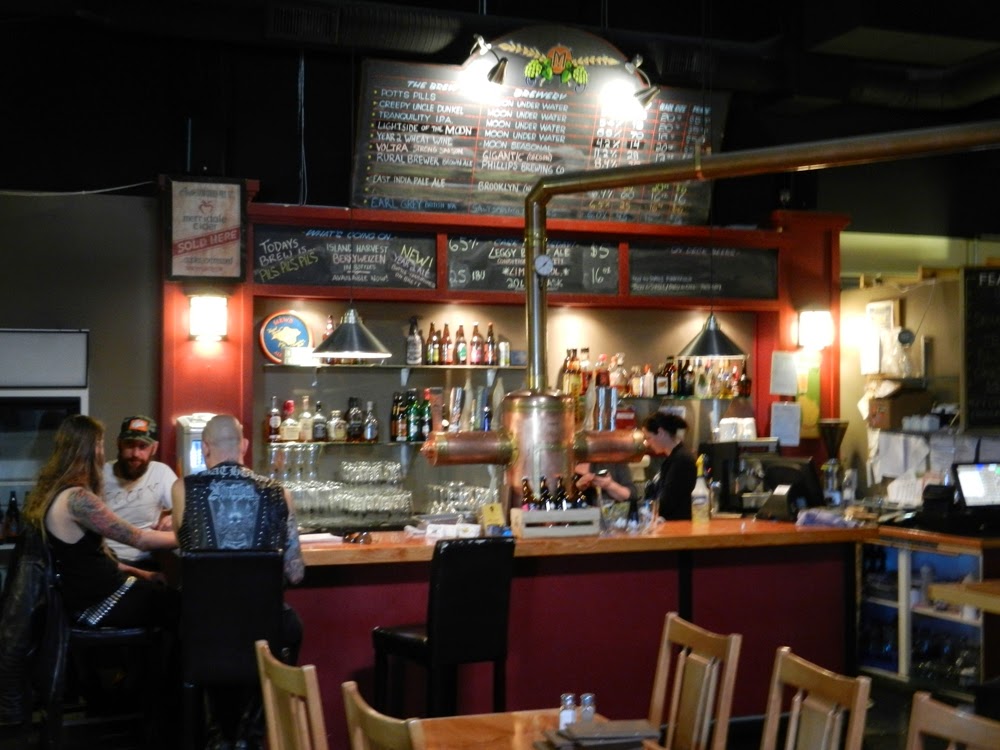
They had some experimental beer going on, including an Earl Gray IPA that was quite tasty. The mainstays are an IPA and pilsner (naturally) as well as a dunkel, which was surprising. I'd put Moon's beers a notch below their neighbor's, though they were pleasant enough. The food and feel was great, and the beer was above-average for a brewpub. And if you're looking for a place to land for a meal, it's a far better choice for these reasons than the final brewery I visited.
Canoe
450 Swift St
Canoe has one of the best locations in the city, and the space is amazing. It melds warehouse and lodge, with very high ceilings with exposed trusses and lots of unfinished wood. The food is also well above average brewpub fare, and I especially loved the moules-frites, which are normally the best beer food going.
Unfortunately, Canoe's beer was not good. Like everyone else, they do a pilsner and an IPA, and they augment these musts with a dark ale and a pale--and on my visit, an ESB. The pilsner was actually very nice. It was the first place I went, so also the first time I had the classic Victoria pils. But after that, it was downhill. The pale was full of diacetyl, the dark was over roasty, and the IPA and ESB had very rough, harsh finishes. Overall, a poor showing. It's not a bad place to stop in for the food, and a pint of lager will do you good. Don't bother with the taster tray, though.
Hoyne and Driftwood
2740 Bridge St and #102-450 Hillside Ave
 |
| They're this close. |
Driftwood is definitely in the conversation, though, and they do it mainly because they have Victoria's favorite IPA, Fat Tug. Brewer Jason Meyer seems most in synch with the kind of brewing we do south of the border, and in addition to the IPA, they do stuff like a saison, gose, wild ale, and fresh-hop ale. It's clear why the IPA is so coveted--it has managed to become the quintessential Victoria IPA, hitting all the notes locals like, but with greater verve than anyone else. It has an immensely juicy aroma, indicating the coming fruity flavor blast. Falsely, it turns out. The locals like their IPAs bitter, and Fat Tug is intensely so--all that juiciness in the nose evaporates under the alpha assault in the mouth. For my tastes, the Pale is a tastier pour. Meyer manages to get a softness out of his beers, and it really shines here with more subdued and flavorful hopping. Their saison uses the Ardennes yeast and black peppercorn and is also quite nice.
 |
| The brewhouse at Driftwood |
Brewer Sean Hoyne got started at Canoe (see below) before founding his eponymous brewery three years ago. Even though the beer geeks have overlooked the brewery, the public has not--Hoyne is already making 7,000 hectos (6,000 barrels) a year, the majority of it on draft. I can see why. As Dave, one of the brewers, was showing me around, the woman working the tasting room handed me a glass. I didn't know what was in it and was taking notes and listening to Dave speak. At a certain point, I distractedly passed the glass under my nose and was instantly rapt: a plume of Saaz hops blotted everything else out. (There are also Hallertau, Hersbruck, and Spalt, which inflect the Saaz with an herbal note, but it's mainly the Saaz that grip you.) The flavor was every bit as rewarding--aromatic pilsner malts and hop flavor that matched the the aroma in kind and intensity. This was their flagship, Hoyner Pilsner.
They do another lager that is Hoyner's equal, called Off the Grid. They call it a Vienna, but I've seen dunkels this color. In any case, it focuses more on the rich, nutty, biscuity malts; the Tettnang hops provide a lacy accompaniment, but this is a moreish lager they'd love in Bavaria. Hoyne, like Driftwood, does an eclectic mix of styles (including, in addition to more standard offerings, a smoked porter, hefeweizen, and espresso stout), but it's their lagers that really sing.
 |
| Hoyne's brewhouse |
Swan's Brewpub
506 Pandora Ave
Swan's is so far off the radar, I didn't even realize it existed until I strolled by on my way to Canoe. I can sort of see why: it's a wonderful space that nevertheless feels a bit touristy (it's right next to Chinatown) and the beer is decidedly old-fashioned. (I don't know if our experience was typical, but on the lazy Sunday afternoon of our visit, the musical selection ran to Jimmy Buffet and Foghat--a choice that didn't make it feel any hipper.) These things shouldn't condemn it, though: the ambiance is louche English pub (it recalled pubs from The Sweeney), airy but languid, and the old-fashioned beers are the reason to go.
Swan's also does some standards--a pale and and IPA and of course, the classic Victoria lager, with lots of Saaz--and one-offs like a white IPA. But it's really the cask ales you should be drinking--they make Swan's a great stop.
Spinnaker's
Victoria's oldest brewery was such an interesting place that I'll treat it to a special case study in a future post.
Moon Under Water
350B Bay Street
If you see a theme developing--new style breweries versus old style--it's because that's how it started to seem to me. Moon is definitely a charter member of the new school. Unlike nearby Hoyne and Driftwood, which are production breweries, Moon is a brewpub. The ambiance would be familiar to Portlanders--brewpub industrial. It's got a casual, cozy vibe. Along with Hoyne and Driftwood, it's in a slightly gritty industrial part of the city, but is in no way off-putting. Some of the locals warned us about the neighborhood, but it was no different than large parts of Northeast and Southeast Portland.
They had some experimental beer going on, including an Earl Gray IPA that was quite tasty. The mainstays are an IPA and pilsner (naturally) as well as a dunkel, which was surprising. I'd put Moon's beers a notch below their neighbor's, though they were pleasant enough. The food and feel was great, and the beer was above-average for a brewpub. And if you're looking for a place to land for a meal, it's a far better choice for these reasons than the final brewery I visited.
Canoe
450 Swift St
Canoe has one of the best locations in the city, and the space is amazing. It melds warehouse and lodge, with very high ceilings with exposed trusses and lots of unfinished wood. The food is also well above average brewpub fare, and I especially loved the moules-frites, which are normally the best beer food going.
Unfortunately, Canoe's beer was not good. Like everyone else, they do a pilsner and an IPA, and they augment these musts with a dark ale and a pale--and on my visit, an ESB. The pilsner was actually very nice. It was the first place I went, so also the first time I had the classic Victoria pils. But after that, it was downhill. The pale was full of diacetyl, the dark was over roasty, and the IPA and ESB had very rough, harsh finishes. Overall, a poor showing. It's not a bad place to stop in for the food, and a pint of lager will do you good. Don't bother with the taster tray, though.
Subscribe to:
Posts (Atom)
I also think it’s an oblique insult to an artist to be too reductive. There are certain art forms–visual art, poetry, music–that are able to express complexity non-conceptually. We can reduce the meaning we take into words, but we are then creating a smaller, less-complex simulacrum. If we’re open to it, the power of a cover like this happens in the nanosecond before we begin the process of assigning meaning, when emotions and curiosity are the sum of our experience. When we then move to “meaning,” we’ve gone to a slightly different place than the artist intended.
I think, anyway.