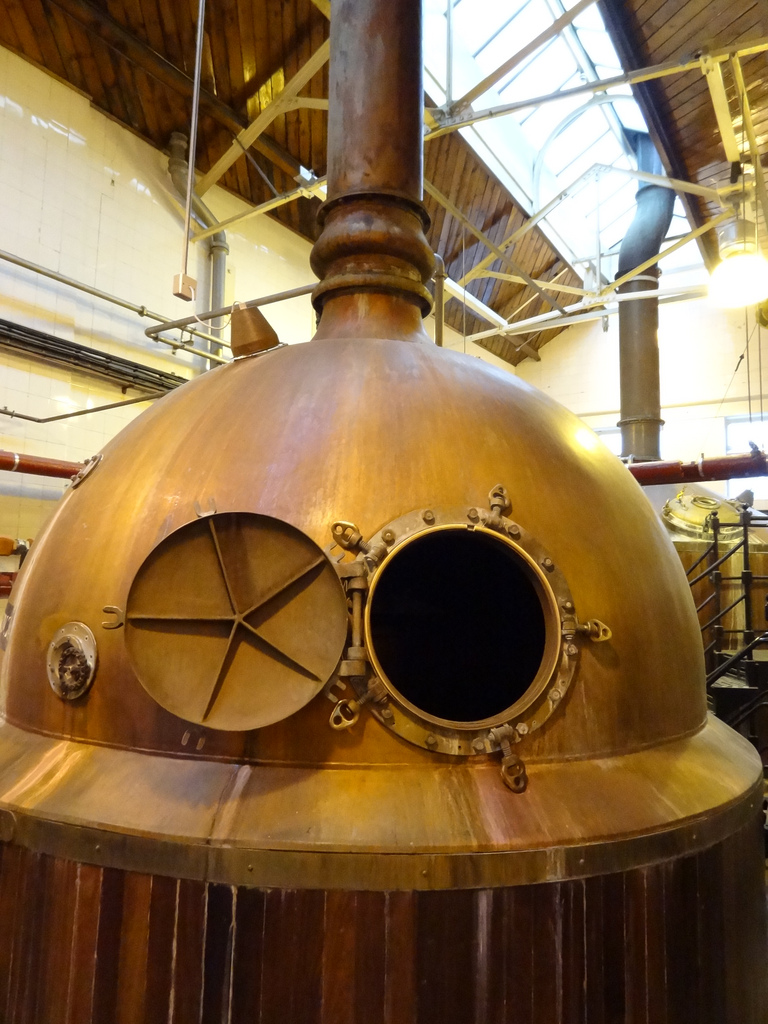
Brewer vignettes feature quotes from brewers I picked up in my travels around the world.
“It’s a very flocculent yeast and it has a natural tendency to float to the surface of the beer. That can be a mixed blessing during the fermentation, because the yeast is so flocculent it does want to do that at a fairly early stage in fermentation. So the approach taken to encourage it to ferment right to the end is to carry out rousing. The rousing effectively means that we pump from the bottom of the tank up and around this circular [inaudible]--a fishtail/fan arrangement that screws onto the pipe and that throws out a fan of recirculated beer into the top--and that pushes the yeast back down and it keeps the whole thing in a dynamic state.”
“It’s quite unusual to do that during fermentation. You wouldn’t expect to be throwing your yeast through the air. Now this whole thing produces CO2 during fermentation, so for the most part there is protection by natural CO2. It’s absolutely relevant to the beers we’re producing that whatever’s happening to the yeast in the process is having an impact on the flavors we’re getting. Typically, a very robust, complex, full-flavored beers.”
“It’s tradition. The brewery’s been here since 1758 at least and it’s still owned by the Smith family and they’re really, really heavily keen on maintaining traditions in everything. Traditional hand-crafted beer, and deliveries, the cooper making wooden barrels. It’s very much about history and tradition, really.”
Steve Barrett retired shortly after I visited and was replaced by Colin Carbert in 2012.
Showing posts with label Sam Smith. Show all posts
Thursday, January 12, 2017
Tuesday, January 31, 2012
Brewery News: Proef, Hair of the Dog, and Samuel Smith's
Fascinating developments. First, Yeager with the good news:
Now to Daily Mail (hat tip BeerNews) for the bad:
I hear it, and there are a few things in this story that just don't add up.
First, while Samuel Smith's has a reputation of treating tenants and employees poorly, they are extremely solicitous to punters. They proudly serve their pints at rock-bottom prices--like, 1970s prices. It seems odd that they'd slam a pub for topping up; that is, after all, a nice service to the punters.
Second, Humphrey Smith is so reclusive I didn't even know his name. During my visit, the brewery would only mention "the family" (la cosa nostra resonances abounding). So why does he show up, on New Year's no less, to shut down the brewery himself? This looks like a case of using the proverbial tank to kill a fly.
My guess--and perhaps the lads across the sea can comment--is that the Gibsons committed some other crime, one so severe it warranted not only sacking, but a public hanging (in the commercial sense) as well. Of course, we'll never know.
I should also add that this is all pure speculation and in the absence of real data, we have to take the case at face value. Maybe the Gibsons had regularly flouted instructions not to top-off the pints (an obscure dictate, but not inconceivable) and the sacking was richly deserved. Another caveat: I have written about the old Victorian brewery and the beer it turns out, which I admire enormously, but that doesn't mean it is exempt from public scrutiny.
For the last five years, much-decorated Belgian brewmaster Dirk Naudts, who develops beer recipes for brewers throughout Holland and Belgium, brings an American brewer over to his village, Lochristi, to collaborate. The chance to work with Naudts at his Na De Proef Brouwerij is much sought.... This year the honor goes to a Portlander, Alan Sprints from Hair of the Dog.
Now to Daily Mail (hat tip BeerNews) for the bad:
A pub landlord and landlady face losing their jobs and their home after brewery bosses accused them of serving too much beer in their pints.Of course, the extremely secretive brewery refused to comment. Having been a close follower and sometimes blogger of politics over the past decade, I have learned to identify coverup spin when
Pete and Debbie Gibson say they were forced to close the Junction Inn pub, on New Year's Eve, following a surprise visit by millionaire Humphrey Smith, owner of brewing firm Samuel Smith, who in front of shocked customers said he was shutting it.
The couple, who have run the pub, in Royton, near Oldham, Greater-Manchester for 12 years, have now been told they owe the company £10,733 in lost stock for topping up people's pints.
First, while Samuel Smith's has a reputation of treating tenants and employees poorly, they are extremely solicitous to punters. They proudly serve their pints at rock-bottom prices--like, 1970s prices. It seems odd that they'd slam a pub for topping up; that is, after all, a nice service to the punters.
Second, Humphrey Smith is so reclusive I didn't even know his name. During my visit, the brewery would only mention "the family" (la cosa nostra resonances abounding). So why does he show up, on New Year's no less, to shut down the brewery himself? This looks like a case of using the proverbial tank to kill a fly.
My guess--and perhaps the lads across the sea can comment--is that the Gibsons committed some other crime, one so severe it warranted not only sacking, but a public hanging (in the commercial sense) as well. Of course, we'll never know.
I should also add that this is all pure speculation and in the absence of real data, we have to take the case at face value. Maybe the Gibsons had regularly flouted instructions not to top-off the pints (an obscure dictate, but not inconceivable) and the sacking was richly deserved. Another caveat: I have written about the old Victorian brewery and the beer it turns out, which I admire enormously, but that doesn't mean it is exempt from public scrutiny.
Friday, January 06, 2012
Friday Flick: The Samuel Smith Cooperage
The video's quite rough, and you may have to put your ear next to the speaker to hear some of the conversation--but still, it is rather rare footage of an almost-extinct profession.
Of course, at one time, every brewery had a team of coopers on hand to make vats and casks. I haven't made enough of a study to know for sure how many working full-time coopers are still on staff in Britain's breweries, but it is certainly no more than the number of fingers on your two hands. If I had to bet, though, I'd say this is the footage of the last one.
Wednesday, November 16, 2011
The Enigmatic Samuel Smith's
I have been to ancient lands--India, China. It's not uncommon to encounter a building that has stood witness to fifty generations of us evanescent beings. The effect is telescopic--events in the rear-view mirror appear closer than they were. This happens with families, too--that, say, pass along the Rig Veda father to son for centuries. In the town of York, Romans run around the countryside and Vikings still adorn buses. On Sunday, I stood on the ancient wall in the city while the cathedral bells rang and in that dense moment was able to feel the dimmest tingling in my spine of the antiquity around me.
In Tadcaster, the keepers of the Vedas are brewers and their names are Smith. The lineage goes back to one family and it's still obvious the Smith name is an important one when you drive into town. At one end, the one named for John rises magnificently above the village much like Greene King stands over Bury St Edmunds. But while J Smith may own a larger market share, it's the other line, Samuel Smith's, where the true family lineage resides. (John Smith's is an industrial plant where Newcastle Brown--now mostly an export--and other supermarket brands are brewed.)
The street front for Samuel Smith's is a kind of metaphor for the brewery: its tiny face is as pleasant as it is inscrutable, and conceals everything about the brewery, which sprawls quite impressively, out of sight. Smith's is a fiercely private company, and they apparently don't open their doors often for visitors--so it was a real pleasure to have the opportunity to see it for myself.
So, how traditional is Smith's? Except for adopting a few technical innovations that have come along during the past century (a lab, for instance), almost everything is unchanged. Steve Barrett, the long-time head brewer, took us to the stable first, to meet William. Standing 18 hands tall, he's one of two immense work horses that deliver the cask beer every day. That set the tone of the tour.

We went to the base if the old Victorian brewery to where the well is located--and which still draws us the hard, gypsum-rich water the brewery uses. We passed the coal bin, next to the boiler that steam-heats the brewery. A bit sheepishly, Steve nodded to the soaring smokestack typical of breweries this age--except Smith's was still sending a thin smudge of smoke into the air. (The brewery has used a bit of technological advancement there to make the coal fire compliant with environmental law.)

At each step, I grew more and more amazed. This wasn't a brewery that couldn't be bothered to move into the 21st century--it was a brewery spending a great deal of bother to maintain the practices of the 19th. The brewery proper was a classic tower, and we hike up the five stories to the grain and mill room and worked our way down. (Smith's was a pioneer in organics, even using organic hops, and when I mentioned this to the shadowy figure, he said, "yes, but organic is very traditional, isn't it?") The mash tuns and coppers are beautiful and huge, and the India Ale even flows over and old chilling contraption that dribbles the wort from a trough over a vertical stack of coils with cold water running through them. It's collected at a second trough and heads off to the fermenters. (This was when I learned there was a lab--even Steve is a little wary of the system. But the lab says it comes out bug-free.)

Of course the beer then goes to the famous Yorkshire squares--though they aren't actually much different than other systems still in breweries around the country. (Caledonian's, though made of modern stainless, are identical.) Square fermenters, in various configurations remain, if not the norm, at least quite common.
In fact, the most remarkable part of the brewery comes after the squares--when it's time to put the beer on cask. Some goes in regular casks, some in bottles. But the Smith's Old Brewery Bitter goes into actual wooden casks. Even more remarkably, the casks are made and maintained on-site by the brewery's cooper, whom we visited next. The casks are built to last, and Steve said there are staves in some of the older casks that go back decades.
(Which raises a question, doesn't it? I asked Steve about it, but he says no wild yeasts have moved into the wood--though this seems incredible to me. I was left to wonder; was this the last extant example of true mild ale--young beer, drunk too quickly to pick up any funk? If so, I can confirm that served in the lovely old pub next door--coal fire burning in the hearth--it exhibits nothing but freshness.)
Finally, the tour was over and we were graciously bid adieu. There has been some talk lately of the old "gentlemen brewers" of the old times. These were very proper men who wore suits and ushered the activities of the brewery in a formal elegance. As the old guard of this generation were just getting started, there were a few of them left. Except that I felt that way about Sam Smith's too, and its formal, proper brewer, Steve Barrett. He retires next April, and someone new--although maybe not new to the Smith family--will take the reins. I feel doubly fortunate to have had the opportunity to meet Mr. Barrett.

There's a lot more I could say to lend texture and detail to the visit, but I've rattled on long enough. I'm finishing this post in Belgium, where I've somehow managed to arrive without incident. Although the drive over was a little shocking: what the hell are all these Belgians doing on the right side of the road?
More to come from the Low Countries--
Tuesday, April 27, 2010
IPAs and More IPAs: Twisted Thistle and Samuel Smith's
I am working on a project which, if successful, I'll not only tell you more about, but celebrate by dancing around in mad joy. But so far the project is mainly keeping me from better blogging. It's a piece of a piece, and the part I'm working on involves IPAs. I've been trying to find examples to laud, from the US and beyond. In particular, I've been trying to find decent British IPAs--something you'd expect would be easy to do. (You'd be wrong.) I'll review them as I work my way through, so here's the first couple.
Samuel Smith's India Ale
Back when I first started drinking good beer, Tadcaster was a go-to brewery. Imports were hard to get, and nice English imports more so.
I loved their oatmeal and imperial stouts, and the nut brown was nice, if sweet. The distinctively-named India Ale never called out to me, but given that it is so widely available and is, after all, an authentic English IPA, I felt I should give it another go. Sometimes a decade does wonders for a beer.
Unfortunately, this beer was a disaster. Even with the important stipulations: modern English IPAs are milder in alcohol and hop than they were in the 1800s and than they are in America. British breweries don't eschew sugar the way we do, but in some beers it's just wrong. I couldn't confirm Sam Smith's uses it here, but it certainly seemed like it. Thin, overly sweet, and harsh in that way sugar alcohol can get. I found it metallic, bordering on sour, and actively unpleasant. There was precious little hopping to be found, and what was there was tepid and undistinguished. There's some chance that part of the problem was age or travel damage, and so I hesitate to write it off completely. Still, what I found in my bottle was undrinkable. I dumped the whole thing.
Belhaven Twisted Thistle
What's the difference between a pale ale and an IPA? Descriptively, an IPA is just stronger and hoppier.
Experientially, though, the IPA should give you a pop. Belhaven's isn't a muscular beer (6.1%), and it isn't super hoppy, but it has a wonderful zip to its hopping. I was surprised at the presentation--a light golden with an arctic white head and quite a bit of bead. One could mistake it for a pilsner. The aroma has a touch of diacetyl and caramel, but not so much in the way of hops. Instead, they come out on the tongue. The labels says Belhaven employs Challenger and Cascade hops, but I don't think they're US Cascades. The Challengers are obvious, but the profile is much cleaner and sharper than our pungent, funky hops. Despite the body, it's a creamy beer. Some malt tannins add to the sharpness of the hops, though there's also a touch of caramel. Given the relative paucity of assertive British IPAs, this stands out.
_______________
Share
Samuel Smith's India Ale
Back when I first started drinking good beer, Tadcaster was a go-to brewery. Imports were hard to get, and nice English imports more so.
I loved their oatmeal and imperial stouts, and the nut brown was nice, if sweet. The distinctively-named India Ale never called out to me, but given that it is so widely available and is, after all, an authentic English IPA, I felt I should give it another go. Sometimes a decade does wonders for a beer.Unfortunately, this beer was a disaster. Even with the important stipulations: modern English IPAs are milder in alcohol and hop than they were in the 1800s and than they are in America. British breweries don't eschew sugar the way we do, but in some beers it's just wrong. I couldn't confirm Sam Smith's uses it here, but it certainly seemed like it. Thin, overly sweet, and harsh in that way sugar alcohol can get. I found it metallic, bordering on sour, and actively unpleasant. There was precious little hopping to be found, and what was there was tepid and undistinguished. There's some chance that part of the problem was age or travel damage, and so I hesitate to write it off completely. Still, what I found in my bottle was undrinkable. I dumped the whole thing.
Belhaven Twisted Thistle
What's the difference between a pale ale and an IPA? Descriptively, an IPA is just stronger and hoppier.
Experientially, though, the IPA should give you a pop. Belhaven's isn't a muscular beer (6.1%), and it isn't super hoppy, but it has a wonderful zip to its hopping. I was surprised at the presentation--a light golden with an arctic white head and quite a bit of bead. One could mistake it for a pilsner. The aroma has a touch of diacetyl and caramel, but not so much in the way of hops. Instead, they come out on the tongue. The labels says Belhaven employs Challenger and Cascade hops, but I don't think they're US Cascades. The Challengers are obvious, but the profile is much cleaner and sharper than our pungent, funky hops. Despite the body, it's a creamy beer. Some malt tannins add to the sharpness of the hops, though there's also a touch of caramel. Given the relative paucity of assertive British IPAs, this stands out._______________
Share
Subscribe to:
Posts (Atom)