You love the blog, so subscribe to the Beervana Podcast on iTunes or Soundcloud today!

Showing posts with label science. Show all posts

Friday, December 16, 2016

Won't A.I. Beer Inevitably Result in Bud Light?

I somehow missed the yuuuuge rollout this summer of IntelligentX, a Britain-based project to produce beer that responds via algorithm to customer choice:
After you’ve tried one of our four bottled conditioned beers, you can tell our A.I. what you think of it, via our online feedback system. This data is then used by our algorithm to brew the next batch.
Because our A.I. is constantly reacting to user feedback, we can brew beer that matches what you want, more quickly than anyone else can. That means we get more data and you get a better, fresher beer. 
Paging through Google search results, I see they got a massive amount of press for this, nearly all of it happy to goose the hype machine. (Admittedly, combining "AI" and "beer" is genius clickbait and I kick myself for not thinking of it first.) For some reason, there's a new round of hype, which is how I stumbled on this just now. 

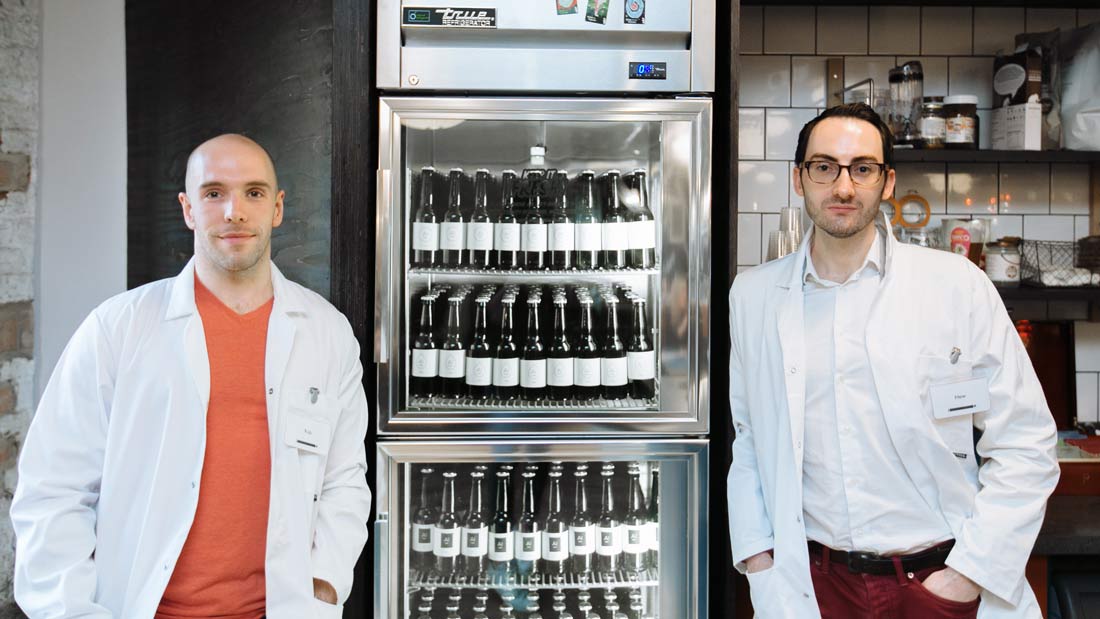
Lab coats make this seem extra sciencey.
Source: 10x


As far as the project goes: whatever. It seems almost inevitable that someone would have invented this in 2016. (In fact, if Elon Musk is right, it was algorithms that led us here in the first place--algorithms within algorthims.) Every start up in the world is trying to figure out how to monetize app-collected data, and fusing that to the jillion-dollar beer industry is a no-brainer. 

I am surprised no one pointed out the three fatal flaws behind the rationale for this project, though. My guess is most brewers would have seen it immediately. First, incorporating feedback into recipes is what breweries do. Markets function as far more effective algorithms than a consequence-free thirteen seconds tapping buttons on a smart phone. There are five thousand US breweries making at a minimum 50,000 beers in the US, and the feedback of preference is available when a customer spends actual cash on a beer. 

Second, people have different tastes. I was out for a beer last night with BeerAdvocate's Ben Keene and Eater Seattle's Adam Callaghan. We discussed how breweries now use IPAs as points of distinction--each one is different, to suit different tastes. And third, collecting the input of hive mind means finding the exact average of their preferences. It will produce a beer most people think is adequate. "In pursuit of the perfectly average beer" was probably not the motto they were shooting for. Brewers know you can either appeal weakly to the largest group (light beer) or powerfully to a small subset (distinctive IPAs), but you cannot simultaneously do both.

And one final thought I throw out to the techies out there. I'm not perfectly versed on my sci-fi futurism, but does any of this actually have anything to do with AI? I mean, find me a HAL who's making his own beer, and then we're talking.

Tuesday, July 12, 2016

A Deep Dive on the Claims About New England IPAs (Way Nerdy)

Last week, the ever-busy Jason Notte had a great piece on the rise of niche brewing. This is a point I regularly make to visitors coming to Beervana: one of the things that makes the city so interesting is the presence of breweries that don't make IPAs--like Occidental, Upright, and the Commons (among others). It's a city of diversity. For his piece, Notte chose Great Notion Brewing, which specializes in the fraught "New England IPA" category.
Miller and Dugan had spent years home-brewing and swapping beers with friends across the country before realizing that their brewery’s inspiration had to lie somewhere other than Portland. They were taken with the hazier, fruitier India Pale Ales being made by Northeast breweries including Maine Beer Co., The Alchemist and Tree House.
(To be fair, Great Notion is making a pretty broad line, and their puckery beers are for me their real calling card.)

All well and good. Let's not relitigate this particular debate. My bone of contention comes with a comment Great Notion's James Dugan makes--a pillar on which these types of beers seems to rest. The overwhelming trend in American beers now is toward saturated and intense hop flavors and aromas, not bitterness. Somehow the idea is that the New England IPAs have a greater abundance of these qualities due to their cloudiness. And here Dugan doubles down with some science:
People look at our beers and say: “You have too much yeast in suspension.” What it comes down to is educating people that there is some yeast in every beer — we don’t filter, we don’t fine, we don’t centrifuge — but we cold crash all of our beer, drop the yeast out and then do a heavy dry hopping. We dry hop about two and a half to three gallons per barrel. When you dry hop that heavily, you get hop polyphenols that are basically tannins that saturate beer with oils.

Without protein content from wheat or oats, those oils eventually drop out. What we’re finding to be the defining characteristic of our beers is this marriage of protein and hop oil saturation. What’s happening is that those two are binding. You have this hop oil stuck in suspension and when you pour it into a glass, you’re tasting the hop oil. 
This seemed ... dubious. I set about looking into the science, but unfortunately, the mechanism of hop flavor and aroma hasn't been studied much. For decades, all hop research was focused on IBUs and paid for by big breweries who were trying to get ever more bitterness out of ever fewer hops. The state of the aroma and flavor research is still in the gestation state. I spoke with researcher Tom Shellhammer at Oregon State last year about a project to understand the mechanism of dry-hopping. He described it for me:
“What it’s getting at is, if you’re going to use hops for dry-hopping and make a consistent product batch-to-batch, should you as a brewer hop based upon the mass of hops, or the oil content of the hops—or based on something else?”  
This illustrates how little we understand about these mechanisms. But we understand something. We know some of the constituents of hops, like oils and and acids and prenylated flavonoids (yes, I way out over my skis on that last one), and we have some sense of what they do and don't do. In particular, scientists have focused a lot of their attention on the terpenes like myrcene, linalool, geraniol, and so on that give hops their lovely citrus or floral kick. But we also know that hops are incredibly complex and not only are there many other compounds I haven't mentioned, but even the ones I have aren't inert. Some terpenes, for example are "biotransformed by yeast during the fermentation" into other terpenes. The question at hand is whether proteins enhance and preserve the behavior of hop flavor and aroma, as proponents of New England IPAs believe.

It doesn't really add up. There's no mechanism that I understand that would cause the polyphenols in hops to bond the oils to the proteins in grain. (It's not clear why the hops don't bond to the proteins of barley, which are also present in beer, except I suppose there is less of it.) Polyphenols affect the perceived smoothness or harshness of hop flavor, but they don't appear particularly relevant to that "juicy" quality prized by modern breweries. The thing you're worried about with hop oils is degredation from oxygenation, not dropping out of suspension. Terpenes in oils appear to be susceptible to this as well, and they are also volatile and can escape the liquid. There's really nothing we know that suggests wheat and oat haze is going to affect these hoppy properties.

I shot an email to Stan Hieronymus, the writer who literally wrote the book on hops, to find out if this sounded plausible to him. If he'd like to weigh in on this, I'll let him do so in his own words. The one thing he mentioned that seemed really important was this: we "have to get past thinking about oil and think about compounds," he said. Oils are part of the equation, but they're not the whole kielbasa.

For me, the proof is in the palate. I still haven't encountered anything different in these cloudy IPAs in terms of hop flavor and aroma than I do in typical (hazy but not milky) modern American IPAs. It's as easy to make a saturated IPA whether it looks like a milkshake or not.  Dugan--and others, apparently--have argued that there's some science going on in these beers that make them especially juicy. Could be! But point me to the studies that demonstrate it, please. Sciencey language doesn't quite cut it alone. (Otherwise hive mind would let me get away with a lot more BS.)

For now, I think these are standard modern American IPAs with a ton of haze. And a special prize to anyone who managed to read through this post to get to that rather modest conclusion.

Thursday, March 17, 2016

The Trouble With Butyric Acid (Nerdy)

Last night I was drinking a gose and noticed a flavor I've encountered in some beers soured by Lactobacillus: the faint flavor and aroma of vomit. Delish! It's never been overwhelming in any beer I've encountered, but does tinge the whole affair with unpleasantness. Horse blanket, a touch of compost, vinegar--all of these have their place. Vomit not so much.

I tweeted out my finding and the result was a flurry of information. The culprit here is butyric acid, actually an ester, which is indeed found in human vomit.
Butyric acid is a carboxylic acid found in rancid butter, parmesan cheese, and vomit, and has an unpleasant odor and acrid taste, with a sweetish aftertaste (similar to ether). Butyric acid is a fatty acid occurring in the form of esters in animal fats and plant oils. Interestingly, low-molecular-weight esters of butyric acid, such as methyl butyrate, have mostly pleasant aromas or tastes. As a consequence, they find use as food and perfume additives. 
(Interestingly, it's not such a problem in beers where Brettanomyces is also present, because that wild yeast can convert the esters to more pleasant tropical-fruit aromas.)

The curious question is where it comes from. One brewer reported that it can be produced by Lactobacillus in the presence of oxygen (lacto are a anaerobic bacteria). But as I dig around in my admittedly crude fashion, it seems more likely to come from Clostridium, another anaerobic genus of bacteria. It seems like a terrifically pernicious beast; there are some species of Clostridium tolerant of boiling temperatures. Even more unsettlingly, it likes carbon dioxide:
Carbon dioxide from both fermentation and artificial introduction has been shown to have a stimulatory effect on the growth of Clostridium butyricum (as well as other bacteria such as E. coli) [11]. If sanitation issues allow for Clostridium to enter the brewery, CO2 purging may encourage butyric acid formation.
It doesn't seem like lacto is a significant factor in all of this. So why do some kettle-soured beer develop the delightful flavor of vomit? My theory is that brewers are introducing Clostridium when they use grain to inoculate their wort during kettle-souring rather than a pure culture of lacto. Grain does indeed have lacto, but it has other stuff, too. (It's why sour mashes almost always produce gross ancillary flavors like garbage and, yes, vomit.) The pH drop eventually inhibits Clostridium, but perhaps not before it's had a chance to add its own charming compound.

This is all just noodling about--the reason, I'm told, blogs were invented--and I would love love love actual scientific info should anyone be in possession of such. One blogger's half-baked theories may make for an interesting three minutes' read, but it would be preferable to actually learn what's going on.

If you know, do tell.

Monday, June 11, 2012

Beer's Implausible "Miracle Molecule"

This sounds great...
Scientists have discovered that a hidden vitamin in beer and milk called the "miracle molecule" may prevent obesity.  A new study found that nicotinamide riboside (NR), a molecule found to indirectly influence the activity of cell metabolism, could play an important role in preventing weight gain and diabetes, improving muscular performance and providing other "extraordinary health benefits," according to a Switzerland-based research team.
Until you consider this: 


Thus the important disclaimers: "However, researchers said that the molecule is extremely small and difficult to reproduce. 'At the moment, we can't even measure its concentration in milk,' [study author Carles Canto] warned. 'So it's impossible to know how much you would have to drink to be able to observe its effects.'"

I'm guessing the value of this extremely small molecule is offset by the large dose of calories you chug with every pint of IPA.  More study is needed.

_________________
Photo credit: Belly Blubber Blasters

Thursday, September 08, 2011

BrewDog's Ghost Deer--Too Strong to be True?

Somehow I missed the latest gonzo marketing blitz from the lads at BrewDog. (That may be a downside of always keeping the volume at 11.) In July, they announced another super-strong beer called Ghost Deer that came with all the unusual bells and whistles we associate with BrewDog:
Ghost Deer is a 28% fermented beer, the strongest ever fermented beer.... After fermentation it is aged for 6 months in some amazing whisky, bourbon, rum and sherry barrels. There is only one Ghost Deer head and this beer will only ever be available on draft, served in a stemmed glass, direct from the mouth of the deer himself.
That business about the deer is of course literal--it pours from the mouth of a taxidermied deer head. The release was accompanied by one of the brewery's famous videos, which tells the tale of the ghost deer and manages to advance the brand brilliantly.

All well and good. But here's the thing: 28%?? Can this be? If BrewDog has managed to ferment a beer to that level, it would be a towering achievement. They report using three yeast strains to get there, but I've never heard of any yeast that comes close to tolerating that level of alcohol (White Labs and Wyeast strains top out at 18%). Beer has complex sugars that yeasts have a hard time digesting at final gravity, so even if you found a yeast strain that could go that high, I don't see how it could munch through the maltotriose to get down to that level. It seems to me that if BrewDog managed to create a beer of 28% strength entirely from fermentation, it would represent a radical advancement--one far more impressive than taxidermied deer heads.

Any sciencey types out there willing to shed some light on this? Is BrewDog polishing the apple here, or is it really possible to tease 28% alcohol out of the hardest-working fungi in the beer world?

Monday, May 02, 2011

Study: Keep the Kids Away From the Liquor Cabinet

(I'm suffering a little bin Laden fatigue, and since this is my blog, I'm allowed to violate my own rules, like not talking about beer today.)

I have no horse in this race (or kids in the house), but I know studies like this provoke strong reactions. Still, I think it's wise not to dismiss them out of hand.
A new study shows that teens who drink with an adult supervising are more likely to develop problems with alcohol than kids who aren’t allowed to touch the stuff till they hit age 21.
I think we all want the same thing for our successor generations: healthy, happy people who enjoy superb beer in moderation. Since the goal is clear, it's worth being open minded about the method. However, it's also worth noting that the methodology mentioned in the story doesn't seem to be perfectly brilliant. Maybe the actual study was better.

Your thoughts?

Wednesday, February 16, 2011

New Blog: Beer Sensory Science

Back in November, I got an email from a new blogger who's work greatly interested me. The site is called Beer Sensory Science, and the "Beer Sensor" describes himself (I think it's a he) as a "sensory panel administrator at a regional American craft brewery." (For the sake of his employer, he's trying to stay anonymous.) The blog is focused on the nexus between science and the experience of consuming beer, a little-discussed, little-understood element of beer.

So, you get a description of the six most prevalent esters that contribute flavor in beer, such as:
Ethyl butyrate (aka ethyl butanoate): very common in beers. Threshold: 400ppb. Common levels in beer: 50-250ppb. Smells of tropical fruit, pineapple, Juicy Fruit bubble gum. Our panel has seen ethyl butyrate in: Alaskan Winter Ale, Hair of the Dog Blue Dot, Stone Levitation, Coors Blue Moon, Deschutes Twilight, Stone Belgian IPA.
Or this post, on the person-by-person variability of olfaction:

Some practical examples of this have been seen in the threshold tests I’ve performed with the panel regarding diacetyl. Some panelist’s thresholds are down below 30ppb, while others are well over 100ppb, and there are even 1 or 2 who may be totally anosmic to it (meaning they have no ability to detect it at any concentration).... Another example comes from the flavor standard “indole”, which has been known to elicit a floral jasmine-like aroma for a certain portion of the population, while the rest of the population smells fecal material.

Or this post on glycosides, currently my fave:

Glycosides are compounds which contain two parts: a sugar component which is in its cyclic (ring) form, and another component attached to the sugar at the number 1 (or “glycosidic” carbon). Some of these companion molecules can also be sugars, so sucrose, being a 2-sugar molecule (disaccharide) made of one glucose unit and one fructose unit attached through the appropriate carbon, is an example of one of these types of glycosides. The glycosides which appear to influence beer flavor are found in hops and have aromatic compounds bonded to the carbohydrates. In their combined state, the glycosides have no flavor; no sweetness and no aroma. However, once this glycosidic bond is broken the aromatic compound is free to volatilize into the headspace of the beer and ultimately into your nose.

Fascinating! Of course, since the Beer Sensor is a chemist, you get baffling information like this, too: "In beer, the substrates that react to form the variety of common esters are the numerous alcohols present (byproducts of amino acid and carbohydrate metabolism) and the various acyl coenzyme A molecules which are active participants in some of the metabolic processes of brewer’s yeast." Err, right.

In any case, it's a great site and one I'll be checking in on regularly. Have a look.

Tuesday, October 19, 2010

If You're Smart, You Drink a Lot

Let's try a little thought experiment here (without looking at that prominent graph just below this paragraph, please). Take humans and divide them into five categories of intelligence, with normal in the middle. Now, imagine these arrayed on a bar chart that measures alcohol consumption per group. Which bars are the tallest? If you subscribe to mid-20th-century psuedo-science, you probably imagined a downward slope, with the dull-witted, criminal minds soaking in the most booze. Actually, just the opposite:

These findings are reported in Psychology Today. Amazingly, you can predict how much adults will drink by measuring how smart they are as children (in the aggregate, anyway):
[M]ore intelligent children, both in the United Kingdom and the United States, grow up to consume alcohol more frequently and in greater quantities than less intelligent children. Controlling for a large number of demographic variables, such as sex, race, ethnicity, religion, marital status, number of children, education, earnings, depression, satisfaction with life, frequency of socialization with friends, number of recent sex partners, childhood social class, mother’s education, and father’s education, more intelligent children grow up to drink more alcohol in the UK and the US.... “Very bright” British children grow up to consume nearly eight-tenths of a standard deviation more alcohol than their “very dull” classmates.
These findings are true even when stress levels are taken into account, factors controlled for in the study:
It means that it is not because more intelligent people occupy higher-paying, more important jobs that require them to socialize and drink with their business associates that they drink more alcohol. It appears to be their intelligence itself, rather than correlates of intelligence, that inclines them to drink more.
The piece also discusses the fascinating implication this behavior has with regard to natural selection. "Evolutionary novelty" describes the emergence of new behavior in a population--the critical step in adaptation. Because alcohol consumption is evolutionarily recent, we would expect humans who adopt it--those engaging in evolutionary novelty--to be the most clever. For it is the clever who tend to innovate, survive, and pass along their genes. And so, evolutionary biologists would have predicted that the humans to adopt drinking would be the most clever. And so it is.

Now, you might take the whole business in a different direction. Y ou might say: "Wow, the fact that I'm a major beerhound apparently confirms my genius." And far be it for me, your humble blogger, to disabuse you of such a notion. You're reading this blog, after all.