Brewer vignettes feature quotes from brewers I picked up in my travels around the world.
“It depends on the beer category you are producing. If you try the lager type, the decoction is very important. We compared decoction versus infusion on our small-scale brewery; always the beer brewed by the infusion process was emptier in its taste—the body was not correct for the lagers. Also the color changed. If you boil during the decoction, you prepare the compounds which cause golden color. So the infusion lagers were yellowish, not so full in its taste.”
“Always there is a discussion of the definition of pilsner lager. We are a bit different [than Pilsner Urquell]. It is not so bitter, and a bit deeper fermented. It’s really difficult to compete with Pilsner Urquell because I think that it’s really the style. It became the style of the pilsner type. We are a bit different in this category because bitterness is really fine, the alcohol is a bit higher than the pilsner has. The Budweiser beer is really different.”
(Incidentally, there's a cool story about that mug Brož is holding. They're
copper-clad but lined by tin, and
are the vessels brewers have used to taste beer for ... ever, probably
(Adam wasn't sure; "a very long time.") It's called something like a mazek, based on what I could hear him say, and that apparently derives from the name of the
volume it holds which I think is related to the German Maß. When we were in the cellars, he used that little
pigtail you can see in his left hand to zwickel beer (the pigtail is
nearly always used for lagers in Germany), and he filled that that
sucker nearly up to its full mazek. The day I visited, the brewery was having electrical work done, and there was no power on in the brewery. Except for the small flashlight he carried, we were in the dark, like thieves stealing the beer. After he filled it up, we passed it back and forth and crept around the echoing cellars--which I couldn't see.)
Showing posts with label Budvar. Show all posts
Wednesday, September 28, 2016
Wednesday, January 02, 2013
Notes from Budvar
Okay, on to the next style. Today I'm listening through my transcription of my visit to Budějovický Budvar with brew master Adam Brož and Petr Samec. It was one of the highlights of all my time in Europe, and easily one of the most edifying experiences (though that's partly because I was so wildly ignorant of Czech brewing). So here are some of the highlights.
Pilsner
I learned that in the Czech Republic, there is only one pilsner. Everything else is světlý ležák. Confused? Here's Adam.
Decoction
I've been thinking and writing about decoction mashing. At Ayinger, they installed a new system recently that includes a mash cooker, but they abandoned it. Too time- and energy-inefficient; a process they describe as old-fashioned. Budvar takes a different view:
The Grant
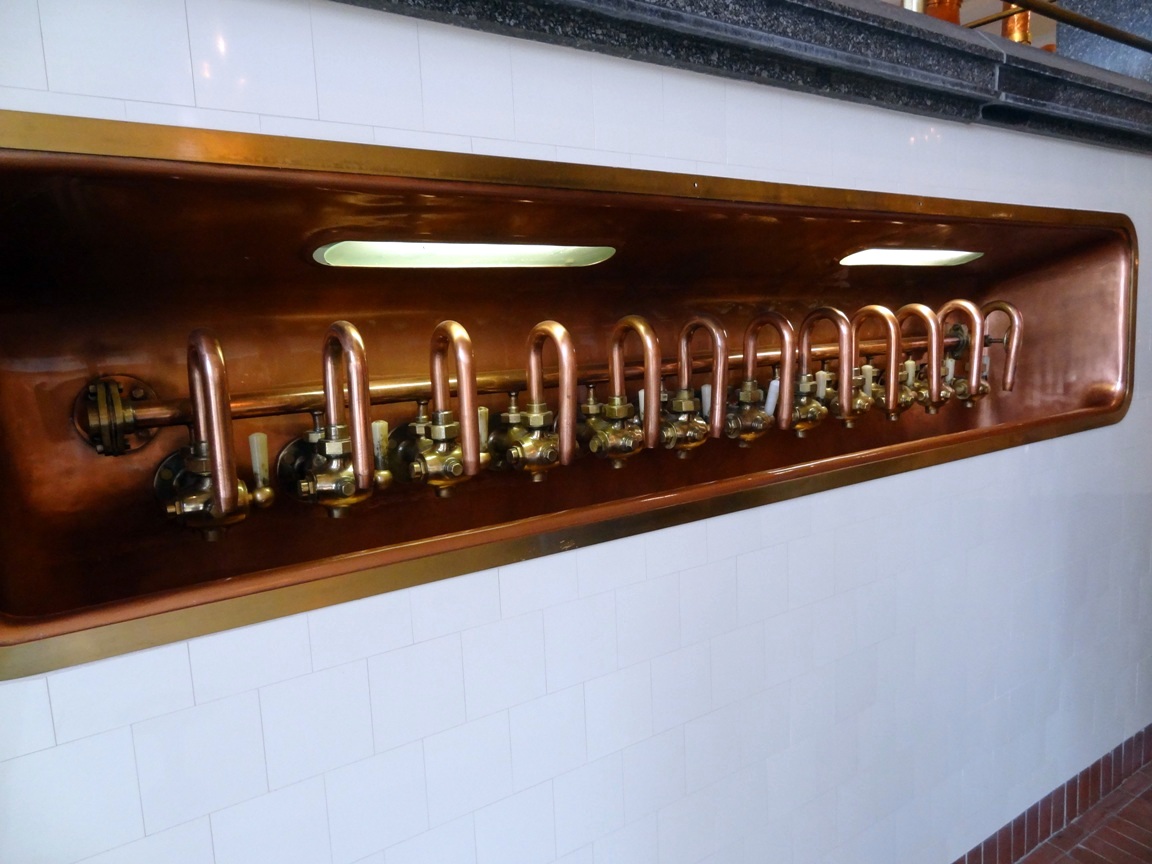
I became fascinated to see that Czechs are absolutely faithful to a piece of equipment called a grant. You see it underneath the lauter tun, a recessed pocket with a long array of swan-neck facets and valves. “These valves served to open or close the lautering manually. Nowadays it’s controlled by the PC.” I've seen these still in use in Belgium, but rarely. The problem, as Brož quickly acknowledged is: “The side effect is this slight aeration of wort, which is an important thing.” Really? Do tell.
Brewing Process
On the beer itself, for those who are interested. It's made with a double-decoction mash (typical in Czech) to 12 degrees P. All Moravian pilsner malt (though "we call it pale malt," Adam said, laughing), the gold color coming from decoction. The hopping procedure is interesting. They use 100% Saaz or Žatec (pn. jha-tetch) hops, whole flower, and the first addition comes as lautering starts “at the beginning when the bottom is covered.” Then the second addition comes "when there is a full kettle," and the final addition is at 30 minutes from the end of the 90-minute boil.
Fermentation and maturation is quite unusual. “There was a very simple rule: one degree of Plato in the wort means one day of fermentation. The lager has 12 degrees of Plato and ferments twelve days for main fermentation.” Budvar then lagers it for 90 days (!), a practice he calls "deep" maturation.
Pilsner
I learned that in the Czech Republic, there is only one pilsner. Everything else is světlý ležák. Confused? Here's Adam.
“Always there is a discussion of the definition of pilsner lager. It’s really difficult to compete with Pilsner [Urquell] because I think that it’s really the style. It became the style of the pilsner type. We are a bit different in this category because bitterness is really fine, the alcohol is a bit higher than the pilsner has. The Budweiser beer is really different. “You will find in Budvar that the bitterness is very mild—not so low—but mild.” (His emphasis.)Breweries defer to Pilsner Urquell as being the pilsner. Others make pale lagers, and they seem keen to point to distinctions.
Decoction
I've been thinking and writing about decoction mashing. At Ayinger, they installed a new system recently that includes a mash cooker, but they abandoned it. Too time- and energy-inefficient; a process they describe as old-fashioned. Budvar takes a different view:
“If you open the Czech brewing books, you will see that the typical process is a two-mash decoction process. It depends on the beer category you are producing. If you try the lager type, the decoction is very important. We compared decoction versus infusion on the small-scale brewery; always the beer brewed by the infusion process was emptier in its taste—the body was not correct for the lagers. Also the color changed. If you boil during the decoction, you prepare the compounds which cause golden color. So the infusion lagers were yellowish, not so full in its taste.”
The Grant
I became fascinated to see that Czechs are absolutely faithful to a piece of equipment called a grant. You see it underneath the lauter tun, a recessed pocket with a long array of swan-neck facets and valves. “These valves served to open or close the lautering manually. Nowadays it’s controlled by the PC.” I've seen these still in use in Belgium, but rarely. The problem, as Brož quickly acknowledged is: “The side effect is this slight aeration of wort, which is an important thing.” Really? Do tell.
“Because sometimes if you open the literature you will see that the oxidation processes are bad for the beer and it’s necessary to avoid them, but there are several articles, especially from Germany, where when the stages in the brewhouse were compared the oxygen was not always bad, especially before boiling with hops. The oxygen has [?] in it in small amounts due to the reaction of polyphenols and proteins. It influences this reaction. So if the sweet wort runs through these valves, a small amount of oxygen is taken in and the reaction between proteins and polyphenols ends well.”He believes the splashing of the grant actually improves the beer.
| Not just for old breweries: this is the grant in Pilsner Urquell's state of the art, modern brewhouse. |
Brewing Process
On the beer itself, for those who are interested. It's made with a double-decoction mash (typical in Czech) to 12 degrees P. All Moravian pilsner malt (though "we call it pale malt," Adam said, laughing), the gold color coming from decoction. The hopping procedure is interesting. They use 100% Saaz or Žatec (pn. jha-tetch) hops, whole flower, and the first addition comes as lautering starts “at the beginning when the bottom is covered.” Then the second addition comes "when there is a full kettle," and the final addition is at 30 minutes from the end of the 90-minute boil.
Fermentation and maturation is quite unusual. “There was a very simple rule: one degree of Plato in the wort means one day of fermentation. The lager has 12 degrees of Plato and ferments twelve days for main fermentation.” Budvar then lagers it for 90 days (!), a practice he calls "deep" maturation.
Saturday, October 27, 2012
Don't call It a Pilsner
So there are a few things you should know about Czech beer. It's not all golden. It's not all lager. They don't call their Moravian malt "pilsner" malt--it's just pale. And at the original Budweiser, from Budweis (which only later became Ceske Budejovice), they don't call their beer a pilsner. That appellation is reserved for the big brewery to the northwest. But more on styles in a while.
We'll get back to that in a moment, but let me step back and mention that I just spent the day at Budvar--and on the first snowy day of the year (!). It was sadly not warm inside because I visited not only on one of the only days of the year the brewery's not in motion, but on a day when the electricity was off for maintenance. So head brewer Adam Broz and communications chief Petr Samec (the man who graciously set up my visit) and I charged around the brewery with a flashlight for a most rare tour. You have to work pretty hard to find the brewery in this state, but I'm just lucky. (In Czech they don't celebrate Halloween, but walking around a silent, dark 1.3 million hectoliter brewery reminded me of the spooky season. It was especially atmospheric to roam the cellars in complete darkness zwickeling beer into an old-timey copper mug.)
Budvar is a big brewery, but it has done an impressive job of holding onto old traditions. The brewhouse is a typical four-vessel system (mash tun, mash cooker, lauter, kettle), and they do a double decoction. Interestingly, while most of the beautiful copper equipment is lined with stainless, a bit is not. Similarly, Budvar uses a grant during lauter--that's theregulator you see in some old systems where a bank of small spigots pour into an open trough before heading to the kettle. To adjust flow out of the lauter, brewers turn the spigots off or on. (Budvar's is computerized.)
This interested me because 1) copper can introduce chemical reactions leading to staling, and 2) any time wort is exposed to air, especially when it splashes, it can pick up staling oxygen. Of course, Budvar knows about this, and Broz has had the system tested--the copper content is too low and the grant not splashy enough to appreciably affect the beer. (Pilsner Urquell's system--just five years old--also uses a grant. Seems to be the Bohemian way.)
Budvar gets its water from a well 300 meters down and they use the water untreated. They use only Moravian malt and whole flower Saaz hops. Interestingly, they let primary fermentation go on for a day for every point of Plato--so 12 days for their standard beer. (That's twice as long as many other lager breweries.) They really lager the beer, two--three months for the regular beer and six (!) for their special strong beer (16 Plato, about 7%). They lager the beer in horizontal tanks rather than cylindroconicals because the pressure is less--and therefore better for the beer. I noticed that 5-month-old strong beer was still bubbling away with healthy yeast activity.
I got to zwickel all three of their beers, and that was a treat. I've long been a Budvar partisan, and especially a day after having the vaunted Pilsner Urquell from the wood, it was a revelatory experience. Budvar is considered less hoppy because, at 22 BUs, it's less bitter than Urquell. But it has tons of flavor and aroma and to me this makes it hoppier overall--if less bitter. From the tank, those qualities were accentuated and it was a wonderfully spicy beer. The "16" (as they call the strong) was also amazing. Alcohol pops more in slender lagers, and it was boozy--but also delicate from both the soft malt and peppery hops. The final beer, a tmave (dark) was surprising roasty and Broz agreed that it bore some resemblance to an Irish stout.
Okay, the style question. It seems Budvar eschews the "pilsner" name out of deference, but that's not all. Broz quickly described the ways in which the beers differed. To international tastes, this may be hair-splitting, but I think it reveals something deeper about Czech brewing. This is the land pilsners were born, the place, thanks to the water, malt, and hops, where their spirit resides. It's no wonder breweries notice the differences. The rest of the world is probably justified In collapsing them into one group--but we should also appreciate why the Czechs resist following suit.
Thursday, March 26, 2009
Budvar Slaps Down InBud
The ever-more-steroidal American Belgian Budweiser just can't take down the mighty mouse in Budweis, Czech Republic:
Pilsners were born in the Czech republic in the 1840s and named for the town of their origin--Plzen. The style spread across Bohemia (and ultimately, the world) and was taken up by breweries in Budweis. What follows is a classic American story. In the 1870s, Adolphus Busch visited Bohemia and returned to the US with an idea about developing a style based on these beers at his father-in-law, Eberhard Anheuser's, brewery. They decided to name it "Budweiser," after the city they had found it in. Of course, the local beer made in Budweis was also called Budweiser. But the wily American managed to beat the makers of the indigenous brew to the legal punch: Busch trademarked the name before the brewery we now know as České Budějovice--aka "Budweiser."
The dispute has been ongoing for over a hundred years, surviving the Habsburg Empire, two world wars, communism, and now democracy and the EU. At issue: can a foreign country raid a traditional product, establish trademark, and essentially displace the original? For decades the dispute has been a draw: Budvar can be sold under the Budweiser name in the EU, but not the US, where it's marketed as Czechvar. The US product is sold in the EU under the name "Bud." (Interestingly, both are sold as Budweiser in the UK.)
Yesterday's news is yet the latest chapter in the ongoing battle. For what it's worth, from where I sit, the deal seems to be settled as best as it can. No company will ever relinquish rights to the name on their home soil, and the countries won't allow an interloper to threaten local hegemony. We have reached, however uncomfortable it is for the two parties, equilibrium, 21st-Century style.
LUXEMBOURG, March 25 (Reuters) - A European Union court on Wednesday upheld a ruling denying Anheuser-Busch Inbev the right to register the Budweiser name as a trade mark in the EU.Backstory
U.S. brewer Anheuser-Busch, bought by Belgian counterpart Inbev last year, applied for an EU trade mark in 1996 for the name "Budweiser" for its "beer, ale, porter, malted alcoholic and non-alcoholic beverages."The application was opposed by Czech brewer Budejovicky Budvar, which makes beer marketed in the European Union as Budweiser Budvar, or Czechvar in North America.
Budvar's opposition was upheld by the European trade mark office, OHIM. After a failed appeal at OHIM, Anheuser-Busch took the case to the Luxembourg-based EU Court of First Instance.
Pilsners were born in the Czech republic in the 1840s and named for the town of their origin--Plzen. The style spread across Bohemia (and ultimately, the world) and was taken up by breweries in Budweis. What follows is a classic American story. In the 1870s, Adolphus Busch visited Bohemia and returned to the US with an idea about developing a style based on these beers at his father-in-law, Eberhard Anheuser's, brewery. They decided to name it "Budweiser," after the city they had found it in. Of course, the local beer made in Budweis was also called Budweiser. But the wily American managed to beat the makers of the indigenous brew to the legal punch: Busch trademarked the name before the brewery we now know as České Budějovice--aka "Budweiser."
The dispute has been ongoing for over a hundred years, surviving the Habsburg Empire, two world wars, communism, and now democracy and the EU. At issue: can a foreign country raid a traditional product, establish trademark, and essentially displace the original? For decades the dispute has been a draw: Budvar can be sold under the Budweiser name in the EU, but not the US, where it's marketed as Czechvar. The US product is sold in the EU under the name "Bud." (Interestingly, both are sold as Budweiser in the UK.)
Yesterday's news is yet the latest chapter in the ongoing battle. For what it's worth, from where I sit, the deal seems to be settled as best as it can. No company will ever relinquish rights to the name on their home soil, and the countries won't allow an interloper to threaten local hegemony. We have reached, however uncomfortable it is for the two parties, equilibrium, 21st-Century style.
Subscribe to:
Posts (Atom)