You love the blog, so subscribe to the Beervana Podcast on iTunes or Soundcloud today!

Showing posts with label Czech Republic. Show all posts

Monday, August 15, 2016

When the Original is the Outlier

Beer styles, like grammar, are at best uneasy agreements about what is considered "typical." English grammar comes with so many asterisks, exceptions, and disclaimers that it seems to have been invented solely to thwart non-native speakers. Beer styles aren't as bad as that, but the curious fact remains that in several cases, the original, classic example of a style is out of step with all the other beers that followed. Schneider's weisse is substantially darker than is considered typical; Dupont is hoppier, more stripped-down (no exotic grains or spices), and more phenolic than most saisons; and Pilsner Urquell is far less attenuated and in possession of far more diacetyl than would be accepted in any other pilsner. Which is why when I came across this "pilsner showdown," I was amused to see poor Urquell coming in 23rd of 24 pilsners sampled:
A reference pilsner entered the showdown, and thankfully wasn’t in a green bottle. We thought it looked great, like a bar of GOLD!! Smelling it, we caught diacytel. While that’s to style when it’s “restrained” we thought it was not restrained at all and it really put us off the beer. Matt successfully nailed it and called the beer, but the off flavors put the whole group off enough to rank it one of the lowest in the showdown.
It even fared more poorly than several lightstruck examples. The indignity!

Diacetyl factory.


Truth is, writers of style guidelines don't know how to handle Urquell. This is the "Bohemian-style pilsener" entry from the 2016 Brewers Association style guidelines, the one used to judge beers at the GABF (bolds mine):
Very low diacetyl and DMS aromas, if perceived, are characteristic of this style and both may accent malt aroma.... Very low levels of diacetyl and DMS flavors, if perceived, are characteristic of this style. 
The folks judging pilsners may well have been looking at these very words while they sampled Urquell, because one thing is for sure: the diacetyl note* in that beer is not "very low." It's huge and aggressive, and because Urquell, a světlý ležák (12° beer), is so under-attenuated--it's just 4.4% ABV--that diacetyl really comes through as sticky and sweet. Budvar, by contrast, is also a 12° beer, but it's 5% ABV. 

Writers of style guidelines have never known what to do with this, because breweries typically don't like their beers to taste of diacetyl. And no one would roll out a beer like Urquell now--it's just too weird and un-pilsnery. Indeed, German pilsners, which form the far more common template for international pale lagers, are specifically prohibited by style guidelines from having diacetyl. In my two trips to the Czech Republic, I managed to sample maybe two dozen pale lagers. I would not therefore forward myself as any kind of authority, but within that sample I rarely encountered diacetyl, and never anything like what you find in Urquell. The Czechs are very deferential to the first pilsner, and my guess is that they don't want to appear to be aping the original.

In conclusion, we should probably write style guidelines that say things like, "if your pilsner is awash in what seems like inappropriately slicky, buttery diacetyl, we'll consider it a fault unless the sample came from Pilsner Urquell." Splitting the baby and saying it's okay in low levels accounts for neither the way diacetyl appears in Pilsner Urquell (where it's massive) nor in most other pilsners (where it's absent). Otherwise you end up in a situation where people are eliminating the original pilsner from pilsner competitions because it's not brewed to style.

___________________
*Diacetyl is slick on the tongue, a bit full, and tastes like butter or butterscotch. It's so buttery, in fact, that it's commonly added to foods to make them taste like butter.

Friday, April 29, 2016

Multimedia Friday

Last night, John Harris addressed a packed house at Ecliptic to comment on his 30 years as an Oregon brewer. I mentioned briefly why those 30 years are going to be hard to beat (he is, to use a metaphor from a different field, a first-ballot hall of famer), but I wanted to relay something Sally told John and I yesterday. She was talking to her business partner and mentioned John's anniversary. "Wow," he told her. "He taught me how to drink good beer." When Devan came to Oregon, he like so many found Deschutes Mirror Pond and was ushered into beer. There are tens of thousands like him.

Here's John speaking last night. If you don't know John, this is a pretty perfect introduction to his personality. (I'm pretty sure the young woman to his left is his daughter.)


And, to close out impromptu Pilsner week with a trip to the Czech Republic on this week's podcast. Patrick and I survey Czech beer and what makes it tick. As I have said a number of times, and which I repeated on the podcast, I think the Czech Republic is my favorite beer country, and it's partly because the beer there is far more varied and interesting than Americans know. With clips from Budvar's  Adam Brož, we walk through the reasons it's so fantastic. Give it a listen on Soundcloud our iTunes (we've submitted it to Google Play, so look for it on android, too.)


Have a good weekend--

Thursday, September 18, 2014

Beer Sherpa Recommends: Únětická 12°

Source: Prague Beer Garden
The following post should be treated something like a public service announcement for travelers to the Czech Republic.  The beer I'm about to recommend can't be had for any price in the US, and isn't entirely easy to find even in Prague, near to where it is brewed.  And yet, should you find yourself in Prague, this is the beer you should seek.  Others might guide you to Klášterní Strahov or Kout na Šumavě (or any of a dozen or more reasonable candidates), and I enjoyed those, too--enormously.  But in the end, the one that kept calling out to me--the one that still calls out to me--is a 12° pale lager from a little brewery about 10 miles north of Prague.

The Únětický Pivovar is housed in a building where monks from Prague started brewing beer in 1710.  Brewing activities eventually stopped, but in 2010, local businessmen in the town of Únětice decided to turn it back into a brewery.  The first beers were brewed in 2011, and were instantly popular.  When I visited Prague back in 2012, Max Bahnson took me out to the brewery where we had lunch and a quick tour.  I was incredibly sick and nursing a sore head from the previous day's tour with Max, and sort of shuffled through the brewery tour.  But then we emerged into the restaurant to have lunch, and I sat down and drank a glass of the stuff.  (In the classic Czech meal, you get a meaty entree drenched in gravy and a row of thick, doughy disks which are called, curiously, dumplings.  They're unlike dumplings as we imagine them, but they're spectacular for soaking up beer and gravy.  And, it turns out, battling the flu.  I instantly put them to work that day.)

Production is small enough that they were still at the
grain-sack stage in 2012.

What followed was one of those clouds-parting-and-sunbeam-shining-down moments of transcendence that beer drinkers experience only on very rare occasions.  I think I was actually drinking the 10° that day, though I've since had more of the twelve.  It's difficult to describe exactly why this half-liter had ascended into that rare upper atmosphere of specialness.  There wasn't anything particularly unique at play: it had the same homey, fresh-bread malt base and tangy Czech-malt zing that the best světlý ležáks have.  It was just better.

The restaurant

I've come to recognize Únětická 12° by a rusticity that has something in common--at least in spirit--with saisons.  When the brewery first made the beer, they only let it lager about three weeks in order to get product out to people.  It was unfiltered and had a shimmering haziness.  Through Max's translation, they told me “We realized that if the 12º lagers for longer than a month, it will get too clear and in the pubs they will complain that it is too clear.  They want more yeast.”  As a consequence, they now lager it only three weeks.  Perhaps one of the things going on is that the elements are not quite as smooth as they are in beer lagered over a month--the malts are a bit grainier, the hops a bit more vivid.  The beer is very dry and there's a hard-water mineral note that sharpens those hops.  The best beers have an ineffable (and indescribable) character of harmony, and that's the final element of Únětická 12°. For my money, it's the best beer in the Czech Republic.

Look for it if you go to Prague.


_______________________
"Beer Sherpa Recommends" is an irregular feature.  In this fallen world, when the number of beers outnumber your woeful stomach capacity by several orders of magnitude, you risk exposing yourself to substandard beer.  Worse, you risk selecting substandard beer when there are tasty alternatives at hand.  In this terrible jungle of overabundance, wouldn't it be nice to have a neon sign pointing to the few beers among the crowd that really stand out?  A beer sherpa, if you will, to guide you to the beery mountaintop.  I don't profess to drink all the beers out there, but from time to time I stumble across a winner and when I do, I'll pass it along to you.

Tuesday, September 16, 2014

The Birthplace of Modern Beer

There are a number of very cool breweries in the world, and I have been fortunate to visit some of them--the foeders of Rodenbach, the koelschip of Cantillon.  I've stood under Crown street at the sprawling Greene King brewery, where beer is pumped to the packaging plant.  Uerige still uses a baudelot chiller; Schlenkerla smokes their own malt--and I got to see both.  But there is no brewery that has had a greater impact on brewing history than the one in Plzeň, České republice.  It's not even close, actually.  When the brewery we now call Pilsner Urquell first made a pale lager 172 years ago, it changed the course of brewing forever.

Pilsner is the world's most popular beer, by miles and miles.  It's made in every country where beer is allowed, and owns something like--just spitballing now--90%+ of the total world production.  It's almost never the case that we can trace some seismic event back to a single place and know the single moment, but with pilsner's birth, we can. No doubt everyone in blogland knows the story, but here's a few sentences to set the stage.

Back in the late 1830s, the beer in Pilsen (about sixty miles southwest of Prague) was bad.  So bad, in fact, that in 1838, local officials rounded up 36 barrels of the stuff and dumped it.  For the most part, Czechs made ales then, but they were aware of lagers and wanted some of their own. Local burghers--citizens with special rights to brew--decided to take action.  They hired a local architect and sent him off to Munich to learn about how lager breweries were built, because they aimed to step up their game and make it as well as the Bavarians.  To make sure the beer was properly made, they even hired a Bavarian brewer to make the beer.  As a final touch, they built a kiln at the brewery "equipped in the English manner" that could produce pale malts.

The rest is history.  That brewer, Josef Groll, brewed his beer on October 5, 1842, and it was released on November 11.  (We even know the date!)  The first truly pale lager was born, and the revolution was under way.

The brewery itself should be considered a world heritage site--at least to those of us who value such things--and is one of the prettiest breweries on the planet.  The last time I traveled through the Czech Republic, I didn't really blog about it.  (Budvar got a better account.)  So when Mark Dredge sent me an email about a month ago asking if I'd like to go tour it again--on Pilsner Urquell's dime--what do you think I told him?  It gave me another chance to give a proper account of it, one I wasn't going to miss.

The Beer
It sometimes happens that a beer has such dominion over a style that subsequent examples are a half-step back from the original.  Eventually, the original can start to seem slightly out of step with what is "typical."  It's the case with dark, spicy Schneider Weisse, and it's the case with Pilsner Urquell.

Compared to other světlý ležáks, Pilsner is an odd duck.  It's roughly a 12-degree beer, but comes in at just 4.4% alcohol.  Yet it's also quite hoppy, with IBUs in the upper 30s.  It's got a caramelly backdrop and comes, at least in Czech, with a two-inch pile of snowy foam.  The most curious thing, though, is that dollop of diacetyl in the middle that is key to the beer's character.  For contrast, Budvar is 5%, but only has 22 IBUs--and no diacetyl.  This odd balance point--lots of residual sugar, lots of hops--makes for a rich, full-flavored beer.  That diacetyl center adds a sensual creaminess that makes it such an easy drinker.  It's altogether an unusual beer, even for the Czech Republic.  As I sampled my way around, I found that dryness was by far more characteristic of the pale lagers there--indeed, I think of dryness as being a hallmark of that type.  But not for Pilsner Urquell.


The City
If you arrive in town by train, as I did on my first visit, you can be fooled into thinking Plzeň (let's go with Pilsen henceforth, shall we?) is a tiny town.  In fact, it sprawls out distantly beyond the town square and has 170,000 people.  But the inner core is compact and contained, and you can walk from the train station to downtown in ten minutes.  The two central landmarks are the spires of St. Bartholomew Cathedral, begun at the end of the 13th century, and the minaret-like water tower at Pilsner Urquell--and they seem to wave at each other from across the Radbuza river.  (I'm not totally up on my religious history--with the Prague twice serving as the seat of the Holy Roman Empire and also the earliest Protestant rebellion, it's rich--but Pilsen is known as a Catholic town.  You see crucifixes in the brewhouse.) It's a great town for strolling, and beer geeks might find themselves drawn again and again from the town square back to the brewery.

The Brewhouse
Pilsner Urquell rests on a plot of land that stretches for acres.  Bound by buildings and gates, it forms a cloistered, spacious campus, with different functions located distant enough from one another that the guides whisk tourists around on buses.  The brewhouse is at the center of the action, both physically and psychically.  Once, rail cars came right into the center of the campus, and you follow the tracks from the visitor's center toward the brewhouse building like it's a trail. 

If you take the public tour, they walk you through the process and ingredients before you arrive at the active brewhouse.  I'll skip most of that except for offering a couple notes.  One of the coolest things on the tour is the original kettle used by Josef Groll, which was twice hidden by burial during wars to protect it from pillaging.  In the photo of it, you may apprehend for the first time why it must have been so hard to make delicate, pale lagers.  Look at that thing.  Leaving aside the rivets and seams, look at how wide and flat it is.  If fire was underneath that whole thing, it must have gotten heavily caramelized.  (I don't doubt that some of the 19th century batches were probably sublime, but let's dispense with the romance of age: beer now has got to be miles better than it ever was when brewers had to work with such crude, imprecise equipment.)

Pilsner Urquell still decocts their beer three times and uses open flames to fire the kettle and mash cookers.  As I understand it, most Czech breweries now use single or double decoction.  And for good reason.  We know so much more about malting now that there's no reason to use such a laborious process.  It's expensive, time-consuming, and except for subtle effects on the beer, mostly unnecessary for most breweries.

Nevertheless, the brewery's Robert Lobovsky says triple decoction is still critical to the profile of Pilsner Urquell.  "We need to do triple decoction for two reasons.  One, to get the golden color out, and then to get the caramelization to take place."  He added this fascinating tidbit.  "They've got the copper chains inside--you saw them in the old brewhouse when you looked in--and they [scrape] them on the bottom, so when you're 700 degrees from your heat, you're scraping up the caramelization so you don't burn the sugar."  (If he means celsius--sorry, I didn't clarify!--that's 1300 degrees F.)

One of the more amazing things about the brewhouses is that there are actually two, side by side.  The old one is no longer in service, but the brewery keeps it polished and in perfect shape.  They currently produce about 2 million hectoliters, and could expand capacity up to three million if they brought the old brewhouse back on line (a real possibility).  Both are gorgeous, but the older one is, purely from aesthetics, the prettier of the two.  I've toured dozens of old breweries, and few have a brewhouse as beguiling as the old one at Pilsner Urquell.  

The new brewhouse.

 
The old brewhouse


The Cellars
Pilsner Urquell has a fully modern building for fermenting and conditioning their beer, but no one ever cares about seeing it.  The place to go is down, to the mostly-obsolete cellars that honeycomb the earth underneath the brewery.  A hundred years ago, Pilsner Urquell was brewing a million hectoliters of beer, and it all needed to sit for weeks in wooden casks to ripen.  At one time, there were over five miles of cellars devoted to the purpose.  It was an amazing operation, with coopers and cellarman rolling gigantic barrels in and out while other wooden giants sat silently, burping slowly as their worty bellies turned to rough beer and rough beer turned to liquid gold.


The cellars alone weren't cold enough to keep the beer at the right temperature, so the brewery used a form of crude refrigeration.  They filled up these enormous caves with ice, and circulated air over them and throughout the cellars.  (It's icy down there today, but they use modern cooling, not ice.)  When you visit now, you can still see the high-ceilinged rooms with apertures at the top where ice came in.  Elsewhere, walls are painted white in lime to retard the growth of mold (it works, too--the place doesn't smell musty), and everything is damp and moist.  The cellars are like a labyrinth, and it wouldn't take a lot to get lost if you wandered off in the wrong direction.


For most people, this is the pièce de résistance, not least because the tour ends with a sample of beer from the wood.  There are a number of ways in which that tipple delivers something different than the beer made 150 years ago.  Changes in agriculture have brought improvements to barley and hops, and the brewhouse enjoys the benefit of modern technology.  (The yeast, though, which was first tested by a lab in the 1870s, is the same.)  It's easy enough to fool yourself when you see that fresh, foamy beer cascade from the barrel, though.  Many people claim moments of transcendence when they taste that beer, but I think it's mostly due to the transporting experience they've just enjoyed.  (I prefer a fresh pint of unfiltered at a pub, personally.)  But I'm not going to argue with them.

This time around, rather than descend into a reverie about what the beer might have been like, my mind turned to the remarkable way it has more or less stayed the same.  There are older breweries in the world, and perhaps a few older beers.  But Pilsner Urquell has been making just one beer at that site since it was ruled by the Austrian empire.  Over 17 decades, it has continued to make just a single beer, the same beer (more or less), as world events have crashed across the country like a wrecking ball.  The Czech lands became independent, then suffered under the oppression of two terrible empires, but all the while, Pilsner Urquell continued to make that beer.

It's a remarkable tale of continuity and even more remarkable to experience first-hand.  Beer lovers should put the Czech Republic at or near the top of their wish list (it's as cool as Belgium, honestly), and if you have the good fortune to go, definitely stop in and see this brewery.


Thursday, September 11, 2014

A Brief Primer on Czech Lagers

Sometimes I skip posting information that I know exists elsewhere on the internet, as if the mere existence of information somewhere means people everywhere are consuming it.  You can find descriptions of Czech lagers from people far more versed on the subject than I--Evan Rail and Max Bahnson (the Pivní Filosof) are your English-language starting points.  (Unfortunately, Evan's old blog, a mighty archive of great data, is now offline.)  Nevertheless, it is sometimes useful for a person to gather together and repeat some information for those who are coming later to the party.  In that spirit, here's a brief primer on Czech lagers.

Only One Pilsner
You do not order a "pilsner" in Prague (or anywhere else in Czech).  You could order a Pilsner, though.  In the Czech Republic, the word pilsner is a proper name reserved for Pilsner Urquell.  All other pale lagers are referred to by either their proper name or by category (see below).  I have gotten several different answers for why this is the case, but my sense is that it has mainly to do with tradition.  Josef Groll invented pilsner at the old burghers' brewery in 1842, and other breweries show great deference to this brewery (now called Plzensky Prazdroj, or Pilsner Urquell).  That beer is the ur-Pilsner, the one that begat the rest.  It is also the beer from Pilsen--not the only one, but obviously the big one--and so for these reasons it is the only one people call pilsner.

The Categories of Beer
The Czech system for grouping beer runs along two axes--strength and color.  If you imagine a table in your mind, on the one side you would have beers of different strength categories based on the Plato scale, and on the other a continuum of color running from pale to black.  So you might have a 10° pale beer or a 12° amber or a 14° dark.  But you might also have a 12° dark. (On our tour, Evan Rail mentioned that while there are no hard and fast rules, if you see a brewery list that includes a 10, 12, 14, and 18, the average Czech would assume the two smaller beers are light, the two bigger ones dark.)   

Let's start with the legal designations, which refer to Plato categories.  These changed a bit in 2011, so if you find lehké on an old list, note the change.  Also, those are my best-guess pronunciations you find.  Fluent Czech speakers may offer corrections or denunciations in comments.

Update: Indeed, the wisdom of hive mind is speaking loudly in comments, with corrections, questions, and clarifications.  Definitely have a look.
  • Stolní pivo, table beer up to 6° P.  (I've never seen one of these in the wild.)  The pronunciation is roughly stole nyee Pee voh. 
  • Výčepní pivo, from 7° to 10°.  Strangely, výčepní comes from the word for taproom and the term literally means “draft beer.”  It is applied to all beer in this range, irrespective of package.  Pronounced vee chep nyee Pee voh.
  • Ležák, from 11° to 12°.  Again, to add to the confusion, ležák literally means lager—and again, it applies to all beer in this range whether lager or ale.  Pronounced leh zhak.
  • Speciál, strong beers above 13°.  Pronounced spet zee-al.  
The colors are more straightforward--pale, amber, and dark, though for etymological reasons, I'm going to list them out of order (you'll see why):
  • Světlé, or pale-colored.  Pronounced svet lee.
  • Tmavé, or dark.  Pronounced t’ma veh.
  • Polotmavé, which literally means semi-dark or half-dark, referring to a color in the amber band.  Pronounced polo t’ma veh.
  • Černé, or black.  Pronounced cher neh.
When you're ordering these, you would mix and match.  That 12° amber would be a polotmavý ležák.  A 10° pale would be světlý výčepní.  Of course, you could also just order the beer based on its gravity, which is the easiest for Americans in whose mouths these words gurgle like giant balls of peanut butter.

Bright, Unfiltered, or Yeasted?
So far, so good, yes?  Now comes the more tricky part of the whole thing.  Not only do you have this taxonomical tangle, but you have an additional stratum of information regarding how the beer was prepared.  In addition to just regular old beer like you might find in a bottle, the beer might be unfiltered or served kräusened.
  • Kvasnicové, literally yeast beer.  It is a specific preparation that involves adding yeast or fermenting wort to fully-lagered beer right before kegging.  It brings a liveliness to the beer that has Czech beer geeks in a swoon.  Pronounced kvass nitso veh Pee voh.  
  • Nefiltrované or unfiltered beer.  Slightly confusing because both kvasnicové and nefiltrované will appear less than perfectly clear in the glass, and both may enjoy the benefits of richer, brighter flavors.  Unfiltered beer is not kräusened.  Pronounced ne filtro vanay Pee vo.   
  • Tanková, or tank beer.  Just means it's served from a large, 5- or 10-hectoliter tank underneath the bar.  What's significant is that this beer is unpasteurized, which means the flavors are sharper and more vivid.  Pronounced tank o va.
All right, are you ready to head out to the pubs?

Tuesday, September 09, 2014

The Ease of Misunderstanding Czech Beer

This photo, captured on my camera, was actually taken
by Max Bahnson--a better photographer than I.
The golden lagers of the Czech Republic are at once the easiest and most elusive beers in the world.  They are easy because, unlike goses and gueuzes, they are imprinted on our brains as the most basic form of "beer."  Frothy, sparkling, pale--no instruction manual required.  We even have two of the most important and tasty examples at hand in Budvar and Pilsner Urquell, which means we don't have to put our brains through a remote intellectual exercise to appreciate them.  A quick visit to a decent grocery store or any bottle shop, and we can be drinking some of the world's best Czech lagers in a half hour.

But the ways in which they elude us are much more important and, after four days of intense remedial study in the Czech Republic, where I found the true story lies.  From a great distance, all Czech pilsners--světlé pivo, "pale lagers" in Czech--look alike.  If pressed, you might admit that hoppy Pilsner Urquell, with its very round body and dollop of diacetyl, isn't actually all that like the drier Budvar, with its subtle kiss of bitterness.  But, eh, really, they're yellow and fizzy and mostly all the same.

An analogy will due to dispel this poor reasoning.  Put your mind on hoppy American ales, which from a great distance also appear a lot alike.  Now, imagine the perspective of a foreign beer drinker--a Czech, say--who believes he understands the style well enough because he has ready access to Dogfish Head 60 Minute IPA and New Belgium Ranger.  Would you say he has an adequate understanding of hoppy American ales?

Given a simple template, it's possible to make beers that are startlingly different. That's as true with pilsners as IPAs.  I spent last week in Prague and Pilsen on a mini odyssey of discovery (on, full disclosure, a junket financed entirely by Pilsner Urquell), where I reacquainted myself with favorites like Únětické 12° (possibly the best pale lager in the world) and Pilsner Urquell (the unfiltered version is a revelation), and discovered new delights like Kout na Šumavě, Pivovar na Rychtě, and U Tří růží.  If you don't have access to the range of these beers, you can't appreciate how diverse they really are.  Once you start adding the different presentations--served with live yeast, unfiltered, from the "tank"--the dimensions grow like new galaxies. 

Over the next couple weeks, I'll try to unpack what I learned on the trip, which ranged from the pubs to the hop fields to a the top of the old water tower at Pilsner Urquell.  I may even make a comment or two about Czech dumplings, which were a minor feature of our travels.  It is a world that can't be fully accessed with the mind--you need your tongue and nose--but perhaps it will inspire a trip to the Czech lands or two.  Half liters only cost a buck and a half!

More to come--

Friday, September 05, 2014

In Czech

I have had an incredibly full schedule on my blitz through Czech. (Hmmm, that may not be the best wording.)  There's too much to discuss briefly, so here are a few pics instead. 

We spent a day in Prague before arriving in Plzen, site of a significant brewery. 


At Pilsner Urquell, we got to see two of the seven staff coopers in action. 


Then we ascended the old, now disused water tower. It was a rare treat. 


And the view from the top. 


And then to assorted other sites at the brewery. 


The old brewhouse. 


In the cellars ...


Where they still do a bit of open wood fermentation. 

Much more to come...

Monday, September 01, 2014

To Czech

No more than a couple weeks ago, I got an offer for perhaps the greatest junket imaginable.  Mark Dredge at Pencil and Spoon does work for Pilsner Urquell.  They thought it would be nice to have some writers come and check out the Saaz crop in nearby Zatec, and asked him to put together a list of folks.  When the invite came down I was relieved to see the schedule was open, and tomorrow I'm off.  I'll also see the brewery (again) and some other cool stuff.  I'll try to blog and post pics on Facebook, but it's going to be a blitz.  I'll be home Sunday. 


Monday, August 25, 2014

The Budweiser Ironies

A couple weeks ago, Pete Brown posted a wonderfully nuanced piece about Budweiser--both of them--in London Loves Business.  He argued that the two Buds were about as well-made as any on the planet and that, while you may not enjoy the American Bud, you could not doubt its quality.  He's correct. As sensory experiences go, American Budweiser is not a particularly thrilling ride.  (When I visited the St. Louis plant, brewmaster Jim Bicklein took me to the cellars, where we had a zwickel from the huge conditioning tanks.  On every previous occasion when I've been offered a tank-fresh pour, I have found depths and delights in a beer I missed in the store-bought incarnation.  I held my breath and sipped the cool, sparkling lager through a skiff of snowy head and ... it was just Bud.  Very, very fresh Bud.)  But the brewing process is exacting and there are no shortcuts.  It is intentionally unthrilling.  (And millions of drinkers like it that way.)

But what really caught my eye was this paragraph:
One of the most famous battles in Beerworld is the epic David and Goliath tussle between the world’s biggest brewer – Anheuser-Busch Inbev – and the small, state-owned Czech brewer Budweiser Budvar. In 1876 Adolphus Busch stole the name Budweiser from the town of Ceske Budejovice – or ‘Budweis’ in German – and over the ensuing decades agreements were reached about who had the rights to the name in various parts of the world. When the Czech Republic disappeared behind the Iron Curtain after the Second World War the American brewer tore up the arrangements it had agreed to and made American Budweiser the world’s biggest beer brand. 
There are a few stories about the Budweisers, and this is the one only a fraction of beer drinkers know.  It is not the one they tell in St. Louis.  However, even this version isn't exactly right.  The real story is much more interesting and filled with irony.

Jim Bicklein at the brewery in St. Louis
The town of České Budějovice [pronounced, roughly, ches kay bud ye-oh vit sa] is located in the south of Bohemia.  Bohemia being located in the Czech Republic, you will not be surprised to learn that the people there speak Czech.  But this also the crossroads of some very important empires, and in centuries gone past, the region was controlled by a German-speaking population, who called it Budweis. Beer brewed there, as it has been since the 13th century, was therefore either Budějovický or Budweiser—literally, beer of the town of Budějovice or Budweis.  Fast forward to the period following the success of Josef Groll’s 1842 pale lager in Pilsen.  Other Czech breweries began making pale lagers, too.  The Civic Brewery in the town then called Budweis was one of them.  A supplier to the court of King Wilhelm II, the lager earned the nickname “the beer of kings.”  Ring a bell?      

By the 1860s an enterprising American brewery, enchanted by the idea of Bohemian beer, decided Budweis’s were the best.  It was no easy task to make those kinds of beers in the United States, but Adolphus Busch of the Anheuser Brewery had managed to do it and in 1876 debuted his own Budweiser beer.  Busch was selling beer for twenty years under the Budweiser name before a new brewery opened back in Budweis as a rival to the older, German-owned company.  This new brewery, the Joint Stock Brewery, was one of a wave of new Czech-owned businesses to spring up as a part of the Czech National Movement of the late 19th century.  Eventually that brewery became known as Budějovický Budvar.    

The fascinating part of the history is that the claims and counter-claims the two companies hurl at each other are generally founded in fact.  As it happens, Adolphus Busch did find inspiration for his beers from Budweis and did spirit away both the type of beer and the name.  But it’s also true that he brewed his beer before Budweiser Budvar even existed.  He did also apparently appropriate “the beer of kings” and turn it into “the king of beers”—one of the most valuable corporate slogans in the world.  (Budvar disputes the history of “beer of kings.”)  But the brewery that inspired Busch is no longer in existence.  And in the most wry of ironies, neither company has a clear historical claim to the name Budweiser: Busch obviously borrowed and rebranded it with absolutely no connection to the town or people; on the other hand, except as a valuable trademark, why would the people of České Budějovice want the name?  Budvar remains state-owned and is an artifact of the Czech National Movement.  “Budweis” was the name the city has abandoned.      

Pete points out that the dispute hasn't exactly been terrible for Budvar.  Picking a fight with the world's most famous and popular brands has its upside.  But the real story is actually more interesting, and the clean lines of the narrative a bit more smudged. 

Friday, January 11, 2013

Czech Lagers in Hood River

Update.  Scroll down to look at the comments where Full Sail's brewmaster, Jamie Emmerson, comments on his background and technique.


The world of Czech lagers is mostly hidden to Americans.  We know of "Bohemian pilsners" and assume that's all there is to the country that invented the world's most famous style.  But the Czech Republic has a brewing tradition as rich as Germany's and if you have the good fortune to visit, you will find more than golden lagers there.  The thing we know as pilsner is called "light lager" in the Czech Republic--světly ležák ("pilsner" is reserved for the beer made at Urquell).  But you'll also find things called tmavéčerné, and polotmavé in hues ranging from light amber to black.

The Czech system for producing beer runs along two axes--strength and color.  On the one side you have beers of different strength categories based on original gravity (they've changed, so old hands need to update their vocabulary): stolní (table beer up to 6° P), výčepní (7° to 10°), ležák (11° to 12°), and speciál (13° +).  On the other, the definitions run from pale to black: světlé (pale), polotmavé (half dark), tmavé (dark), and černé (black).  Anything on one side may be matched to anything on the other, so you could have strong pales or table darks--or anything in-between.

This all seems academic to the average American, though, right?  When was the last time you saw a tmavé in the grocery store? It might have been more recently than you know.

Several years ago, Full Sail's James Emmerson tried a Czech tmavé and had an epiphany: it would be the perfect style to compliment Session Lager.  "When I had the tmavé, to me that was the yin to Session’s yang, just a perfect beer to pair with the all-malt helles, which is what Session is."  And thus was born Session Black, a stealth tmavé.  I was working on a chapter about dark lager and I called Jamie up to talk about Black, which I knew was inspired by the Czech dark.  I was surprised to learn that Session Fest and the current LTD seasonal--LTD 06--are also Czech-inspired, and that Full Sail has quietly been brewing up a portfolio of Czech beers.

When Session Black was released, I described it as a schwarzbier--and was later corrected.  Last week I called and asked Jamie what he saw as the difference was between German dark and black beers and the Czech versions:

The difference between a dunkel, schwarzbier, and tmavé style is the Munich dark being really malt forward in that Munich malt character. The schwarzbier being drier with that roast character. And then the tmavé was an interesting balance, with that roast being subdued and that malt-forward character wasn’t so surrounded by the Munich malt character. Maybe it’s a different brewing philosophy. The Czech beers in general have a really nice creaminess that [is] different than say the kind of malt character that came from a Munich beer
For my money, that last point is really the key.  Czech beers are made with very different malts than German beers.  Czechs use floor-malted grain that is less modified than German malts.  Most larger German breweries have abandoned decoction (though it's more common in Franconia and Bavaria), but it's typical in Czech breweries.  The combination of the less-modified malts and decoction create that creaminess--a quality that runs through all the Czech lagers I tried.  He agreed:

Certainly when you’re using the kind of malt they’re using, it lends itself more to decoction than the kind of malt we’re using. The degree of modification here does a lot of the work for you, but it takes away some of the opportunities as well. The challenge for us it to use American malts and specialty malts to try to recreate those flavors. Is it the same? Probably not—but it’s pretty close. 
Full Sail first released Session Fest last year, and it is probably the country's only regular-rotation polotmavé.  Emmerson: "No roast in it all all—it’s all caramel malts, Munich, and pale malts. It’s got that same kind of creamy mid-palate again. After bringing the Session Black, then, the idea of a polotmavé for Session Fest was a natural."

Okay, we have the half-dark and dark, what about black?  That would be the LTD 06:   "The černé is one I’ve always wanted to do, and the LTD 6 allowed that, because it’s a much larger beer. It’s very dopplebock-y, but that whole dark-roasted thing at the top created an interesting character to that beer."  If you haven't tried it yet, go buy a sixer.  It's pretty spectacular beer.  The balance between the burnished smoothness of the malt with that twist of roast is fantastic, and it's a perfect winter beer.

Emmerson has also made a strong Czech beer, inspired in part by Budvar's Speciální pivo called Bud (not sold, as you may have guessed by the name, in the US).  Emmerson wanted to create "an homage to the Czech thing of super-simple," and LTD 04 was just pilsner malt and Willamette hops.

Of course LTD 03 was the one beer people might have recognized as a Czech beer--it was a pilsner.  Or, as Jamie probably wished to call it, a světly ležák.

So that's pretty much the full range of Czech beers, and you can find them right here in Oregon.  I still think it's worth that trip to Prague you were always planning on taking, but maybe these beers will tide you over in the meantime.

Wednesday, January 02, 2013

Notes from Budvar

Okay, on to the next style.  Today I'm listening through my transcription of my visit to Budějovický Budvar with brew master Adam Brož and Petr Samec.  It was one of the highlights of all my time in Europe, and easily one of the most edifying experiences (though that's partly because I was so wildly ignorant of Czech brewing).  So here are some of the highlights.

Pilsner
I learned that in the Czech Republic, there is only one pilsner.  Everything else is světlý ležák. Confused?   Here's Adam.

“Always there is a discussion of the definition of pilsner lager. It’s really difficult to compete with Pilsner [Urquell] because I think that it’s really the style. It became the style of the pilsner type. We are a bit different in this category because bitterness is really fine, the alcohol is a bit higher than the pilsner has. The Budweiser beer is really different. “You will find in Budvar that the bitterness is very mild—not so low—but mild.” (His emphasis.)
Breweries defer to Pilsner Urquell as being the pilsner.  Others make pale lagers, and they seem keen to point to distinctions.

Decoction
I've been thinking and writing about decoction mashing.  At Ayinger, they installed a new system recently that includes a mash cooker, but they abandoned it.  Too time- and energy-inefficient; a process they describe as old-fashioned.  Budvar takes a different view:
“If you open the Czech brewing books, you will see that the typical process is a two-mash decoction process.  It depends on the beer category you are producing. If you try the lager type, the decoction is very important. We compared decoction versus infusion on the small-scale brewery; always the beer brewed by the infusion process was emptier in its taste—the body was not correct for the lagers. Also the color changed. If you boil during the decoction, you prepare the compounds which cause golden color. So the infusion lagers were yellowish, not so full in its taste.”

The Grant
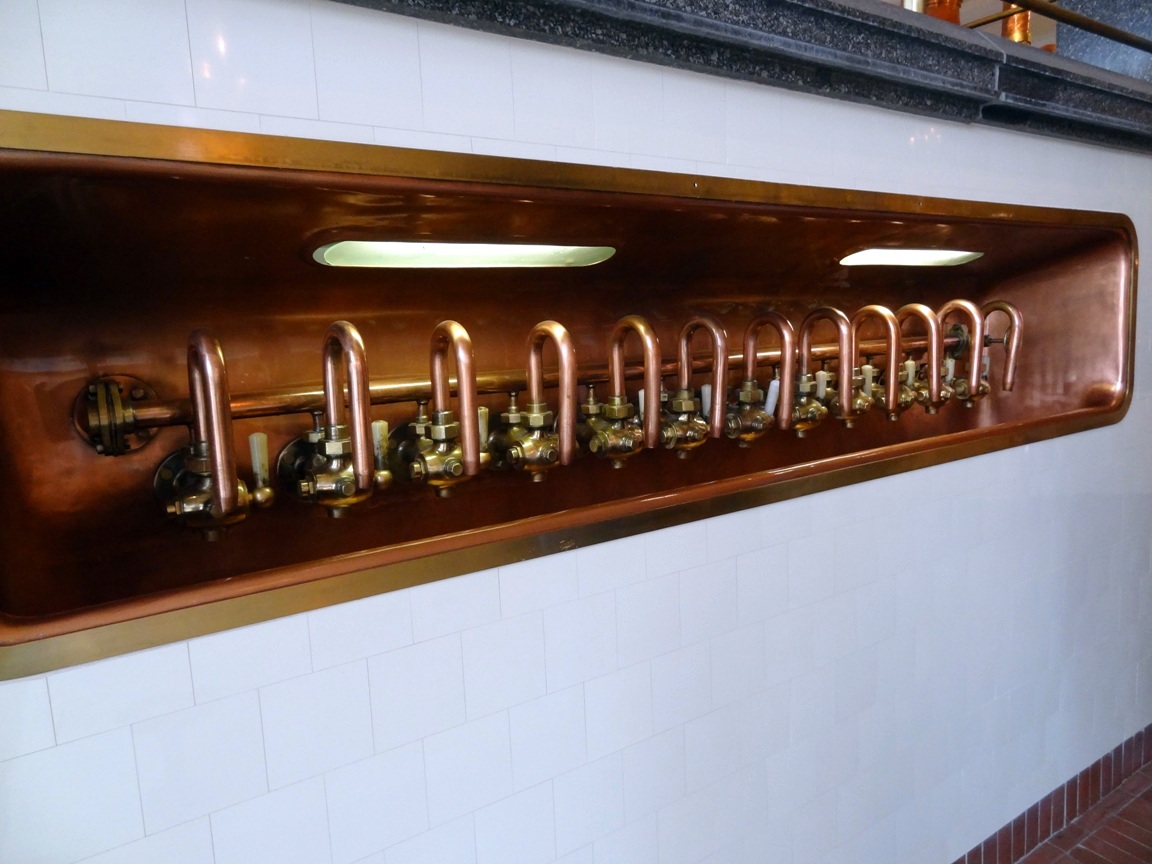
I became fascinated to see that Czechs are absolutely faithful to a piece of equipment called a grant.  You see it underneath the lauter tun, a recessed pocket with a long array of swan-neck facets and valves.  “These valves served to open or close the lautering manually.  Nowadays it’s controlled by the PC.”  I've seen these still in use in Belgium, but rarely.  The problem, as Brož quickly acknowledged is:  “The side effect is this slight aeration of wort, which is an important thing.”  Really?  Do tell.
“Because sometimes if you open the literature you will see that the oxidation processes are bad for the beer and it’s necessary to avoid them, but there are several articles, especially from Germany, where when the stages in the brewhouse were compared the oxygen was not always bad, especially before boiling with hops. The oxygen has [?] in it in small amounts due to the reaction of polyphenols and proteins. It influences this reaction. So if the sweet wort runs through these valves, a small amount of oxygen is taken in and the reaction between proteins and polyphenols ends well.” 
He believes the splashing of the grant actually improves the beer.

Not just for old breweries: this is the grant in Pilsner
Urquell's state of the art, modern brewhouse.


Brewing Process
On the beer itself, for those who are interested.  It's made with a double-decoction mash (typical in Czech) to 12 degrees P.  All Moravian pilsner malt (though "we call it pale malt," Adam said, laughing), the gold color coming from decoction.  The hopping procedure is interesting.  They use 100% Saaz or Žatec (pn. jha-tetch) hops, whole flower, and the first addition comes as lautering starts  “at the beginning when the bottom is covered.”  Then the second addition comes "when there is a full kettle," and the final addition is at 30 minutes from the end of the 90-minute boil. 

Fermentation and maturation is quite unusual.   “There was a very simple rule: one degree of Plato in the wort means one day of fermentation.  The lager has 12 degrees of Plato and ferments twelve days for main fermentation.”  Budvar then lagers it for 90 days (!), a practice he calls "deep" maturation. 

Tuesday, October 30, 2012

Where Czech and Oregon Beer Met

The Czech Republic, not for reasons strictly of geography, is far, far from the American consciousness. Don't talk polotmave, don't mention ales. All we know is pilsner (only a part of the landscape), and we don't really even understand that. It has been one of my great pleasures to experience the beer here--in some ways it is closely related to Oregon beer. For one thing, a good lot of the lagers here are unfiltered. They're hazy like Oregon skies (and beers). Of course, they're also hoppy (though not always bitter). Even more, it's like Oregon in the sense that it's this huge, rich scene no one knows that much about.

As I alluded to yesterday, one of the key things is malt. Moravian and Bohemian malt is particular. The grains are smaller, and the malting--often floor-malted--is rougher, less efficient. In the US, base malts are essentially sugar. If you want color or flavor, add specialty malt as needed. In Czech, the base malts are full of color and character. To get a splash of color, you may not need Munich. These "pilsner" malts are twice as dark as what Americans think of. The beers here are deeper colored, and--as with English floor malts--softer, richer, grainier.

Another thing that's key to understanding beer here: it's not all pale lager. Amber (polotmave) and dark lagers (tmave) are common, and they're not exactly like marzens and schwarzbiers. They bear the stamp of Czechness--those round malts, the spicy hops, and a few of the tmaves I've tried were flat-out roasty and stout-like. Czech beers also run the range of strengths, not only colors, so you might have a light pale, a medium dark, and a strong pale. Beers are identified by both color and strength--the shorthand is to use the beer's original gravity, as expressed in Plato, 10, 12, 16, etc.

And those are the standards. As everywhere, the Czech Republic is not immune to the influence of the craft beer movement, so breweries are also dabbling in ales, including American style eepahs (IPAs), imperial stouts, and so on.

And here we come to the place where the very remote places travel through space to meet--and blow my mind. Max Brahnson, the great chronicler of Czech beers, has generously given
me two days of his time in an intensive tutorial of the country's beer. Today, as we toured Břevnovský, a new
Brewery in an old Prague monastery (though not a project of the monastery), something remarkable happened. I was slowly ambling by the conditioning tanks when I came across one called "Pelican Ale." curious, I asked about it. By chance, a coupe had come in with empty bottles and were setting up a hand-fill line. Max explained that the tank was actually theirs--they were gypsy brewers using the new monastery brewery's excess capacity. Max relayed, off-handedly, that the Pelican was some beer they'd made with an American brewer. "Really!" I said. A few back-and-firths confirmed: the brewer was Darron Welch, from Oregon's own Pelican, who was in that very building two weeks ago. The beer was a hoppy pale made with Czech malt and Czech and American hops. (It was totally Oregonian--saturated late-addition hopping--and made me nostalgic.)

Earlier in the day, Max took me to Únětický Pivovar (pivovar means brewery and may be the only Czech ive been able to master). It's a new brewery established on the site of one from the 18th century. The beer is that wonderful unfiltered stuff which here flows hazy straight from conditioning tanks. You hold up a glass and it looks like Double Mountain's Vaporizer and smells maybe not a lot less hoppy. I told Max: "I wish I could take a keg of this back with me just to show Americans what Czech beer can be." the irony is that, despite Bohemia's immense contribution to the beer wod, we don't really understand Bohemian beer. Even more strange: based on what I've seen here in Prague, Czechs may actually have a better sense of our beer.


Monday, October 29, 2012

Czech Floor Malting

I've visited three Czech breweries now, and in each case, the emphasis has been on malt. Think Britain. Not only is barley grown locally, but it's floor-malted (the base malts, anyway), and those malts are a big part of the beer's character. Leave aside the lagering, and what distinguishes Czech beer? No, not those delicate, spicy hops: malt. In exactly the way British malts do.

The illustrious Pivní Philosof took me oto Ferdinand brewery (pivovar) today, and we got to see the traditional method of preparing malt. Once, Ferdinand made 200,000 hectos of beer and now they make 25--but still they make enough malt to supply Weyermann and others. But the malting/brewery is still seriously old school. Have a look.

(Sorry, my Bligger app again puts them out of order).

1. (a). Farmers deliver raw barley to the brewery.

2. (c). Malters turn the wetted barley so it doesn't rot.

3 (f). Primary fermentation in open vessels.

4 (b). Malters spread out the freshly-soaked barley.

5 (e). The steam punk aging cellars.

6 (d). "Chitted," or sprouted grain.

7 (g). Tasty beer from the tank.

Saturday, October 27, 2012

Don't call It a Pilsner

So there are a few things you should know about Czech beer. It's not all golden. It's not all lager. They don't call their Moravian malt "pilsner" malt--it's just pale. And at the original Budweiser, from Budweis (which only later became Ceske Budejovice), they don't call their beer a pilsner. That appellation is reserved for the big brewery to the northwest. But more on styles in a while.

We'll get back to that in a moment, but let me step back and mention that I just spent the day at Budvar--and on the first snowy day of the year (!). It was sadly not warm inside because I visited not only on one of the only days of the year the brewery's not in motion, but on a day when the electricity was off for maintenance. So head brewer Adam Broz and communications chief Petr Samec (the man who graciously set up my visit) and I charged around the brewery with a flashlight for a most rare tour. You have to work pretty hard to find the brewery in this state, but I'm just lucky. (In Czech they don't celebrate Halloween, but walking around a silent, dark 1.3 million hectoliter brewery reminded me of the spooky season. It was especially atmospheric to roam the cellars in complete darkness zwickeling beer into an old-timey copper mug.)

Budvar is a big brewery, but it has done an impressive job of holding onto old traditions. The brewhouse is a typical four-vessel system (mash tun, mash cooker, lauter, kettle), and they do a double decoction. Interestingly, while most of the beautiful copper equipment is lined with stainless, a bit is not. Similarly, Budvar uses a grant during lauter--that's theregulator you see in some old systems where a bank of small spigots pour into an open trough before heading to the kettle. To adjust flow out of the lauter, brewers turn the spigots off or on. (Budvar's is computerized.)

This interested me because 1) copper can introduce chemical reactions leading to staling, and 2) any time wort is exposed to air, especially when it splashes, it can pick up staling oxygen. Of course, Budvar knows about this, and Broz has had the system tested--the copper content is too low and the grant not splashy enough to appreciably affect the beer. (Pilsner Urquell's system--just five years old--also uses a grant. Seems to be the Bohemian way.)

Budvar gets its water from a well 300 meters down and they use the water untreated. They use only Moravian malt and whole flower Saaz hops. Interestingly, they let primary fermentation go on for a day for every point of Plato--so 12 days for their standard beer. (That's twice as long as many other lager breweries.) They really lager the beer, two--three months for the regular beer and six (!) for their special strong beer (16 Plato, about 7%). They lager the beer in horizontal tanks rather than cylindroconicals because the pressure is less--and therefore better for the beer. I noticed that 5-month-old strong beer was still bubbling away with healthy yeast activity.

I got to zwickel all three of their beers, and that was a treat. I've long been a Budvar partisan, and especially a day after having the vaunted Pilsner Urquell from the wood, it was a revelatory experience. Budvar is considered less hoppy because, at 22 BUs, it's less bitter than Urquell. But it has tons of flavor and aroma and to me this makes it hoppier overall--if less bitter. From the tank, those qualities were accentuated and it was a wonderfully spicy beer. The "16" (as they call the strong) was also amazing. Alcohol pops more in slender lagers, and it was boozy--but also delicate from both the soft malt and peppery hops. The final beer, a tmave (dark) was surprising roasty and Broz agreed that it bore some resemblance to an Irish stout.

Okay, the style question. It seems Budvar eschews the "pilsner" name out of deference, but that's not all. Broz quickly described the ways in which the beers differed. To international tastes, this may be hair-splitting, but I think it reveals something deeper about Czech brewing. This is the land pilsners were born, the place, thanks to the water, malt, and hops, where their spirit resides. It's no wonder breweries notice the differences. The rest of the world is probably justified In collapsing them into one group--but we should also appreciate why the Czechs resist following suit.

Wednesday, October 10, 2012

Program Note: European Blogging

On Saturday, I head back to Europe for round two of research for the Beer Bible.  Internet permitting, I'll be posting every day.  Probably not a lot more than a photo and brief description of where I am and what I saw, but at least that.  Here's the itinerary:
Sun-Mon, Oct 14-15: Dusseldorf
Tues-Wed, Oct 16-17, Köln
Thurs, Oct 18, Kelheim 
Fri-Sun, Oct 19-21, Bamberg and Franconia
Mon-Wed, Oct 22-24, Munich
Thu-Fri, Oct 25-26,Plzeň (Pilsen)
Sat, Oct 27 České Budějovice (Budweis)
Sun-Tues, Oct 28-30, Prague
Wed, Oct 31, Milan
Thu, Nov 1, Piozzo (near Birrificio Baladin)
Fri, Nov 2, Busseto (near Birrificio Del Ducato)
Sat, Nov 3, Fidenza (near Birra Toccalmatto)
Sun, Nov 4, Tradate (near Il Birrificio di Como)

Those are the places I'll be laying my head; with travel, I'll be spending less time in some of them than it looks (I really only have a day in Plzeň, for example, and two in Prague). 

Last year I focused very heavily on scheduled brewery tours (I averaged one a day).  It's going to be a bit more leisurely this year--14 scheduled tours in 22 days.  I am looking forward to every stop on the tour, but there are three places that I expect will hugely deepen my understanding of the beer world.  Franconia (#3 on the map) is a region studded with small brewpubs that Americans have never heard of (unless they read certain blogs).  I am especially keen to try ungespundet bier--German cask ale.

In Prague, I will rendezvous with the best guide the city has--the man who literally wrote the book on Prague's beer.  (My copy is already in the suitcase.)  Max is going to give me an insider's view, one that will be hugely useful when I sit down to write about světlý ležák and tmavé vycepni. 

Finally, Italy is on the cutting edge of European craft brewing--an edge that cuts further south every year--and it will be fascinating to see what they're up to.  Spontaneous fermentation, chestnuts, and gastronomic beers are apparently in the offing, but I'll tromp around and see for myself.

I will try to post on the various other social media--Twitter, my Beer Bible Tumblr page--but I'll use this blog as my first line of communication.  Keep reading--

___________________
Postscript.   Last year I toted a bunch of beer with me so that, when I came to the end of a tour, I could make an offering from the homeland.  I wanted the brewers to know how much I appreciated their time and effort.  This year, I've serendipitously scheduled the trip during fresh hop season, and I'll be taking some Deschutes Hop Trip and Killers (Red and Green) from Double Mountain--among other non-fresh-hop beers. It pleases me greatly to think of spreading this bounty.  And of course, the space I clear out by emptying the suitcase of beer is ideal for replenishing.

Monday, July 30, 2012

Czech Treasures?

In October I return to Europe for what will be part two of a dream journey through the legendary breweries of Germany and the Czech Republic.  After Czech, I head to Italy to survey what is by all accounts the most interesting new scene on the planet.  (Cantillon's Jean Van Roy, apologizing, said he felt it exceeded the US.)  So far I have the first leg coming together: landing in Dusseldorf and visiting Uerige; zipping south for Kolsch country; down to Kelheim to see Schneider; back north to Bamberg and Franconia; and finally to the cradle of Munich.  Italy also looks to be coming together--or looks, anyway, like it will come together when I start matching breweries and dates.

In between is the Czech Republic, which remains a bit of a cipher to me and most Americans.  We know Pilsner Urquell and Budvar, of course (those are on the list mos def).  We know Prague.  But here's a little test: name me five Czech breweries.  I've spotted you two, but my bet is that you'll find it very hard to fill out the list.  The truth is, one of the world's greatest brewing country remains mostly hidden from American eyes.

I will be very fortunate to have the estimable beer philosopher, (Pivní Filosof) Max Brahnson, do a little pub-and-brewery crawling with me when I'm in Prague.  I've also studied his Pisshead's Guide to Prague to bone up on my vycepni pivos and my tmaves (since I'm working in Blogspot and am lazy, all diacritics have been left in the cupboard).  Because, of course, there's a lot more to Czech beer than just "Bohemian pilsner."  (There is, in fact, more to the Czech Republic than just Bohemia.)  All of that will be enormously useful to me.

But since we do know so little, and since I'm still waiting for my copy of Evan Rail's now somewhat outdated Good Beer Guide to Prague, I'll throw this out to the hive mind.  What small treasures, invisible to American eyes, await me if only I know where to look when I visit the Czech Republic?  I'll be in a car, so it doesn't have to be in a big city. 

Help me, hive mind!