You love the blog, so subscribe to the Beervana Podcast on iTunes or Soundcloud today!

Sunday, June 11, 2006

The Beers of Summer - Pilsner Urquell

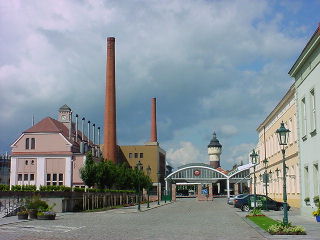
Among beer afficianados, no story is more familiar than pilsner's (except in Oregon, possibly, where IPAs are king): in 1842, a newly-founded brewery in Plzen, Bohemia shattered convention by introducing a clarion gold beer. Until its release, all beers had been dark and murky, suitable for serving in ceramic steins. The new, straw-colored beer captured the imagination of beer drinkers with its bright clarit, spread across the globe like a virus, and now is produced in nearly every country on the planet. It is one of the most popular products in world history, and certainly the most popular beer. That newly-founded brewery was Pilsner Urquell--literally "the original beer from Pilsen."

Due to their ubiquity, pilsners have some backsliding in quality. Beers like Singha, Kingfisher, Panama, and Pabst may be interesting national variants, but they don't really match the original, which is one of the few pilsners still widely available across the world--and rightly so. It's also a very nice beer to crack on a sunny afternoon.

Tasting notes
Pilsners are remarkably fragile. They are sensitive to light, heat, and age, and by the time any of their golden essence arrives in America--worse, Oregon, way over on the west coast--they have inevitably degraded somewhat. I have heard tales--uttered in uniformly hushed tones--of freshly-racked kegs taken from the brewery to waiting planes and airlifted (chilled, of course) directly to waiting Americans. The beer described in these stories apparently cures disease, reverses aging, bestows enlightenment. (Variants of the story, in which pilgrims tell of fresh beer pulled from taps in the Czech Republic, are equally as glowing.)

I can't speak to that beverage--I have only tasted the beers available to American mortals, which is absurdly shipped in a green bottle, an aid the forces of degradation. Still, when handled gently, it is nevertheless an extraordinary beer. As beautiful today as in 1842, it bursts with the pepper of Saaz hops and Bohemian yeast--an aroma unique in the beer world, and one of the most familiar.

The palate is simultaneously soft and dry, effervescent and--in a surprise to people who think Budweiser is a pilsner--intensely hoppy. The beer is triple-decocted, which may be one reason it's so gentle (though the decoction debate is an ancient and hotly-contested one).

In much the way that alder-smoked beer remind people of salmon, Saaz hops give pilsners their "pilsner" flavor--that earthy, spicy, peppery quality that typifies the style. Pilsner Urquell is the most aggressively hoppy of any exported Czech pilsner, and if you're looking for a study in the hop style, go no further. Plzen water is reported to be very soft, but I detect a slight quality of mineral in the beer--perhaps from the effervescent carbonation. A wonderful beer.

(Finally, a note on the "skunky" flavor. When light hits the iso-alpha acids from hops, the acids undergo a chemical change that give beer a skunky flavor. Darker bottles protect beer somewhat, but green or clear bottles offer almost no protection--and Pilsner Urquell comes in a green bottle. The lighter and hoppier the beer, the more susceptible it is to becoming light struck, and at least half the bottles of Pilsner Urquell I've purchased from grocery stores have been so fouled. And even the flourescence of the beer case is enough to turn the beer. So, if you do buy it from a beer case, dig around in the back of the case where its shadowy and hope for the best--that's improved my odds. And let it be known that that skunky flavor is not "European" or characteristic of pilsners. It's bad.)

Stats
Hops:Saaz
Malts: Two-row Bohemian and Moravian (proprietary strains)
Alcohol By Volume:4.4%
Original Gravity: 1.048, 12 degrees Plato
BUs: 40

Rating
Oh, come on.

Friday, June 09, 2006

Tuak

Fal Allen is one of the old-time brewers from Seattle, having turned in stints at RedHook and Pike. He is currently the brewmaster of Archipelago Brewing (a division of Asia Pacific Breweries) in Singapore. And he has a blog.

All of this would be interesting enough on its own, but add to it this: in his wanderings, he discovered a locally-produced Indonesian coconut beer called tuak.
As the lane turned onto a wider road a small gathering of people called me over to a house, where on the front porch area they were sitting around drinking out of these unusual looking bottles. As I got a little closer I could see that the bottles obviously contained a fermented beverage of some kind that I was not familiar with. I was offered a seat and the chance to buy a bottle. My first thought was - well, look it's still fermenting in the bottle - those guys are drinking it and they are not dead (yet) or comatose (yet), so sure why not, what could happen?
(As he managed to complete the post, I think he must have survived.) The entire tale is fascinating, so go read the rest.

North American Organic Brewers Festival

The pied pipers of Organic beer, Craig Nichols and Jason McAdam of Roots, are hosting what they describe as the world's only organic beer fest. One day only--tomorrow. Sad to say I won't be able to go, but you can:
World Forestry Center in Portland
(In Washington Park, adjacent to the Children's Museum and Oregon Zoo)
June 10, 2006

Admission to the festival is $4 which includes a mug, tickets for 4 ounce samples of beer will be $1. Attendees get $1 off admission with three cans of food for the Oregon Food Bank, a validated MAX ticket, or a World Forestry Center ticket. The Forestry Center will offer a $1 discount for festival attendees.
Nineteen breweries (including three international) are bringing thirty beers. Craig always does things right, so I expect it to be a rockin' good time. Go forth and bring back news.

Monday, June 05, 2006

Summer Beers

Ah, summer, that time when I really don't want to drink beer. It's too hot, the beer dehydrates and goes to my head. I guess, like my fellow webfeet, beer is a beverage for a cold day and a warm pub. (Maybe that's why local breweries often just skip summer seasonals.) But then again, summer is long, far too long to go without a beer. So, since we must slake our thirsts with something, I bought a few examples of summer seasonals (okay, two are classic Czech pilsners, but to me that's a summer seasonal) and I'll review 'em this week. First up, Alaskan Summer Ale.

Alaskan Summer Ale

Much as you will not find American made “Belgian Ale,” you will only find Kölsch-style ales; the city of Cologne made sure of this by enshrining Kölsch’s status in the German legal code in 1985 (one of the definitions was a strict limitation about where the beer is brewed). The style is one of the few German ales, but the flavor palate, like altbiers, is drier and less fruity than other ales. For an obscure style, Kölsches are more popular in the NW than you'd imagine. Widmer has experimented with the style, and the McMenamins' regular summer ale is a Kölsch. In fact, there seem to be more examples of Oregon-brewed Kölsches than pilsners--perhaps the only place outside Cologne where that's true.

(Perhaps it's more than coincidence that no less than Michael Jackson has made a comparison between Portland and Cologne. From an interview I did with him in 1998:
I was asked on radio this morning, 'How important is Portland in all of this, and is Portland the beer capital of the United States?' To which my answer always is that it's a private squabble between Portland and Seattle, really, and nobody else comes close. Portland has, within its zip codes, between a dozen and 20 breweries, which is actually slightly more than Cologne has--and it's the most breweried city in Germany. So, you could make an argument for Portland being the beer capital of the world. I'd like to see more evidence of this when the city promotes itself. When I come into the airport, I'd like to see a sign that says, 'Welcome to the Beer Capital.'")
Tasting notes
Alaskan Summer Ale is a rather rich hue of gold--substantially darker than the pilsners to which Kölsh is often compared. The head dissipated quickly, but the beer roiled with a vigorous fine bead. I don’t doubt that there’s an aroma to Summer Ale, but next to none from the bottle I poured (maybe the slightest note of yeasty tartness).

Kölsches, despite the paucity of ingredients, can pack a complex punch--the good ones, anyway. Alaskan's is a nice example. The first note is subtly sweet and tart, but it finishes with a dry note. Alaskan underhops their version, but it's not a mistake; the more subdued flavors come to the fore. The brewery uses its regular yeast, which is a drier version more akin to the yeasts of Germany (and atypical for West-coast beers)--a great fit for Summer Ale. All in all, a beer fit for Cologne.

On a hot summer day, you might have a bottle or two and not regret it. A cooler summer eve? Even better.

Stats
Hops: Hallertauer
Malts: Pale, Munich, Vienna and wheat
Alcohol By Volume: 5.3%
Original Gravity: 1.048 OG
BUs: 18

Rating
Excellent.

[Note: posting has been edited slightly to remove gross errors of grammar and syntax.]

Tuesday, May 30, 2006

BridgePort's Renovated Digs

1313 NW
Monday-Thursday: 7 am - midnight
Friday-Saturday: 7 am -1 am
Sunday: 7 am -10 pm

Beers: IPA, ESB, Porter, Blackstrap Stout, Ropewalk Amber, Blue Heron (session), seasonals.

In 1984, Dick Ponzi decided being a pioneer in the wine industry wasn't enough, and so he founded BridgePort, Oregon's first craft brewery.* He dug around until he found a place in gritty Northwest Portland near to the railroad tracks and freeway--much as Fred Bowman and Kurt and Rob Widmer did a year later when they founded Portland and Widmer nearby. The BridgePort building was a brick warehouse, and it was apparently as gritty as its neighborhood when Karl Ockert first brewed BridgePort Ale (which became the name of the brewery, at the time called Columbia River Brewing). Ah, but what bones: thick beams of native fir supported nicely rounded, 100-year-old brick. It became, along with the Lucky Lab, the quintessential Oregon brewery.

But then came the Pearl and wealth and young urban professionals, and apparently, a need for a new aesthetic. Thus a million-dollar remodel.** Gone are the homey nooks, the dart board, the pizzas, the beer towels, the loading dock languor. In it's place? Well, here's how the brewery describes it:
Whether you drop in for a meal with friends at our east side BridgePort Ale House, or stop by for an espresso at the new bridgeport brewpub + bakery in the heart of Portland’s Pearl District, you are sure to have a great experience. Our brewpub and bakery has just reopened after a major renovation. While so much has changed in the century-old building, you’ll find a comfortable and familiar atmosphere awaits with rustic brick, aged timber, and classic iron.
I alert you to this language so that you'll see where I'm headed in this (now overlong) review. The new place is engineered to appeal to those who love sterile steel, vast expanses in which to be seen, and an unchallenging nouveau industrial (nouvel industriel?) chic style. In short, none of the people who used to go there.

It is a radical change. The entire floorplan has changed and all the old Portland pub quality is absolutely scrubbed from the place. Even the food menu accentuates wine--for the beer list, you have to go to the drinks menu. Pearlies want shiraz with their crispy artichoke risotto cakes (okay, maybe pinot gris), so the brewery makes it easy for them. (Though the truth is, as I looked around the place, I saw that most patrons had pints of cloudy IPA in front of them.)

Food
All brewpubs don't have to have the same halibut fish and chips to please me. Pub fare is often starchy and fatty and just so-so on the tongue. A change-up is welcome. BridgePort features pretty standard Northwest cuisine (which was formerly known as California cuisine, until Greg Higgins appropriated and tweaked it, adding local vegetables and meats). I had the pork tenderloin with cannelini beans and rapini, and Sally had a special halibut dish with assorted tubers. Both were excellent, and both went fairly well with the classic British ales BridgePort serves (I had porter with the pork, and the halibut went well with ESB). Even more surprising, the entrees were fairly reasonable, ranging from $11-18.

Beer
BridgePort long ago standardized its beer menu. In addition to beers available in bottle--IPA, Blue Heron, Ropewalk, Old Knucklehead, and Supris--they serve old standbyes Porter, ESB, and Blackstrap Stout. I suggest trying the porter and ESB as your food selection dictates. The porter is thick, creamy, and intense--black sunshine for rainy nights. The ESB is in the British style, with an accent on malt. This makes it far more suitable for most entrees than the IPA, which may tend to overwhelm. Blackstrap is aptly named; if you like molasses, you'll like the stout. I don't.

Final Judgment
Gambrinus
, which owns BridgePort, has made what is probably a shrewd short- and middle-term decision. When we were there on a Thursday night, it was packed with people, all of them paying more per person than the old pub ever got. It has a contemporary style that serves the neighborhood that (unexpectedly) grew up around it.

But it is not a classic, nor does it reflect anything intrinsic about the brewery or Portland. Styles will change and so, presumably, will the brewery. In ten or fifteen years, as aesthetics have changed, it will have the dog-earred, slightly embarrassing aspect trendy restaurants inevitably acquire. And then Gambrinus can update it. I hope, for the sake of the brewery and the city, that the company recognizes the beauty and history resident in the massive beams that still span the old warehouse and restore some of the old Portland funkiness.

That may seem a long wait, but hey--I recall the brewery of 1991, and it doesn't seem that long ago. The beams will still be there.
_________________
*Okay, second, but the Cartwright Brewery, founded a few years earlier, died after a short life of making (reportedly) bad beer. BridgePort is now the oldest Oregon brewery. Deep history here.
**I surmise/recall. A Google search fails to locate the actual cost.

Updated 6/26/06

Wednesday, May 24, 2006

Overheard

Great rule of thumb right? Where ever you are, try the local brew.

I'm in St. Louis....


Is Budweiser really beer?


(Mike Rasmussen, via email)

Monday, May 22, 2006

Blind Tasting: Pale Ale

The first Beervana blind tasting happened outdoors under (unseasonably) sunny Oregon skies. Appropriately, we sampled that epitome of summer beers (at least here in Beervana), the pale ale.

Tasters
I'm toying with the title "Council of Beer Elders" for anyone who becomes a regular in the panel, but I don't want to encourage arrogance. We'll think on that one. In any case, the four tongues that swished ales were Iggi, a native Oregonian who counts Roots among his favorite breweries, Absent Mindful, a ringer and a pro who works for BridgePort (and another native), and Cap'n Cyber, the elder of the beer elders, who has surely drunk more pints than anyone on the panel. Rumors that he enjoys Hamms are slightly exaggerated. I rounded out the panel.

Beers
In alphabetical order: Caldera, Deschutes, Fish, Full Sail, Pike, Sierra Nevada, and, to mix it up, London's Whitbread. We happened to be drinking BridgePort Blue Heron, which is not a true pale, but Absent Mindful demanded its inclusion.

Initial Impressions
The major discovery in this tasting was that pales are uniformly good, but, ah, uniform: with small distinctions, five of the eight beers were very similar. Everyone was able to not only distinguish, but also identify the Blue Heron, Pike, and Whitbread. The other five were the toughies. Iggi and I both felt we knew Mirror Pond and FS Pale, but couldn't actually tell which was which (we were right and we both guessed wrong).

Individual tastes seemed to determine which beers got the big thumbs up. There were four tasters, and four different beers were identified as faves: Mirror Pond, Caldera, Sierra Nevada, and Whitbread. I asked which were second faves, and we had votes for Caldera, Mirror Pond, Full Sail, and Pike. And, just to show how close the beers were top to bottom, I asked for least favorites and got a Pike, Whitbread, and Sierra Nevada--all beers that were others' fave or second-fave.

Identification
Based on what I've already reported, it won't come as a surprise that tasters did a poor job of identifying the beers. Absent Mindful batted .500--the best in the group. Cap'n Cyber and I got three right, and Iggi--well, Iggi didn't strike out completely, and we'll leave it at that. (If Iggi and I had guessed right on the FS/Mirror Pond pair, we would have stood a little taller.) Bragging rights to both Absent and the beers we tasted--all of which were very nice.

Other Thoughts
It's worth mentioning that Caldera is available only in can. (All beers, incidentally, came from Belmont Station, so I know they were their freshest.) This caused some eyebrow-raising among tasters, but no one could distinguish the slightest tinniness from Caldera (which was my favorite).

Also, Caldera, Deschutes, Fish all employ solely Cascade hops. Full Sail and Sierra Nevada use Cascade, but others, as well. It was interesting to see the differences malt and yeast make in the production of beers--Caldera and Deschutes, for example, were noticeably different, yet made from substantially the same ingredients.

Next time, I may vary the flight somewhat and perhaps through in some beers that we should be able to identify as outliers (a macro, and import, or a beer we profess not to like, say). Just something to keep the Council honest.

Blind Tastings

This weekend, we conducted our first ever blind beer tasting--in what I hope becomes a rich tradition at Beervana. I generally followed the successful formula I used in the winter beer tasting I did for the Willamette Week last December, which was itself a modification of the now-legendary (but unavailable online) macropilsner taste-off. I may make minor revisions along the way, but here's how it works.

1. Rating.
A non-participant poured out the beers into numbered glasses, keyed to a sheet with the list of beers in the tasting. Participants then tasted each beer, gave it a rating, and identified his favorite (yes, all the tasters were men, but that, with luck, will change) and second-favorite. I also asked for least fave, but that potentially volatile element may or may not continue.

2. Identification.
This is more than a parlor trick. Depending on the flight of beers you're tasting, it is remarkable to see how similar they are, and how much factors unrelated to our senses are in determinining which beers we think are our favorites. It is also useful in exploding certain myths privately and publicly held. Explosions are painful, but we are fearless drinkers.

This weekend's tasting included a flight of pale ales, and I'll put up the results in a few hours.

Friday, May 12, 2006

Inactivity

Q: Good lord, man, do you realize how long it's been since you last made an entry?

A: Yes.

Q: This blog isn't going down the crapper is it?

A: Possibly, but not due to lack of content, which will pick up directly.

Q: You're just lame, then.

A: That's right.

Tuesday, May 02, 2006

Elysian's "The Wise ESB"

As I just two posts ago discussed Elysian, I'll jump right to the tasting.

Tasting notes
What's the difference between an IPA and an ESB? They're both biggish (IPAs are bigger) and both hoppy and both pale and both British. It's the malt. In an IPA, the malt is merely there to protect you from the lacerations of the hops' alpha acids--brewers may hope there's residual flavor for the discerning drinker, but that's gravy. Not so with ESBs--although they feature robust hopping, it's their malty depths by which they're defined.

The two best ESBs I've tasted are Fuller's and Elysian, and both are distinguished by their wonderfully complex malts. Elysian is a deep golden in the glass, and smells delightfully of caramelly malts and a touch of citrus. I don't recall exactly what Fuller's looks like, but my recollection of the palate is that it is much like Elysian's--a deep, rich maltiness (nutty sweet) offset (in a IPA reversal) by balancing bitterness. The hops in Elysian are pure Northwest, but they, like the English hops in Fuller's, are there to carry out the malt note.

It's one king hell of a beer.

Stats
Hops: Bittering, Chinook, finished with Cascade and Centennial hops
Malts: Pale, Munich, Crystal, Cara-hell and Belgian Special B malts
Alcohol By Volume: 5.9% by volume
Original Gravity: 4.5 Plato/1.058 OG
BUs: 39
Other: Won the gold for ESB at the 2003 & 2004 GABF.

Rating
A classic.

Monday, May 01, 2006

Widmer Broken Halo IPA

The Widmer Brewery has been in a bind since the late 80s, victims of inadvertent success. When Rob and Kurt founded the brewery, they imagined the flagship ale would be an alt like the one they fell in love with in Germany. Dry, bitter, and smooth--it would actually have been a great beer for current Oregon palates. Alas, they started brewing a wheat ale during a period of evolving palates and now their flagship--and anchor--is the bland Hefeweizen.

The Widmers have staked out a few interesting niches. Their Collaborator project, wherein homebrewers create obscure beers, has produced a milk stout, Snowplow, that is now part of their regular rotation. Mmmm, tasty. And they are famous for producing some of the most interesting beers for brewfests--beers locals can later try at the Gasthaus. But the commercial experiments tried and abandoned--Big Ben Porter, Sweet Betty Blonde, Hop Jack Pale (the list goes on)--litter beer bottle collections across the state.

Will Broken Halo break the string of bad luck? We'll see.

Tasting notes
The brothers always produce very bright, filtered beers, but Broken Halo looks too bright when it pours out. It's straw pale, clear as water. This is a hint to the central character of the beer, but we'll get to that in a moment. The aroma is nice--a clean, citrusy bouquet.The head is, like the picture in the photo, snowy white. My initial impressions were favorable, but there was something out of place.

Turns out that Broken Halo is not an IPA--which had been suggested by its delicate appearance. Judged against some of the broad shoulders of the NW IPA world, poor BH is wouldn't stack up well. But if the label said Pale Ale, you'd nod admiringly. The hopping is rich and resinous, not just bitter, but flavorful. The malting is subdued, coming through as a mildly sweet balance. A fine pale and a fine beer.

I think what we're seeing is the result of the misnamed BridgePort IPA--one of Oregon's most popular beers. Though it tastes big enough to be an IPA, it has the advantage of drinkability: people knock back a couple-three and they're not staggering around. All the flavor, but manageable alcohol. No other IPA has cracked BridgePort's domain because they tend to be actual IPAs--7% alcohol or more--which are just too big for people to drink regularly.

The downsizing of IPAs leads to compromises. The Widmers have made a tasty, balanced beer. Pour this in a glass and hand it to a hophead, and she'll be happy. Just leave out the India part.

Stats
Hops: Bittering, Alchemy, finishing Cascade and Columbus
Malts: Pale, Caramel (10 and 20l), and Munich (10l)
Alcohol By Volume: 6.0% by volume
Original Gravity: 14.25 degrees Plato
BUs: 45
Other reviews: Belmont Station Blog

Rating
As an IPA, Average. As a pale, Excellent.

Wednesday, April 26, 2006

Elysian Immortal IPA

I picked up a batch of Elysian at the store, lured by a remaining bottle of Bifrost Winter Ale. Seattle's Elysian has been one of my favorite breweries since they brought a batch of Elysee Saison to the Oregon Brewers Fest a few years back. I assumed they specialized in Belgians, but it turns out that's actually just one of many interests (albeit an exceptional one): their 14 beers represent British, Belgian, and German traditions, plus a dose of good old American innovation.

A few facts: Co-founder Dick Cantwell brewed at three breweries before Elysian (including Pike and Big Time), so he knew his way around a lauter tun. Although the brewery does bottle some of their beer, it was founded as, and remains, centrally a brewpub. I've visited their Capitol Hill location, and it's got that pub Feng Shui so rarely attained (eg: some of the McPubs, the Lucky Lab). So tasty are its beers and so groovy its bricks and mortar that the GABF named Elysian Large Brewpub of the Year in 2003.

Tasting notes
This is a beer that looks great on paper (see stats below), but doesn't sing like a few of the stellar Northwest IPAs out there. Things start out great: it is a rich, slightly hazy golden ale with a creamy white head. The nose is florally hoppy, almost perfumy (had I not been reading the webpage as I slurped, I might have guessed dry hopping).

On the palate, it's a nice, but unexceptional beer. It's balanced and pleasing, and not too rich to have a couple pints (I had the full 22-ounce bottle and it wasn't too heavy or alcoholic). However, in a world of BridgePorts, Terminal Gravities, and Walking Mans, Elysian's IPA is, sorry to say, merely mortal.

(I have a bottle of The Wise ESB in the fridge, and it is one of the most celebrated beers in America, so immortality is just around the corner.)

Stats
Hops: Bittering, Chinook, finishing Amarillo and Centennial
Malts: Pale, Munich, Crystal and Cara-hell
Alcohol By Volume: 6.3% by volume
Original Gravity: 15.5 degrees Plato/1.063 OG
BUs: 42
Other: The brewery has a homebrew recipe of Immortal, and the brewer is also a beer writer.

Rating
Good

Monday, April 24, 2006

World Beer Cup Winners

I received two emails about the recent World Beer Cup awards--one from a BridgePort employee (I'll let him out himself is he wishes) and one from the BridgePort publicist. It should therefore come as no surprise that BridgePort took home the gold. They did. At the end of the post, I'll put a listing of Oregon and Washington winners (Washington being the northern province of Beervana).

But before I do, let me spend a few moments venting. There are two main US brewery awards, the Great American Beer Festival and the World Beer Cup. I don't exactly know what distinguishes them--both are part of the Brewers Association hive, and both claim to be the bee's knees in terms of competitions. (Admittedly, the Beer Cup is an international competition, though barely--of 2221 beers entered, 1433 are American).

I have two major problems with the fest(s), and I think any announcement of the winners should be prefaced by this acknowledgement. First, the Brewers Association long ago made the decision to judge beers by style. Thus the macropilsners, by virtue of being entered in the "stink-ass tin can, cheapo" category (I think it's actually called "American-Style Low-Carbohydrate Light Lager"), always take home some metal. Meanwhile Hair of the Dog, by virtue of not being brewed to any known style, has won exactly bupkis.

The second problem is geographic. Each region of the world--and now of North America--has developed a particular palate. The West Coast loves beer that's got rich mouthfeel and is hop hop hopilicious. This is particularly true of the Northwest. It is almost impossible to find a beer with less than 30 IBUs or less than 5% alcohol. Even Full Sail's "Session"--their offering as a competitor for Pabst--is 5.2%. The Colorado style is quite the opposite. They love sessions, don't like aggressive hopping, and tend to brew slavishly to style. And of course, the Brewers Asssociation is a Colorado production, and the founder and Lord, Charlie Papazian, has always been slavish about style. What results are competitions that favor precision over virtuosity, and Colorado beers over Oregon beers.

Oh, and what the hell--here's a final whinge. To compensate for the problems raised by deciding to judge according to style, the Beer Cup has now created a style for almost every beer, including such beauts as "Coffee Flavored Beer" and "Wood and Barrel Aged Beer," not to mention two or three different version of standard English-derived beers like "English IPA," "American IPA," and "Imperial or Double IPA." In all there are 85 "styles," a proliferation worthy of the DSM. Can "Northwest Style Double Pale Tall Skinny Machiato Flavored Beer" be far behind?

So anyway, having spent four paragraphs detailing why this fest sucks, here are the winners. Enjoy!

Oregon Breweries (by alpha)
BridgePort - Blue Heron Pale Ale - Gold
Caldera - Caldera Pilsener Bier - Gold
Caldera - Caldera Dry Hop Red - Bronze
Full Sail - Session Premium Lager - Bronze
Laurelwood - Organic Deranger - Bronze
Pelican - Kiwanda Cream Ale - Silver
Pelican - India Pelican Ale - Silver
Pyramid - Pyramid Hefeweizen - Bronze
Pyramid - Pyramid Crystal Weizen - Bronze
Rogue - Shakespeare Stout - Gold
Rogue - Morimoto Black Obi Soba Ale - Silver

Washington Breweries
Boundary Bay - E.S.B. - Silver
Boundary Bay - Cabin Fever - Bronze
Elysian - Dragonstooth Stout - Gold
Fish Brewing - Old Woody - Silver
Ram/Big Horn - Seattle - Total Disorder Porter - Bronze
Rock Bottom - Bellevue - Vienna - Silver
Rock Bottom - Bellevue - Hop Bomb IPA - Silver
Silver City - Fat Bastard - Silver
Snipes Mountain - Sunnyside Stout - Bronze
Walking Man - Blootvoetse Bruin - Gold
Walking Man - Walking Man IPA - Gold
Water Street - Big Phatty - Silver

Tuesday, April 18, 2006

Spring Beer Fest (2)

But nevermind the tchotkes, here's the beer. In order of tasting, as scrawled in my notes.

Rogue Chipotle
Pretty amber, thick head. Rich, creamy beer without harsh chile bite. Chile imparts a smoky meatiness. Also a smoked malt quality. Subtle bite in finish. Rating: Excellent

Widmer Brown Porter
Horrible smell.* "Wet Schnauzer" (Sally). Robust flavor, roasty rich palate, but also a cabbagy off-flavor. Can't get past the nose; quesy. Rating: Not poisonous.

Alpine Pilsner (Oroville, WA)
Beautiful golden, bright. Nice head. Light and spicy and totally clean. [Apparently I was still smarting from the Schnauzer.] More of a Bavarian pilsner. Rating: Good.

Spanish Peaks Black Dog Ale (Bozeman, MT)
Off nose: cabbagy. Again?! Tastes same, plus some fusel alcohols. Pretty bright brown ale, however. Rating: Not poisonous.

Walking Man Street Walker Malt Liquor (Stevenson, WA)
Clear golden. Tastes like malt liquor. Sorta strong and a bit harsh. Clearly well made, but.... Rating: Average.

Stone Imperial Russian Stout [IRS, it was April 15, get it?] (Escondido, CA)
Huuuuuuuge. Black. Latte-like head. Massive. Would hold up a spoon. Actually, though, not super-intense. Creamy and rich. Rating: Good.

A Belgian Kriek
Didn't take notes.

Alesmith Grand Cru (San Diego)
Dark amber. Palate going. I can tell it's strong. May be roasty. Residual cherry from failure to rinse glass after kreik. Rating: Average (?)**

Walking Man Double IPA
Quite a large beer, yet harmonious. On the other hand, I'm a wee tipsy. Rating: Excellent (?)**

Sierra Nevada Brown (Chico, CA)
Mixed with residue of WM. Seems of the Basement Brown variety (a homebrew I regularly brew)--thicker, richer, nuttier. Maybe. Rating: Excellent. (?)**

Chateau Lorane Apricot Mead (Eugene)
Wonderfully spicy and dry. I ultimately resolved that the spice was from the apricot. Complex. Rating: Excellent. (?)**

New Deal Hot Monkey (Portland, OR)
No notes.

I also recall having Widmer Broken Halo (I felt they needed the redemption after the Schnauzer, and this earned it), another mead (cherry, also dry), Victory Pils, a cider, and Chimay Cinq Cents, but failed to take notes. Naturally, the crappy SBF website is of no use.

I may have had others.

______________
*I haven't always been the Widmers' biggest booster, but I've also never known them to produce an infected beer, and am left to conclude that something happened between the brewery and my mouth.
** I was still rating beers, but at this point, my judgment was suspect.

Monday, April 17, 2006

Spring Beer Fest (1)

For many reasons, the most famous beer fest, perhaps outside Munich, is the summer Waterfront Brewers Festival. For three or four years, it looked like the Spring Beer Fest might rival it. While the OBF is a hell of a lot of fun, it's not really an exceptional showcase for brewers. Organizers selected the hottest weekend of the year, and they invite people according to an obscure formula that has nothing to do with quality.

The SBF, by contrast, originally set out to make the brewers the story. They invited the brewers to the fest and you'd often find them pulling beers. I discovered a bunch of Oregon treasures this way. For example, I recall meeting a young brewer who was trying to promote a rare foreign-style stout. He was a cool guy, and he was trying to drum up business for a brewery hailing from an obscure town on the coast. It was Pelican, the brewer was Darron Welch, and the beer was Tsunami Stout, which has won a gold, a silver, and two bronzes at the GABF. I saw brewers from Caldera and Walking Man, two breweries I consider exceptional to this day.

But things sorta went south. The SBF started expanding its invitees--first to vintners, but then to totally random people. The last couple years, it's seemed more like a flea market than a beer fest, and this year was the worst. There were vendors hawking salsa, tchotchkes, and vinyl windows. Worse, the beer booths were staffed by volunteers who knew nothing about the breweries--sometimes even where they came from. The booths were often bleak affairs with nothing more than a table and a sign with the brewery's name.

A few breweries were decked out and making the most of the event, notably Roots, Widmer, and Walking Man. (Also vodka distiller New Deal.) But for the most part, it felt like a flea market--with great beer.

If anyone from the fest reads this, here's my advice: retool, downsize, and focus on the beer. No one's going to see some guy peddle vinyl windows.

This Person's Choice: Rogue Chipotle Ale

The Spring Beer Fest came and went this weekend, and I'll post a review, including mini-reviews of the beers I tried, later today. For now, I want to turn your attention to the beer that caught my attention: Rogue Chipotle Ale.

A classic, and under-appreciated beer style is known as rauch (or "smoke") bier. Traditionally, a portion of the malts are smoked before brewing, and this imparts a rich, smoky flavor. (Some breweries add smoke flavor, with predictably inferior results.) It's apparently not the only way to achieve the flavor of smoke, however. (I mention this apparently unrelated information for reasons that will become clear in a moment.)

Tasting notes
Breweries have experimented with chile ales for some time, and they are usually gimmicky. The chiles don't contribute much in the way of flavor, just a sharp pepper bite in the aftertaste. You have one (or one sip) and that's all you need: experiment concluded. But Rogue, a brewery known for more than a few gimmicks, hasn't made a pepper ale. Quite unexpectedly, Chipotle Ale has the palate of a rauchbier.

The chipotles have the same smokiness of a rauchbier, and are actually far lighter. Rogue uses its Golden Ale as a base, so the effect is a light, creamy smokiness, with unusual notes you associate with food. The finish is ever so slightly peppery, but not hot (I'm a chile wimp, so I feel qualified to judge), which is yet another surprise to the beer.

I've seen Chipotle in Rogue's (now archaic) 22 bottles--though I don't recall where--so see if you can track it down. In a world of a million pale ales, it's something different and original.

Stats
Hops: Willamette, Cascade
Malts: Northwest Harrington, Klages, Maier Munich
Alcohol By Volume: Unknown
Original Gravity: 12 degrees Plato
BUs: 35
Other: smoked jalapeno (chipotle) peppers

Rating
Excellent

Thursday, April 13, 2006

Deschutes Inversion IPA

There are 5,237 Northwest-brewed IPAs. Or thereabouts. Of all beers, IPAs have become the signature style of the region. I recognized that this was the case when a co-worker ordered one at a pub. After ordering, she turned to me, wrinkled her nose, and said, "I don't like bitter beers."

Americans have come to associate the taste of tin with the "bitter" the tin-can beer companies told them they should fear. The flavor of hops, intense, green, and bitter (as in, say, a strong cup of Stumptown), fit the region like a glove. We don't fear organic flavors, we relish them. It is somehow appropriate that the last region of the country that still produces hops should become so delighted by them, and so we have our 5,237 IPAs to shock and delight our tongues.

So now we have one more, and from a brewery that already had an IPA--the woeful Quail Springs. I recall its much ballyhooed release. Obsideon, Black Butte, and Mirror Pond were the leading stout, porter, and pales in the state, and they meant to displace BridgePort with Quail Springs. There was no contest--QS was harsh and overly aggressive, with a palate offset by tannic malts. You might have thought you had accomplished something in finishing one; you didn't want another. BridgePort was unalarmed.

I am therefore not surprised that Inversion has crept onto shelves. The brewery apparently feels this beer will win converts without the hype.

Tasting notes
If they're not filtered out, hops will often cloud a beer, and so it was promising to find a murky golden-orange beer pour from the bottle. I expect the beer has some aroma at warmer temperatures, but I could detect but a hint of citrus in my refrigerator-temperature bottle.

As you would expect from a burly IPA like Inversion, the flavors are intense. Hops are the main note (again, as expected), a festival of citrus that contain notes of apricot and spice. The malt offers a nice biscuity complement and the alcohol seems to atomize the aromas in the mouth.

All intense beers are not created equally. Beer geeks love big beers because they do have intense flavors, yet finding the right balance is tricky. It's easy to make a good IPA; hard to make an exceptional one. I've now had two bottles on separate evenings, and my reaction was the same both times--the second the beer hits my tongue, it seems like a fully realized, perfectly harmonious beer. I can't call it a classic after just two bottles, but if I keep having that same reaction, Inversion will definitely be due for an upgrade.

(As for BridgePort, they might not yet be alarmed, but perhaps concerned. Though in truth, BridgePort's interpretation is much lighter and easier to drink in a session. You wouldn't want more than two Inversions.)

Stats
Hops: Unknown
Malts: Crystal, caraston (and ?)
Alcohol By Volume: 6.8%
Original Gravity: Unknown
BUs: 75

Rating
Excellent

Tuesday, April 11, 2006

Deschutes Buzzsaw Brown

Deschutes has a couple of new beers on the shelf, news definitely worth noting. I'll review the replacement for the woeful Quail Springs IPA tomorrow. Tonight it's Buzzsaw Brown.

Brown ales are the forgotten stepchild in American brewing. Whenever they are taken up, it seems like an afterthought to fill out a line between pales and stouts. But brown ales should be something more than a pale with chocolate malt.

In England, the venerable Newcastle brewery actually introduced its beer as a rival to pale ales in 1927. That beer is light and bright, with toffee and banana notes. Other browns can have a richer, winier quality while others are nutty. The best beer I ever brewed was a brown, which was the result of a brewing error: we forgot the finishing hops and so decided to dump them in the carboy with the wort. Thus did we invent (hundreds of years after the fact) dryhopping.

Tasting notes
Despite the name, Buzzsaw is a deep, bright red (which is actually appropriate to style). The nose is malty and has a fresh bakery characteristic--scone? Having poked my own nose into many a Black Butte, I found a lot about the beer that was familiar--like many great breweries, Deschutes has developed a house aroma.

The palate is also familiar--sweet and light, also akin to Black Butte. There are a few hops, enough to give the beer additional interest and balance. It's essentially a session ale, so it's not bursting with intensity. Yet it's that kind of beer that immediately has a comfortable, recognizeable quality, like you've been tippling pints for decades.

Deschutes is recognizeably one of Oregon's world-class breweries, and turning out beers like this is why.

Stats
Hops: Unknown
Alcohol By Volume: 4.8%
Original Gravity: Unknown
BUs: 30

Rating
Excellent

Sunday, April 09, 2006

Recession Blues: How Are Your Habits Changing?

In January, I posted a poll asking how your drinking habits were being affected by the recession. Based on the news of declining sales of craft beer sales--even while overall beer sales are up--it seems like a good time to poll you again. Incidentally, I would tweak the poll if I were offering it for the first time. I'd let you select more than one item or offer a "mixture of the above" category. But for comparison's sake, I'm leaving it as is. Some of you may be employing more than one method to save money--if so, select the strategy you use most often.

(Usual disclaimer: The poll isn't scientific. There are a number of reasons why we shouldn't make the mistake of thinking the results reflect larger trends. Still, it might plausibly register some change over time--or at least provide us an opportunity to compare results with those taken in January and again this summer.)

Monday, March 13, 2006

Irish Ales - Wexford Irish Cream Ale and Smithwick's

Irish ales form more a loose configuration than a cohesive style. They tend to be low- to medium- bodied amber-red ales with a creamy malt palate. But beyond a general range of qualities, nothing especially distinguishes the style. I found a couple, and their differences seem to prove the rule.

Smithwick's
Smithwick's was founded in 1710 in Kilkenny (making it Ireland's oldest) and now inhabits an abbey to which it was originally adjacent. It was purchased by Guinness in 1964, who has now made a big push to get it to American markets. (I've seen it around Portland, but haven't heard much buzz surrounding it. Methinks it may be a short-lived experiment, so if you find a pint or bottle, buy it.) I was informed by an Irish-born waitress at what was formerly my neighborhood pub (County Cork) that it's pronounced "Smitticks." Wikipedia concurs, but most webfeet are ignorant of the fact, so beware.

Tasting notes
A tawny-red brew with a fluffy head, light nose with notes of caramel. Early impressions are deceiving--could be any mass-market amber. But the flavor is impressive in subtlety. The initial flavor is toffee sweetness and a gentle, soft mouthfeel. The finish is very clean and doesn't cloy at all--surprising following the initial sweet note; after a sip, you're hand is making another trip to your lips. We don't tend to hail session ales in the Northwest, but we should; it's hard to find a beer that you could drink over the course of an evening and enjoy the last pint as much as the first.

(It is also, incidentally, one of Sally's favorite beers, and that's high praise--at this point her palate is at least as good as mine.)

Stats
Hops: Unknown
Alcohol By Volume: 4.5%
Original Gravity: Unknown
BUs: Unknown

Rating
Excellent


Wexford Irish Cream Ale
Wexford is one of the beers available with a widget, which seems like an unfair advantage--perhaps Smithwick's should join the growing crowd. I was able to learn exactly squat about Wexford, except what was posted on the importer's webpage. So I thus hasten to the review...

Tasting notes
After the entertaining nitro cascade, the beer settled into a deep amber, topped by a cream-colored, creamy head. The aroma was suprising: pure green apple. I sniffed deeper and got caramel notes. This marks the first time I've gotten a caramel apple aroma from a beer. I feared the worst, but there were no off-flavors; I haven't a clue why it smelled like that.

Like the Smithwick's, it was a creamy, gentle ale. I was surprised to find a fair amount of hopping supporting the caramel sweetness, though. It wasn't exactly NW hoppy, but it was surprisingly hoppy for an Irish. A good beer, but I would call it less polished, less nuanced than the Smithwick's.

Stats
Hops: Unknown
Alcohol By Volume: 5.0%
Original Gravity: Unknown
BUs: Unknown

Rating
Good

Saturday, March 11, 2006

Irish Beer (Ain't Green)

As you all know, St. Paddy's is just a week away. For the occasion, I have tracked down three Irish beers for review: Wexford Irish Cream Ale, Smithwick's, and the old standby, Harp. I'll follow these up with the stouts--Beamish, Guinness (draught and extra stout), and Murphy's (if I can find it). I may even try my hand at a black and tan.

Sláinte!

Thursday, March 02, 2006

Bittering Units - Measuring Hoppiness

So in my reviews, I used stats that included the enigmatic "BUs" (sometimes rendered "IBUs") . This stands for bittering units (or international bittering units), and it's a standard chemical equation for how much alpha acid from hops is utilized in a beer. It's fairly useful shorthand for estimating how bitter a beer is going to be, with a few caveats. I'll try to use them as often as possible when writing about beers, so this handy primer should be valuable.

What Hops Do
Without hops, beer would varying degrees of sweet (depending on the amount and fermentation of the malt), something like a breakfast cereal. Hops, which have a complex chemical structure, are used principally for bittering--they offset the sickly sweet of malt and make a beer drinkable. The chemical in the hop that creates bitterness is known as "alpha acid." Hops have a multitude of other chemicals, though (some of which are not well understood), and these contribute other flavors and aroma. Each hop has its own character, so those aromas and flavors vary. So, two beers hopped at the same alpha level but with different hops will be roughly as "bitter," but will taste different.

Caveats
  1. Bitterness is a perceived, not absolute, quality. There are some hops I find intensely bitter like English Target. To my tongue, they produce a far more bitter beer than one made from an equivalent amount of alpha acids derived from, say, Chinook.
  2. Bitterness Units are only a mathematical calculation of the percent of alpha acids per ounce. The more malt used in a beer, the less bitter it will be. So if a pale ale has 35 BUs, it will taste pretty hoppy, but an imperial stout with only 35 BUs would be overly sweet.
  3. Much of the flavor that comes from hops isn't bitter. BridgePort IPA has 50 BUs, but few people would describe it as "bitter" because the hop concoction (there are five varieties) is so citrusy.
Using BUs
An average beer is around 5% alcohol by volume (1.050 OG). Roughly speaking, this is how bitterness would be perceived in that beer based on BUs:
BUs
10-15 - almost no perceived bitterness (industrial lagers)
14-20 - mild (golden ales, wheat beers)
20-30 - some bitterness (brown ales, English bitter)
30-40 - pronounced bitterness (pilsners, pale ales, porters)
40-50 - sharp bitterness (IPAs)
50+ saturated, intense bitterness
Some beers are super hopped, in part because of high malt bills. A few examples:
Strong ales - 40-65 BUs
Imperial stouts - 50-80 BUs
Barleywines - 60-100 BUs
Imperial or double IPAs - 65-100 BUs

Wednesday, March 01, 2006

Widmer '06 Hoppy Red Ale

Before we address Widmer's Spring seasonal, let's note this at the outset: there are no red ales. Okay, that's not entirely true. There are Belgian reds like Rodenbach, but they are uniquely Belgian (sour and tart; funky). There are also Irish ales, which are reddish in hue and which Coors hyped into a pseudo-style with Killian's. But red ales as such are a modern phenomenon, and seem to have been invented along with ambers to fill the spectrum between pale ales (which in Britain might have been anything from straw to scarlet) and browns. There's no real style though--some reds are like their Irish forebears, mild and malty. Others, like the Widmers', are huge and hoppy.

Tasting notes
Hoppy Red Ale is well-named. It is, indeed, red--richly so. The white head burned off fairly quickly, owing to the high alcohol content, but laced nicely down the glass. I got almost no aroma--just a fresh, aley note with a tiny bit of hop bitterness. As the beer warmed, the hops came out a little more, but not much.

I'd love to hear someone else's opinion about this beer, because I distrust my own. I found the beer to be the ale equivalent of Starbucks--a strong, I'd call it harsh bitterness, but thin and out of balance. The flavors are all strong: a clear hop bitterness (no funky NW hopping); a strong alcohol bite; a soapy maltiness; and a resinous finish that coats the mouth.

The beer resisted me, despite qualities I'd normally appreciate. Could be worth revisiting.

Stats
Hops: Alchemy (bittering), Simcoe, Cascade
Alcohol By Volume: 7.1%
Original Gravity: 17
BUs: 50

Rating
Average

Ratings

I have concluded after three minutes of uncareful thought that, where ratings are concerned, less is more. The various systems of detailed ratings on each element of the beer thwart the purpose, methinks. Therefore, I will henceforth employ these categories to all beers:
  • A Classic - a superlative example of the style.
  • Excellent - technically flawless, just short of the kind of character that distinguishes it as as the best in its style.
  • Good - a well-made beer that is a fairly common example of its style.
  • Average - nothing stands out; beer doesn't have off-flavors, but fails to impress as a good example of its style.
  • Not Poisonous - off-flavors mar the recipe.
  • Poisonous - off-flavors so profound the beer is undrinkable.
Almost every commercial brewery should be able to make at least average beer, but there may be a few brewpubs out there who don't. Thus the lower categories. Feel free to comment if you have thoughts.

This post has been updated.

Tuesday, February 28, 2006

Buried Toolkit Graphic.

Widmer Brothers -- Secret Bushies?

For a couple years now, the Widmer Brothers have been getting into trouble over the design of their seasonal beer packaging, which I'll reproduce thus:


Looking closely, you may think it bears resemblance to the Bush bumper sticker from a couple years ago (which I can't seem to find online now), which had the W '04 logo. They have been accused of secretly sending red-state messages in blue-state Oregon. The Oregonian had an article about it recently (also not online), in which they resurfaced the rumors.

I have to say, it was a little bothersome to have to contemplate, so I did a little digging. Turns out both of the brothers have made financial contributions--which is where the rubber meets the road, politically. Care to guess to whom these donations were made?

Drum roll, please:

To Bill Bradbury and Ron Wyden, Dems both. (Go here and type in their names to see.) Whew.

Monday, February 27, 2006

Ratings

One thing that arises with an enterprise like a beer blog is how to rate beers. On the one hand, I think it's a kind of fake endeavor--is a 9.0 hefeweizen really better than an 8.5 IPA? I mean, a lot of it is subjective and it's style-limited. On the other hand, having a rating does tell you something. Yesterday, when I was reviewing the Supris, what rating do you think I would have given it (on a ten-point scale)? I'd probably have gone something like a seven, with extra points for creativity and rarity. I'd probably buy a sixer rarely, but I'd recommend it strongly for people who haven't tried it. Would it have been more helpful to add that, or just go with the description.

There are a few different models. RateBeer uses this system (the link takes you to ratings of Supris):
Aroma 1-10
Appearance 1-5
Flavor 1-10
Palate 1-5
Overall 1-20
Scores work out to .5-5.0. The problem when you have a large sample set, though, is that ratings tend to flatten out. Westvleteren 12 gets the highest user rating 4.51, whereas 2,500 beers in, and the ratings are still around 3.4--which seems not very useful. But I digress.

The Beer Advocate has a similar system for its members (again, link is to Supris). A ten point scale for appearance, smell, taste, mouthfeel, drinkability. The site operators then convert users scores into a score similar to wine ratings, ranging from the 70s to 100, which seems more useful.

Homebrewers, for what it's worth, have a similar system.

Somehow I'm not so high on the aggregate based on component elements of the beer. You get averaging that way: a beer that smells awful but is actually kind of unexpectedly delightful might get a 3.5, along with a completely forgettable beer you wouldn't pay a plug nickel for. Finally, big beers always get better ratings because there's so much more to push the envelope higher (every beer in the RateBeer top ten is a big beer).

I'm at a loss. Any suggestions?

Sunday, February 26, 2006

BridgePort Supris

BridgePort is known ... well, mainly for its IPA. Among the beer geek set, it is known for the English-style ales of Karl Ockert, who brews perhaps the most authentic versions of the Isles' originals. So it is an interesting new foray for BridgePort into the land of Belgians with the new Supris. (They've apparently tried to do a viral internet campaign, which is just embarrassing--Google "Supris" to see.)

Belgian ales--and particularly American versions--are always hard to review because you have no reference point. Supris has qualities of a Belgian golden like Duvel ("Devil"), though it's milder. Duvel is triple-fermented, Supris double; Duvel employs Styrian and Saaz hops, Supris those plus Hersbrucker. If it's not exactly a strong golden, it's lineage seems evident. At six percent, I can't call it a strong, but how about a little Devil?

Tasting notes
It pours out with a vigorous bead; honey-colored, cloudy and golden. The head is snowy and a nitro-like tuft remained on my glass until the last swallow. The nose had a tart, cellary yeast smell that was pure Belgian (the first test). I got hints of citrus, mineral, and a candy undertone (perhaps from high mashing temperatures that produce high unfermentables?).

Supris has a soft palate, enlivened by the prickly effervescence. It is fruity but tart, and finishes with a gentle sweetness. The hopping is pretty subtle, which allows the yeast to come forward--a good, if commercially risky call. I drank it alone, but because the palate is crisp but not intense I suspect it would be great with food.

It's an authentic Belgian effort, if slightly muted. Even so, I wonder if it will find much of a market. I wouldn't call it a classic, but it's a nice beer.

Stats
Hops: Styrian, Saaz and Hallertau Hersbrucker
Alcohol By Volume: 6.0%
Original Gravity: 14.5
BUs: 17

Rating
Good

Wednesday, February 15, 2006

The Maestro's New Place

Originally published July 26, 2005 on BlueOregon.

There are two schools of brewing, the scientific and the artistic. They are not quite diametrically opposed. The scientific school, characterized by the great German brewers, holds that beer is a compound of precise elements--the more rigorously one strips this compound of extraneous flavors, the purer the product. The artistic school, characterized by Belgian brewers, views brewing as an improvisational art. For these practitioners, the essence of beer can only be expressed through originality and audacity. In the new world, Colorado brewers hew the scientific line, Oregonians the artistic. And in Oregon, the maestro of the art is Craig Nicholls.

Heather_3Nicholls, the founding brewer at the Alameda Brewhouse in the 90s, gained wide fame (among beer geeks) for alchemical brews that included roses (Spring Rose Doppelbock), juniper branches (Juniper Porter), and sage (Zeppelin Sage Fest Bier), among other odd infusions. He bumped around for several years, toting his bag of herbs to Hood River, Gresham, and points nearer by. Four months ago, he landed in SE Portland in a place he can call his own (in what may or may not be Portland's newest brewery)--Roots Organic Brewing.

The art continues at Roots. I know of only two beers in Oregon that are brewed without hops (blasphemy?), and both are brewed by Craig. The first is an old fave, Burghead Heather Ale, in which heather tips offset the sweet malt--a standard in the days before brewers discovered hops. Upon first inspection--sniff, swallow, smack--it seems different enough from a regular beer that many stop at the one sip. Weirdly, though, the more you drink, the more it starts tasting like a regular beer. With Nicholls' brews, that's usually the way; he uses herbs to accentuate beery tastes, not to mask them. You could travel the country and never find a beer like it.

Another of the no-hop specialties is a Kolsch made with a potpourri of herbs--lavender, coriander, bitter (Curacao) orange peel, paradise seeds (I think), camomile, among others that now elude me. I suppose Kolsch is the style closest to this beer--it's soft and mild--but again, it's in its own class. The spices come together to create a gingery aroma, but are very subtle to taste seperately. He was nearing the end of his supply at the brewery, but you'll have an opportunity to try it at the Oregon Brewers Fest.

But perhaps you want regular beers. Roots has 'em. The pub offers a pale ale of modest bitterness, but rich hop flavor, an IPA of profound bitterness and strength, a succulent stout so creamy and rich you don't notice the 7% alcohol (this recipe was brewed by Nicholls' partner, Jason McAdam, a McMenamins vet), and a beer called "Red" and "stout" which is neither, though it is rich with oats and sharp with English hopping. If you're really in the mood, there's also an Imperial IPA with enough Amarillo hops to knock you on your ass.

Craig and Jason are currently the whole staff. If you stop in, one of them will pour you a beer (if you find yourself shaking the bartender's hand, that's Craig), and if you order a sandwich, one of them will scuttle over to the side of the bar and make it for you on the spot. And if they blow a keg--as they did last night with the stout--one of them will wheel around to the brewery, which encircles the pub in stainless steel, and whip up a new batch. As I was on my way out, Craig stopped to sniff the air. "Smell that?" he asked. "That's the stout Jason just started." It was eight-thirty at night.

Artists and brewers are not beholden to office hours.

___________________________
Roots Organic Brewing

1520 SE 7th Avenue, Portland -- just two blocks from the Lucky Lab

Purple Beer

originally published 6/24/2005 on BlueOregon

BarnI have learned many things in pubs. I've learned to shoot pool, score a dart game, and how to snuggle a blue puck up to the edge of a shuffleboard table. I've learned all about beer. I've learned about the consequences of drinking too much. I've even learned that those consequences are substantially reduced if I stick to stouts. But the most important lesson came at the Terminal Gravity Brewpub in Enterprise, Oregon, when I visited there five years ago.

Enterprise is the major metropolis of Wallowa County, boasting nearly a third of the population. Of course, Wallowa County only has 7,082 people, and so Enterprise, despite its gravitational pull, is a small town. It sits in a valley of golden fields, sluiced with streams and dotted with red barns, everything framed by the mighty, snow-capped Wallowas to the South and West. It is, like most of Eastern Oregon, Republican country--and in 2004, 70% of the residents cast ballots for George Bush.

The brewpub--a converted bungalo--is a gathering place, where bronze forgers, ranchers, writers, and tourists gather for a beer after work. They congregate on the aspen-wooded lawn, next to a stream, on a scattering of picnic tables. There aren't enough tables for everyone, so you just crowd in and share.

When I visited five years ago, I was parked in-between a rancher and a local artist. We struck up a conversation, and I learned that the rancher was Bush-red, and the artist Kucinich-blue. Yet we weren't there to discuss politics, we were there for the beer. As the night progressed, and after we'd become acquainted, the conversation did wander into politics--the environment, actually. But, instead of devolving into the usual partisan fracas, we continued to treat each other like three guys enjoying a beer. And guess what: we had a fascinating and productive discussion and walked out friends.

The partisan divide has become so stark that it's self-perpetuating. We seem to have forgotten that politics are really best when they serve the people. With our scorched-earth language (liberals as treasonous America-haters, conservatives as jack-booted Nazis), it's impossible not to elevate the partisan loyalty above the greater human loyalty. In a pub, though, looking a person in the eye, it's a lot harder to think of him as a stinking pit of evil.

Perhaps because of the loss of the public square and the rise of selective media, even in Oregon we've grown suspicious of each other. Maybe beer's the answer--anyway, it's a theory I'm working on. Yesterday, Oregon kicked off "Beer Week," which will culminate next weekend with the Oregon Brewers Festival (at which you'll find a tap of Terminal Gravity Ten--a massive barleywine). Let's all go out to a local pub (or pubs, if you're really feeling patriotic) and celebrate with our fellow Oregonians. We may not agree about Karl Rove, but surely we can agree that our brewers make the best damn beer in the world. In the dim light of a brewpub, all beer is purple.

Cheers!

(Oh, and when I went back to Terminal Gravity two weeks ago, it happened again: we made friends with a quartet from Idaho who'd come specifically to Enterprise for the beer. We were having such a good time that they bought us a final round just to extend the conversation. I tell you what, it's hard not to like someone who will buy you a beer.)

Friday, February 03, 2006

Insiders Guide to the 2005 OBF

Originally published July 28, 2005 at BlueOregon.

Tom Potter and Ted Kulongoski have declared July 23-31 "Beer Week" in the Rose City and throughout Oregon. We are therefore doing our civic duty and offering beer-related content on Blue Oregon. Cheers!

[Now Updated. Details at post's end.]

Let's start with the stats: 72 beers, 30 styles, 15 states, 70,000 visitors, 1,200 volunteers, 18 years, and four--four!--days. I'm describing, of course, the Oregon Brewers Festival, that grand, sweaty celebration of malt and hop. All grown up now (18--able to vote, no doubt a registered Dem), organizers apparently thought the Fest required an extra day to accomodate its newfound gravitas.

Like last year, I will spend no time promoting the Fest. You either love or hate it, and ain't nothin I can say will change your mind. But I can help you navigate it, should you wish to brave the heat and crowds for the perfect (plastic) pint.

General Orientation
If you wish to dodge the throngs, go early. As the day wears on, crowds, lines, and temperatures grow. Another word to the wise: the Fest pre-buys kegs and allocates a certain amount to each day; by early evening, the favorites begin to run dry. The earlier you go, the more variety you'll find. Although the weekend looks to be cooler than the last couple days have been, sun and beer make a potent combination, so drink lots of water and make sure you eat before you go. Tote sunscreen, hats, water bottles, and bus fare as needed.

If you actually want to appreciate the beers, start with lighter, less-hoppy beers and work toward intensely-flavored, hoppy ones. Once you've downed a couple Imperial IPAs, your tongue will be coated with a protective layer of hop resin, and dainty blonde lagers might as well be water for all your palate will know. (Some of you appreciate only hoppy beers. Ignore previous.)

Finally, to help you navigate the manifold selection, we have created two printable (.pdf) checklists: one with breweries sorted by style and one sorted by state.

Obf_1With 72 beers on offer, even ambitious drinkers will have to be selective. Your job is made somewhat easier by breweries like BridgePort and New Belgium who sent their ubiquitous Ropewalk and Fat Tire. Why on earth breweries don't take advantage of the opportunity to experiment a little is beyond me. Fortunately some do: Deschutes sent a beer called "Enigma," and Widmer the almost-as-enigmatic "Halo." You'll find the beers that appeal to you, and I wouldn't presume to steer you away from them. But mixed in among the 72 are a good dozen beers you should give strong consideration to, and four you shouldn't miss.

Nuevo Noir Ale - Lagunitas Brewing, Petaluma CA
Three of my big four are Belgian-style ales, which reflects a mini-trend at this year's fest. First up is a Flanders Brown (aka Oud Bruin) from Lagunitas. This style of beer is characterized by a classic sour Belgian note, but balanced with an approachable sweetness. The brewery told me that they've been experimenting with Belgian yeast strains, and this beer has more a figgy, dark-fruit sweetness and less sourness. Flanders Browns are rare even in Belgium (Liefmans is the most well-known)--for a domestic brewery to make a run at this style is all the rarer still.

Saison de Lily - Magnolia Pub, San Francisco

The Saison style was one of the most endangered until the good beer revolution revived it. Brewed mainly in small farmhouses, put away for winter cellaring, and drunk during the summer months, saisons (SAY zhan) combine all the attributes that appeal to IPA drinkers--robust alcohol, dry palate, and complex flavor. Magnolia's version (named for brewer Dave McLean's daughter) is brewed with chamomile, coriander, dandelion leaf and telicherry pepper. The coriander is responsible for what Dave describes as an orange-like quality. It will also be slightly sweeter than typical Belgian offerings, but not quite as strong (6.0 abv).

Yuzu's Belgian-Style Golden Ale - Elysian Brewing, Seattle
Black Gold Emperial Stout - Full Sail Brewing, Hood River

The most famous Belgian golden is Duvel ("Devil"), and it characterizes the style: rich, creamy, and seductively drinkable (but very strong). I couldn't find any info on Yuzu, but I've grown to trust Elysian, which consistently makes authentic--and usually exceptional--versions of classic beer styles. Imperial stouts were originally created by British brewers for the Russian Czars, and are incredibly dense, rich, and alcoholic. As with Yuzu, I wasn't able to contact the brewery about Black Gold, but Full Sail has a long track record with porters and stouts. This ought to be a special beer.

Short List
There are a number of other beers I plan to seek out. Here's a list with something for every palate.

Wisconsin's Sprecher Brewing is bringing their seasonal Mai Bock. Where the Northwest is rich in British-style ales, the Midwest, with its German heritage, boasts a number of top notch lager micros. Sprecher was one of the first, and this is a classic German style--and a good way to start the fest. Another beer that won't spoil your palate will be Walking Man's Flip Flop Pilsner. The brewery consistently wins people's choice awards at area fests, and knows its way around a hop back. I expect this to be a particularly aggressive version of the old Bohemian classic, but I can't be sure that it refers to Bush's position on firing Karl Rove. One more beer to try early in the day is French Prairie Blanche, a Belgian wit (white) beer by Golden Valley Brewing. Named for a hop-producing region south of Champoeg park, it is a tart interpretation of a wit that brewer Mark Vickery originally sampled in Bruges, Belgium.

As you look for more robust beers, you might like Siletz Chocolate Porter, made not with chocolate but oats, which creates a creamy texture out of the chocolatey malt. Rogue is offering a Schwarzbier, which is the name of the beer and also a famous black lager style from Germany. Generally light-bodied but rich, this might be the perfect July dark beer.

For hops, you have many options. Russian River Brewing (Santa Rosa, CA) is bringing an IPA called Pliny the Elder--satisfying even before you learn that Pliny was the Roman who first named the hop plant--lupus salictarius "wolf among scrubs." From New Hampshire comes Smuttynose IPA, named best American beer at the 2002 Great British Beer Festival. On my visits to my wife's homeland in Maine, I've enjoyed tippling Smuttynose ales, so I look forward to welcoming them to Oregon. Among the 14 other IPAs pouring, I recommend Ashland's Standing Stone IPA. I had this beer a couple years ago when I visited Southern Oregon, and recall it fondly. Finally, you might also see what the buzz is on Deschutes Enigma, Widmer Halo, and Steelhead Perigrin Took Pale. Any or all might be classics.

If none of those satisfy--well, you still have 56 more from which to choose. If, among those 56, you find one I should know about, just look around. I'm likely to be wandering around somewhere. Hope to see you there--

[Update:

Fave beers post-tasting (always more well-informed). Yuzu's Golden (Elysian) - Dense and rich, the best Belgian-style at the fest. Mucho complexity, from the layered palate to the vinous, tart yeast. Yum. Flip Flop Pilsner (Walking Man) - The only problem with pilsners is that even the really nice ones could use more hops. Walking Man gives 'em to me. I could drink it all day long. Deschutes Enigma - It's rare to find a beer that can achieve complexity to through soft, subtle notes. Aged in pinot casks, so perhaps that's the thing. Try to guess the alcohol content: you'll be surprised. Black Gold (Full Sail) - It was 85 degrees and I thought it was delicious. What would I think when it was 40 and raining? Scary. Pliny the Elder (Russian River) - Since the untimely demise of Sasquatch Strong, the world has seemed a little empty. Not any more.]

Insiders Guide to the 2004 OBF

Originally published July 22, 2004 on BlueOregon.

Enough of these political hors d'oeuvres, let's get to the main course--beer!

We are on the eve of the last weekend in July (and the summer's first brutal heat wave), which beer drinkers instinctively sense as time for the Oregon Brewers Festival. As befits Beervana--aka Oregon--it's the largest beer fest outside Munich. For a state where beer drinking knows no party membership, this is one great opportunity to rub elbows with your fellow Oregonians. Celebrate bipartisanism in style.

I will spend no time here promoting the fest--after 16 years, you know how you feel about microbrewing's biggest kegger. But, whether your aesthetics tend towar Mint or McMenamins, if you like beer, you can have a good time at the OBF. Provided, of course, that you read and heed this insiders' guide.

When and How
The brewfest's rep for sweaty, beer-fueled rancor arises mainly from activities in the evening hours. Early in the day--and most of Friday--you'll find a sparse crowd of portly bearded guys gently caressing their plastic mugs with adjectives like "mouthfeel" and "catty" (don't ask). After work on Friday and beginning about 3:00 on the weekends, this crowd gives way to a svelter, less-discriminating throng. Attend whichever suits your tastes.

It's apparently going to be in the triple digits this weekend, so ensure a pleasant time by drinking lots of water. At intervals along the tents you'll find water cooler-style bottles, but sometimes it runs out: take some with you. Also, I've discovered that a belly full of protein (soy or sinew) tends to moderate absorption rates. Again, adjust to your taste.

Which
Having made the decision to go, you are now confronted with the decision: which ones? With 72 beers pouring, you've got to be a little selective. And, since there's no accounting for taste, here's the one's I'm going to select. (After I recover on Saturday, I'll try to get a review up for you Sunday fest goers.)

There are four beers that look like sure bets. The Golden Valley Brewery from McMinnville is bringing a Champagne Barrel Aged IPA. In the past decade or so, breweries have occasionally spent some money investing in discarded liquor barrels to age their beers in--the Widmers did a famous bourbon bock a few years back. This is a first to me, though. India Pale Ales are marked by their high alcohol content, so the champagne should impart a clear, alcoholic note.

Two of my favorite breweries, Ashland's Caldera and Seattle's Elysian, are bringing intriguing beers. Caldera, famous for their mastery over the hop, has brought Dry Hop Pale Ale. Elysian, a great brewery known to dabble in botanicals, brought Avatar Jasmine IPA. Does it have jasmine? Dunno--but I'll be in line early to find out. Flying Fish sent kegs of Farmhouse Summer Ale all the way from Cherry Hill, NJ. Farmhouse ales are dry, aged ales traditionally from the Belgian-French border. They're creamy and thirst-slaking, but they usually pack a hidden wallop.

In the I'll-try-anything-once category, Far West Ireland (from Washington--wait a minute and you'll get it) sent down a beer called Mango Tango, which is also a Belgian-style ale. That means it could taste like anything. (As a historical note, I'll mention that the third beer I ever brewed was a mango ale. It was ... unsuccessful.) 21st Amendment Brewery (San Francisco) brewed something called Watermelon Wheat. Probably a treacly dud, but you never know--it could be stunning. Finally, the brothers Widmer have sent the punnily-named Muscat Love. Muscat is a kind of grape, which clarifies nothing. We'll just have to give it a try. (The Widmers have by far the best track record at the OBF. While other local breweries send over their uninspiring usuals, Widmer has made a habit of brewing up something just for the fest. I can think of only one time when their submission wasn't the it beer. So Muscat Love may be special.)

Finally, I should mention a sentimental fave. All the way from Boston comes Harpoon IPA--a New England version of BridgePort. My lovely and talented wife hails from New England, and I've spent many a fine evening with her family talking Red Sox and tipping back Harpoon. Amid the sea of 29 other pale ales, it may not stand out, but get a mug anyway. You can raise it to old John Kerry.