You love the blog, so subscribe to the Beervana Podcast on iTunes or Soundcloud today!

Showing posts with label rumination. Show all posts

Thursday, February 09, 2017

In Defense of Clarity

I like bright beer and I cannot lie...

What humans prize is inversely proportional to what is common. Is this a need to desire what others don't have? Do we have a gene that tells us the rare is useful to survival? Whatever the reason, it's an iron law, and one we follow, in the manner of self-parody, back and forth across the decades.

Take for example the industrial age. Machines allowed us to make objects of perfect lines and proportions--by the millions. Where once we made crude cut-shank nails and left saw marks on our wood, now we make perfectly straight and measured boards and hold them together with machine-made nails that will last centuries. At first, these innovations were greeted with greed: dispensing with the evidence of the human hand was a way of transcending our own imperfection. Eventually, of course, mass-production reduced costs and made these products ubiquitous. Soon our ardor cooled. These once-perfect objects began to seem cheap and disposable. When the artisanal movement emerged as a reaction against the impersonal factory age, products again revealed the makers' hand--and made customers' eyes gleam with desire. Where once we saw imperfection, now we see character and personality.

Which brings us to brewing. The very idea of "craft beer" is a reaction against mass-produced factory stuff. There's a lot of romance involved with this (almost entirely false) dichotomy between craft and industrial, but it is powerful. The more a beer can be tied to images of barns, a sea of swaying barley stalks, and a brewer deep in a mash tun with a canoe oar, the more we can attach that romance to it. In the glass, however, a beer is a beer is a beer. Some may be good, some bad, but it's impossible to look at a glass of beer and know the size of brewery it came from.

I'm pretty sure this is where the current fetish for cloudy, hazy, milkshakey beer comes from. It's a visual cue that says: I am craft. A perfectly brilliant beer not only looks like something that comes from a factory, it is in many ways the product of decades of technical improvement. Most of what causes haze is not desirable in beer, but a lot of it was unavoidable or at least hard to remove in centuries past. Lager-brewing was prized in part because the process produced a bright beer that stood as testament to the brewer's skill. Any beer that was perfectly bright would be likely be free of infection and age. In a real way drinkers could see the quality.

Over time, though, that clarity became associated with lackluster flavor. People began to imagine that the brewer was intentionally trying to filter out anything tasty. To people drinking modern ales, a bit of haze represented the flavor a brewer left in the beer. And, if a bit of haze suggests more flavor, a beer perfectly opaque with chunks must have the most flavor, you feel me?

Patrick, overcome with lust.


This post, now already five hundred words long, is not actually about taking sides. I don't dispute that there's something strangely attractive about the most cloudy beers--they're like an orange milkshake topped by a scoop of vanilla ice cream. (It's no wonder Bavarian weissbiers have been rolling along for four hundred years.) Rather, I'd just like to put in a plug for clarion, haze-free beers.

As a matter of aesthetics, the perfect beer is somewhere between gold and ruby, luminously vitreous, and stippled by a cascade of pinpoint bubbles. I also like darker beers that appear opaque until you hold them to the light and see that brilliance within, like light refracting through a jewel. It's a secret the brewer's hidden for the careful drinker to discover. Anyone who's brewed so much as a batch of homebrew knows that clarity is hard, and so the mind naturally wants to see it as a symbol for good process. I don't mean to praise clarity through that lens, though. A bright, coruscating beer is a gorgeous thing on its own. People who know nothing about beer can stop to appreciate its beauty. Remove beer entirely from all context--if it's bright and limpid, it's as gorgeous as a mountain lake, something anyone with eyes can appreciate.

Incidentally, that beer at the top of the post is a pilsner brewed by Grain Station out in McMinnville. I took that picture at the end of the year and have been meaning to get around to writing this post. It was such a gorgeous beer, so elegant and lovely, and it's stuck in my mind for six weeks now. (It was also very well made and tasty--sort of a hybrid Czech and German pils.) I guess my message here is not to be too blinded by lust for cloudy IPAs that you cannot stop to admire the captivating beauty of a perfectly clear beer.

Sunday, January 15, 2017

How Would You Choose the Four Best Breweries in Portland?

This coming weekend, the Association of Alternative Newsmedia will be gathering in Portland for its 2017 Digital Conference. One of the events of the conference is the "best brewery tour" hosted by Willamette Week's Martin Cizmar. When I got the email, I clicked on the link to see which breweries would be on the tour. Turns out there are four of them, and you can find Martin's choices at the link.

Over the past year, I welcomed a dozen or so people from other parts of the country and globe who came in part or entirely to tour Portland breweries. The question of "best" was a discussion with each one of them. There are probably thirty or so breweries that might regularly appear on the average Portlander's best of list, so choosing four is fool's errand. Even when those visitors arrived with more the four slots on their dance card, the process was one of winnowing, always tinged (in my case) by regret. I doubt I ever recommended the same breweries twice.

The question is not even so much as which breweries to put on the list as how you go about your own winnowing. What criteria do you use? How do you make sure the person leaves with a sense of the city's diversity and quality? There is no right answer to the question--nor which breweries are "best." Still, these are questions I bet you all wrestle with and I'm curious--what is your thought process?

(Now back to this excruciating Green Bay/Dallas game, in which my beloved Packers are slowly, inexorably--and inevitably?--giving away the game.)

Wednesday, November 02, 2016

The Paradox of Choice


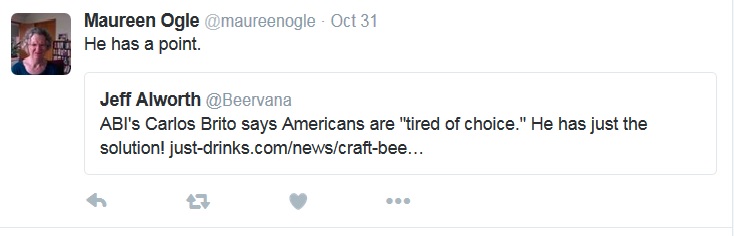
I got into an unexpected Twitter conversation two days ago following this exchange:


Maureen's obvious and mild comment then sparked a discussion that ran 51 tweets, was joined by eleven people, and lasted 21 hours before everyone finally got exhausted by the terrible medium and wandered away. (Or anyway, that's how these conversations make me feel.) Along the way, it touched on just about everything that we love, hate, and worry about in the beer world.

Maureen's point was hardly controversial: "Sure, [they're] fun to try, but again, daily basis? I don't need zillion choices." I don't think there are many people who haven't confronted a wall of beer in the cooler and had exactly this thought--which is true at the pub as well. As the conversation went on, Maureen and others started stacking observations to the mix like cord wood:
  • When retailers stock many different beers, it's inevitable that some will get stale. (Good retailers and distributors, of course, will remove that stock, but that doesn't happen in every case.)
  • The risk of buying stale beer further makes consumers gun-shy.
  • The proliferation of beer means a decent amount of it is meh at best.
  • Lots of people do want choice, of course; this is true not only of advanced-case beer geeks, but regular consumers (who have made seasonals and mix-packs perennial best-sellers).
  • As another data point, pubs don't pull out handles because there's too much choice.
  • Breweries love choice, because it's a great way to attract new drinkers, but...
  • They also hate the need to continually offer new products and worry when workhorse best sellers flag due to disinterest.
  • The churn of choice can be expensive, particularly because not every choice is a win.
  • Finally, Joel Winn pointed to this article in which Anthony Bourdain complains that some of this choice seems to feed the thirst of dilettantes: "the entire place was filled with people sitting there with five small glasses in front of them, filled with different beers, taking notes. This is not what a bar is about." 
The truth is, all of this is right. Beer is no longer simple. That is both its great strength and weakness. When I came up, you walked into a bar and there were four taps all pouring the same basic beer. Since all the beer was the same, people made decisions based on loyalty or price. You went to the pub to drink, but not for the beer--it was the opposite of what Bourdain describes. This was a time of simplicity, but it was dismal.

There is no doubt beer drinkers have it far better now, but the world offers no utopias. With choice comes chance--bad beer, stale beer, and of course wondrous beer. This bounty has delivered a new culture and several subcultures. Even those of us who (sometimes) love fussy taprooms with exotic beer and little glasses can sometimes just want a nice session with simple, nuanced beer and no complications. There's a reason craft beer has been subject to satire about twee hipsters. All this choice has given brewers many more customers and sales, but also headaches. Trying to stay ahead of the novelty curve is maddening, and some breweries have had trouble replacing capacity lost when a flagship's sales start flagging.

All of this is why Schell's brewmaster, David Berg, tweeted "the paradox of choice strikes again." These are the best of times--but even still, they're not without their troubles.

Related: Bryan Roth riffs on the same Twitter storm.

Wednesday, October 26, 2016

Why We Love Lists and Awards

My cursor hovered over a link to "the best IPAs in each state." I wondered--did they get Oregon right? But, in that moment of indecision, I asked myself another question: why do you care what some random site thinks? On a Saturday morning a few weeks back, live tweets from Denver started announcing winners at the GABF. I spent an hour looking at my phone as the results dribbled in, again, transfixed by the results. As consumers of online media, these moments happen all the time.

Why do we care?

There's a totally functional purpose for awards and best-of lists--they help us navigate worlds populated by too many attractions. Whether it's beers or books or 80s alt rock albums, there's just not enough time to consume everything. We've all found ourselves Googling for best-of lists to help us winnow choices. Awards serve a similar purpose in helping us find the creme of any given crop. Looking for a novel on Kindle; why not scan recent Hugo award winners for guidance? But this function is a mere downstream benefit of awards and best-of lists. They actually function at a much deeper level--the desire to bring authority to the subjective.

A perfect example of this dynamic is playing out in the kerfuffle over Bob Dylan's recent Nobel for literature. The Nobel has cultivated the reputation as being the most authoritative judge of merit. The Nobel is by far the most prestigious award on the planet, and serves, for winners, as a crowning confirmation of greatness. The basis for that authority is rarely challenged (except by non-winners), but Dylan, in refusing to even acknowledge that he's won, has illuminated the grubby, largely subjective nature of the whole thing.
On Saturday, an academy member called Mr. Dylan “impolite and arrogant.”  “One can say that it is impolite and arrogant,” the member, Per Wastberg, a writer, told the Swedish newspaper Dagens Nyheter, according to a translation by The Associated Press.
Of course, the Academy is not a purely neutral algorithm of aesthetics; it is comprised of humans with idiosyncratic opinions. Their authority comes in part from the universal agreement of their authority--and not least by the acknowledgement of the winner. Wastberg erred by demonstrating that there's a quid pro quo at play: we call you the best, you say we are uniquely qualified to make that judgment. Dylan, in refusing even to comment, challenges the sandy foundation on which Nobel rests. (Sartre declined the award, but announced his rejection. In doing so, he affirmed the import of the award.)

The thing is, we know this, and yet we still have this bizarre urge to find "the best." It appears when our finger hovers above the link to a listicle, of our urge to fight over the meaning and approriateness of Dylan's Nobel. We may often disagree with a particular award or list, but we seem never to disagree with the idea of the award or list. The problem arises when our own personal preferences come in conflict with the authority of the list or award. Weirdly, we rarely think, "this idea of 'the best' is stupid"; instead, we think, "that award/list is wrong." Why can we not just abandon our urge to quantify the subjective?

Whatever the reason, we can't. And so year after year, listicle after listicle, we continue to debate these things, forever thinking that somehow, someway, there's got to be a satisfying (read: quantifiable) answer to it. Humans are such funny creatures.

(Incidentally, I considered titling this post "Eleven reasons we love lists (you won't believe #4!)" but I spared you that. You're welcome.)

Thursday, September 29, 2016

On the Nature of Fresh Hop Beers


 Mt Tabor Brewing held a media event unveiling their new, inner-Southeast location, and as things began dissipating, a dispute broke out about fresh hop beers. I thought I'd settled all this already, but I see there's still work to do. As such, I'm reposting comments from September 24, 2014--"You Know a Fresh Hop Beer By Its Taste."

Let us consider the fresh hop beer. A seemingly simple beast, it is made from the addition of undried hops rushed sun-warm from field to kettle (or tank). In recent years this simplicity has been obscured by off-topic etymological and existential discussions about what "fresh" really means. It has come to mirror--or rhyme with--the debates about gluten and organics, as if the best way to ascertain the true nature of a fresh-hop beer is to check your conscience. Can it be a fresh hop beer if some dried hops are used?  Can it be a fresh hop beer if none are used? These inquiries lead in the wrong direction, to ethics, and away from the thing that is so blindingly obvious. The "fresh" in the fresh hop comes from the living plant and anyone who has tasted that life in a beer appreciates it through the proper instrument, her senses.

This is not rocket science.  What we should be looking for in a fresh hop beer are those very obvious flavors and aromas that ooze out of the [pick one: fresh, wet, unkilned, undried] hop. We know a fresh hop beer not by querying the brewer about his methods, but by tasting it. I recognize that a lot of people in the world haven't had the chance to try these beers, so Pacific Northwesterners must act as envoys to tell of these wondrous creatures from afar. The first lesson is: they're about as easy to distinguish from normal beers as a porter is from a pale. If you're sniffing and swishing and cocking your head trying to figure out if the beer was made with fresh hops, it's not a good example no matter how it was made. If you're getting lively, feral, sometimes unsettling flavors, that's a fresh hop beer.

I am all for truth in labeling, and I endorse Bill Night's long crusade to expose breweries who call their beer "fresh hop" when they're nothing of the kind. But it obscures the far more relevant and important inquiry into the joys and wonders (and mishaps and disasters) that are to be found in those that are manifestly fresh hop beers. They are their own thing, and their thing is obvious by the way they taste. We should go forth and discover.

Tuesday, September 13, 2016

In the Public Interest, But Not the Public Domain


This morning, NPR ran a story about an effort to preserve pubs in the UK:
The British pub is as much a part of the fabric of the United Kingdom as fish and chips and the queen, but each year hundreds close their doors for good. The reasons include the high price of beer, more people drinking at home and rising land prices. Now — in an apparent first — the London borough of Wandsworth has designated 120 pubs for protection, requiring owners who want to transform them into apartments or supermarkets to get local government approval first.
This is not going to be another demise-of-the-British-pub posts, partly because "demise of the British pub" articles have been a going concern since the first Bush presidency. In fact, I recall but cannot find a post/article that pointed out these articles have actually been popular for centuries. It seems the English pub is always endangered.

No, what it made me think of was something related: the demise of the independent brewery.

Since 2011, when AB InBev bought Goose Island, something like 15 breweries have been purchased by large companies. That's compares with the nearly 5000 that remain independent. And yet, we do harbor a gnawing worry that independence is in danger. Part of this is because we don't relate to pubs and breweries the way we relate to, say, iPhones and soda brands. The part of that NPR piece that really crystallized it was this comment by Jonathan Cook, deputy leader of the Wandsworth Council:
"What we're saying is, 'Well, hang on a minute — we have an interest here as well. The community values the pub and you've got to factor that into the equation,'" says Cook.
We don't relate to pubs as interchangeable service-providers any more than we relate to breweries as random widget-makers. In our minds, they're something of a public trust. The Councilman says it more baldly than most, but there's a piece of this thinking that goes into every angry comment on a Facebook post announcing the latest buy-out.

Pubs and breweries, for their part, strongly encourage this thinking. What business would fail to capitalize on this rare emotional connection customers have to their favorite brand/establishment? We want to have connections to these entities. But, as Martyn Cornell pointed out when he addressed this issue of restricting pub sales two years ago, as much as they may be in the public interest, they're not actually in the public domain:
The whole idea that pubs need special protection is nonsense, anyway, as I have frequently argued. Pubs are not sacred. The rights of pubgoers do not trump the rights of property owners. The disappearance of any pub is not the same as, eg, the disappearance of a Saxon church. Pubs are, and have always been, “churned” all the time: one closes, another one opens. (It may surprise you to learn that JD Wetherspoon has closed more than 100 of the pubs it has opened over the years). If a pub is making less money for its owner than it would under another use, the owner must have the right to maximise their income. If a pub closes, and a community feels it needs a pub, let someone open a new pub, in a more viable site with fewer overheads. 
I am perhaps more sentimental than Martyn. When an old pub closes to make way for a convenience store or fast-casual restaurant, I feel the poorer. Were Deschutes or Sierra Nevada or Breakside or Other Half to sell to ABI, I would feel the poorer. As a guy interested in policy, I'm with Martyn that efforts to restrict the sale of private businesses is bad public policy. It does not necessarily follow that I'm happy to see the churn.

I participate in the false sense that I somehow have a piece of the pubs and breweries I like, as do they, and I will continue to do so because it's a more pleasant way to live. But it's good to acknowledge from time to time how silly this is of me.

Friday, August 19, 2016

On Perfection

An article in the NY Times Magazine got me thinking. The subject of the piece is Michelangelo's David, which may in time--like all things--collapse into dust. But what caught my eye was not the fascinating backstory of the statue nor the nature of the physics that threaten it, but writer Sam Anderson's description of the statue's perfection:
When I first saw the David in person, the only word that came to mind was “perfect.” Why hadn’t anyone ever told me he was perfect? I was 20 years old, exhausted, unwashed, traveling for the first time ever, ignorant of almost everything worth knowing. “Perfect,” I know now, is not a terribly original response to the statue, nor a very precise one, but in that moment it filled my mind. It felt like a revolution — urgent, deep, vital, true.
And then a bit later:
I stood there in my filthy Birkenstocks feeling a sense of religious transcendental soaring: the promise that my true self was not bound by the constraints of my childhood — by freeway exits, office parks, after-school programs, coin-operated laundry rooms at dingy apartment complexes, vineyards plowed under and converted into Walmarts, instability, change, dead dogs, divorce. No. The David suggested that my true self existed most fully in some interstellar superhistorical realm in which all the ideal things of the universe commingled in a perpetual ecstasy of harmonizing trumpet blasts. If such perfection could exist in the world, I felt, then so many other things were suddenly possible: to live a perfect life creating perfect things, to find an ideal way to be. What was the point of anything less?
Curiously, Anderson details all the conventional ways in which the statue is not perfect. That's actually the point of the article: "The seed of the problem is a tiny imperfection in the statue’s design" (my bold). The marble itself is pockmarked in places, and one of David's arms was once knocked off and reattached. What Anderson's describing is an artistic and aesthetic perfection, one with such power as to impart a religious experience. He ignores the tangible imperfections and instead locates a mystical perfection beyond the physical object.

Is he looking for the perfect beer?
Perfection is a weird concept. It suggests both an empirical and  subjective quality. Like a perfect ten in gymnastics, it's the way we attempt to codify in concrete terms our certainty of a surpassing aesthetic triumph. The perfect moment, the perfect man/woman, the perfect job. It's a self-defeating concept, though, because there's no way to actually measure the subjective, which is by definition a judgment based on non-quantifiable criteria like taste, opinions, or feelings. And that unverifiability is exactly why we want to have a concept like perfection. Calling something perfect is the act of desperate hyperbole, when we try to end an argument with the maximal rendering of judgment.

The reason "perfection" is a paradox is because the elements that compose it are always open to debate. We can't arrive at perfection because we can never agree to the rules of debate. I mean, when I look at David and see that bizarrely mannered tuft of pubic hair riding David's junk like a pair of furry chestnut burrs, I have a hard time moving on. And because perfection suggests a Platonic ideal, one which is so manifestly obvious that even a philistine like me can see it, David must not be perfect. In these matters, the doubters get the final veto.

In art, the idea of perfection is thrown around a lot. Maybe this has to do with the money involved. If you just spent a half a billion dollars on a Van Gogh, you don't want anyone telling you it's not perfect. In lower forms of expression--beer, let's say--perfection is generally considered a quality to aspire to, not one to attain. I've seen this over and over again. In homebrewing competitions, no one gives out a 50, the highest score. You're lucky to get a 40. It seems like the reasoning is encouragement: no matter how kick-ass your bock is, the theory goes, there's always got to be some room to make it more kick-ass. Homebrewing is a journey, and a natural 50 would abruptly end things at the summit. Best to think there's another, higher mountain beyond the one we're just about to crest.

When I sat in on the tasting panel at the Widmer Brothers brewery a few years back, they rated the beers on a five point scale. Four was the maximum any beer ever received, which seemed odd to me. I assumed five would represent the best quality the brewery could produce, since they were evaluating the beer before it shipped. Nope, four was the highest score I heard that day. I asked about that and they said five was reserved for a truly exceptional beer, one that, like Anderson's David, truly deserved the title of "perfect." They had never encountered such a beer but, like hopeful Sasquatch-hunters everywhere, wanted to believe one existed.

I sometimes use perfect casually (so please don't dig around the archives to disprove the following clause) but I've abandoned it as a useful concept. Whether we're talking about beer or art, perfection is a unicorn. We can describe it in rich, vivid detail, but no one has ever actually encountered it. Worse, the existence of this fictitious state denigrates the excellence we find occasionally in the real world. We hold open the possibility that there's something better than a Usain Bolt hundred-meter dash, or a 1966 Jaguar E-type roadster, or a Saison Dupont, but in pining for the impossible, fail to apprehend the real genius in front of us. The notion of "perfect" is what leads to hundred-dollar bottles of Cantillon and a veneration of mythical "whales" (or worse, "whalez"). There are a staggering amount of exceptional beers out there, more than the earth has ever seen, and settling into their enjoyment seems like a far better use of time than waiting interminably for perfection to come along.

Friday, July 15, 2016

Naive Pleasure

Something's not quite right this summer. There's a sour mood in the air, the feeling of confusion and conflict. Social media has a mean edge. I could be speaking about politics, but the same is true with beer. We have passed out of the fun stage of infatuation and have entered the period Sartre called "the age of reason"--the loss of the simplicity of youth. Or perhaps the scene in the Matrix is a better analogy. The one where Neo is offered the chance to embrace the harsh truth of reality (the red pill), or take the blue pill and slide back into a blissful fiction. Too many of us have eaten the red pill, and we sink into the sludge of buyouts, lawsuits, sales reports, and purity tests.

But these analogies are inexact. The one great thing about beer is we can turn off the discursive mind and slide into the emotional mind. A nice beer on a sunny day, just you and your senses, falling into a blissful absorption of beer. There are many ways to do this--as a drinker, as a homebrewer, or, if you're lucky enough to be a writer, as a kind of motivated fan.


I'm off to Block 15 today to spend some time with Nick Arzner, one of my favorite brewers. We're going to spend some time today discussing his projects, process, and philosophy, and I will have the joy of just listening. (With luck you'll be able to hear part of our discussion, because I'm hoping to get some tape of Nick discussing the art of blending for the podcast.) One of the great things about writing about beer is that you get to hang out with brewers and learn about how they think about and make beer. At some point, I'll need to turn our conversation into something with shape and form, but the conversation itself should be pure pleasure.

We probably need to spend more time rediscovering that sense of naive pleasure that drew us to beer in the first place. There is plenty of drama and conflict in the beer world to sustain a million tweets, but that is decidedly not why I started writing about beer. Summer itself is a time of uncomplicated pleasures--bare skin, dime-store novels, popcorn blockbusters, tall glasses of cold beer.

Happy Friday, everyone--

Wednesday, June 01, 2016

Why I'm Not a Beer Geek

Note: post updated below.

Yesterday, on the discussion-resistant platform of Twitter, I had a choppy exchange about the nature of the beer geek. I argued that I wasn't one, and Nick concluded, "Hilarious to think that a guy who writes books about beer and travels the world to explore rare styles denies being [a beer geek]." (New motto!: "Providing inadvertent hilarity since 2006 .") Let's take it off the Twitter and break this whole thing down. I have lately noticed quite a deviation in my own behavior and that of many other beer fans, and it seems worth a paragraph or seven of exploration.

If "beer geek" is a general category identifying anyone who knows what a session IPA is, then I and anyone reading this fit the bill. I think that's Nick's point. Until ten years ago, that was a useful category because the number of people drinking good beer was relatively small. We were already a subculture. But now a majority of beer drinkers are at least sometime "craft" (read: anything but mass market lager) drinkers. Which means this use of beer geek would mean most people who drink beer, and would therefore be drained of any real meaning.

Even more to the point, there's a big difference behaviorally, and this is where I've noticed it. A subculture of super-fans has developed, and they behave in distinctive ways. They spend a lot of time pursuing new beers and are very trend-sensitive. They are the first adopters, lavishing love on beers like "New England IPAs" (right now), kettle-soured beers (last year), or fruit IPAs (2014). They are hugely promiscuous in their fandom, trying to taste as much beer from as many breweries as possible. They have strong opinions about the best breweries and beers and organize them into tiers of coolness, much like music fans. They dream about landing ultra-rare, usually vintage beers ("whales"). They'll stand in line for hours to get a bottle of the latest, coolest beer--or even drive to Vermont so they can stand in line for hours to get one. They avidly record their activities on various social media apps and ratings sites. When they travel abroad, they want to drink as many different beers as possible, and may go to six pubs in an evening. This is the person I think of as a beer geek.

It lines up pretty closely with the way people describe geeks in other subcultures, too. In fact, people have drawn a distinction between nerds and geeks to give the term extra valence:
Geeks are “collection” oriented, gathering facts and mementos related to their subject of interest. They are obsessed with the newest, coolest, trendiest things that their subject has to offer.... Nerds are “achievement” oriented, and focus their efforts on acquiring knowledge and skill over trivia and memorabilia.
We don't regularly use the phrase "beer nerd," but I guess it would, in Nick's words, describe a guy who "writes books about beer and travels the world to explore rare styles." I'm definitely far more nerdy than geeky. But there's another dimension here that goes back to the behavior bit, and it's the one that makes me think I'm not a beer geek--and maybe only nerd-adjacent. Beer is unlike sci-fi or just plain sci in that it has an attendant culture and context of use. And this gets to where my interests lie.

Source
There is a group whose main engagement with beer is social. I've wandered into this life of writing about beer, but I don't objectively like beer more than I like basketball or politics, and had things gone a different way, I might now be writing a post about the difference between a hack and a wonk. I could give up beer, the beverage, more easily than I could coffee. By far. But what I'd find very hard to give up is the simple pleasure of sitting with people in a pub and enjoying a pint. In that context, I like a good beer, but it isn't the central feature of the outing. This view is far more prevalent in pub-going countries, where people regularly drink a lot of beer over the course of a year. But the term "beer geek" just doesn't fit. They're beer drinkers, and surely beer lovers. But not beer geeks.

There are other subgroups within beer fandom (the historians/scholars, the homebrewers, the style nazis, the low-information drinkers), but if I had to identify my tribe, it would be the pub-goers. This has given rise in the past five years to conversations that peter out after I confess I haven't tried some new beer or been to a newly-opened brewery. (And by newly-opened I mean since 2010.) It means I end up defending low-status beers in conversations with mystified geeks. Weirdly, it also means that some of my beery interests--an old European brewery I've visited, some weird technique a brewer told me about--are met with glazed eyes by bored geeks. The rise of this kind of beer geek is fairly recent--super-fans didn't exist in enough density to coagulate into a subculture until maybe ten years ago. But now beer geekery is a full-fledged subculture, and its rules, values, and membership mystify me. I am not a beer geek.

Update
This post has spent 24 hours percolating through social media, and there's a vein within the chatter I'd like to respond to. The idea with the post was to point out that a new subculture within beer has developed. I don't think semantics matter here--whether that or another subculture, or even the whole of beer fandom, gets called "beer geek" isn't really the point. The point is more that there now are many different currents within the beer-enjoying community and I feel somewhat out of step with some of them.

I'd like to add that, although I don't see myself as a beer geek in the way paragraph three describes them, I have nothing against those who are. Fandom is like anything--your preferences may vary. I have much more in common with whale-hunters than I do with Bud Light drinkers. We don't need to play our expressions of fandom against one another.

Monday, May 02, 2016

Dusting Off an Old Manifesto

We are entering the week of the Craft Brewers Conference, when a huge amount of energy will be devoted to this theoretical netherworld called "craft beer." It follows a week in which Stone's Greg Koch announced he'd be dumping $100 million into "real" breweries. Or something. Oh god, I grow weary of all this. Titans are arguing about which purity tests to apply (Greg Koch has A LOT more in common with the Busch family than he does with me.) And all of these titans will be appealing to your emotions to get you to buy the right brand, and it's starting to feel awfully tawdry.

What should a good drinker do? Six years ago I wrote a post that got very little traction, but which always struck me as the right answer. Consumers want good beer and a system that supports diversity. I think you should ignore all the blather about craft and consider my old manifesto. It looks even better to me now. Below I've reprinted an edited version, with a few additions in italics. Since I wrote this post, I've traveled the world and learned a bit more about beer, but it all convinces me I was right in the first place.


Buy local, buy good, drink on tap.

Back in the 1970s, Charlie Papazian founded the Association of Brewers--and the more well-known American Homebrewers Association--as advocacy groups for fledgling brewers. The mission grew out of the particular circumstances of that time and place, and was, for at least a decade, clear, accurate, and important. There were two categories of beer: insipid, tin-can beer and handcrafted, artisanal beer. The former had eaten its own, stamped out diversity and quality, and was busily consolidating itself into a single, monolithic product where the only distinction could be found in the color on the label. The latter cared about beer, brewing history, and beer styles, not money. The Association of Brewers therefore had an easy task: support the little guy, support good beer, support independence. It was a moral as much as business crusade.


Unfortunately, breweries can't easily be divided into good beer/bad beer, big/little, and independent/multinational. The brewing industry is a market, and markets grow like amoebas. Trying to contain them in boxes is of no use. And markets are by nature amoral. I have no particular interest in how American breweries organize themselves politically. This manifesto is designed not for brewery owners, but beer drinkers concerned with creating an environment that fosters a healthy market for good beer. It is designed to create the conditions for the production of good beer and a sustainable market. It could also be said to be a blueprint for how Beervana became Beervana, how Bamberg became Bamberg, and how Prague became Prague. These things, rather than a series of ever less explicable categories of being, are what we want to nurture.

Buy Local
Show me a town where the beer drinkers are avid fans of good beer, and I'll show you a town with local breweries. It makes sense, right? If locals are buying your beer, you're inclined to make them happy. But it's not just small breweries that have this effect: look at the great brewing regions, the areas around Portland, Seattle, Denver, Philadelphia--have or had large, regional breweries located nearby. Beer is local. If you have a beer city, it means you have beer people. If those beer people buy locally, they'll have access to good beer. Good beer is fundamentally a product of culture; a dialogue between the people who drink beer and the people who make it. You find good beer where you find good beer culture, and you only find good beer culture in places where beer is made locally by a number of breweries.

The Brewers Association has focused on the independence, but this misses the point. Markets require masses. Towns with breweries have those masses. The problem with consolidation in the 60s and 70s was that local brewing culture died out--vast swaths of the country, lacking any local beer, drank whatever was cheapest, further fueling consolidation and turning beer from a product of local culture into a generic commodity. It's counterintuitive, but even bigger regional breweries help smaller ones flourish because they make the market even that much bigger. You don't have to be xenophobic about it, but spare a copper or two for the local guy(s).  And of course, when you're traveling, drink local wherever you happen to be, to..

(Buying local also helps communities, and is a source of local wealth and prosperity.)

Buy Good
Of course, it's not enough to only buy local--consumers have to demand good beer. Rather than descending into a long philosophical dispute about good, let's use the Judge Stewart rationale: we know it when we see it. Minimally, it's a beer brewed with quality ingredients and attention to style. The reason we should support good beer--whether or not it comes from a small brewery--is that this creates the market for good beer. If consumers always eschew the good for the cheap, they'll get the cheap. If they spend a bit more and buy the good, they'll make it possible for breweries to continue to brew the good. And round it goes.

Buying good creates the environment for local culture to flourish. The commodification of beer creates a generic blandness. Buying good encourages breweries to offer more enticing offerings. What we've seen in the US in the last decade is a race to the top, as breweries use techniques like late-addition hopping to create a new style of hoppy American beer (which is anything but cheap) and embrace techniques like spontaneous fermentation, kettle souring, and barrel-aging. In communities that develop a taste for one of these techniques, local styles may emerge. That has been the history of beer style for 10,000 years.


Drink on Tap
You can buy many of the world's greatest beers in bottles. You can buy brewery-fresh local beer in bottles. But from time to time, you should go to your neighborhood pub and plunk down a five spot on a pint (an honest pint, naturally). The brewing ecosystem is large and diverse. If we don't support pubs, we fail to support the incubators of beer culture. Seeing others in a public space, sampling different kinds of beers, talking with your local publican (who may be the brewer)--these things are the fertilizer for healthy markets. When people go to pubs, they support local beer and local business. More importantly, buying on tap means that the communication between the brewer and the drinker is direct and transparent; it's the basis of that responsiveness that leads to local culture. Markets respond to product trends; publicans respond to people.

Buy local, buy good, drink on tap. Do these things, and good beer will continue to be brewed in your neighborhood. After all, isn't that's what we're really after? 

Wednesday, April 20, 2016

Wonder and Humility

Last week, Patrick and I sat down to record a podcast on tasting beer. (Give it a listen!) The simple idea was that, in blind-tasting our way through a few beers, we could illustrate how much your eyes, noses, and tongue will tell you about the beer you're drinking. Beer's many flavor and aroma compounds can easily bewilder, and it takes years of sampling to find your way through their thicket. I've led tastings where we sample a beer and break it down, and for people new(ish) to beer, it can be revelatory. Being able to connect flavors to ingredient and process creates a map that drinkers can use with any beer--a rosetta stone that demystifies all that complexity.

Is Fred about to listen to his beer?


But in deciding to do the tasting blind, we revealed another truth to beer: so much of our "knowledge" comes from things that we don't learn through our eyes, noses, and tongues. I'd asked Sally to buy some beers for the experiment and prepare them for us. We didn't coordinate about anything--style, brewery, country. Stripping away all those cues left us with only our senses, and that's a surprisingly naked experience. You want to reach for the bottle to see what the brewery says about the beer. Our second bottle was a saison by Bend's Crux Fermentation Project. It had a lot of clovey phenolics and a touch of banana-y isoamyl acetate. I looked at the cloudy liquid in the glass and wondered whether it was a saison or a slightly offbeat Bavarian weizen. I had no crutch to lean on, though, so I just settled further into the experience. Not knowing let me get to know that beer on fresh terms.

Even more remarkable was the experience of bottle three, a beer we had already reviewed on the podcast. It was my favorite beer of the flight, and such a curious experience! The aromas were richly malty, with layers of cocoa, nuts, toffee, and chicory. The flavors were if anything more varied. There was a fragile layer of roastiness floating on top of the palate, and it gave way to a buffet of malty goodness underneath. There was a vanilla/butterscotch note so pronounced we were pretty sure it had been bourbon-aged. Amazingly, the beer was light and delicate, and as you swallowed, it disappeared with a satisfyingly crisp snap.

It turned out to be Black Boss, which we sampled for the porters and stouts podcast (one of my favorites). In that case, I condemned it because I found it wanting as a porter. And indeed, when we blind-tasted it, we agreed it wasn't a porter. The roast is far too subtle. It was a ruby color, very bright, with an ecru head and, poured into a Rodenbach glass, did a decent enough visual impersonation of Roselare's finest. But my impression of the beer as a bad Baltic porter clouded my judgment about the beer itself. What I "knew" about Black Boss prevented me from experiencing something much more obvious and accessible. Absolutely every time I do a blind tasting, I find myself re-learning the lessons of humility, and this was a prime example.

Recently, Bryan Roth wrote a great post about bringing ears into the equation and listening to your beer. Fred Eckhardt used to exhort drinkers to listen to their beers, too. Like Bryan, he meant it partly literally--you can hear a head collapse, he pointed out--but Eckhardt was a bit of a mystic. He meant it poetically, as well. We "know" so much about beer because of what the label tells us, what its reputation is, what our previous experience has been, and what style it was brewed to. But this isn't knowledge, not really. When Fred told us to listen to our beers, he was saying, "put everything else aside." Every beer will tell you about itself, if only you stop to listen to the story.

Real knowledge is naked experience, untroubled by extraneous details. We so often foreclose the possibility of discovery because we already have the answers, the knowledge. If we know a beer is a well-regarded dubbel from a famous brewery in Belgium, we mold our experience (subtly, unintentionally) to fit that knowledge. We lose the opportunity for wonder. We can't meet someone we already know.

Periodically I have an experience that reminds me of these truths. Afterward, in the few days when I can remember to recapture my wonder and humility, I marvel at the experience and pure pleasure of a pint of beer. This is one of those moments. I better have another beer soon.

Monday, April 11, 2016

What Makes a Great Brewery?

Over the weekend, a discussion broke out on Facebook that led, as discussions often do, down a little side alley away from the main topic. It got me thinking. In the beer world, we spend countless hours discussing "bests." Beers get the most attention, but breweries get a lot, too. (The Facebook discussion started out with this post about people lining up for hours just to buy a brewery's beer.) The debates, inevitably, come to tears or smears because no one agrees about the definition. And there's the rub--and opportunity.

It occurred to me that I have some criteria for what makes a top tier brewery. I'm talking here about the crème de la crème--the Duponts, Schenkerlas, and Sierra Nevadas. Some of them are so famous no one disputes their membership in this rare club, but most are not. When you survey the breweries of a country like the US, where there are so many of them and many are so recent, how would you distinguish the best from the rest--particularly lacking that agreed-upon consensus? (And the truth is, we should probably throw that out as well.)

Are these people waiting outside a great brewery?
Credit: Jon Urch


I haven't toured the world anywhere near as extensively as some people, but I have drifted around a bit. As a writer who's supposed to bird-dog the good breweries and guide people to them, it's not just an academic exercise. As I've traveled, I found myself relying on a set of criteria that seems to work pretty well. Like all considerations of "best," it ultimately runs aground on the shoals of subjectivity and tautology (a good brewery is one that makes a lot of good beer!). But it does rough out the important categories that define greatness. Which breweries qualify will always be a personal judgment, but I think these are the criteria against which greatness should be judged. Note that a great brewery has all of these:
  • Consistent excellence. First, the beer has to be excellent across the entire line. Not every beer has to be a world classic, but the whole line should be accomplished and consistent.
  • An exceptional beer. It must also have at least one exceptional beer--that evanescent "world classic" or whatever terrible term we use to describe it.For my purposes, it should be unique and original, not just a good example of a well-known style. The kind of beer that sticks in your head both because it is so good, but also because its unlike anything out there. It doesn't hurt if it's the standard for a style, either. (Until about a decade ago, there weren't many American breweries that met this standard.)
  • A unique voice. Next, the brewery must have a distinctive "voice." Talented brewers can reproduce beers they've tasted elsewhere. Making a line-up of quality ales is a function of craftsmanship, and it's critical but not sufficient. I also want the brewery to offer a vision for their beer. When I taste a Schlenkerla, a Dupont, a Fuller's, I know the beer. This is an under-appreciated virtue, and possibly the hardest mark to hit.
  • Bonus: continued originality. The final criterion is really extra credit, a fixture of modern brewing. I appreciate it when a brewery is able to continue to create new and original beers along with the established classics. I would not mark Westmalle down for failing to do this, but I admire it when breweries like Schneider do. And with young, new-world breweries, it is almost a requirement. It's why Sierra Nevada, for example, continues to stay out in front.
I would guess that there are no more than a couple hundred breweries out there that meet my standards for "great"--and maybe only twenty or thirty in the US.  There's a tier below this that is much larger, though still small considering the tens of thousands of breweries in the world. In that group you'd have breweries that might have an exceptional beer but are inconsistent, or which have great standards but lack anything truly exceptional, or the ones that haven't yet found their voice.

And what about longevity? How do we compare breweries that have been making great beer for decades or centuries with ones that have been making them for months or a few years? It's a good question, and one I've never settled on. Greatness is not a permanent achievement. Once-great breweries can and do go into periods where they're making mediocre beer. But it's also important to establish a track record of quality. I might put an asterisk next to a young brewery that had a great year with the mental note to check back and see how they manage after competing in the marketplace for a few more years.

Your thoughts?

Thursday, March 03, 2016

The Madness of Causation: Why Do We Care?

You may find yourself in a brand new pub, and you may find yourself in a nice part of town. You may find yourself behind a pint of beautiful IPA. And you may ask yourself, how did this IPA get here?

Thus passed a week in Beervana--with theories spun about how American IPAs evolved, counter theories, and counters to the counter theories. Don't worry!--this is not going to be another round in the madness. But it is a consideration of the madness itself: why do we care so much about the causal explanation?

This is not a new debate. Establishing causality is a way of creating meaning now, in this time, and that's what we care about. For decades, Americans have fought bitterly about the American Civil War--was it a dispute over states' rights, or human slavery? The causal argument is critical because if we trace events back to a defense of slavery, those who support symbols like the Confederate flag and policies like voter ID laws are indicted by it. But, if we can trace them back to a more noble defense of state sovereignty, then the politics of today are cast in a similarly more noble light.

Dusseldorf, where the ale is altbier and only altbier.


We fight for the history of beer for the same reason. (Fortunately the stakes are somewhat less dire.) So often, though, we don't realize that's what's happening. We are convinced by our argument without seeing why we are committed to its logic. If we argue that a certain beer style goes back to a particular brewer, we're attempting to both elevate the accomplishment of that brewer and diminish the breakthroughs and innovations of others. (This is the "great man" theory of history.)

It seems fair to mention my logic, and why I find the great man or single-origin theories unpersuasive. Beers and beer styles are the result of a conversation between breweries and beer drinkers, and the whole process is heavily influenced by local culture. Breweries make beers and offer them to the public. They start with beers they like, with a vision for how they should be made. But the drinkers have the final say. Breweries make the beers that people buy. Along the way, they tinker and refine, so that the preferences of the drinkers get fed back into the thinking about how to improve the beer. This is the process that has led to the very different brewing traditions and beers of Europe, and why we in the US are developing our own brewing tradition and beer.

No case is ever airtight. In some cases, certain beers do exert and outsize influence; they're the beers that get the ball rolling style-wise. Josef Groll's pilnser springs to mind. Acknowledged.

I'm committed to the idea of the brewer-drinker feedback loop because it acknowledges the role of society in the process. That's the only secret sauce I've ever encountered that explains why Germans grew to like clean, unadorned lagers while their neighbors in Belgium favored funky, sometimes bizarre ales. When I look at the evolution of American hoppy ales, it seems too vast and too nested to have any single origin. We have been on a road for at least twenty-five years (and possibly forty) that led to this moment. Along the way there have been extremely important contributions, but this invention had many, many fathers. Millions, I'd say.

If you a theory of causation, where's your commitment in all of this?

Tuesday, February 02, 2016

Why the Beer Matters

Yesterday, I discussed the beer Cartwright Brewing made when it launched an early microbrewery in Portland in 1980. It was definitely the most interesting part of the papers posted by The Oregon Hops and Brewing Archive. But there is an element that's almost as interesting. Chuck Coury, Cartwright's founder, came to the project from wine-making. He'd already seen the change that had taken place in wine, and he gave an incredibly prescient overview of where beer was heading. (Although a small handful of American microbreweries had opened within the year or two before Coury started thinking about opening his own, they were far too new and tiny to suggest that any of his predictions were imminent.)

In the review he made of his own project at the time, here's what he observed about the coming beer market:
  • "There is a market for quality domestic beer. Note the rise in import sales. Compare to the explosion in fine wines. Prohibition theory: America's beer palate is only now recovering."
  • "Not everyone will enjoy your beer. That is good."
  • Things to stress about your brewery: "Local, small-scale production. Traditional/European quality. Re: chill haze and sediment; stress positively as 'real beer.'"
Kurt Widmer at the recent
release of Hopside down.
This is exactly what happened. It's remarkable that he had this insight into the market, because it took the rest of the country more than a decade to catch up with him. For basically all of the 1980s, it was touch and go in terms of whether what he wrote above would actually come to pass. Karl Ockert once told me that when the Ponzis were looking for bank funding to open BridgePort a few years later, the banker said (paraphrasing), "Nobody opens breweries; they just shut them down." But here we are, a generation later, and it turns out there is a market for domestic beer. Not everyone like every brand, and that is good--it means we have a very rich and diverse market. He even correctly identified that elements of craft beer that would be anathema to a large industrial brewery like haze could become a marker for hand-made authenticity.

Which raises the question: why did Cartwright fail?

Part of it was that the market Coury envisioned wouldn't emerge for years. Sometimes visionaries suffer a first-mover disadvantage (you could say Cartwright was the MySpace of beer). But a far bigger reason was the beer. It just wasn't good. There are still lots of people around who remember it, and that's the overwhelming memory; even on Facebook people were recalling the beer with amusement as a crapshoot. Apparently there were a few good batches, but they seem to have been the minority.

When you look at the breweries that survived the 1980s, nearly all of them did so by making very good beer. But it's also true now. A glance at the largest breweries in the roughly "craft" camp (Boston Beer, Sierra Nevada, New Belgium, Craft Brewers Alliance, Lagunitas, Deschutes, Bell's) confirms that quality really helps a brewery. It's not the only thing that matters. Good branding, smart distribution, fortunate brand performance, good location--all these things can really help. Good beer alone is not sufficient to become a big brewery, either; there are thousands of small breweries worldwide, from Block 15 and Breakside to Dupont and Schlenkerla, that make world-class beer. Some breweries making great beer even fail for reasons unrelated to the beer.

But an iron rule is that without quality beer, it's very, very hard to build a successful brewery if you're competing in the "quality" category. (I'd say impossible, but wise hive mind is going to point out a case where it's happened.) Coury understood where the market was headed. Unfortunately, he charged into it with bad beer and that insight didn't do him any good.

Friday, January 08, 2016

A Long-Winded Way of Saying: Quit Counting Breweries

On Tuesday, in one of my least-viral posts in recent history, I pointed out that assessing countries based only on the growth in number of new breweries gives you a limited perspective. It's better if you also consider existing breweries and total beer production. Germany produces a ton of beer and still managed to support 1,300+ breweries, so despite its anemic new-brewery growth, you still have to acknowledge its preeminence among brewing countries. Owing to the wild success of that post, I'm back for more.

Now we turn to the US for a similar look at state-by-state numbers. These figures come from a paper in The Journal of Wine Economics from a couple months past. They were working with 2012 numbers, but they still paint a very rich portrait. Here are the brewery counts from that year for the top ten states (they look woefully out-of-date, but probably line up pretty closely with the current top ten and demonstrate a similar distribution).


But now have a look at the top ten states by production (this is craft brewery production only). It paints quite a different picture.


California had nearly three times as many breweries as Pennsylvania in 2012, but actually brewed less beer. (Also not that  theMassachusetts number is misleading. It comes principally from Sam Adams, but of course, the amount of Sam Adams brewed in Mass is a tiny trickle--the state's production is actually south of 500,000 barrels.) Washington made less than a tenth the amount of beer as Pennsylvania. It would be great to run this with 2015 numbers, because the effect would be far more dramatic. Nearly all of the breweries that have opened since 2012 are brewing a tiny fraction of the beer. So all the talk of new brewery openings and total breweries would obscure that fact that two states brew a huge share of all the craft beer in the US, and the top four are far ahead of the rest of the country.

And the effect can get very pronounced the further you go down the list. Illinois, for example, had 59 breweries in 2012, but collectively only brewed 81,000 barrels--less than many larger craft breweries. (North Carolinians, who do a lot of bragging about the number of breweries they have, should probably be a bit more circumspect; in 2012 their 59 breweries only made 156,000 barrels--about a tenth the amount of Oregon.)

If you think I'm on a weird bender about possibly extraneous measures, well ... there's more! Over at All About Beer, I try to make the case that brewery numbers are themselves not terribly reliable. (Barrel numbers, which are tracked by the tax man, are rock-solid.)
If you’re like me, you suspect there’s an actual number of breweries in these locations, one that is knowable and countable, and if everyone adhered to the same rules, we could tot them up officially. We know quarks exist, for god’s sake; surely the number of breweries in London, England can’t be beyond our ken. It kind of is. Here we drop into something like a quantum state, where arithmetic may no longer suffice. There exist what we might call Schrödinger breweries, entities that can simultaneously be said to exist and not. I’ll describe the difficulty by way of example.
All of which is to say that counting breweries doesn't make a lot of sense. Cities and states do not try to burnish their cred by citing stats on the number of restaurants or karaoke bars or pet stores. What we actually care about are important, excellent, interesting, or unusual breweries, right? I propose that we quit harping on total numbers.


Update. In the manner of blogs, this post sort of developed as I was writing it. (Note to self: don't do that.) Let me clarify the actual point by responding to Stan Hieronymus' comment:
"Right now there are four breweries within 3 miles of our house (in St. Louis). If plans for 2 more go through, likely, then there will be 6 breweries. At a personal level, the number matters. And shouldn't beer always be personal? Put another way, the big picture that interests me is a sum of all the little pictures." 
Yes, exactly. My real belief is that there is way to much focus on the number of breweries to the exclusion of other factors. Production is a proxy for popularity at both the market and brewery level. They suggest a market where a lot of people are drinking a lot of beer. Illinois looks like a good beer state until you consider that people weren't drinking the beer. In Stan's example, it's great to have a lot of breweries near your house if they're good breweries. Having a bunch of mediocre breweries is no bonus at all. By only focusing on numbers, we miss other important factors. It should be a consideration, but it should never be the only consideration.

Saturday, November 07, 2015

Counterfactuals

A little Saturday morning chin-scratcher for you to mull. Stan links to an article about the famous "judgment of Paris" in the wine world and wonders:
What if Fritz Maytag had not bought Anchor Brewing in 1965?

What if the committee charged in 1906 with interpreting the meaning of the Pure Food and Drug Act had decided to implement some sort of legal differentiation between all malt and adjunct beer, or enacted a proposal that lager beer be required to lager at least three months? (Both were considered and rejected.)

What if the USDA had not released the Cascade hop variety in 1972?
In comments, I suggested that there is no analogue in the beer world. It's just impossible to imagine that beer would remain the one product immune to the post-industrial return to quality and diversity that came to all the other products on the grocery shelves.

But there's a side debate here--one Stan and I have been batting back and forth for years. When we look at the landscape of American brewing now, what we see is a fully-developed American idiom: hoppy ales made with neutral yeasts and base malts, accented (if at all) with just a bit of caramel malt. Whether the name on the package is IPA, double IPA, white IPA, Session IPA (etc), that national lineage is always evident. I have argued to Stan--who has steadfastly remained unconvinced--that there is basically one source for all that. So let me put it out to you, and you can line up in the Stan, Jeff, or alternative camp as befits your reading of history:
What if Ken Grossman had never made Sierra Nevada Pale? (And as a corollary: Sierra Nevada Celebration?)

Discuss.

Monday, August 24, 2015

A Sour, a Porter, and an IPA Walk Into a Book Signing...

On Friday, I had the great pleasure to visit Book Passage, a fantastic independent bookstore in Corte Madera (Marin County), just north of San Francisco for a Beer Bible-related event. And thanks to their wonderful pre-planning, I learned something incredibly valuable.

Pouring Beatification.
To make it a fun and memorable event, they had arranged to have some beer on hand for tasting: Russian River Beatification and Pliny the Elder, Lagunitas Little Sumpin' Sumpin', and Anchor Porter. I decided to incorporate the beers into a little presentation about the book. As I've been going along, I've been focusing on the nature of "style," and how it comes together as a result of a tangle of interesting factors (history, national tradition, ingredients, technology, war, and law). Having four beers there meant we could go through them and I could tell the story of the style as we went. Plus, it game me an opportunity to describe beer tasting and what to look for.

We started out with the Beatification, which is Russian River's spontaneous beer roughly in the gueuze style. The crowd was composed mainly of novices and intermediate drinkers, so I saw a lot of surprised looks with the first sips. I was describing how lambics have been made, and the effect of wild yeast, and at some point I mentioned that basically everything we were tasting came from the fermentation. Again, surprised looks.

The next beer was Lagunitas, and I mainly described the American practice of brewing, focusing on the way we have developed for exhibiting hop flavors and aromas. (If you're interested in a deep dive about that, listen to our podcast on Session IPAs.) I pointed out the flavor elements, but because there's a fair amount of caramel in it, I talked mainly about older-school IPAs and the development of the American oeuvre than I did on the flavor components.

Photo by Patty Stanton.
It was when we got to Anchor Porter, and I was mentioning that basically all the flavor there came from the malt, that I realized what a great line-up Book Passage had solicited. One beer's flavor came exclusively from fermentation, and one almost exclusively from malt. The last one, Pliny, gets almost all of its flavor from hops. For people who have been drinking craft beer sporadically or who don't brew or spend times on the blogs, this was absolutely revelatory information. Flavors in beer can be so strong, and in many beers, they are a melange of several sources. Having three beers where the sources were singular really demonstrated how variable beer is--and helped the people there begin to decode its flavors.

If you have people in your life who are a little interested in beer but not especially knowledgeable, I recommend buying three bottles of yeasty, malty, and hoppy beer and walking them through these flavors. (Something like a low-hop bock might be better than a porter.) It's quick, easy, and very useful.

Thursday, July 30, 2015

Hot Days and Cold Beer

I understand a great deal about beer. I understand how its made, a lot of the history behind various national traditions, even baroque stuff like the way pH affects fermentation. Before I started writing about beer, I had favorite styles and styles I didn't much enjoy; through the process of writing about beer, I even started understanding those unenjoyed styles so now there's basically no beer I don't actively like. What I cannot understand is a thing almost everyone else on the planet knows by intuition: that a cold beer tastes good on a hot day.

As I write this, I am huddled next to a mediocre air conditioner in the bedroom as the afternoon sun bakes the city of Portland in this alarmingly changed climate. We are people of the clouds, Oregonians, and like amphibians, hot, dry weather causes us existential panic.

I could imagine having a beer now, here by the air-con, but the second I step into the un-air-conditioned house (or unthinkably, the deadly outdoors), it's the last thing I want. There's nothing about beer that slakes thirst, nevermind all the half-baked poetry (and ad gloss) devoted to convincing me it's so. Beer, even crisp, light lagers like my summer go-to Pacifico, are relatively thick and heavy when compared to life-giving water. On top of that, the alcohol dehydrates, which is the last thing an amphibian needs on a hot, dry day.

I know I'm an outlier on this point. I was recently talking to a woman who doesn't even drink beer, and she was mentioning how this weather causes her to crave a cold one. I nodded and agreed, knowing she was just using the opportunity to find common ground. But, as I yawned and thought about the bad night's sleep I had gotten and the bad night's sleep I was about to get, I was actually thinking about a cup of coffee to cut through the haze.

It's summer, and brewers are swamped during the busiest time of the year. The whole world wants to find a shady patch and crack a frosty one. You're crazy, the lot of you. This is the one day I don't want a beer. Give me a tall glass of water with a java chaser. And please, rain gods, a nice low-pressure system and an inch of rain.

Monday, July 13, 2015

Craft Brewing Does Not Have a Sexism Problem

The summer of slow blogging continues, and today's anemic offering is a brief rebuttal to this silly article in Slate about sexism, rife in brewing, in which the subhead reads "There are gross puns and derogatory illustrations on far too many beer labels. The misogyny needs to stop." Writer Will Gordon trots through the case of some pretty egregious examples of sexism, but not, however, very many of them--and herein lies the problem. The existence of something does not make it a problem.

Take for example the case of Irvine, CA, which had two murders in 2013 (I can't find 2014 numbers, but this is an example so 2013 will suffice). The number of murders we consider acceptable is zero, of course, but at what point does the murder rate become a problem; you know, a situation that needs to be corrected as opposed to a situation of imperfection that is the state of the real world? It's a lot more than two, that's for sure, because in 2013, Irvine had the fewest murders of any large city in America.

Craft brewing (accepting this as a market segment if nothing else) has around 3,500 members making something on the order of + / - 50,000 different beer brands. Would we expect none of these breweries to be making products that are sexist? At what point does the sexism become a problem? You see the issue here.

Weirdly, Gordon acknowledges how integrated women are into this beer segment, citing craft beer's civic-mindedness and female consumption rates and cicerone memberships as evidence of how well it's doing. So the point is? Right: clicks. (Slate has made a business trying to write contrarian articles to drive traffic, with at least as many misses as hits. Put this in the swing-and-a-miss column.)

Obviously, sexist beer labels are worthy of contempt and the breweries that made them, of opprobrium. But their mere existence doesn't illustrate that, as the title of this article claimed, craft brewing has a sexism problem. The article actually manages to prove the opposite; if you can't come up with any more than a few examples out of the tens of thousands of possible cases, you've illustrated there's actually no problem at all.

Tuesday, January 27, 2015

A Consolidation Dialectic (or Why Buy-Outs Do Sort of Suck)

A funny thing happened on the way Elysian's public flogging.  There I was, bracing for another round of "Judas" called collectively from the internet.  If 10 Barrel Brewing, a nice outfit but certainly nothing like the beating heart of Bend, could generate a week's worth of existential angst, then authentically beloved Elysian would surely cause Facebook to crash.  Instead, a somewhat large group went immediately on AB InBev defense--or made something like the "meh" argument.  I saw comments like this everywhere, but I'll single out the estimable Jordan St. John, who wrote one of the more entertaining versions on my blog Facebook page.
People buy the narrative of small underdog companies vs large companies and they are intended to do so because it plays on their innate acceptance of binary narrative even though it is patently not the reality of the situation which includes thousands of parts moving independently in a finite market.

Go look at the language in the comments of various websites who have reported this and tell me that the sudden hatred of Elysian on the part of long time loyalists is a rational reaction to the potential that the beer may shift in quality two years from now. It simply isn't. The craft beer narrative of the hero's quest and the idea that the "underdogs" must be the hero because there is an empire that they are up against is collapsing because the lines muddy when faced with what has always been a generational industry. It's the reaction to a hulk hogan heel turn or Anakin turning to the dark side. It's not the reaction to a potential quality shift that may or may not happen eventually.
You don't want AB InBev to own this brewery.  Really.
This leaves us in an interesting place.  The default position holds that buy-outs are bad for diversity, bad for the bought-out brewery, and bad for beer.  But there's a second sentiment, like Jordan's, which argues that it's all business and who cares who owns a brewery so long as the beer is good.  Can these views be reconciled?  In philosophy and logic, there's a concept known as "dialectic," which indicates a train of reasoning that flushes out bad thinking and gets at the truth.  There are many different versions of dialectics (it goes back to the Greeks), and it seems like we need one to interpret consolidation.  Allow me.

1.  AB InBev is not evil, it's just a company.
It's true.  AB InBev is a large company that (like small breweries) sells beer. Beer companies are morally neutral entities, and what they do is sell widgets.  To associate moral value with any brewery is to make the argument that there is a higher way to sell beer, and that's obviously not defensible. 

2.  Little breweries are not virtuous; like multinational conglomerates, they're just companies.
For reasons I shouldn't have to enumerate, I love beer.  But the notion that little companies are doing something categorically different than multinational conglomerates by making and selling beer is absurd.  They're breweries.  Smart people have decided to quit the idea that there's craft beer and then some other, lesser category.  There's beer and then there's, well, beer.  It's all made in breweries of malt, hops, water, and yeast (and increasingly, other things).  Companies that make this substance sell it on open markets.  Some are big companies, some are wee. 

3.  You can't judge the quality of beer by the size of the brewery
Fans of American craft beer take it as gospel that big companies make "crap" and little breweries make good beer.  This is not true.  Big breweries make beer that millions buy.  It may not be the beer I love, but that doesn't make it crap.  In many cases, mass market lagers are the cleanest and most consistent beers on the market.  One of the common stories told back in the 1980s was that big breweries used "additives" and chemicals to their beer--it was one of the arguments in favor of small-scale brewing.  I dunno, maybe some did (I'm no historian).  But as far as I can tell now, that's total hogwash.  Oh, and plenty of little breweries make pond water.  Like, literally.  I'm pretty sure I recall finding a pollywog in an ESB once.  Little breweries make plenty of crap.

4.  Big companies have a lot of power in the marketplace and don't love competition.
You have to be willfully forgetful to acquit Anheuser-Busch of being a malignant force in beer diversity in the 21st century.  There were 700 breweries following Prohibition, and A-B (and other giants) ran almost all of them out of business by 1980, when there were only 80 breweries left.  They did this by being bigger and more efficient, sure, but they also used bare-knuckle business tactics to dominate distribution, rig local laws in their favor, and buy out everyone they couldn't drive out.  Given a choice between competing against a few other companies in a stable market and competing against a hugely fragmented competition in a volatile market, they would--they have--chosen the latter.

5.  Local breweries keep traditions alive.
Companies are people.  Here in Portland, I know the majority of brewers in the city.  They're my neighbors and members of my community.  They employ my neighbors and other members of my community.  That alone is reason enough to at least be prejudiced toward local breweries, but there's a much more important reason.  Beer is one of the most varied products on earth, and that diversity comes from the preferences of locals who, say, favor dark ales in Dusseldorf and light lagers in Munich. There was a mass extinction following the Second World War when cheap, commodified beer displaced more expensive local styles.  Dozens of funky, interesting types of beer vanished from the earth.  Here's Frank Boon telling Belgium's story (from an interview I did with him):
“Forty years ago, this was a time when breweries were closing and all the local styles were disappearing.  Everywhere in Belgium.  Louvain white disappeared, Peeterman disappeared, [ascot beers?] disappeared.  In the 1950s and 1960s they switched to cheaper and technically better beer.  In every village and small town, brewers said the only thing we can do is sell the brewery.  There is no future for small breweries.  If gueuze had disappeared in the 1960s, nobody would ever have imagined to make such a beer.  It’s an absolutely crazy way to make beer.” 
There are cases in which the existence of one or two single breweries--Dupont, Schneider, Schlenkerla and Spezial--kept a beer alive.  These are never multinational conglomerates, but family breweries keeping traditions alive.  The more breweries there are--particularly funky little breweries that can make a living by selling niche beer--the more diversity that will survive.  Sometimes people denigrate the support for local breweries as mere sentimentality, but the consequences for losing them are not insignificant.

___________

To finally get off the ramble, here's the upshot.  Like Jordan says, it's best to avoid thinking of these things in moralistic terms. It's clarifying to recognize that beer is beer. However, that doesn't mean that one beer is as good or valuable as the next.  In the aggregate, we want a market where lots of breweries are competing to make the best beer.  Recent history has shown that consolidation isn't good for good beer.  Each brewery is a node in the diversity of the ecosystem--and some are more important than others.  10 Barrel?  Meh.  I'm not sure that they were really doing anything to increase biodiversity.  But Elysian, which was early on the scene with botanicals, which helped launch (God help us) the annual pumpkin frenzy, and which could make beers like this, had its own, unique flavor.  Those kinds of breweries are important, and it's perfectly reasonable to lament their absorption into a multinational conglomerate.