
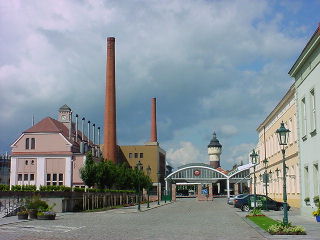
 in 1842, a newly-founded brewery in Plzen, Bohemia shattered convention by introducing a clarion gold beer. Until its release, all beers had been dark and murky, suitable for serving in ceramic steins. The new, straw-colored beer captured the imagination of beer drinkers with its bright clarit, spread across the globe like a virus, and now is produced in nearly every country on the planet. It is one of the most popular products in world history, and certainly the most popular beer. That newly-founded brewery was Pilsner Urquell--literally "the original beer from Pilsen."
Due to their ubiquity, pilsners have some backsliding in quality. Beers like Singha, Kingfisher, Panama, and Pabst may be interesting national variants, but they don't really match the original, which is one of the few pilsners still widely available across the world--and rightly so. It's also a very nice beer to crack on a sunny afternoon.
Tasting notes
 Pilsners are remarkably fragile. They are sensitive to light, heat, and age, and by the time any of their golden essence arrives in America--worse, Oregon, way over on the west coast--they have inevitably degraded somewhat. I have heard tales--uttered in uniformly hushed tones--of freshly-racked kegs taken from the brewery to waiting planes and airlifted (chilled, of course) directly to waiting Americans. The beer described in these stories apparently cures disease, reverses aging, bestows enlightenment. (Variants of the story, in which pilgrims tell of fresh beer pulled from taps in the Czech Republic, are equally as glowing.)
I can't speak to that beverage--I have only tasted the beers available to American mortals, which is absurdly shipped in a green bottle, an aid the forces of degradation. Still, when handled gently, it is nevertheless an extraordinary beer. As beautiful today as in 1842, it bursts with the pepper of Saaz hops and Bohemian yeast--an aroma unique in the beer world, and one of the most familiar.
 The palate is simultaneously soft and dry, effervescent and--in a surprise to people who think Budweiser is a pilsner--intensely hoppy. The beer is triple-decocted, which may be one reason it's so gentle (though the decoction debate is an ancient and hotly-contested one).
In much the way that alder-smoked beer remind people of salmon, Saaz hops give pilsners their "pilsner" flavor--that earthy, spicy, peppery quality that typifies the style. Pilsner Urquell is the most aggressively hoppy of any exported Czech pilsner, and if you're looking for a study in the hop style, go no further. Plzen water is reported to be very soft, but I detect a slight quality of mineral in the beer--perhaps from the effervescent carbonation. A wonderful beer.
(Finally, a note on the "skunky" flavor. When light hits the iso-alpha acids from hops, the acids undergo a chemical change that give beer a skunky flavor. Darker bottles protect beer somewhat, but green or clear bottles offer almost no protection--and Pilsner Urquell comes in a green bottle. The lighter and hoppier the beer, the more susceptible it is to becoming light struck, and at least half the bottles of Pilsner Urquell I've purchased from grocery stores have been so fouled. And even the flourescence of the beer case is enough to turn the beer. So, if you do buy it from a beer case, dig around in the back of the case where its shadowy and hope for the best--that's improved my odds. And let it be known that that skunky flavor is not "European" or characteristic of pilsners. It's bad.)
Stats
Hops:Saaz
Malts: Two-row Bohemian and Moravian (proprietary strains)
Alcohol By Volume:4.4%
Original Gravity: 1.048, 12 degrees Plato
BUs: 40
Rating
Oh, come on.


 Alaskan Summer Ale is a rather rich hue of gold--substantially darker than the pilsners to which Kölsh is often compared. The head dissipated quickly, but the beer roiled with a vigorous fine bead. I don’t doubt that there’s an aroma to Summer Ale, but next to none from the bottle I poured (maybe the slightest note of yeasty tartness).


 What's the difference between an IPA and an ESB? They're both biggish (IPAs are bigger) and both hoppy and both pale and both British. It's the malt. In an IPA, the malt is merely there to protect you from the lacerations of the hops' alpha acids--brewers may hope there's residual flavor for the discerning drinker, but that's gravy. Not so with ESBs--although they feature robust hopping, it's their malty depths by which they're defined.


 A classic, and under-appreciated beer style is known as rauch (or "smoke") bier. Traditionally, a portion of the malts are smoked before brewing, and this imparts a rich, smoky flavor. (Some breweries add smoke flavor, with predictably inferior results.) It's apparently not the only way to achieve the flavor of smoke, however. (I mention this apparently unrelated information for reasons that will become clear in a moment.)
 There are 5,237 Northwest-brewed IPAs. Or thereabouts. Of all beers, IPAs have become the signature style of the region. I recognized that this was the case when a co-worker ordered one at a pub. After ordering, she turned to me, wrinkled her nose, and said, "I don't like bitter beers."
 Deschutes has a couple of new beers on the shelf, news definitely worth noting. I'll review the replacement for the woeful Quail Springs IPA tomorrow. Tonight it's Buzzsaw Brown.