You love the blog, so subscribe to the Beervana Podcast on iTunes or Soundcloud today!

Showing posts with label Beer Bible. Show all posts

Friday, October 07, 2016

A Moment of Horn-Tooting


This morning, the North American Guild of Beer Writers announced their annual writing awards, and they sent some sugar my way. Over the past half-decade or so that they've been doing this ("we" actually--I'm a member and judged the first two years), the competition seems to have heated up. I completely crapped out this year in the blog category--after clawing my way to a bronze last year. (Bryan Roth has a hammer lock on the blog category.) I'd have to go back and look at the other categories I got skunked in--there were more--but there was something to celebrate, as well:
  • Best book category, 1st for the Beer Bible.
  • Best historical/technical writing, 1st for my Reinheitsgebot article at All About Beer.
  • Best national/international reporting, 3rd for "Hop Shift" in All About Beer.
  • And finally, for best podcast, Patrick and I picked up an honorable mention. (There's something delightfully perverse about our lo-fi production getting "honorable" anything.)
It's always meaningful to get recognition, but even more so from the peers who actually know the subject. Seeing the names of the people going by reminded me how strong the field of beer writing has become. I'm honored to be in their company.

Saturday, September 10, 2016

Where To Find Me in September

I have been remiss in my self-promotion duties in the face of what turns out to be an unexpectedly active September. (Hey, I can hear your groans, you know!) Mark your calendars.

Klindt's Books, The Dalles, today, noon-3pm
Today, in just two hours, I'll be signing books at Klindt's Booksellers in The Dalles. (Oregon's oldest bookstore, dating back to 1870.) If you wanted to scramble and drive there--presuming you don't live in The Dalles--there's still time. I'll be there until 3pm.

Feast Portland
On Friday (9/16, noon) I will be joining a star-studded panel to discuss cider. Tickets are still available, and you should buy them to listen to Kevin Zielinski, Nat West, and Josh Bernstein.

On Saturday, from 1-2pm, I will be signing/selling books at the Grand Tasting. That event is sold out, so if you have tickets, come and say hi.

South Dakota Festival of Books, Sept 22-25
I'm doing several events at this book festival in Brookings, South Dakota. If you're anywhere nearby and interested, have a look at the events I'll be doing (click on the link) and see if any tickle your fancy. The guided tasting on Friday, Sept 23 is going to be super cool. We'll talk flavor elements, but we'll also talk national tradition and how you can spot it in your pint--or stange--glass.

Update.
An unexpected troll hit this post, and after a few exchanges, s/he (though one suspects "he") decided to retreat and delete all his comments. I was able to turn them off before he could delete the first one, so you can get a flavor of the conversation. 

Saturday, December 26, 2015

Thanks For a Lovely Year

Yesterday as I was idly scanning through Twitter while attempting to endure the assault of pre-movie ads at a Regal Cinema*, I came across this little gem:


It hadn't occurred to me until that moment that my book would be playing a bit role in people's Christmas mornings across America or--more meaningfully--that people would actually be excited to receive it. As so often this year--as I trotted around the country hawking my book, as I read (mostly positive) reviews, as I received well-wishes from friends and family--I found myself flush with gratitude.

Writing is not a solo endeavor. It is an act of communication, and isn't whole or complete until someone reads the written words. The meaning exists in trust between reader and writer, and both contribute to that meaning. Once a sentence is put to paper, it begins a life that will only be complete when someone else reads it and it becomes transmuted in her mind. The writer never has the final word; the reader does. The text then goes on to live a separate life outside the control of the author. Whether a book becomes beloved, reviled, or ignored is entirely dependent on public, in the thinking and discussing and considering done in the months or years after publication.

I had two books out this year, and one of them has managed to begin living its separate life. (Cider Made Simple--though I think a book equal in quality if not scope to the Beer Bible--may end up in the "ignored" camp.) The gratitude comes because I see all those lovely readers out there giving it that life.

Thanks thanks thanks thanks--it's been a special year.

_____________________
*I've basically scrubbed Regal from my life, except on Christmas day, when it's generally the best/only theater option available. Christmas-day movies are, for this Buddhist, a tradition going back two decades.This year it was Star Wars.

Monday, November 30, 2015

When I Climbed the Mountain

The writing life is filled with peaks and valleys. I've been bumping along at high altitude lately, but no time was more exhilarating than the day I woke up in Tampa, Florida after a book event, got on a plane for Atlanta, was picked up at the airport and zipped downtown to CNN. I was there to do the spot you see below--two and a half minutes of very fluffy commentary on winter ales and "light beers." (When asked to do light beers, I selected session IPAs, which was my own subversive contribution.)

At CNN, they take your pic and give you a lanyard and then you go through a pretty serious security screening. The spot we did took maybe an hour, and I got to joke around with Coy Wire, a former NFL player who hosted the piece (a down-to-earth, self-effacing guy), and a couple of producers they roped in to taste the beer. Afterward, I was shuttled to Decatur for another Beer Bible event, and I was on a 10 pm flight to Nashville for the next book event. For one marvelous day, I felt like quite a big shot.


Anyway, there it is, my 2.5 minutes of fame on national TV. The piece ran several times yesterday, and now I have it for posterity.

ON-AIR GUEST

With Coy Wire on the set.

Monday, August 24, 2015

A Sour, a Porter, and an IPA Walk Into a Book Signing...

On Friday, I had the great pleasure to visit Book Passage, a fantastic independent bookstore in Corte Madera (Marin County), just north of San Francisco for a Beer Bible-related event. And thanks to their wonderful pre-planning, I learned something incredibly valuable.

Pouring Beatification.
To make it a fun and memorable event, they had arranged to have some beer on hand for tasting: Russian River Beatification and Pliny the Elder, Lagunitas Little Sumpin' Sumpin', and Anchor Porter. I decided to incorporate the beers into a little presentation about the book. As I've been going along, I've been focusing on the nature of "style," and how it comes together as a result of a tangle of interesting factors (history, national tradition, ingredients, technology, war, and law). Having four beers there meant we could go through them and I could tell the story of the style as we went. Plus, it game me an opportunity to describe beer tasting and what to look for.

We started out with the Beatification, which is Russian River's spontaneous beer roughly in the gueuze style. The crowd was composed mainly of novices and intermediate drinkers, so I saw a lot of surprised looks with the first sips. I was describing how lambics have been made, and the effect of wild yeast, and at some point I mentioned that basically everything we were tasting came from the fermentation. Again, surprised looks.

The next beer was Lagunitas, and I mainly described the American practice of brewing, focusing on the way we have developed for exhibiting hop flavors and aromas. (If you're interested in a deep dive about that, listen to our podcast on Session IPAs.) I pointed out the flavor elements, but because there's a fair amount of caramel in it, I talked mainly about older-school IPAs and the development of the American oeuvre than I did on the flavor components.

Photo by Patty Stanton.
It was when we got to Anchor Porter, and I was mentioning that basically all the flavor there came from the malt, that I realized what a great line-up Book Passage had solicited. One beer's flavor came exclusively from fermentation, and one almost exclusively from malt. The last one, Pliny, gets almost all of its flavor from hops. For people who have been drinking craft beer sporadically or who don't brew or spend times on the blogs, this was absolutely revelatory information. Flavors in beer can be so strong, and in many beers, they are a melange of several sources. Having three beers where the sources were singular really demonstrated how variable beer is--and helped the people there begin to decode its flavors.

If you have people in your life who are a little interested in beer but not especially knowledgeable, I recommend buying three bottles of yeasty, malty, and hoppy beer and walking them through these flavors. (Something like a low-hop bock might be better than a porter.) It's quick, easy, and very useful.

Saturday, August 08, 2015

Beer Bible Launch: You Are Cordially Invited

Beer Bible Book Launch
Tuesday, August 11, 5-7 pm (some comments at 6 pm)
Belmont Station, 4500 SE Stark

On Tuesday, August 11, the Beer Bible will officially go on sale. We will celebrate this milestone with a celebration at Belmont Station, where you can buy the book and where I will gladly sign it. I'll plan to say a few words around 6 pm, but I'll be signing books from five onward--so come early if you can and pick up a copy of the book. Belmont Station is hosting this event for free (thanks, guys!), so consider enjoying a delicious beer when you come. I suspect there will be some toasting going on sometime a bit after six.

For those of you who have been following this odyssey, you know how much the book has dominated the last four years of my life. It's been odd to have such a huge presence that is essentially known only to me. Finally, finally, I get to share this thing, and I really hope you consider buying a copy, even if you can't make it to the launch. Whether you like it or not, at least you will finally see it. I look forward to hearing your thoughts, good, bad, snarky, corrective, thoughtful--all of it will be great.

If you can't make the launch, it won't be your last opportunity. I'll be doing an event on August 31 at the Cedar Hills Powell's. In addition, next week I'll be elsewhere in the state. On Thursday, August 13, I'll be in Corvallis from 6:30-8:30 with Nick Arzner at the new Block 15 Taproom (3415 SW Deschutes Ave). Nick was a great advisor before I went to Belgium, and I will be pleased to see the new place and have a conversation about beer with Nick before another signing there. That should be a cool event.

On Saturday, August 15, I'll be visiting Ninkasi Brewing in Eugene (272 Van Buren St) from noon-1:30pm. Jamie Floyd has been a regular source of insight and information since he was at Steelhead back in the 1990s, and this feels a bit like a homecoming. Please join us for that if you're in Eugene.

In case you haven't seen my 219 posts about this book, here's a quickie backgrounder. Hope to see you next week--

Monday, August 25, 2014

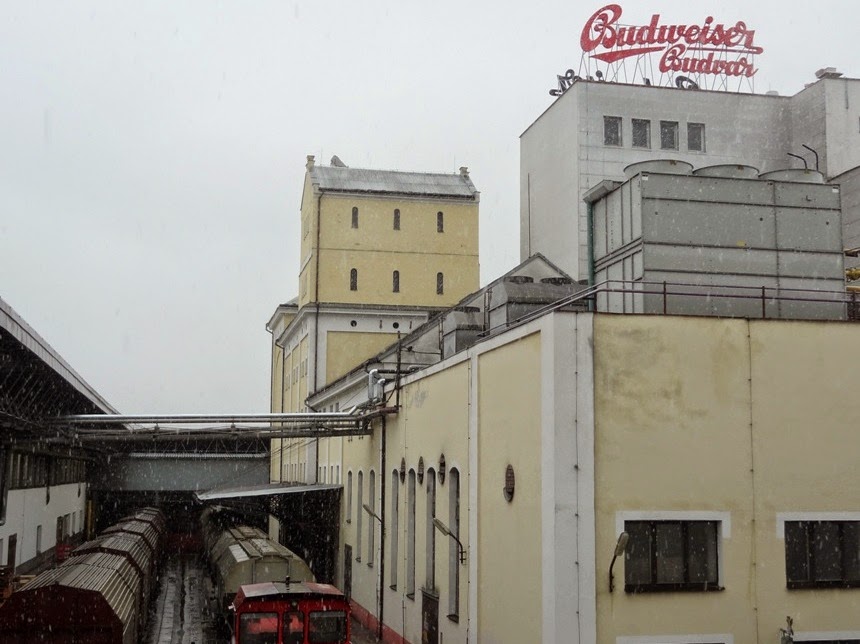
The Budweiser Ironies

A couple weeks ago, Pete Brown posted a wonderfully nuanced piece about Budweiser--both of them--in London Loves Business.  He argued that the two Buds were about as well-made as any on the planet and that, while you may not enjoy the American Bud, you could not doubt its quality.  He's correct. As sensory experiences go, American Budweiser is not a particularly thrilling ride.  (When I visited the St. Louis plant, brewmaster Jim Bicklein took me to the cellars, where we had a zwickel from the huge conditioning tanks.  On every previous occasion when I've been offered a tank-fresh pour, I have found depths and delights in a beer I missed in the store-bought incarnation.  I held my breath and sipped the cool, sparkling lager through a skiff of snowy head and ... it was just Bud.  Very, very fresh Bud.)  But the brewing process is exacting and there are no shortcuts.  It is intentionally unthrilling.  (And millions of drinkers like it that way.)

But what really caught my eye was this paragraph:
One of the most famous battles in Beerworld is the epic David and Goliath tussle between the world’s biggest brewer – Anheuser-Busch Inbev – and the small, state-owned Czech brewer Budweiser Budvar. In 1876 Adolphus Busch stole the name Budweiser from the town of Ceske Budejovice – or ‘Budweis’ in German – and over the ensuing decades agreements were reached about who had the rights to the name in various parts of the world. When the Czech Republic disappeared behind the Iron Curtain after the Second World War the American brewer tore up the arrangements it had agreed to and made American Budweiser the world’s biggest beer brand. 
There are a few stories about the Budweisers, and this is the one only a fraction of beer drinkers know.  It is not the one they tell in St. Louis.  However, even this version isn't exactly right.  The real story is much more interesting and filled with irony.

Jim Bicklein at the brewery in St. Louis
The town of České Budějovice [pronounced, roughly, ches kay bud ye-oh vit sa] is located in the south of Bohemia.  Bohemia being located in the Czech Republic, you will not be surprised to learn that the people there speak Czech.  But this also the crossroads of some very important empires, and in centuries gone past, the region was controlled by a German-speaking population, who called it Budweis. Beer brewed there, as it has been since the 13th century, was therefore either Budějovický or Budweiser—literally, beer of the town of Budějovice or Budweis.  Fast forward to the period following the success of Josef Groll’s 1842 pale lager in Pilsen.  Other Czech breweries began making pale lagers, too.  The Civic Brewery in the town then called Budweis was one of them.  A supplier to the court of King Wilhelm II, the lager earned the nickname “the beer of kings.”  Ring a bell?      

By the 1860s an enterprising American brewery, enchanted by the idea of Bohemian beer, decided Budweis’s were the best.  It was no easy task to make those kinds of beers in the United States, but Adolphus Busch of the Anheuser Brewery had managed to do it and in 1876 debuted his own Budweiser beer.  Busch was selling beer for twenty years under the Budweiser name before a new brewery opened back in Budweis as a rival to the older, German-owned company.  This new brewery, the Joint Stock Brewery, was one of a wave of new Czech-owned businesses to spring up as a part of the Czech National Movement of the late 19th century.  Eventually that brewery became known as Budějovický Budvar.    

The fascinating part of the history is that the claims and counter-claims the two companies hurl at each other are generally founded in fact.  As it happens, Adolphus Busch did find inspiration for his beers from Budweis and did spirit away both the type of beer and the name.  But it’s also true that he brewed his beer before Budweiser Budvar even existed.  He did also apparently appropriate “the beer of kings” and turn it into “the king of beers”—one of the most valuable corporate slogans in the world.  (Budvar disputes the history of “beer of kings.”)  But the brewery that inspired Busch is no longer in existence.  And in the most wry of ironies, neither company has a clear historical claim to the name Budweiser: Busch obviously borrowed and rebranded it with absolutely no connection to the town or people; on the other hand, except as a valuable trademark, why would the people of České Budějovice want the name?  Budvar remains state-owned and is an artifact of the Czech National Movement.  “Budweis” was the name the city has abandoned.      

Pete points out that the dispute hasn't exactly been terrible for Budvar.  Picking a fight with the world's most famous and popular brands has its upside.  But the real story is actually more interesting, and the clean lines of the narrative a bit more smudged. 

Wednesday, May 01, 2013

Done.*

Yes, it's that long. 


_______________
*Context, for those of you who don't live in my brain.

Wednesday, March 13, 2013

Beer Bible Update

Source
Sometime Monday or yesterday--I didn't happen to notice--I passed the 200,000-word mark on the Beer Bible.  Word counts never mean anything to people, but page counts are hard to assess.  In my current cheater pagination, it's about 650, but if I do it honestly, it balloons to over 750.  I probably have something on the order of twenty thousand more words to go--another 50-60 pages--and the book is due on May 1, a deadline I have every intention of making.  (Never missed a deadline yet!)  I have one more fun chapter to write (beer and food) and one more fun trip to take--St Louis, to see the home brewery of Anheuser-Busch.  And then ...

It's a strange thing to write a book.  I can't speak for anyone else, but in my own case, it has been the experience of extreme tunnel-vision.  Beer, beer, beer, beer.  I dream in beer.  Someone will mention something and I think: that reminds me of [some story about beer].  I do my very best to remind myself that this is an interior experience, and that to everyone else these matters are of (rightly) little import.  It will be fascinating to emerge on May 2 from this weird cocoon, blinking in the sunlight, and be out of a job.  From incredible tunnel-vision to unemployment.  What whiplash that will be.  I'm trying to let that future self remind present self that he's got a great job and he should enjoy himself.

The bad news is that Workman has slated the publication for Fall 2014.  Talk about delayed gratification.  I guess we'll all be waiting a good long time for it to ripen, like Budvar.  Anyway, 200,000 words, fifty days--these are the relevant numbers of the moment. Back to my hole.