You love the blog, so subscribe to the Beervana Podcast on iTunes or Soundcloud today!

Thursday, November 17, 2011

Cantillon

I managed to navigate the streets of Brussels today and find parking just two blocks (and I use that term generously--the streets of the city writhe like snakes, so what lies between them is rarely rectilinear--away from the legendary Brasserie Cantillon. To top it off, owner and brewer Jean Van Roy was brewing today, and as I arrived, he was pumping steaming wort into the koelschip (cool ship). Since Cantillon is one of the world's most famous breweries, and since he has an open-door policy to all who drop by, everything I could write is already well-documented.


So instead I'll tell you three things that surprised me.

1. The brewing season, which depends on cool temperatures to drop the wort to fermentation temperatures in the koelschip by morning, is getting shorter. It runs from roughly late October to early April, but this is down by a month since Jean's grandfather brewed. (Capacity, not available brewing days, are the limitation for the brewery.)

2. Faro is strangely malty. Cantillon's is as historic as you'll find (though strong), but I've never had the chance to try it before.


3. Unlike in Britain, where a renaissance in brewing has excited the market (without exception, every brewer expressed optimism and excitement for the future), the same isn't happening with lambics. In the US, we're crazy for sour beers. Jean said Italians are even ahead of Americans. But in Belgium, not so much.

Jean let us try a 2006 bottle of Gueuze before I left and it was stunningly good. Cantillon's fauna sometimes produce beers too dry for my taste. This one was absolutely perfect. It was alive with citrus rind and a lavender delicacy. The souring was more acid than vinegar, and the resemblance to wine was marked. It would be a useful mile marker for new world brewers looking to find the sweet spot for sours. They don't have to be extreme to exhibit amazing complexity, and they don't have to have (indeed shouldn't have) excessive Brett harshness or exotic solvent notes. I mean, we should know that the taste of burning tire is bad, right? This beer's a reminder.

I will see Frank Boon tomorrow.

Pictures

I've been loading a selection of pictures onto my Flickr page. Here are some slideshows:

Samuel Smith's


Thornbridge


Adnams


Greene King


Fuller's

Wednesday, November 16, 2011

The Enigmatic Samuel Smith's

I have been to ancient lands--India, China. It's not uncommon to encounter a building that has stood witness to fifty generations of us evanescent beings. The effect is telescopic--events in the rear-view mirror appear closer than they were. This happens with families, too--that, say, pass along the Rig Veda father to son for centuries. In the town of York, Romans run around the countryside and Vikings still adorn buses. On Sunday, I stood on the ancient wall in the city while the cathedral bells rang and in that dense moment was able to feel the dimmest tingling in my spine of the antiquity around me.

In Tadcaster, the keepers of the Vedas are brewers and their names are Smith. The lineage goes back to one family and it's still obvious the Smith name is an important one when you drive into town. At one end, the one named for John rises magnificently above the village much like Greene King stands over Bury St Edmunds. But while J Smith may own a larger market share, it's the other line, Samuel Smith's, where the true family lineage resides. (John Smith's is an industrial plant where Newcastle Brown--now mostly an export--and other supermarket brands are brewed.)

The street front for Samuel Smith's is a kind of metaphor for the brewery: its tiny face is as pleasant as it is inscrutable, and conceals everything about the brewery, which sprawls quite impressively, out of sight. Smith's is a fiercely private company, and they apparently don't open their doors often for visitors--so it was a real pleasure to have the opportunity to see it for myself.

So, how traditional is Smith's? Except for adopting a few technical innovations that have come along during the past century (a lab, for instance), almost everything is unchanged. Steve Barrett, the long-time head brewer, took us to the stable first, to meet William. Standing 18 hands tall, he's one of two immense work horses that deliver the cask beer every day. That set the tone of the tour.


We went to the base if the old Victorian brewery to where the well is located--and which still draws us the hard, gypsum-rich water the brewery uses. We passed the coal bin, next to the boiler that steam-heats the brewery. A bit sheepishly, Steve nodded to the soaring smokestack typical of breweries this age--except Smith's was still sending a thin smudge of smoke into the air. (The brewery has used a bit of technological advancement there to make the coal fire compliant with environmental law.)


At each step, I grew more and more amazed. This wasn't a brewery that couldn't be bothered to move into the 21st century--it was a brewery spending a great deal of bother to maintain the practices of the 19th. The brewery proper was a classic tower, and we hike up the five stories to the grain and mill room and worked our way down. (Smith's was a pioneer in organics, even using organic hops, and when I mentioned this to the shadowy figure, he said, "yes, but organic is very traditional, isn't it?") The mash tuns and coppers are beautiful and huge, and the India Ale even flows over and old chilling contraption that dribbles the wort from a trough over a vertical stack of coils with cold water running through them. It's collected at a second trough and heads off to the fermenters. (This was when I learned there was a lab--even Steve is a little wary of the system. But the lab says it comes out bug-free.)


Of course the beer then goes to the famous Yorkshire squares--though they aren't actually much different than other systems still in breweries around the country. (Caledonian's, though made of modern stainless, are identical.) Square fermenters, in various configurations remain, if not the norm, at least quite common.

In fact, the most remarkable part of the brewery comes after the squares--when it's time to put the beer on cask. Some goes in regular casks, some in bottles. But the Smith's Old Brewery Bitter goes into actual wooden casks. Even more remarkably, the casks are made and maintained on-site by the brewery's cooper, whom we visited next. The casks are built to last, and Steve said there are staves in some of the older casks that go back decades.

(Which raises a question, doesn't it? I asked Steve about it, but he says no wild yeasts have moved into the wood--though this seems incredible to me. I was left to wonder; was this the last extant example of true mild ale--young beer, drunk too quickly to pick up any funk? If so, I can confirm that served in the lovely old pub next door--coal fire burning in the hearth--it exhibits nothing but freshness.)

Finally, the tour was over and we were graciously bid adieu. There has been some talk lately of the old "gentlemen brewers" of the old times. These were very proper men who wore suits and ushered the activities of the brewery in a formal elegance. As the old guard of this generation were just getting started, there were a few of them left. Except that I felt that way about Sam Smith's too, and its formal, proper brewer, Steve Barrett. He retires next April, and someone new--although maybe not new to the Smith family--will take the reins. I feel doubly fortunate to have had the opportunity to meet Mr. Barrett.


There's a lot more I could say to lend texture and detail to the visit, but I've rattled on long enough. I'm finishing this post in Belgium, where I've somehow managed to arrive without incident. Although the drive over was a little shocking: what the hell are all these Belgians doing on the right side of the road?

More to come from the Low Countries--

Sainsbury's House Beers

As I was waiting for my laundry to dry this afternoon, I sauntered over to a nearby Sainsbury supermarket to scope the beer scene. The UK has a few giant retailers that exercise enormous control over the beer industry; two, Tesco and Sainsbury, seem to have a Walmart approach to stacking it deep and selling it cheap. So in I went.

The beer aisle would have been broadly familiar to Americans. The largest portion was devoted to international mass market lagers. The smallest, about the size of the craft beer section in a decent-sized city, was upscale ales. There was another section devoted to mainstream ales like Greene King (and which may further that sense among drinkers that it is not rare and prized.)

Up to this point, nothing really surprising. But then I noticed, tucked in with the good ales, two under the Sainsbury label. These were intriguing. One was a Yorkshire bitter weighing in at 5% that had been brewed at Black Sheep--a brewery I aspired to visit. The other was an IPA brewed by Marston's at a hearty 5.9% (sounds "meh" to Americans, but I've now seen three "IPAs" in the mid-to-high threes). Both come in handsome bottles that both signal quality and contrast the generic canned 2.1% "bitter" and "lager," which signal--in orange flashing lights--cheapo.

I have no idea If the beers are any good, and I didn't pick them up--I am flying out of the country today. But as canary-in-coalmine indicators, it appears Sainsbury's is still betting on quality. Or the perception of quality, anyway: the sale prices (pounds 1.77 and 1.89) were over 50% cheaper than some of their neighbors.

I'd be interested to hear from British readers whether they've tried these and what they think.


Tuesday, November 15, 2011

Edinburgh

A lot of Edinburgh breweries today, not a lot of Edinburgh. I'm not sure that's entirely right, but there it is. For the first time, I will pass through a town without exploring it much at--which is a shame given my long fascination with the country.

Still, I did get to see two classic Scottish breweries--a decided treat. I'm a bit too exhausted to blog, but I will refer you to the Tumblr page on the odd chance you haven't been visiting--there are sights there to go with these words (in some cases standing in for them).

To Belgium tomorrow--


Monday, November 14, 2011

Greene King

It is difficult to understand the biases and preferences of a country without first understanding the larger context. In the US, if you want to brew and sell a beer in most states, all you have to do is file the paperwork. With third-party distribution, small breweries have a decent route to entering the market. When beer drinkers walk into a pub, they'll find beers the publican has learned his customers like--no matter which brewery made the beer.

Right. In Britain, the waters are muddied by a system that puts small breweries at a grave disadvantage. The majority of pubs are owned by breweries. In these you will find guest taps, but you'll also find a lot of the host's beers. A pretty small minority (perhaps readers know the figure) are "freehouses"--independent, and able to serve any beers the like. The big breweries and pub companies own hundreds or thousands of pubs, and tend to dominate regions. (For the visitor, that last part is pretty cool; you find yourself in different "catchment areas"--Fuller's in London, Green King in Suffolk, Marston's around Burton, and so on. Thornbridge even has four.) Very often, these pubs are the picture of the quintessential English pub--lots of wood, a cozy fire, cask engines, and opinionated punters sitting at the bar. I am molecularly drawn to these places and can, like a hound, detect one even around corners and down the road. It will gnaw at me to lose these when I return.

A secondary problem is grocery sales. There are a few companies that control most of the grocery trade, and these outlets want beer at rock-bottom prices. While they do pass these along to the consumer, it means breweries make next to nothing per unit. Only extremely high-volume breweries can afford to make money this way. The little guys can actually lose money.

Which brings us to Greene King. The brewery now operates over 2000 pubs and has acquired several brands--Morland, Hardys and Hansons, and Ruddles. It owns Belhaven--which we're visiting tomorrow--though the latter is still independent. Their size and ubiquity, the prevalence of a few brands like Old Speckled Hen and Abbot Ale, and their own flagship, a 3.5% bitter called "IPA" are things that rankle certain folks. On my way to Bury St Edmunds from London, I kept hearing quite harsh criticism. I expected to find one of those uncomfortable corporate environment where everyone's used mandated jargon so long they don't realize it sounds creepy to outsiders. I expected focus-grouped, insipid beers and a sterile, lifeless brewery.

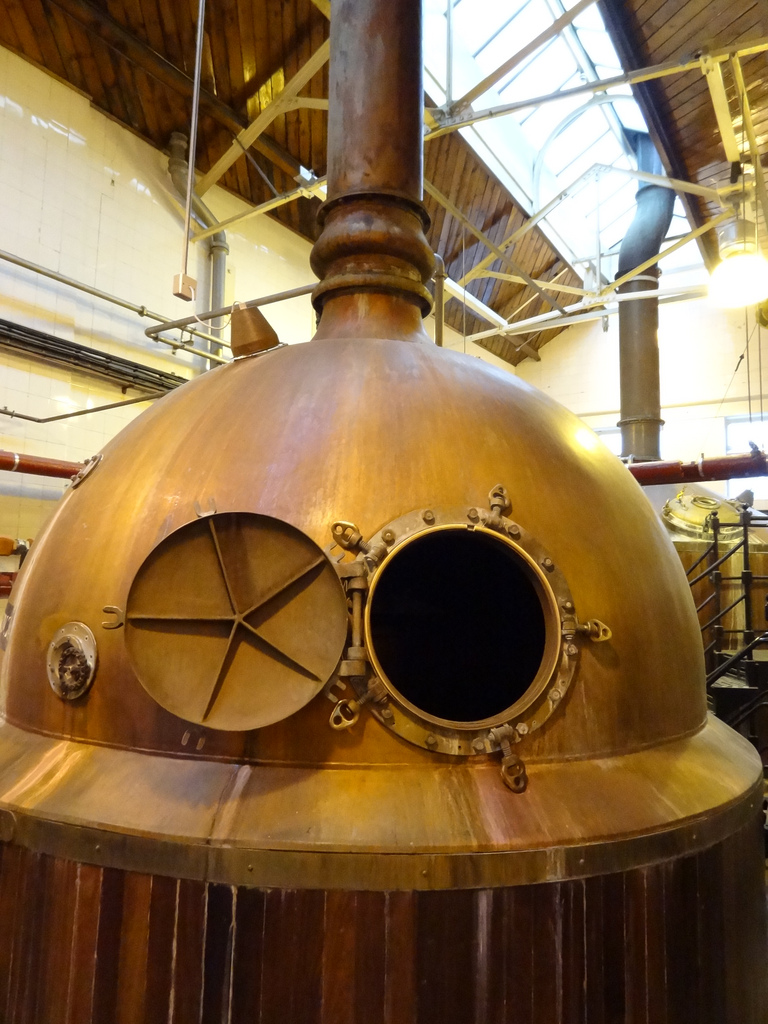
Instead, I found quite the opposite: Greene King is a hodgepodge of facilities and eras, and it feels like a small town unto itself. A traditional tower brewery, it features old coppers and the least interference by technology of any facility we've seen. They vat a 12% strong ale in ancient wooden vessels that slowly sour the beer over the course of two years--the only extant use of this practice I know about. It links their current operation to a lineage that dates back hundreds of years--worthy of historical recognition and protection. Strong Suffolk Ale is a gem in beer's treasure chest, and to my mind puts the brewery rarefied company. Even the despised IPA is a fabulous beer, a tour de force of flavor and balance for such a small beer. (The name is, obviously, unfortunate.)

The irony is that Greene King is hated for being a kind of destructive force--ruining beers and breweries on its way to world dominance--rather than the preserver of tradition and craft. It's a very strange paradox for the visitor--Americans in particular are suckers for tradition. (Our country was 23 years old when Graham Greene's great grandfather founded the brewery.) Yet I understand that there are other concerns, and whenever any one brewery begins to dominate a market, it has a distorting effect. Still, there seems to be little of that--Greene King brews about half as much beer as Sierra Nevada and has a tiny slice of the British beer market. I don't know the particulars of their various buy-outs, but it appears that in some cases, they were picking up breweries in the process of collapse (not uncommon in England, sadly).

From the outside, it looks like this. The British beer market is in the midst of serious churn. On the one side are producers of light lager that sell for nothing in the grocery stores. This is a direct challenge to pubs, which support ale brewers. Whatever a person's opinion of Greene King (and CAMRA's position seems absurd), it's impossible to think of them as the foe of small ale breweries. The real foe makes cheap beer without concern for taste, tradition, or culture. Small craft breweries and traditional ale breweries are on the same team. Know your enemies indeed, and that means knowing who's not.

Sunday, November 13, 2011

Trip to Jerusalem

On our way North from Burton to York, we stopped off in Nottingham (the same--there's a statue of Robin Hood at the castle). In addition to being a lovely little medieval town (and a modern one, too), it has what purports to be the oldest pub in England. I say purports because it's always wise not to treat the owners, who obviously have an interest in this claim, as historic authorities--but it may be. In any case, it's definitely one of the most interesting pubs.


The city is built around a historic walled castle that tops a hill. The pub is built at the base of the hill, and, it turns out into the hill. It is a honeycomb of rooms, many natural caves with supple, curving walls and ceilings.


I'm writing this on the fly without benefit of the Internet--which has been damned elusive here in the Midlands. (Burton, rich with history, has fallen on hard times.) anyway, forgive the errors where you find them.

Friday, November 11, 2011

Poor Wi-Fi

I am in a beautiful little pub and guest house called the Unicorn Inn along the legendary Trent River--and across from Burton. There is not a thing wrong with this place ... except the wi-fi connectivity. I should be able to get a post or two up, but bear with me.

Numerology

Today is 11/11/11, as you know, and we'll be visiting Thornbridge at--auspiciously--eleven. So, when it's straight elevens (11:11), we'll be at what one source called Britain's best brewery.

Thursday, November 10, 2011

Adnams and the Modern-Traditional Paradox

Tucked away in one of the prettiest towns I've visited is Adnam's of Southwold, a traditional maker of cask ales. In what has now become a familiar story, this traditional brewery confronted the question of whether to double down with tradition and keep their old equipment or go through a full-scale remodel. We've visited three famous traditional breweries, and all have had a similar decision. Fuller's upgraded, but kept their original brewhouse and left their old equipment as a living museum, Greene King (which will get a full post at some point) has mainly continued on with the same brewery, upgraded periodically, and Adnams scrapped the entire thing and started from scratch.

Their brewery is a state-of-the-art Huppman system that is so automatic it will start brewing at four in the morning before anyone has arrived at the brewery. (That's brewer Fergus Fitzgerald gesturing to the computer that controls it all.) They pre-program the system with all the brews they'll be making throughout the week and the system just plugs along on its own. So this is an abomination, right?

I guess if you've seen as many breweries as I have, you begin to think that the old funky coppers, while gorgeous, have lots of drawbacks. And I don't mean for the poor bastard who has to come in at 4 am to start hauling grain sacks to the mill. Old systems are always touted for their quirky qualities which, purists believe, are the very things that a brewer can use to coax rarefied flavors and aromas out of his beer. There's some truth to this. Old systems are all one-offs, unique to the way the particular brewery was built. A brewer who pays very close attention to his process and equipment, a person who listens to the beer, can work wondrous magic with such a system. The problem is that it takes years or decades to perfect and is not versatile.

A system like Adnams' has been engineered to put full control in the brewer's hands. He doesn't have to work around the limitations of his system, but can harness the technology to dial in every single parameter in the brewing process. This gives him enormous versatility and the ability to brew any beer exactly as he envisions it.

After the tour, we had some beers over lunch, and although I don't have the best-trained palate in the world, I felt that Adnams' cask ales were wonderful and traditional. Fergus Burtonizes his water and the bitter is a fantastic beer--sharp and quenching, with very clean, articulated hop character. It's a perfect tipple and quite a bit different from an example like Fuller's, which is silky and soft.

Adnams is also expanding into spirits (vodka, gin, and whisky) and this precision is useful in producing washes (essentially unhopped beer used in distillation) to exacting specifications. I've already talked about the Adnams biogas digester and I learned today of other uber green initiatives they're pursuing. All of this has that same dichotomous sense--traditional and modern.

At the end of the day, the drinker cares only about the beer. But how it gets into the pint glass isn't incidental, as I'm becoming more and more aware of. Anyway, Adnams was big fun. More later--

Wednesday, November 09, 2011

Whew

Our big days continue. This morning at a well-regarded micro in Sussex (directly south of London). It's named after a Grateful Dead song (sort of apocryphally, as it turns out), which made it a great location for Oregonians. In fact, there's no Dead-headiness about anything. What there is is very good beer made in a kind of fusion between traditional cask ale and American craft brewing.

The beer reminded me a bit of Double Mountain--recognizable beer styles tweaked a half turn. Their Best Bitter has a dash of smoked malt, a touch that creates the impression of an old, traditional beer. Their flagship is a low-alcohol extra pale shot through with a stiff dose of Cascade and Amarillo hops.

My favorite was an exceptional imperial stout full of yeast character. Fruity, plummy, figgy, with an underlayment of chocolate. One of the better imperial stouts I've tasted.


The second stop was Greene King, an apparently controversial brewery among some of the geekier set. But now I'm tired and a post on GK will just fail to do it justice. (Though for anyone wondering how far under the bus I'm willing to through them, consider that it's one of the last breweries in England to vat a strong ale [with requisite wild microfauna] for two years. What sell-outs!)

Anyway, more later. Meantime, here's the vista from atop the brewery, which rises above the town of Bury St. Edmunds in Suffolk, east of London.


Tuesday, November 08, 2011

Fuller's Errata

By the way, my last post didn't mention Derek Prentice, John Keeling's right-hand man, and the brewer at the former Young's Brewery. He is super knowledgeable and a wonderful tour guide. Didn't mean to short him in the last post. I also met a Fuller's brewer name Brandon Bray who is in his 46th year at Fuller's. He helped train John and brewed on the old system--which gives the brewery wonderful continuity. Also, consider 46 years. He might have given young Fritz Maytag advice when he was starting Anchor. He had been brewing 14 years when Ken Grossman founded Sierra Nevada.

Spent too little time with Alastair Hook, the man behind Meantime Brewing. (He's too busy to arse around with the likes of me.) A fascinating contrast to Fuller's in terms of business model.

Later, my shadowy partner and I got to rendezvous with Brewer's Union's Ted Sobel for a pint of cask ale in London, which now binds us as true brothers of the ale. A joy. The synchronicity that would lead us both to plan trips for the same slot is rare indeed. I can't imagine any brewer on the planet I'd more enjoy having a pint of cask ale with.

Off to bed-

Is Fuller's Craft Beer?

I'm kidding, halfty. We've already had far too may armchair philosophers and linguists weigh in on the question. And yet, on a day that included an absolutely glorious tour of the venerable Fuller's Brewery here in Chiswick, London (that's chizz-ick to you yanks) and a craft-brewery pub, the specter haunted us.

Fuller's is a 166-year-old independent brewery that produces a stellar line of cask ales as well as uber crafty offerings like strong ales and their "Past Masters" series based on historical recipes from the vaults. (The flagship is London Pride, one of the finest best bitters I know and, despite its modest strength, possibly my favorite.) They're one of the larger cask ale producers, but they're roughly the size of Widmer or Deschutes.

They are a perfect example of the difference between the US and British markets, though. Because, while no American would exclude them from the "craft" category, that's the bias they face in England. At the craft brew-focused pub we visited last night, they scoffed at Fuller's: too old.

That age is a huge part of it's virtue. I sat down with John Keeling and the shadowy figure with whom I'm traveling (he gave me permission to out him--some of you know him as the beeronomist--but shadowy figure amuses me), and listened to the history of Fuller's transformation thirty years ago into a modern facility.

Fuller's was until that time brewing beer on an ancient system--one the brewery preserved as a kind of museum-within-a-brewery. This is one of those decisions I take it the tradition-steeped British don't take lightly. Yet here's what British brewers confront: a steadily declining market for ales (currently 14%, according to Keeling) in which cask is just one niche (the famous "flat, warm" beer of England now commands just 8% of the whole market). For the first time in centuries, the proportion of beer consumed in pubs dropped below 50% this year. Those who hew exclusively to tradition in this market risk the oblivion of such titanic names as Bass, Whitbread, and Courage.

Fuller's modernized the brewery, which now looks like a standard American craft brewery. But interspersed throughout the modern stainless steel tuns and tanks are the earlier relics--copper equipment with the burnished patina of age.


Keeling offered a bit of analysis that parsed the "craft" question nicely. You want the beer to be clean and consistent on the one hand, flavorful and characterful on the other. Industrial breweries emphasize the former but not the latter. The antiquated coppers delivered the latter, but it was harder to achieve the former. Weirdly, I think this means the ultratraditionalists also ding Fuller's.

From my perspective, Fuller's is the model craft brewery. Eventually, the current crop of craft breweries won't be new anymore. Then they'll be judged purely on their beer. If they work hard and are very lucky, they'll be mentioned in Fuller's company.

Monday, November 07, 2011

Touching Down in London

After a long-than-expected flight, I made it to London yesterday afternoon local time. I'm traveling with a shadowy figure who may want to remain slightly anonymous (he dozes or I'd ask) and who has a relative studying architecture in town. We found her at her school and she took enough time off a project to join us at The Jack Horner, Pies and Ales, a Fuller's pub around the corner in Bloomsbury. I started the trip off with a pull of London Pride (unsparklered), which sang with flavor. It barely bears mentioning that the version we get in the US (a different recipe) can't match fresh, live ale on cask. I will pop over to the brewery in four hours and hear more.

Cheers--

Friday, November 04, 2011

Think Out Loud (Again)

I normally wouldn't flog this a second time, but I have an apology to make. This morning I appeared on OPB's Think Out Loud (audio here), hoping to offer samples of three beers. We only got to one--a bottle of Jubelale I pulled out of the basement. I had gone hoping to promote a standard fave of mine, Hopworks' Abominable Ale (review here) and the newly-released Ninkasi Imperiale Stout (review here). The Imperiale isn't even available in single bottles yet (ETA next Tuesday) and so Morgan Miller spirited one over to me before the broadcast. I also had several others I wanted to name-drop: this year's Winterhook, Fort George's new North V (which I haven't had a chance to try), Pelican's Stormwatcher and Mother of All Storms, Double Mountain Fa La La La La, and--bone to the lager lovers--Bayern's Doppelbock.

Moral: twenty minutes is nowhere near enough time to discuss winter ales.

To Europe: 24 Breweries in 24 Days

Tomorrow at 12:47 pm (8:47 pm London time) I board a plane for Europe. I'll be there most of the month, returning Nov 29. I'll roughly split my time between Britain and Belgium, with the balance going to a day and a half in France--all research, tax-deductible research [!] for the Beer Bible (I am appropriately happy/amazed at this fact). I don't want to give away too much of the itinerary beforehand, because I do hope to keep up a travelogue here. But as a teaser, I'll mention that I will be touring these breweries and talking with the brewers there:
  • Fuller's (11/7)
  • Samuel Smith's (11/14)
  • Belhaven (11/15)
  • Rodenbach (11/21)
  • Dupont (11/24 -- Thanksgiving)
  • Orval (11/28)
That is but a quarter of the total breweries, and I've left out a few other biggies. (If my experience in foreign travel is any guide, one or two of the less-famous breweries will emerge as one of the best visits.)

In addition to the blog posts here, I've set up a Tumblr page for the Beer Bible where I can post lots of pictures and iPhone videos. In a way, that may be more interesting than me blathering on about what you'll be able to plainly see there. (But blather I hope to do.)

Wish me well, and I wish you all well. See you on the other side.

Thursday, November 03, 2011

What's Up With the New Jubelale?

If you've had a chance to try the Jubelale this year, it may not have matched your expectations. This happens with beer drinkers all the time, largely because their memories are faulty or they have experienced unnoticed palate shift between samplings. With Jubel, though? You're not imagining things.

I've done two blind tastings of winter warmers (the original iteration that gave us Wassail and Snow Cap) over the past few years, and in both cases, Jubel came out on top. It had a candyish sweetness balanced by a perfect blush of peppery hops. It was incredibly smooth and warming, like a hot chocolate on a chill day.

This year's, by contrast, has a much pricklier hide. It's got some roast roughness and what I perceived as a dry tannic note. In fact, it was so dry I suspected that some wood-aged, brettanomyces-soured portion had been blended in. It is a startling departure from the Jubel of my memory. I shot Deschutes owner Gary Fish an email to get the lowdown, and he described the changes:
The original motivation for Jubelale that John Harris formulated was an English Old or Strong Ale.... I had been noticing for several years as our brewing techniques have gotten better and the equipment we were using became more sophisticated, a “drift” of our Jubelale flavoring to becoming, essentially, cleaner and drier (less estery). My comment to the brewers a couple years ago resulted in a project to, essentially, engineer back in the flavors or characteristics our processes were removing, but to do it deliberately, not by accident the way we, and most small brewers, have done things. The result is what you perceive as a change, whereas, from my perspective, we have simply returned to the way Jubelale used to taste, before these “improvements.” It is interesting you perceive wood aging. There is no wood aging in Jubelale, no brett, no oak.
So there you have it.

Fish says the beer is selling well and the customers seem to like the change. For my part, I think it's a step backward. The Jubelale of 2009 and the few years before was in my view a nearly perfected beer. There's not a thing I would have changed, even by the smallest degree. I will damn the new (or return to old) recipe by that weasel word we use in beer reviews and call it more "interesting" than the old Jubel. There is more going on here. So much, in fact, that I was completely thrown off about what was in the beer. Simplicity has its virtues, though, and the seductive balance and approachability of the recipe from a couple years ago was a triumph of clarity and drinkability. The new beer is more challenging, less satisfying and way, way less moreish.

That Deschutes will tinker with sacred cows and risk losing customers like me by reformulating recipes is one of the many reasons I think it's a model for large craft breweries. Deschutes has launched a branding strategy based on the slogan "bravely done," but they've earned it. This is a ballsy move, and the consequence is that people like me will buy less Jubel this year. They've always bet on their own palates, though, and Fish clearly believes they'll earn more customers in the trade-off. (And it may work, if reviews like this are any indication.)

_______________

Relatedly, I had this year's Full Sail Wassail last night, and it is an excellent vintage. (There was one in the early aughts that remains the standard-bearer, but this one's not super far behind.) Wassail is sometimes a bit hoppy for my taste, but this year's is a wonderful blend of chocolate and caramel malts and assertive woody hopping. It is deeper and rounder than some years--my preference in a winter ale. Stock up--this is definitely a beer to have in the fridge for the long nights ahead.

Wednesday, November 02, 2011

Beer (and me) On "Think Out Loud"

Update: OPB informs me that they are switching it to Friday--which will apparently give us more time to chat about beer.

Tomorrow (or possibly Friday), Oregon Public Radio is doing a segment on winter drinks on their show Think Out Loud. They tapped me to talk about beer. You can listen to it live beginning at 9am Pacific time (noon Eastern time) here or find the archived show here.

The Honest Pint Project Rides Again; Long Live the HPP!

If you visit the Honest Pint Project website today, you will not find a dead URL. I am pleased to say that after my post last week, three people came forward who wanted to jump in and save it from certain death. (I'm not sure if they want to go public yet, so I'll leave names out for now.) We've been scrambling to make the transfer, and it looks like everything's running smoothly.

This is uniformly good news. The three have a more sophisticated sense of social media, website development, and nonprofit organization than I do--by a long shot. There's one Oregonian there, but a couple from further afield--giving it a more national presence. So not only will the project be carried forward, I expect to see a quantum leap in terms of organization and activity. Any time a group of volunteers agrees to do a bunch of work, they deserve at least the control over the work they've taken responsibility for. I've let them know that I've always only been interested in the spirit of the thing--transparency in glassware sizes. So, if they wish to change the criteria, the certification process, or the logo, that will be their call and I'll delightedly support any changes. (And if they leave it exactly the same, I'll support that, too. Except for the logo. Someone should improve on my crude efforts.) The main thing is that they are committed to pushing the thing forward and keeping the idea alive.

Huzzah!

Tuesday, November 01, 2011

Pardon the Metablogging

Over at the Atlantic, Clay Risen notes quite accurately that it's "not to say there aren't great beer writers, or great beer magazines, books, and blogs. But compared with wine, they're few and far between -- and, to put it as kindly as possible, not exactly aimed at the mainstream, non-beer-obsessed public." Which is why I feel guilty about plunging into the following post, which is total inside baseball, pure metablogging, and of interest to almost no one. But since I was called out in the piece (though not, sadly, by name), I gotta respond. If you can't use your blog for a little navel-gazing every now and again, what good is it?

The issue is the Oxford Companion to Beer ... again. I had intended not to mention it or get re-embroiled in the ongoing debates, but Risen goes after the many small-fry bloggers who have been harping at the book, and he takes interest in my review, and so now I have to talk about the damn thing again. (Throw me a frickin' bone department: one virtue of having a brewer act as editor is that there's a great density of technical entries in the book, all of which seem extremely well-done to me. Most of the criticism has been aimed at the history pieces, but if you want a nice technical reference, it's pretty kick-ass.)

Following a recap about the paucity of good beer books (mostly true), Risen describes it as "viciously criticized" and cites Martyn Cornell's and mine. Cornell he can't actually fault except in tone (and his critique is "more trenchant" than mine). He cites my post as one of the more degenerate varieties that " have made an intramural sport of identifying the book's omissions." He continues by criticizing my criticism of the pretty well-documented NY-centered bias in the book.

Fair enough, but then he goes on to review Christian DeBenedetti's new book and observes this:
Anyone who picks up the The Great American Ale Trail can think of a bar that was wrongfully overlooked. Them's the breaks: this is a guide, not a directory. Still, it's frustrating to see large swaths of the country left out completely. Yes, the best bars and breweries may be in Oregon, Colorado, and New York, and they deserve coverage.
It's exactly the same criticism. (And I find it deeply trenchant.) You review a book, you offer praise and critiques. Look: I've done lots of them. So let's not overstate the significance of one post on a blog with thousands of them.

And Clay, would it kill you to mention me by name in the article?