You love the blog, so subscribe to the Beervana Podcast on iTunes or Soundcloud today!

Wednesday, March 17, 2010

Three Cheers for Green Beer

Ah, Saint Paddy's, the day we celebrate old traditions. Like the bad old days when beer was so colorless and insipid that people dyed it green. Yet now we can celebrate truly green beer. Off the top of my head, a few shout outs to:
  1. Full Sail, for using less water per gallon of beer produced than any other brewery;
  2. Roots for being Oregon's first organic brewery and sponsoring the Organic Beer Fest;
  3. New Belgium for pioneering the way on green design and recycled water;
  4. Lucky Lab and Fort George for solar-powered water heaters;
  5. Hopworks for promoting two-wheeled, people-powered transport.
I know this only scratches the surface. We should all be hoisting green beer tonight, so who'd I miss?

Update, 3:30pm. A tweet from Laurelwood:
laurelwood1 Did an interview with KGW channel 8 about "green" beer (organic, that is). On at 5 and 6! Chad #fb
_______________
Share

Deconstructing Hop "Bitterness"

Which is more bitter, an export stout, a pale ale, or an English barleywine? We have ways of measuring certain constituents in beer, and these translate into calibrations. To assess bitterness, brewers measure how much of a hop's alpha acids are present in the beer and produce a standard measure of bitterness ("international bitterness unit," or IBU). But of course, where flavor is concerned IBUs are relative measurements; malt sweetness dulls the clean expression of bitterness. The bigger the beer, the more hops are needed just to maintain a consistent level of perceived bitterness. So, if I told you that each of the beers had 50 IBUs, this would give you a sense of which is going to taste more bitter: the barleywine will be sweetish, the export stout dry and crisp, and the pale ale vivid in direct hop bitterness.

But you knew all this.

Last night, I was enjoying my first Hop Henge, a beer that has managed to elude me these past four years (a level of negligence that demands its own post). The bottle lists the beer at 95 IBUs, which, even in a beer with 8.8% alcohol, is a tremendous number. Yet it misleads. Hop Henge was absolutely saturated with hops, with additions that began in the grist mill (!) and continued on through dry-hopping. The effect is fascinating. While no one would say Hop Henge isn't bitter, it's rather much more--a leafy green beer so infused with hops you almost have an allergic reaction (in a good way, of course).

We know that many things affect the perception of bitterness--in addition to malts, the level of carbonation, the specific hop variety used, and yeast attenuation all play a role. Now I wonder: can hops themselves affect the perception of bitterness? In Hop Henge, Deschutes used just about every element of the hop--the acids, oils, pollen, even the inert, cellular material. As a consequence, the perception of bitterness is colored by a staggering spectrum of other flavors and aromas. By adding hops at various points throughout the brewing process and extracting more hop elements, are breweries also changing the way we perceive bittereness? I think so.

More and more, breweries are infusing their beers with hops at all stages of brewing. As they do, the measure of bitterness becomes a less valuable tool in predicting flavor than knowing the method the brewery used to hop the beer. I recall when I first began to see dry-hopping mentioned, maybe 15 years ago. It was really useful information. Perhaps its time to invent a term to suggest this use of hops from mash tun to fermenter. "All Phase" hopping, say. Anyway, yet another wrinkle in the appreciation of our favorite ingredient--and a welcome one.
________________
Share

Tuesday, March 16, 2010

Inner Rind of a Fir Tree

The good folks at Brewers Publications were kind enough to send me Stan Hieronymus' Brewing With Wheat, which debuted just a few weeks past. If you are at all interested in beer, books like this one are catnip. As Jeff Sparrow did in his excellent Wild Brews, Stan begins with a historical overview. It passes through, as all brewing histories do, the caprice of law and geography that conspired to create beer styles. As if walking a cemetery, Stan reads off the names of the dead, including, much to my fascination, a deceased style from England--in the days before England banned the use of wheat in brewing (!)--called mum. The source he quotes describes it thus:
"To produce 42 gallons of mum start with seven bushels of wheat malt, one bushel of oat malt, and one bushel of beans. Once fermentation begins thirteen flavorings are added, including three pounds of the inner rind of a fir tree; one pound each of fir and birch tree tips; three handfuls of 'Carduus Benedictus,' or blessed thistle; two handfuls of 'flowers of the Rosa Solis' or sundew; the insect eating bogplant, which has a bitter, caustic taste; elderflower; betony; wild thyme; cardamom; and pennyroyal."
A few things spring to mind:
  1. Do brewers prefer bogplant rich with insects or free thereof?
  2. Would our native firs suffice as a substitute, or possibly the cambium of the Western red cedar, said to be edible?
  3. Beans?
In seriousness, I have long wondered if we could figure a way to incorporate local ingredients into beer to create something a bit more indigenous. I'm delighted to hear about this fir-rind business, and hope to inspire an experimental brewer to get cracking. Derek?

I'll have more from Brewing With Wheat as I read on. Meantime, I have already found enough of interest to recommend it, so if you are similarly fascinated by the history and art of brewing, consider picking up a copy.
________________
Share

Other Metrics: Volume Distribution, Total Volume

Last week, I pointed to numbers from the Brewers Association showing that, yet again, craft breweries grew in 2009. But you know, damn lies and statistics. I shot off an email to Brian Butenschoen, director of the Oregon Brewers Guild, to get a sense of what these numbers mean.

He said that in 2008--the last years for which he has numbers, Oregon craft breweries produced 912,000 barrels. That was 10.7% of the entire production of the annual total for that year. Cool, right? But then it occurred to me: Boston Beer brews nearly 2 million barrels. So I kept on thinking.

In 2009, craft breweries produced 9.1 million barrels of beer. That sounds like a lot, until you do the math. According to BA, there were also 1565 craft breweries in the US in '09, so that means each one produced just an average of 5,750 barrels. But as Boston Beer shows, not all breweries are near the mean. To their total, add Sierra Nevada's 700,000 or so, New Belgium's roughly 400,000, and the next few--Deschutes and Widmer among them--with a few thousand apiece, and you can probably knock 4 million of those barrels off the list. Say that leaves you with 1550 craft breweries, now producing five million barrels. That's just an average of 3,225 barrels per brewery. That ain't chopped liver, but it's pretty easy to grow at 7% when your base is three thousand barrels. (To hit that mark, you'd only have to brew 3,255 barrels the next year.)

All of which is to say, the numbers, while good, don't tell the whole story.
___________

Share

Monday, March 15, 2010

Ides of March

All right, back in the saddle. Looks like, in addition to the usual brewery opening, the teams for some kind of basketball tourney were announced in my absence. Good to see life continues apace.

(Smart money's on the Wisconsin Badgers, fourth seed in the East, btw. Kentucky, pah.)

Brief Reviews: Full Sail Imperial Stout, MacTarnahan's Spine Tingler

I am falling behind again in my reviews, and so here are a couple of quickies.

Full Sail Imperial Stout
I recently picked up a 22 of Full Sail's imperial, lured partly by the price ($4). Anything under five bucks these days seems like a bargain. Full Sail divided this batch into two; the first half is what's in bottles now and the second half is sitting in 19 and 19-year-old Heaven Hill bourbon casks for later release. So this is really just a preview of coming attractions. As imperials go, it's on the small end, just 8%, and what jumped out at me was how thin the body was. Generally imperial stouts are like pudding--you spoon them down rather than sip them. This isn't a criticism, though--it makes for a very smooth, creamy beer. It's a roasty, plummy beer, fairly sweet in the middle, though the hops assert themselves in the aftertaste. If such a thing as a session imperial is possible, this is it. Eight percent may not be a lot for an imperial stout, but it's a lot for 22 ounces. Careful when you crack this one. Rating: B+

MacTarnahan's Spine Tingler
Will Belgian strongs ever in Oregon? Several breweries have tried versions of robust golden ales--Duvel style, tripels, or hybrids--and none have repeated the experiment, which I take to mean that they're not selling well. Spine Tingler is a fairly straightforward tripel, brewed with a touch of wheat and sugar. This is a beer that depends on the yeast. I hope someone will correct me if I'm wrong on this, but I think I heard folks at the brewery say they went with a yeast like Unibroue. Here it produces a quite dry, sparkling beer with evident sugar alcohol and a crisp finish. Not a lot of funk, but clearly Belgian. Tripels are not actually my favorite style, so while this was a fine version, it didn't light me up. I'll be interested to see what true fans of the style think. Oh, and I don't know what it costs, because I had my pour at the brewery, gratis, when I visited. Rating: B+

Sunday, March 14, 2010

Lucky Lab in the Northeast?

Although I have placed myself at some remove from the greater Beervana catchment area, satellites reach even my undisclosed location. And they send signals to my cell phone in the form of emails, on which, this morning, I heard a rumor that the Lucky Lab has added a new outpost. The rumor suggests Killingsworth and Concord. What the ...?

Friday, March 12, 2010

Brand Dissection: MacTarnahan's

American craft brewing is still mostly a first-generation industry. The owners and brewers who founded these companies still run them. In this way, the brands of craft breweries very closely resemble the personalities of the founders. The first two brand dissections, of Hopworks and Rogue, were selected for this reason. But today we consider MacTarnahan's, a brewery in arguably its third incarnation, managed by people far removed from the founders.

Company History
MacTarnahan's was founded as Portland Brewing by Fred Bowman and Art Larrance, and occupied the building now owned by Rogue at NW 14th and Flanders. They didn't start putting beer out until 1986, but were busy setting up shop earlier than that--right at the dawn of craft brewing in Portland. At that time, trying to find money for breweries was like asking someone to bet on a sure bet in the third race at Portland Meadows. Art and Fred decided to approach this by getting a little money from a lot of people, so they sold shares Portland--a decision I think dictated how the company evolved. One of those people was Mac MacTarnahan, a businessman who offered $25,000 to get things started.

To begin with, like other early breweries, things hummed along. Their first flagship was called Portland Ale, a pale that they started bottling around 1990/91. As the bottled products gained currency, they added Oregon Honey Beer and MacTarnahan's. For awhile it looked like the honey beer might become the flagship, but Mac's came into its own in the mid-90s.

Around that time, Portland joined a bunch of breweries in expansion, building the new brewery and Tap Room in the early-mid 1990s. And, like a lot of breweries, they made a bad bet and the market for good beer dipped, leaving a lot of breweries stranded. Mac stepped in in 1998 and effectively bought the brewery. From there, Portland went through a series of buy-outs and mergers, acquiring Saxer/Nor'Wester in 2000. With those brands it became the 12th-largest brewery in the US, but the moment wouldn't last. In 2004, Pyramid acquired Mac's and in 2008, Magic Hat bought Pyramid. In the 1990s, Art left Portland and went on to found the Raccoon Lodge, and Fred left active management a few years later.

Currently, MacTarnahan's, Pyramid, and Magic Hat are separate shops, with separate brewers and marketing departments. Mac's was spared complete integration, ironically enough, by the facility that weakened them a decade earlier--the brand continues to have a home in the brewery built to produce MacTarnahan's, and in fact is the brewery where all of Pyramid's Northwest-bound beer is brewed, too.

Brand History
Predictably, the changes at the brewery led to similar iterations of brand identity. In the first instance, Portland Brewing highlighted its Portland identity. As it began to grow into a regional company, it downplayed the city roots (Portland Ale was scuttled fairly early on--a loss only we old-timers had the chance to lament) and got into stylistic experimentation. The company made a fantastic German-style weizen that purportedly sold well in Chicago (but not here). They also did an Irish Ale, a lager, and an Oktoberfest--all useful in moving the brand beyond the city. When Mac came on-board, the company eventually abandoned these products and introduced a new line that focused directly on Mac's Scottish heritage--along with a new name for the brewery. These labels featured tartans and names like Blackwatch and Highlander, brands that survived until very recently.

The next iteration came when the master-brewer, Alan Kornheuser, left for a year to manage Pabst operations in China. In his absence, head Brewer Brett Porter produced a series of the most distinctive beers the brewery has ever offered. They were based on beers he learned to brew at Gale's, a traditional brewery in England. For some reason, the brewery decided to go for garish, outlandish packaging in this period, culiminating in the psychedelic Bobby Dazzler.

When Kornheuser returned, the beers did, too, and the line and brand identity continued to attenuate until the re-design in 2007.

Brand Identity--Back to Square One
By the time of the re-design in 2007, MacTarnahan's was a receding brand. Pyramid has limited Mac's to sale in the Northwest, and so it made sense to return to to an identity focused on the city of Portland. Ironies abound: the brewery that abandoned the city so it could have a bigger market has returned to the city as a key branding strategy even while Portland--which has itself become branded as a beer town--is now recognizable far outside the Northwest.
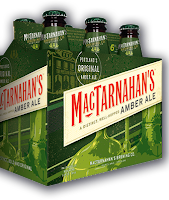
The re-brand was almost like starting fresh and getting back to basics. One of the brand's strengths is age, and this is echoed everywhere in the design: the classic font, suggestive of brands 50 years ago, the faux-rubber stamp on the label that reads "Portland's Original amber ale," and the stylized images of the copper kettles from the Tap Room, which themselves look antique. The design is intended to suggest solidity and age and associate the beer with Portland.

Two other elements jump out. First is the thistle that the brewery started using when it switched to the MacTarnahan's name. This is yet another nod to the brewery's lineage and an homage to Mac MacTarnahan's wish to see his Scottishness represented. But it's also a clever way of tying the brand together, even in its 22s, which have a totally different stylistic signature. Second, the tagline on Mac's, "A distinct, well-hopped ale" is a subtle cue to beer geeks that the brewery is trying to make something other than a bland, middle-market beer.

MacTarnahan's Amber anchors the brand (and in fact, it's the only regular beer left in the line-up; the rest are seasonals and special releases), but these elements are projected through the line. When I sat down with Mike Brown, president of Pyramid, last week, I asked about the bizarre characters on their seasonals, particularly the grifter and humbug'r. It started with Slingshot, he explained. They started with the kind of punky kid "mischievous," as per the label, and asked what became of him. Thus Grifter, the seedy character on their summer brand. Stylistically, these follow Mac's in the mode of nostalgia, with comic-book colors and images. "But Grifter, really? What were you thinking there?" I wanted to know.

Mike was blunt--"To catch people's attention. We wanted it to stand out on the shelf." Essentially, the branding scheme here was exhibitionism. When these beers were coming out, I was mighty skeptical of this idea. It seemed to mock the very quality the brewery was trying to project. But Brown says it was quite successful. Apparently, within the riot of new brands, standing out has its virtue. Of course, the test will be this year, when consumers are familiar with the labels; it will be the beer that will bring them back in year two.

Finally, Mac's has a line of specialty releases in 22-ounce bottles. The themes here d, but follow deviate from the Mac's themes, but do carry over with the thistle. And they follow the jump-off-the-shelves theory. These brands are released in small runs and won't drive sales much, except to the extent that they signal to beer geeks that MacTarnahan's is a brewery that takes beer seriously. (Personally, their brewing staff, not their labels, has been more convincing to me.)

Brand Health
I don't think you'd ever see a beer called "Grifter" from a brewery that saw the beer as an extention of themselves. It's hard to imagine Mac MacTarnahan signing off on that name. This is branding in a more traditional mode--the unemotional commodification of beer. As a good-beer fan, though, I ultimately care less about the theatrics involved in selling beer than I do in the beer itself. Breweries that try to put out a good product get a pass from me if they use crass means to sell them.

In the last few years, the bigger changes with MacTarnahan's involve the introduction of an imperial stout, saison, and now a tripel. These beers have not yet scraped the sky like Dissident or Abyss in terms of accomplishment or daring, but they indicate a brand that's trying to compete with beer, not just spin. The brewery is anchored by MacTarnahan's a lovely little session, and trying to get bold with more aggressive beers. The brand identity, a mixture of the very traditional and a pulpy sensationalism, pretty well mirrors what's happening in the brewhouse. All in all, a brand in coherence.

Thursday, March 11, 2010

Program Note

I will be out of town from now through Monday evening, but I have taken advantage of blogger's software to schedule posts through then. But don't be offended if I don't comment--I'll be away from a computer. Have a good weekend--

The Upside of Three Tiers

Nothing kills traffic as effectively as posts about beer distribution, but there's a case in Chicago I can't avoid. Before your eyes glaze over, read on--it's fascinating stuff!

At issue was an effort by Anheuser-Busch Inbev (ABI) to buy a local distributor in Chicago. Following Prohibition, beer companies were required to sell to distributors who in turn sell to retailers--a "three-tiered" system designed to limit brewery dominance (backgrounder here). Things were humming along on the Chicago deal until it reached the Illinois Liquor Control Commission.

The seven-member Illinois board ruled that Anheuser, as a company based outside the state, can't control a distributor in Illinois.... The commission said Anheuser—which is based in Leuven, Belgium—couldn't buy the 70% of City Beverage that it doesn't currently own, or it would revoke City Beverage's license to distribute beer in Chicago. City Beverage, which distributes the bulk of Anheuser's products in the Chicago metropolitan area, is part of Detroit-based Soave Enterprises. Anheuser and Soave were close to wrapping up the deal last month before the commission expressed concerns.

ABI is fighting back, of course. They are already allowed to own distributors in other states, and given that sales are flat or falling for macro beer, the only way to increase share is to strong-arm it from the competition. And here's where things get interesting. ABI doesn't really have a credible argument; the Illinois LCC ruled to limit this sale because it would effectively undermine the effectiveness of the three-tier system. ABI's response? Pretty much to agree:
Anheuser, the largest in the U.S. by sales, wants to own the Chicago distributor outright so it can improve its performance and make the brewer more competitive in the Windy City with MillerCoors LLC. MillerCoors, a joint venture of Molson Coors Brewing Co. and SABMiller PLC, is the nation's No. 2 brewer, but it has long led the Chicago market.
I have lots of problems with the three-tier system, which generally hurts small breweries. But where it is clearly needed is in protecting competition among players in the market. I've written about how the tied-house system in England may be one of the reasons pubs are dying off in such stark numbers. Control of the American beer market is now down to just three major players (craft breweries, in total, command just a micro 4.3% of the market), and ABI wants to take an even larger piece of the pie. Congratulations to the Illinois Liquor Control Commission--rulings like theirs will make it harder for the Belgian giant to consolidate power.
____________
Share

Wednesday, March 10, 2010

Lists, Lists

A slow day today, and I've been doing other things. However, I see Stan has linked to a list of BrewDog's favorite hops. This is interesting for a couple reasons: 1) Scottish brewers have not heretofore been noted for their hop passion, and 2) half are American. Bonus points for how they associate the different hops (positively, which goes to show that Scotland is a long way from Oregon) with Lady Gaga, David Hasselhoff, Spandau Ballet, Ziggy Stardust, Tony Christie [?], and the Boss. You can decide how well these personalities align.

Next, Derek rather off-handedly selects his top ten Oregon breweries. Inclusions include Standing Stone and Big Horse, and exclusions include Full Sail, Pelican, Caldera, Ninkasi, Fort George, Widmer, Roots, Hopworks, and so on and so forth. His fave brewery? Hint: it's been open less than two years. Very bold! Personally, if you gave me a few more slots--say 35-40, I might play along. But ten? No way. You may go take issue with him there.

Update: I should add--confess--I do like Lady Gaga. But I'd call her more of a Summit than a Simcoe.

National Craft Brewing Numbers (*)

Craft brewing sales were up in 2009--a remarkable fact given how bad the economy was. This story has been circulating for a few days now (and was even reported on OPB this morning). Some of the facts, bullet-style:
  • Sales in craft beer were up 7.2% by volume and 10.3% by sales--exceeding the rate of growth in 2008;
  • Overall beer sales fell 2.2%, and sales on imports fell 9.8% (but, keep in mind that Stella Artois, Corona, and Heineken are imports, not just brands like Cantillon and Fuller's);
  • Craft breweries produced 9.1 million barrels, but still enjoy only a modest 4.3% of the total beer market.
This is of course good news--and way better than the alternative. But looking at numbers in the aggregate conceals the performance of individual breweries--and based on murmurs I heard, there was substantial volatility. We'll get a fuller report in April, and then we'll have a better sense of how things are going.

Update. As an example, Boston Beer missed its sales goals for the fourth quarter. Barrels sales dropped 14% in Q4 compared with the same quarter a year earlier. It's only one data point--but a pretty big one.
___________
Share

Tuesday, March 09, 2010

BeerAdvocate's Misguided Question

This morning, BeerAdvocate tweeted that they were soliciting comments to this hypothesis:
From what the bro and I have been reading, it appears that most people feel that special release beer events have gone too far. Generally speaking, these special release day beers gain an insane amount of hype, get put on eBay before they're even released, bad distribution systems are put in place, people are waiting in lines for many hours/traveling from afar in hopes to get their hands on a bottle or taste, hoarders/campers are an issue, many walk away disappointed, etc, etc, etc. There are exceptions of course ...

So assuming that most think they've gone to far, what are some solutions? (Examples from some of the exceptions perhaps?)
In the eight plus years I've had a login at BA, I've commented on exactly four threads. So I didn't take it very seriously when Todd wrote not to post if you disagreed with the "general consensus." So I commented. And my comment was deleted. D'oh! Now I know. Anyway, since BA is clearly not the forum for dissent, I'll use my own. Here's what I wrote, and I offer it partly as Beeronomics bait.
I disagree that this is a problem. The issue is one of demand outstripping supply. If breweries wanted to put the supply and demand into equilibrium, they would either produce more beer or raise the prices. An example: for the first three years of production, Deschutes enjoyed the intense scramble for Abyss. Last year, they produced far more Abyss than in previous years. The result? Bottles are still available, months later, at local grocery stores. They'll sell the full run, but the scramble is no longer mad.

Breweries have to be a little careful not to abuse what is actually a wonderful manifestation--a constantly-growing interest in intense, specialty craft beers. If they make it too difficult or too expensive for consumers to buy their beer, they risk alienating them. But one of the main goals is to create exactly the fervent interest these specialty releases produce. The market is self-correcting, and to the extent there is a problem, it will resolve itself--to the detriment or benefit of individual breweries. In this balancing act, smart breweries will use specialty releases to bring attention to their products, which will in turn boost sales on regular releases--the bread and butter of most breweries.
Your thoughts?

_____________
Share

MacTarnahan's Reconsidered

Last week I went to the MacTarnahan's Taproom to chat with folks about new beers and brands. Mark Carver invited me out, and he may now be the longest-tenured guy left at Mac's. We were joined by Pyramid President Mike Brown and brewers Tom Bleigh and Vasilios Gletsos. The featured beer was Mac's Spine Tingler, a tripel that will be released within days. But the real revelation came just before I left, two hours later. Mark plopped a MacTarnahan's in front of me.

There are many cool things about writing about beer. Like sitting around drinking beer with brewers and brewery presidents. But there are some embarrassing moments, too, like the one I was about to experience. I sniffed deeply of the beer and was surprised at how vivid the hops were. Then I tasted it and was even more surprised. It was a totally different beer than the last time I tried it. "Have you changed the recipe?" I asked. "Not since we started dry-hopping it in 2001," Mark replied, mildly.

2001!?

It has apparently been that long since I've had a Mac's. (I never forget a beer--just the last time I had it.) MacTarnahan's was always a tasty beer, but understated and, as the decade of the 90s wore on, a bit underpowered as well. It went through a series of rebrands, becoming a "Scottish-style ale" for awhile (a nod to the namesake), and now calls itself a "distinct, well-hopped amber." I have always thought of the beer as perfectly characteristic for a brewery that prized consistency and drinkability above daring.

Despite the now-anachronistic name ("ambers" emerged during a phase of American craft brewing when consumers didn't know how to relate to ales. To help them along, breweries named their darker pale ales "ambers" to bridge the gap between pales and browns.) Naming tradition aside, MacTarnahan's is a pretty classic pale ale (in fact, it won gold at the GABF in that category last year).

Apparently, though, the brewers tuned it up a decade ago, and what a fine tuning it was. It's a very simple recipe, just pale and caramel malts and Cascade hops, and a modest beer at 5.1% and 32 IBUs. Dry-hopping is the key, because it takes those hops up a notch, saturating the mild recipe in lupulin goodness. As a region, we've grown to associate Cascade hops and pale ales so closely that a great many are, like MacTarnahan's, single-hop ales. With dry-hopping, Mac's wrings a bit more of the juice from them, and I found a perfumy note absent in most pales. (I had a bottle at home after I visited the brewery and I can confirm that if you really want the full monty, you need to try the beer on tap.)

One of the problems with writing about beer in the Northwest is that there are literally hundreds of new beers to try every year. I could easily try a new beer every time I went to the store or pub and never run out of options. As a result, I often fail to loop back around and try the old standards (a phenomenon I've Karl Ockert has called the "novelty curve"). It's been a long time since I've been out to the Tap Room, which is flanked by those beautiful copper vessels. If you have been similarly remiss, maybe it's time to take a trip out.
__________
Share

Monday, March 08, 2010

Meanwhile, in Macro World

We all have an inner Doc Wort--a curmudgeon who expresses himself perhaps inappropriately at the thought of yet another 247-IBU quad IPA. It's good to have a reality check every now and again. Have a look at what the macros are up to. While Bud is releasing a 55-calorie beer (aka water), Miller is promoting their latest product:
MillerCoors, the second largest beer company in the U.S., has launched a new iPhone application called Tip ‘n Spin in time for March Madness. Tip ‘n Spin, MillerCoors’ sixth iPhone app, is a great example of how a leading consumer packaged goods brand is embracing mobile technology to strengthen the emotional bond with the “sweet spot” of their target audience to drive deeper engagement with the brand. The application is integrated with Miller Lite’s March Madness marketing campaign that is rolling out nationwide.
(Bolds mine.) This is so meta and attenuated that it is effectively postmodern art. It is pure context; the attempt to comment on a product in the absence of that product. And the jargon! It makes you long for the solace of a real, wet, quad IPA, doesn't it?

Speaking of brand, I plan to do my next installment of brand dissections on MacTarnahans later this week. So far I've looked at two breweries with distinctive, consistent brand identities. I thought it would be cool to look at a company that has spent decades changing theirs.
_________________
Share

Easy Lambic

Yesterday afternoon, I transferred a batch of lambic that had been sitting on peaches for about a month. I know braver brewers go longer with their fruit, but I got skittish--peaches just sitting there at room temperature all that time. (Finding: when I dumped the spent peaches in the compost, they were perfectly preserved and not remotely close to ruining the beer. Should have kept my powder dry.) As usual, I had a sample during transfer and: wow! This should be an amazing beer.

As I have confessed many times, I'm a poor brewer. By the standards of the time when I started (1993), I was pretty good. But, when I try beer brewed by folks like Gansberg and Ganum, Harris and Swihart (just to name a few)--well, what I do shouldn't properly be mentioned in the same breath. Except--and let this be a lesson to everyone who loves sour beer--when I brew with Wyeast 3278.

A traditional lambic is a hairy beast to brew, even leaving aside the spontaneous fermentation. There's this nightmare known as a turbid mash, which I've never even considered. But a psuedo-lambic, fermented with this strain, is super easy. Just brew it like you would any beer, with a ratio of about 60-40 barley-wheat malt. If you have foresight or plan to be brewing a lot of years, buy some low-alpha hops (Saaz, Hallertauer, etc.) and throw 'em in a paper sack and let them sit. Otherwise, just use fresh ones in small quantities. (You can try to subject them to low heat to speed-age them, but it's unnecessary.) Then pitch with the Wyeast Lambic blend, and let the little beasties do the real work.

Lambics are all about the yeast, and this is an amazingly well-designed blend. Like a good sour ale, it produces beer that evolves. In the last lambic I brewed, I added some apples from my tree out front. I didn't use enough though, and the effect was exceedingly subtle to begin with. A bit in the nose. But as the brettanomyces continued to work and stripped away the last of the malt sugars, the evanescence of the apples emerged. Still very mild, but now clearly evident. Straight lambics evolve, too, and become these fantastically layered, austere beers after a couple years.

Fanatics will observe that these are neither real lambics nor as singular and intense as versions from the traditional breweries. But they're definitely in the ballpark. And since I usually can't even see the ballpark from where I man the kettle, this is enormously satisfying. If you like to brew, you like lambics, and you have some time, give it a shot. Results guaranteed ... eventually.
________________
Share

Friday, March 05, 2010

Cans Are Great ... Except for the BPA

Patrick Emerson read John Foyston's piece on canned beer this morning and gave the idea his economic seal of approval ... except for one thing:
But it is not all good news and for this reason I think brewers should be cautious. Currently, as far as I can figure out, most or all aluminum beverage cans are lined using BPA.
He then gives a backgrounder on the substance and refers to conflicting studies before offering this conclusion:
So, until there is a source of BPA free cans for craft brewers, I think it would pay for them to be cautious about moving wholeheartedly into cans.
Well, is there? Should brewers be cautious?

Must Have Been Fun

Via Twitter, Maine's Allagash Brewery shares this photo.


Owner Rob Tod and brewer Jason Perkins are traveling in Belgium, and they stopped in at Cantillon, where the two breweries shared each other's beer. Each other's spontaneously fermented beer. Allagash, for those who missed it, is leading the charge on spontaneous fermentation in the US. They consulted with Cantillon and built a "coolship"--or large, flat vat used to inoculate fresh wort with wild yeast. (I wrote a longer piece about this when I visited in 2008.) Must have been an enormous pleasure to share beer there in the cradle of lambics.

If you're interested in following Allagash's progress across Belgium, sign up for their Twitter feed. (Most recent stop was De La Senne. Smeirlap!)

Thursday, March 04, 2010

Newsy Bits

I've had a few event/news items rattling around my inbox, and now seems as good a time as any to throw together an odds-and-ends post.

1. Barleywine and Big Beer Fest
The Lucky Lab is hosting its third (fourth?) annual barleywine and big beer fest this weekend. For fans of the style, this is a must-see. Something like 50 big beers, a great many of them aged a year or more. The beer list is here, and both The New School and Brewpublic have previews.
Barleywine and Big Beers Fest
Friday and Saturday, March 5th and 6th, Noon to 10 p.m.
Lucky Labrador Beer Hall
1945 NW Quimby Street
A custom glass and two tokens are $8 and additional tastes are $1.50

2. Irish Whiskey Tasting
For the second year, the Pilsner Room will be hostin an Irish whiskey tasting for St. Paddy's. Hosted by Stuart Ramsey, it is both informative and entertaining. The event is divided into four courses and each is accompanied by a Full Sail beer. This year's features Session Black, Slainte Stout, Hop Pursuit Extra Pale, and aged Imperial Porter along with Greenore Single Grain, Red Breast Irish Whiskey, and Connemara Peated Irish Whiskey. I went last year and had a great time.
Irish Whiskey Tasting, March 17
McCormick and Schmick's Harborside
$25, reservations required
Seating is limited so call ahead: (503) 220-1865

3. Pelican Self-Delivery
Darron Welch and the folks at Pelican managed to lobby the legislature to change the self-distribution laws to include slightly larger breweries last year. And were successful! The result is that the brewery plans to begin distributing to Portland. That means more availability of more of the beers, and possibly a cheaper price tag.


4. Double Mountain Third Anniversary
If you're anywhere near Hood River on March 13, Double Mountain's the place to be. It's an all-day event with live music and 14 Double Mountain beers (!), including some "archival rarities." Should be a real cool time.
Double Mountain Anniversary Party
Saturday March 13, 2010 – Noon to 11pm
8 Fourth St, Hood River OR
As an FYI, keep your eyes on the Oregon Brewers Guild blog for a complete listing of beer events--things are starting to heat up on the beer calendar.

Way Back When - Jackson and Gomes

The following two photos are courtesy of Steve Goebel, the former paper executive who came to Oregon to start a brewery. He had the idea that the brewery should hearken back to the days of old, when German immigrants made traditional lagers. He hired the best brewer he could find, a young German-trained guy named Tony Gomes. As a final touch, he christened the brewery "Saxer" in honor of Henry Saxer, who founded the first brewery in the Oregon territories back in the 1850s. Goebel was equal measures dreamer, promoter, and wheeler-dealer, and he brought in Michael Jackson one year as part of a big homebrew competition and general celebration of beery goodness.

These photos document the day Jackson toured the brewery (I got to tag along). It was quite an experience. I was surprised how interested Jackson was in every aspect of the brewery--I figured, having toured a few thousand, he must have been able to scan it briefly and see what he needed. But Jackson was thorough--a true newspaperman.

When we finally got to the beer, Gomes lined up full pints of each brew, and Jackson worked his way down the line (drinking maybe an ounce of each). He stopped after the first, the flagship bock, commented on the grains and hops he identified and then asked, "You used a decoction mash?" Gomes beamed and shot a look at Goebel. Decoction mashing contributes a subtle quality of malt richness--but is time-consuming and expensive. Gomes and Goebel had an ongoing debate about whether anyone could actually tell the beer was decocted. To his credit, Goebel never got in the way of the brewing process, but he wasn't convinced. With Jackson's question, the matter was settled.

Jackson left the world too soon, Gomes has left craft brewing, and Saxer didn't survive the 90s. (No idea what happened to Steve Goebel.) So this is indeed a moment passed. Enjoy.


_____________
Share

Wednesday, March 03, 2010

Deschutes Jubel 2010

In terms of beer appreciation, nothing prepares you quite as well as home brewing. It allows you to become familiar with the way ingredients express themselves, and also to identify off-flavors. One of the skills you develop as a home brewer is tasting beer at various stages of maturation and extrapolating about what it will taste like in finished form. A home brewer can transfer a week-old batch of beer and determine a great deal from an ounce of warm, flat, under-fermented liquid. (Bad home brewers, like me, are also excellent at ignoring what we know. I've got a batch of old ale in the basement that's been aging for 3 months in the bottle, and when I had one last week, still convinced myself that it would come around ... eventually.)

Jubel 2010
All of which is to say that Deschutes' latest Reserve Series beer, Jubel 2010, is a work in progress. Last night I had a goblet with a local beer geek and video maven--who can identify himself or not, as he prefers--to discuss an overly ambitious idea I have for a brewing documentary. (Side note to arts patrons: email if you want to get in on the ground floor. Producer credits available!)

Jubel 2010 is a decade-later echo of a souped-up version of Jubel the brewery bottled back in 2000 (and which its been releasing on tap as "Super Jubel"). For my money, calling this beer Jubel is a little misleading. Regular Jubelale is 6.7% alcohol and has 60 IBUs and is one of the best examples of a winter warmer available--a perfect balance of malt, hops, and alcohol warmth. Jubel 2010 is a barleywine-strength 10%, but actually has five fewer IBUs. Because hop bitterness is a relative measure--the more malt you have, the less you perceive a given amount of bitterness units--this means Jubel 2010 is waaaaay sweeter. It is in no way a winter warmer. At this stage, it reminds me a great deal of a ruby port. Lots of grapey, fruity sweetness. (It was aged in pinot barrels.) The sweetness doesn't quite cloy, but like some sweet liquors, snuggles right up to the line. I had a 10-ounce goblet and felt that that was plenty.

I give Deschutes credit for producing a beer that is drinkable at release. Jubel 2010 is a creamy, gentle digestif-type beer that is perfectly approachable right out of the gate. So far, the reaction on BeerAdvocate is uniformly positive. But in my home brewer mode, what I taste is a beer that hasn't yet become its final self. As with this winter's Abyss, Jubel 2010 is stamped with a "best after" date, and I encourage people to take that seriously. Strong, dark beers age well, and Jubel 2010 should dry out a bit more and allow the alcohol to come forward to balance out the sweetness. I would hope that the strong grape note will recede a bit, too.

I still have yet to pick up bottles from the store--$11 is a lot for a single beer--but I'm encouraged that in a few years' time, I'll be glad I did. It's fine, but Deschutes wants it to wow. With beers like this, patience is the final ingredient.
___________________
Share

Tuesday, March 02, 2010

Oregon Vinters Kegging Wine--Of Course They Are

Somehow this doesn't surprise me. In today's FoodDay, wine writer Catherine Cole reports that Wooldridge Creek Vineyard, a winery in Grants Pass, now kegs their vino:
Each reusable 5-gallon stainless-steel barrel holds the equivalent of 25 bottles of wine (15.5-gallon kegs also are available). The contents are kept pressurized by argon, a nontoxic gas that is naturally present in air. The result is 125 glasses of wine, the last tasting as fresh as the first.
There are many virtues to this practice. When restaurants serve wine by the glass, they regularly have to dump half-bottles that have been sitting too long. Packaging in bulk keeps prices lower, so customers can find expensive wine for a relative bargain if it comes from a keg. And kegs are also really good for the environment.
"What's really great is, because of the lower cost of production, we can sell what would normally be a $20 glass of wine for $7 or $8," says Sean Culley, general manager at [Portland's] The Melting Pot.... "The other thing is the sustainability factor. They don't have to use and ship the bottles, labels and corks, and we don't have to throw them away," says Culley.
(In the entertaining photo I found on the winery's Facebook page, you can see just how sustainable kegs are--note the Elysian keg in the foreground.)

I don't know how many wineries in the US current do this--maybe Woolridge Creek is the first--but it certainly seems appropriate for Oregon wine to be served in kegs. Maybe wineries and breweries can start bartering--stainless steel kegs for used pinot casks.
______________
Share

Monday, March 01, 2010

Preservationists Race to Save Cincinnati's Brewery District

I happened across a fascinating article in the Cincinnati Enquirer anyone interested about beer should spend a few minutes reading:

More than a century ago Over-the-Rhine's streets were lined with hundreds of saloons, teeming with lager-drinking Germans who were immersed in a beer brewing culture.

Vine Street alone was home to more than 135 saloons where beer barons like Christian Moerlein mingled with laborers. Today, that deep-rooted brewing heritage has been nearly erased from the city's landscape - the breweries demolished or left to decay.

Now preservationists are racing to save the remaining crumbling relics - considered the largest collection of their kind nationally.

Last week I rattled on about losing Henry's here in Portland--well, Cincinnati had dozens of breweries in the good old days before prohibition. At the end of the post I'll include a cool video that shows the underground lagering caverns those old breweries dug in the days before refrigeration. Cincy was a seriously beery city--a "beervana" of a past era.
In 1872, according to an annual report of Cincinnati Chamber of Commerce, 32 operating breweries in Cincinnati produced more than 436,000 barrels of beer and contributed to a labor payroll of $1.2 million.

"Some of these breweries would employ well over 100 people," Tolzmann says. "They were a vital part of the economic fiber of this community."

Here's that video, but do yourself a favor and go read the article, too:


___________________
Share

Spints, Six, and Oyster Stout

Entering Upright Brewing is probably as close as you can get to approximating the experience of visiting a speakeasy. The Left Bank building is an urban island in the middle of two major streams of traffic, at the fork where Broadway and Weidler split, right at the nexus of I-5. I don't know that there's a building more cut off by major thoroughfares in the city. You might be able to park at the edge of this island, but careful!--you might also get caught up with the flow and find yourself shooting across the Broadway Bridge.

Once you do get parked, you enter what appears to be a vacant building. Renovated, promising, but vacant; I'm never sure if the front door is going to open when I get there. But it does and you make your way to the elevator and descend a floor to an industrial little hallway. As you stand there, certain you've taken a wrong turn, you do hear murmurs coming from around the corner. Following those you arrive at the basement brewery, which really is just a brewery. The tables around which folks gather appear ad-hoc, as does the gathering itself, like you're at a secretive one-time party. By the time you have a beer in your hand, you feel like you've earned it.

On Friday, Sally and I stopped in for the release of the Upright's oyster stout--a style that is the current front-runner for 2010 trend of the year. I have tried a great many styles of beer, including some of the most obscure, but I've never had an oyster stout. (I hope to get a pint of Fort George's before it disappears, too.) It's a bizarre idea: putting oysters into a beer. No doubt the drunken inspiration of a Londoner who figured that the effort to pair seafood and stout was redundant. The effect, by all accounts, is subtle. You get a briny, sea-water note.

Indeed, that's how Upright's was. The basic stout is burly and heavy. I don't know what the alcohol content is, but it's the unfermentables you notice, with a density akin to Turkish coffee. I didn't get any of the brine at the outset, but when the beer warmed up it emerged. I suspect that you could serve this beer to ten people without identifying it and maybe one would pick up the brine. Knowing to look for it helps, but still, you have to look. (Upright also had five gallons of a strong ale that was heavy and sweet, but finished with a nice cherry tang. I actually liked it better than the oyster stout, but with just five gallons, it's long gone now.)

After Upright, we headed to Spints for dinner--my first visit. By chance, they had Upright Six on tap, and I had a pint. I've had less Six than any of the regular line-up (actually, just once, before the brewery opened), and was delighted to find it on tap. Six is the dark rye beer, which tastes not at all like ryes people normally expect. Since the rye backs the tart, farmhousey quality, it doesn't have the same insistent tannic character. Rather, the tartness pulls out spicy notes and elongates them. Fantastic beer.

As to Spints, the atmosphere is great, but the cuisine is not exactly in my wheelhouse. The food is based on heavy, meaty German cuisine, and I like light, fresh vegetable-rich food. They did bring out a plate of amazing bread, and I'll visit for that alone. An apple bread, two ryes (the dark was fantastic), and a sweet white bread. The beer list is also exceptional, and I think the rumors about pricing are inflated. They have four volumes of glassware (12, 16, 20, and 23 ounces), and the prices for beer range widely depending on Spints' cost. I went with the 16 ounce glass and paid five bucks. That's on the high end, but not excessive. As for the selection, it's exceptional. I won't declare it the best in the city based on a single visit, but it's definitely in the conversation.

Upshot? Put it on your short list for places to visit for a good pint.

Saturday, February 27, 2010

NYT, One More Time

Yesterday, I used an article from the New York Times as a jumping-off point to discuss how I wished more Oregon beer were available on the East Coast. The writer of that article, John Holl, commented on my thoughts, and rather than let them languish deep in a day-old thread, I thought I'd pull them up to a full post so you could have a look. John wrote:
Thanks for mentioning the NYT piece.

I didn't mention Rogue simply because it's all we folks from the New York Area know, but because they have a hops farm and let people stay there. This wasn't a review of beer or even beer styles this article was a way to let people know that they can get more from beer than simply a taste.

This is a trend that brewers are embracing and if I can help spread the word to the millions of people who wouldn't otherwise make breweries a part of their vacation plans than I feel like this article helps.

I'm sure there are places that I missed where people can get a deeper experience with their beer. Such is the world of newspapers.

The article was about tourism, not Cascade Apricot Ale. When it comes to travel, Rogue stands out. That's why I mentioned them. Plus, the beer is pretty good too.
Periodically, I try to get Sally to read a blog post (generally a post from a political blog). She almost invariably complains that it feels like being dropped into the middle of a conversation you're not a part of. This is one of the major downsides of blogs. In my post, I used John's article as an example of a larger corpus of beer-related reporting from the east coast, and it was really the whole I wanted to discuss. John's article was just a convenient entry point. As a consequence, my speculation about his intentions appear to have been wide of the mark.

I do appreciate any light that gets shined on Oregon as a destination, and I should note that the Times has been especially good about this--last fall, they published that very nice piece by Lucy Burningham about fresh-hop ales. So even where my larger point may be true in general, it's probably not an accurate criticism of the Times.

Thanks, John, for stopping by and setting the record straight.

Friday, February 26, 2010

Couple of New Blogs

I get regular requests to add new blogs to my blogroll, which I'm happy to do. However, since a lot of blogs peter out pretty quickly, I like to see them survive a few months before I add them. A couple of folks contacted me this week who fit into that category. I recognize that one of the main causes of petering out is the lack of traffic, so it's a bit of a catch-22. So, while I wait to see if these make it, I'd like you to go visit and encourage them:
Give 'em a little love--

Way Back When - Old Lompoc

That may be Bud Clark, and he may be pulling the first pint at the newly rechristened New Old Lompoc (formerly Old Lompoc), but this damned brain has a hard time drawing out details. It was in the bottom of my box of pictures. Or it could just be a bartender who looks like Bud.


Anyone confirm?

(Oh, in case you happen not to be from Portland, Bud Clark was a barman who got his dander up in the 80s and decided to run for Mayor. And won. But he was probably more famous for the poster below.)

An Oregon Trail Back East

The New York Times will publish a fluffy piece in it Sunday edition--already available online--that celebrates the experience of traveling to a brerwery. (Yes, one has the sense that New York is a good two decades behind the west coast in beer appreciation, but that's a different post.) In it, writer John Holl surveys some breweries, and does his best to make it a national article. He mentions a little brewery from New Hampshire and then throws in three others a national readership may have heard of: Boston Beer, Dogfish Head, and Rogue. If you spend much time reading national stories about craft beer, the one Oregon name that pops up again and again is Rogue. Why? Because you can buy Rogue everywhere.

Craft brewing remains a mostly local--or at most, regional--phenomenon. This is its great virtue. Almost without exception, the best beer is fresh and untraveled. The more one loads a keg or case in and out of trucks, the longer it spends sitting on shelves or under a pub's bar, the more it degrades. Oregon brewers have always had the luxury of having a vast customer base right here in its back yard. Why worry about setting up relationships with distributors in the Midwest and East when you can sell all you brew right here? Local brewers know the market, know what Northwesterners like, and know how to sell beer here. So, I get that as a business decision, a local brewery probably won't see the upside in shipping to far-flung locations.

But as a shameless fan of Oregon beer, it's frustrating. We sit in the richest vein of craft brewing in the world, and almost no one outside of the West realizes it. Our breweries produce some of the finest beers in the world, yet these beers, because they are distributed only locally, are never mentioned outside the region. Why would they be? Why would a New Yorker care that Cascade Apricot Ale--to select just one example--is one of the best beers in the world when they have no chance of ever tasting it? For newspapers, there's no editorial reason to mention obscure little beers brewed 3,000 miles away--they want to discuss products available to their readers.

I have no idea what can be done to remedy the situation, except to hope that eventually some of our beers begin a trek to other parts of the country. Everyone knows that Oregon pinots are among the best. New Yorkers can buy them at their local wine stores. I wish they could buy a sampling of Oregon beers, too. Then they'd realize there's more here than just Rogue. I can dream.
______________
Share

Thursday, February 25, 2010

La Folie is Really Good

On my way to a social gathering last night, I stopped off at Belmont Station to pick up a range of Baltic porters (from Poland, Russia, Finland, Latvia, and Lithuania). (Report on that at some point--it was fascinating.) As I charged in, I was brought up short by a crowd just inside the door. A New Belgium tasting--bonus! Some comments:

1. NB was pouring the beer in a strictly prescribed fashion: Fat Tire from a can, Ranger, and then either La Folie or Kriek. The guy who was pouring the beer seemed to be centrally interested in talking Fat Tire. I accepted the pour to get along to the good stuff.

2. I managed to skip the Ranger, thinking that a sharply hoppy beer is a poor lead-in to a kriek. Interesting decision by the brewery.

3. La Folie is an exceptional beer. So much complexity (full review here). They were also pouring a Lips of Faith-series kriek, which was a collaborative brew with Frank Boon. Boon spontaneously fermented a kriek, sent it to Fort Collins, where it was blended with a beer from NB (I missed what their contribution was). Interestingly, I found it to be far less complex and interesting than La Folie. Interesting, because Frank Boon's lambics are my favorite, and are to my mind the most complex, with layered sourness that never gets too dry or funky.

4. The guy pouring the beer seemed actively irritated by my questions, when I could get his attention. He was far more interested in promoting canned Fat Tire. Maybe just an off day, but I gotta say, if someone's interested in talking to you about your beer, talk to him. A bit off-putting, but essentially beside the point. He was offering me free beer and I was happy to accept.
____________
PHOTO: Atlanta Beer Master. | Share

Wednesday, February 24, 2010

NYT on Belgian Goldens

Eric Asimov, wine writer for the New York Times, periodically takes on beer. Generally to my dissatisfaction. (A friend kidded me for my "Asimov envy," which is half-true. What a huge megaphone he has! What I wouldn't do to write just one column for the Times.) Yesterday he took on Belgian golden ales, illuminating things not a great deal. Read it and make your own judgments. I will, however, make a comment or two on this passage:

One surprise in our tasting was that Duvel, the classic example of a strong golden ale, did not make our top 10. This especially surprised me as I loved its spicy, flowery flavors, which lingered in the mouth, but my colleagues felt the example we tasted was not as fresh as it ought to be, so they voted it out. Freshness is always an issue when dealing with imported beers, which have to travel a long way in not-always-ideal conditions.
I have two problems with this. The first is amazement that the NYT couldn't manage to find a fresh bottle of Duvel, one of the most widely-available Belgians in America. This is a paper that lets reporters go for months or years on a single story, has bureaus around the world, and regularly wins a majority of the pulitzers. But they couldn't find a decent Duvel?

The second point is related to the first. As a matter of journalism, I don't see what the point is in writing an article that explores a product when you ignore the giant within that product segment. It's as if a tech writer were doing a review of smart phones but ignored the iPhone. Never mind that the iPhone you brought to the testing lab was dead, you don't just chuck it aside and pretend you're telling people anything when you laud the Droid instead.

Generally when I grouse about Asimov, I am taken to task by readers more generous than I. Truth is, I had other quibbles, but they seemed to trifling to mention. But perhaps this will seem enough of a trifle to spur comment.
___________________
Share

Way Back When - Henry Weinhard

Over the holidays, Sally and I picked up a new printer to replace our obsolete 1990s tech. The new-fangled machine we got is a printer/copier/scanner, which gave me the opportunity to dig around through the box of photos for digitization. Amid those thousands of snaps are a few cool beer pics, and I'll be posting them from time to time as I come across them. First up, a shot I took of the Henry Weinhard brewery sometime between about 1995 and when it closed in 1999.

Henry Weinhard founded his brewery in downtown Portland when there really wasn't much of a town to speak of. He located it on the western outskirts, several blocks away from the river. For the next 140 years, it scented the Rose City. Going downtown meant encountering that particular aroma--bready, yeasty, wet, spicy. The city has transformed itself so radically that it's difficult to recall the era when a million-barrel industrial brewery anchored downtown--or perhaps more accurately, stunted it. Until just before Henry's closed down, Burnside was a very rough street; prostitution, drug sales, and homelessness marked it as a kind of dangerous DMZ. On one side, office workers and respectable downtown; on the other, old town and long unihabited tracts of quiet warehouses.

There was a functional aspect to the brewery's location: it was right on the rail line, critical for delivery of those tons of ingredients Weinhard consumed. Periodically you'd see the scene I captured in this photo--a rail car of corn syrup (more visible in the detail). Now, I'm not sure what they used corn syrup for--quite possible it all went into their root beer--but as meta-narrative, the image was stark. By the time Henry's died, Portland had already become Beervana. Jackson had feted us as the country's best beer town, and we were already bragging about having the most breweries. There was something so anachronistic about a creaky old brewery that had corn syrup delivered by the rail car.

When Miller finally shuttered the doors in '99, it was a sad time. Henry's had been a part of the city since pretty much there was a city. (It was founded in 1856, five years after the city had been incorporated with just 800 souls.) Fortunately, you can still get that lovely aroma at points throughout the city. I wouldn't be surprised if Widmer one day brews more beer than Henry's did. Certainly the time when the city produces more beer in aggregate is not far away (or maybe has already arrived). And of course, most of that beer is far tastier. Still, Henry's was an institution. It was a little bittersweet to find these photos--but also amusing. Times have changed, haven't they? I don't think we'll be seeing corn syrup being delivered to breweries anytime soon.


_________________
Share

Tuesday, February 23, 2010

Drinking for the Buzz

Last week I made an argument that craft brewing has encouraged a competing culture of drinking that focused on the flavor, not the buzz. This guy didn't get the memo:
The lawsuit claims that Deschutes Brewery allowed Joseph Umphery unlimited access to beer in a keg room at the back of its bottling plant and at its brew pub in Bend....

According to the suit, on Feb. 22, 2008, Umphery drank 10 to 13 beers at the keg room and brew pub, then five to seven more beers at a strip club called "The Fan" in Redmond even though he was visibly drunk, the lawsuit alleges. A bouncer told him to leave for arguing with another customer, then helped him to his 1992 Oldsmobile Cutlass, according to the suit.

As he drove home along U.S. 20, Umphery slammed into the rear-end of a 2003 Toyota 4-Runner, driven by Brian Vajda. Vajda and three passengers were injured when the SUV rolled several times, crashed through a "guard fence," and hit a pine tree, according to the suit.
Afterward, police measured Umphery's blood alcohol level at .29%--almost four times the legal limit. I have no idea what the facts are around Deschutes' culpability here (Gary Fish disputes the claim.) I guess that's a question the courts will answer. (Though I'm betting Deschutes' employee policy is about to get a lot more strict.) Yet a few amazing details spring from the article.
  • Deschutes is being held responsible for Umphery's drunkenness, despite the fact that after he left the brewery he went to a strip club and continued to drink. (The strip club is also named in the lawsuit.) Fascinating.
  • He was sentenced to six years in prison for the crime.
  • In addition to the time, Umphery will have to pay $384,000 in restitution. Given that the current personal median income for males is about $39,000, he could lose half his pre-tax income, earn the median salary, and not pay this off for 20 years.
When I was doing my research into consumption levels and the effect of craft beer, I discovered that the one clear, measurable outcome has been the precipitous drop of alcohol-related deaths in America. With consequences this dire (and I'm agnostic about whether they've struck the right balance), it's no wonder. Amazing.
_________________
Share

Monday, February 22, 2010

From the Larder

Apropos of this review of Jubel 2010 over at the New School, I was reminded that I had a couple bottles of Jubel 2000 in the basement (authenticated with their patina of dust). But I wonder, reading both those reviews and the brewery's "try after" date--should I wait a year or two to do a side-by-side tasting? Probably.


This post was, of course, really just an excuse to show off my cool treasures. Not that I was fooling anyone...
_____________________
Share